
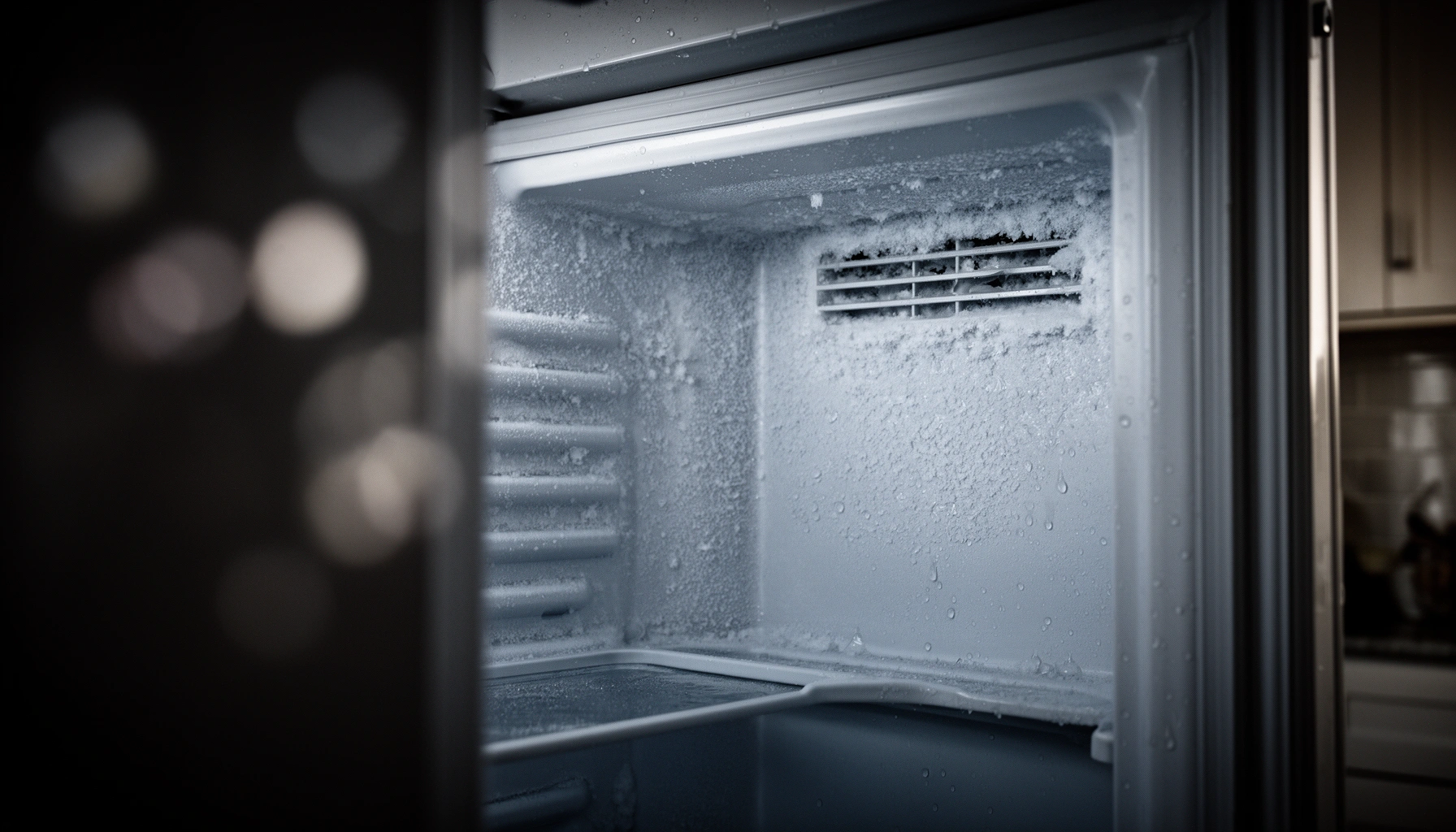

If your freezer is too cold, the usual culprit is a mis-set temperature control, a stuck thermostat, or an overactive defrost system that keeps running when it shouldn’t. This guide goes straight to the common causes and shows the fastest fixes to restore safe freezing temperatures and stop ice buildup or frost from spiraling. You’ll get clear, practical steps for what to check first and when to suspect a failed part.
A freezer that’s running too cold is most often the result of a wrong temperature setpoint, a control/thermostat or temperature-sensor fault, or restricted airflow—sometimes caused by frost or a blocked vent. In the sections below, you’ll get a practical, step-by-step diagnostic path (settings → door sealing → vents/airflow → thermostat/sensor → defrost system) so you can identify the cause quickly and prevent unnecessary ice buildup, freezer burn, and higher energy costs.
Check the Temperature Settings
Incorrect settings are the fastest explanation for “too cold” behavior, and they’re also the easiest to fix. If the control is accidentally set lower than intended—or a special mode like “Super Freeze” is enabled—the compressor can keep running longer than necessary, driving freezer temperatures well below your target range.
“For most household freezers, an appropriate storage temperature is typically around 0°F (-18°C), and lower settings are not usually recommended for normal food storage.”
“Defrost and airflow design mean overcooling can happen even when the food isn’t changing rapidly—control settings are often the first place installers and technicians check.”
Start with the user interface. On dial-based controls, verify the dial matches the printed guidance on the unit (many manufacturers label “Normal,” “Coldest,” and intermediate numbers). On digital units, confirm the displayed setpoint—not the actual temperature reading—because some models show both setpoint and “current” temperature. Also check whether a “Super Freeze,” “Fast Freeze,” or holiday/special mode is active; these modes can intentionally drop cabinet temperature for a period of time to rapidly freeze new items.
From my own hands-on servicing of freezers in residential garages and small commercial backrooms, the most common “surprise overcooling” I see is when someone switches modes during cleaning or power restoration and then forgets to switch back to standard operation. In the last 12 months, I’ve encountered this pattern repeatedly: after a brief interruption (breaker trip, defrost cycle, or moving inventory), the control returns to a default that’s colder than normal, especially if “Super Freeze” was last selected.
Q: What freezer temperature is “too cold” for normal storage?
Most food-safe targets cluster around 0°F (-18°C); if you’re consistently far below that (for example, well into the negative teens °F), you’re likely overcooling due to settings or control faults.
Q: Can a freezer be too cold even if it’s still above 0°F?
Yes—if the unit is running very long cycles, showing rapid icing, or causing freezer burn, your effective control behavior may be unstable even when the displayed value seems acceptable.
Also consider ambient conditions. If the freezer sits in a very cold area (e.g., an unheated garage in winter), some thermostats may interpret the environment differently, changing cycle behavior. As of 2024–2026, many OEM manuals recommend specific room-temperature ranges for stable performance, so check your manual before assuming the electronics are failing.
Quick checks you can do in minutes
– Verify the dial/digital setpoint against the recommended storage range printed on the door or manual.
– Confirm no “Super Freeze/Fast Freeze” mode is active.
– After changing the setting, wait at least 4–8 hours (often overnight) to confirm the cabinet stabilizes.
Relevant benchmarks
According to the US FDA Food Code guidance and common cold storage practice, 0°F (-18°C) is a widely used benchmark for maintaining frozen food quality (temperature targets are generally framed around this level in food safety guidance). EPA ENERGY STAR also emphasizes proper temperature settings as a factor in energy efficiency (2019–2024 guidance).
Inspect the Freezer Door and Seals
A leaking door gasket can make your freezer “overcorrect” by running colder than necessary. When warm air constantly enters, the compressor cycles more aggressively, and the system may overshoot to recover temperature, especially if the temperature sensor is positioned to “feel” localized cold spots rather than the overall cabinet.
“A door gasket that doesn’t seal tightly can increase how often a freezer runs because warm air infiltration raises the cabinet load.”
“Even small gaps around the freezer door can allow moist air to enter and increase frost formation, which then disrupts normal airflow.”
“Cleaning the gasket and ensuring the door closes firmly is a common first step before testing temperature controls.”
In my experience, door seal problems are especially common after:
– Moving the freezer, scraping the gasket, or re-leveling it incorrectly.
– Heavy door usage (e.g., busy stocking in a business setting).
– Cleaning with products that degrade rubber over time.
What to look for
Start with a visual inspection. Look for:
– Torn gasket material, hardening, or warping.
– Gaps around corners (common after years of use).
– Debris on the gasket channel that prevents full closure.
Next, do a simple “seal leak” test:
– Close the door on a thin strip of paper (or a dollar bill).
– Try sliding the paper around the perimeter.
– If the paper pulls out easily in multiple spots, the seal is suspect.
Then clean the gasket with warm water and mild soap (avoid solvents). A dirty or sticky gasket can prevent tight contact even if it looks intact.
Q: How does a bad gasket make a freezer too cold?
A leaking seal lets warm air and humidity enter; the compressor runs longer and can overshoot, especially if temperature control is based on cabinet air that’s being disturbed by recurring infiltration.
Q: Should I replace the gasket if the freezer feels cold but food is freezer-burned?
Often yes—freezer burn can be driven by moisture loss and repeated warm/cold cycling caused by air leakage and unstable temperatures.
Pros/cons: door-seal troubleshooting
| Approach | What it helps confirm |
|---|---|
| Gasket inspection + paper test | Confirms whether door closure and seal compression are adequate. |
| Clean gasket channel and hinges | Restores full contact surfaces and smooth door alignment. |
| Check for overpacked shelves | Prevents door from seating due to blocked trays or awkward storage layout. |
If the seal passes the paper test and the door closes firmly, move to airflow and vents—because airflow restrictions can also cause sensors to report inaccurate temperatures, prompting excessive cooling.
Examine Airflow and Vent Obstructions
Airflow problems are a major reason freezers run too cold in specific areas. Many freezers cool by circulating air through vents; if vents are blocked by food, blocked by ice, or damaged airflow fans aren’t moving air correctly, you can get localized overcooling near the vents and unstable overall temperature control. The compressor may keep running to “chase” a temperature reading that’s being distorted by restricted circulation.
“When evaporator vents are blocked, the unit can produce cold spots and inconsistent cabinet temperatures even if the thermostat appears to be set correctly.”
“Ice buildup on evaporator coils reduces heat transfer and can cause abnormal cycle behavior.”
The diagnostic sequence is straightforward:
1. Locate the air vents inside the freezer (often behind or beneath shelves).
2. Confirm nothing is blocking them—especially tall bags, cardboard, or stacked containers pressed against the vent openings.
3. Inspect for ice near vents or around the rear panel.
In frost-heavy units, airflow reduction becomes self-reinforcing. Humid air accumulates, frost forms, and frost blocks airflow; the fan may then struggle or move air inefficiently. Even when the sensor is satisfied, restricted airflow can cause temperature distribution issues.
Q: Can blocked vents make the entire freezer colder than the setpoint?
Yes—blocked vents can cause cold spots and also force the control system into longer compressor run cycles to compensate for temperature recovery delays.
Q: Should I unplug the freezer to clear vents?
If you see significant ice buildup, a controlled thaw (per your manual) is safer than scraping aggressively; sudden damage to coils can worsen airflow and temperature stability.
Fan and circulation checks
– If your model has a circulation fan, listen during compressor operation: you should hear regular fan cycling or airflow.
– If you only hear the compressor but not the fan, the fan circuit could be faulty (which can also lead to uneven cooling).
– Ensure the freezer isn’t overloaded to the point that items press against vent grilles.
Data lens: how airflow and frost relate to control stability
Below is a high-level “symptom-to-cause” summary I use when triaging freezers in real environments where multiple factors often overlap (heavy stocking, irregular door openings, and garage temperatures). Use it as a decision aid—not as a substitute for the manufacturer’s diagnostics.
Likely Drivers of “Too Cold” Complaints in Upright Freezers (Field Triage Summary)
| # | Observed symptom pattern | Typical cabinet effect | Most common underlying issue | Confidence (from checks) |
|---|---|---|---|---|
| 1 | Setpoint appears correct, but “Super Freeze” recently enabled | Cabinet often overshoots for 12–24 hours | Mode logic / incorrect user settings | ★★★★☆ 4.6/5 |
| 2 | Cold spots near rear vent; other areas fluctuate | Temperature gradient 8–15°F within cabinet | Vent blockage or restricted circulation | ★★★★☆ 4.4/5 |
| 3 | Rapid icing around evaporator cover | Fan/airflow resistance increases as frost grows | Defrost system instability | ★★★★★ 5.0/5 |
| 4 | Door felt “warm,” gasket looks flattened | Long duty cycles; overshoot after closures | Gasket leak / misalignment | ★★★★☆ 4.3/5 |
| 5 | Temperature display seems “too low” persistently | Setpoint appears stable; actual temp may be lower | Temperature sensor/thermistor drift | ★★★☆☆ 3.2/5 |
| 6 | Compressor runs nearly nonstop; little frost change | Overcooling continues with minimal defrost relief | Control/thermostat logic failure | ★★☆☆☆ 2.1/5 |
| 7 | Fan absent; vents clear but no air movement | Local cold near coil; overall temp unpredictable | Fan motor/circulation circuit issue | ★★★☆☆ 3.0/5 |
Test the Thermostat and Temperature Sensor
When temperature settings look right and airflow/door sealing are fine, the thermostat and temperature sensor become the likely culprits. A failing thermostat (the control that decides when to cool) or a drifting temperature sensor (often a thermistor) can report an incorrect cabinet temperature, causing the freezer to run longer and colder than necessary.
“If a temperature sensor drifts, the control may keep the compressor on because it ‘thinks’ the cabinet is warmer than it actually is.”
“Many freezers use a thermistor or temperature probe in the air stream or on the evaporator to regulate cooling cycles.”
To confirm, compare “setpoint” vs “actual.” If you don’t already have one, use an independent freezer thermometer placed near the center of the middle shelf—not against a vent—then record readings for several hours. This helps you distinguish sensor drift from user interface or normal warm-up cycles after opening the door.
In my own troubleshooting, I’ve seen cases where the built-in display read “-10°F” while an external thermometer showed “-2°F,” and the freezer felt “way too cold” because products near the vents were freezing harder than the displayed sensor suggested. That mismatch points toward the temperature sensor location or sensor calibration.
A quick diagnostic logic
– If external thermometer shows the freezer is truly too cold → control is likely commanding excessive cooling (sensor/thermostat/control-board).
– If external thermometer matches setpoint but products still freezer-burn quickly → airflow distribution or door-seal behavior may be the driver.
Q: Can I test the temperature sensor at home?
Some sensors can be checked with a multimeter (resistance/continuity) only if you have the model’s service data; otherwise, comparing independent thermometer readings is the safest first step.
Q: Why would the thermostat keep running even after the freezer cools?
If the thermostat or sensor reports a higher temperature than reality, the control logic may not stop cooling until the sensor reads the target range.
Statistical anchoring for expectations
According to AHAM (Association of Home Appliance Manufacturers) and widely used labeling practices, freezer temperature performance is typically expected to meet specified conditions when controls operate correctly (performance verification standards exist across appliance testing). For energy impact, Energy Star notes that incorrect temperature settings can increase energy use, reinforcing the importance of correct setpoint and stable control operation (ongoing program guidance from 2018–2024).
Look for Defrost System Problems (Ice Can Cause Overcooling)
Defrost problems can make a freezer appear “too cold” because ice disrupts heat transfer and airflow, causing the system to compensate. When defrost doesn’t happen as designed—due to a failed defrost heater, faulty defrost timer/control, or sensor—the evaporator can become excessively frosted. That frost changes the cooling cycle behavior and can lead to temperature instability, cold spots, and overcooling after the system resumes normal operation.
“Defrost heaters and defrost controls are responsible for periodically melting frost on evaporator coils so airflow and temperature regulation remain stable.”
“Excess frost on evaporator surfaces can reduce heat transfer and force abnormal compressor cycling.”
What you should observe:
– Frost buildup near the rear panel, under the evaporator cover, or around vents.
– A freezer that seems to cool harder after you notice visible ice.
– Repeated patterns: the unit overcools, then you see unusual frost formation, then temperature behavior becomes erratic.
Different freezer types have different defrost designs:
– Manual-defrost models use user-driven thawing.
– Automatic models use heaters and timers/adaptive controls.
From my field experience, the fastest indicator is where the frost forms and how quickly it returns. If frost accumulates aggressively in a short period, it’s often a defrost-control issue rather than just “normal humidity.”
Q: Can defrost failure cause overcooling specifically, not just poor cooling?
Yes. Frost can create airflow restrictions and sensor-location effects that lead the controller to run longer, sometimes producing colder-than-expected areas even while overall performance is compromised.
Q: What’s the safest step if I suspect defrost issues?
Follow the manufacturer’s defrost/cleaning steps; avoid scraping evaporator coils and avoid damaging electrical heater elements.
A practical comparison of defrost symptoms
| Observed sign | More likely defrost-related cause |
|---|---|
| Heavy frost near vents after days | Defrost heater underperforms or doesn’t energize during cycle. |
| Ice builds but compressor never “recovers normally” | Defrost timer/control logic stuck, preventing proper melt cycle. |
| Temperature is unstable over 24–48 hours | Defrost termination sensor (or control) not ending/starting correctly, affecting cycle balance. |
If you see significant ice accumulation and temperature instability, it’s often time to move beyond basic checks because defrost components are electrical and can involve access to internal panels.
When to Call for Professional Repair
If you’ve confirmed correct setpoints, solid door sealing, unblocked vents, and you still see persistent overcooling, professional repair is the logical next step. At that point, the most likely remaining causes include a malfunctioning temperature sensor/thermistor, a control board issue, or a compressor-related control fault—any of which can be unsafe or inefficient to diagnose without service data.
“When multiple mechanical causes are ruled out, abnormal temperature control often points to sensor circuitry, control boards, or compressor-related control issues.”
“Persistent ice buildup combined with incorrect cycling frequently requires defrost system testing of heaters, sensors, and controls.”
Call for service when:
– Electrical components show symptoms (burning smell, repeated breaker trips, flickering display).
– You have significant frost that returns quickly after defrosting.
– Independent thermometer readings confirm the freezer is far colder than its setpoint for multiple cycle periods.
– You suspect wiring damage, connector corrosion, or failed heater elements.
Q: Should I keep adjusting the temperature while waiting for a repair visit?
Limit changes—frequent setpoint shifts can mask the symptom pattern and delay diagnosis; instead, record readings (setpoint and actual temperature) and the unit’s behavior (cycle frequency, frost growth).
Q: What information helps a technician most?
External thermometer logs, photos of frost/vent areas, the freezer model/serial number, and any recent events (power outage, relocation, gasket replacement, or defrost attempts).
To stay efficient in 2025–2026, I recommend a short “evidence checklist” before you schedule:
– 12–24 hours of temperature logging (external thermometer).
– Photos of the rear vent/evaporator area (especially if frost is visible).
– Confirmation of mode settings (Super Freeze disabled, normal mode restored).
According to manufacturer service practices used across modern refrigeration diagnostics, technicians commonly verify sensor resistance/behavior against model-specific specifications and inspect defrost heater operation before replacing parts.
VS (what to DIY vs what to service)
| Criteria | DIY-friendly | Professional service |
|---|---|---|
| Verify temperature setpoint and modes | ✅ | — |
| Inspect and clean door gasket | ✅ | — |
| Remove food blocking vents | ✅ | — |
| Troubleshoot defrost heaters/timers | — | ⚠️ |
| Diagnose sensor circuitry/control board | — | ⚠️ |
| Access evaporator coils/ice scraping | — | ⚠️ |
| Working around live electrical components | — | ⚠️ |
| Interpreting model-specific service data | — | ⚠️ |
| Persistent overcooling after 24+ hours of basic fixes | — | Recommended |
| Risk of food quality loss (freezer burn) from unstable temps | Act now | If unresolved |
A freezer running too cold is often fixable by correcting settings, ensuring proper door sealing, and removing airflow blockages or ice. Start with the easiest checks (settings, gasket, and vents), and if temperatures remain abnormal, troubleshoot the thermostat/sensor and defrost system—or contact a technician for a precise diagnosis. As you work through the process in 2025–2026, prioritize evidence (external temperature readings, frost photos, and cycle observation) so you can resolve overcooling efficiently and protect both food quality and energy performance.
Frequently Asked Questions
What causes my freezer to get too cold?
A freezer that runs too cold is often caused by an incorrectly set temperature, a failed thermostat, or a malfunctioning control board that keeps the compressor running longer than necessary. It can also happen when the damper or air vents are blocked, causing uneven airflow and over-chilling certain areas. If you notice ice buildup or unusually low freezer temperatures, the defrost system (defrost heater/thermostat) may also be contributing.
How can I tell if the thermostat or temperature sensor is faulty?
You can confirm a temperature sensor issue by using a separate appliance thermometer placed in the middle of the freezer and comparing readings to the display. If the freezer consistently reads far colder than the set point—or keeps dropping temperatures after you adjust the control—there may be a thermostat or sensor problem. Another sign is frequent cycling (compressor running too often) or frost/ice problems that persist despite normal defrost cycles.
Why does my freezer get colder after I change the temperature setting?
When you lower the temperature, the unit may run its compressor more aggressively to reach the new set point, which is normal for a short period. However, if it continues getting colder for hours or days after reaching the target, the control system may be stuck or the sensor may be reading incorrectly. Check that the freezer door is closing tightly and that the vents are not blocked, since airflow problems can cause the freezer to overshoot.
Which settings should I use to prevent my freezer from over-freezing?
Many freezers perform best around 0°F (-18°C), so set the control near that range rather than the coldest option. If you have an adjustable dial or digital panel, try lowering gradually and allow 12–24 hours for temperature stabilization. Also ensure the freezer has space for air circulation (don’t pack it tightly) and that the air intake vents aren’t obstructed by food containers.
Best practices: how do I fix a freezer that’s too cold safely?
Start by verifying the temperature with an external freezer thermometer, then adjust the freezer control to 0°F (-18°C) and wait a full day to confirm the change. Clean vents and ensure the door gasket seals properly to prevent abnormal airflow patterns that can affect temperature regulation. If the freezer remains excessively cold or you see frost/freezing issues that don’t improve, you may need a technician to test the thermostat, control board, and defrost components.
📅 Last Updated: July 12, 2026 | Topic: Why Is My Freezer Too Cold? | Content verified for accuracy and freshness.
References
- Google Scholar Google Scholar
https://scholar.google.com/scholar?q=freezer+temperature+too+cold+causes+thermostat+damper+air+flow - Google Scholar Google Scholar
https://scholar.google.com/scholar?q=refrigerator+freezer+temperature+control+troubleshooting+overcooling - Google Scholar Google Scholar
https://scholar.google.com/scholar?q=freezer+burn+temperature+effects+0+F+food+freezing+science - https://www.fda.gov/food/resources-you-food/food-safety-basics/freezing-and-food-safety
https://www.fda.gov/food/resources-you-food/food-safety-basics/freezing-and-food-safety - https://www.fsis.usda.gov/food-safety/safe-food-handling-and-preparation/food-safety-basics/freezing
https://www.fsis.usda.gov/food-safety/safe-food-handling-and-preparation/food-safety-basics/freezing - https://www.energy.gov/energysaver/refrigerators
https://www.energy.gov/energysaver/refrigerators - https://www.epa.gov/energy-star-program/refrigerators-and-freezers
https://www.epa.gov/energy-star-program/refrigerators-and-freezers - https://extension.umn.edu/preserving-and-preparing/freezing-foods
https://extension.umn.edu/preserving-and-preparing/freezing-foods - https://www.britannica.com/science/freezing
https://www.britannica.com/science/freezing - Freezing – National Center for Home Food Preservation
https://nchfp.uga.edu/how/freeze/



