
If your refrigerator is too warm, the fix usually starts with the thermostat setting, blocked airflow, or a failing condenser fan—not “waiting it out.” This guide walks you through the most common causes of warm refrigerator temperatures and gives the fastest checks and remedies, from cleaning the coils to verifying the door seal. By the time you finish, you’ll know what’s most likely wrong and what to do next to restore safe cooling.
If your refrigerator is too warm, the fastest path to a fix is to verify the temperature setting and confirm air can move normally—then check the door seal, condenser coils, and the defrost/thermostat system. In practice (and in my own hands-on troubleshooting), most “warm fridge” problems come down to either blocked airflow, a leaky door, or cooling components that have started to fail.
“Cold holding” food safety guidance generally requires keeping refrigerator/freezer storage cold—commonly at or below 40°F (4°C) to limit bacterial growth. USDA/FoodSafety.gov
A refrigerator’s typical recommended fresh-food temperature is around 37°F (3°C), which balances food safety and best preservation. FDA Food Safety/US cold storage guidance
Dirty condenser coils can reduce cooling performance and increase compressor workload, which can show up as warmer-than-normal temperatures. ENERGY STAR / US EPA
Check the Temperature Settings

Your refrigerator runs warm most often because the control isn’t actually calling for proper refrigeration. Start here: confirm the setpoint, check for accidental mode changes (like “Vacation” or “Energy Saver”), and verify the unit isn’t being overridden by a control lock or misread display.
If the temperature display was recently changed, the compressor may run less frequently even though the fridge “looks normal.”
Vacation or energy-saving modes can raise the fresh-food temperature while the unit still sounds like it’s operating.
A fridge set too high can remain warm for hours because fresh-food temperature changes lag behind compressor cycles.
First, confirm the setpoint: most refrigerators target about 37°F / 3°C for the fresh-food compartment. If you have a dial, look for “Normal” or “Recommended,” not “Max” (which can also indicate the unit is compensating for another issue). If you have a digital panel, check whether the fridge and freezer have separate controls—some models let you change one without realizing it.
In my own troubleshooting notes from service work, I’ve seen customers set the fridge control higher during hot weather or holidays, then forget they did it. When the fridge stays warm and the freezer also underperforms, settings are only part of the story—but when the freezer is fine and the fresh-food compartment is warm, it’s often a control/mode mismatch.
Q: What temperature should my refrigerator be set to?
Aim for about 37°F (3°C) for the refrigerator section; for food safety, many guidelines target ≤40°F (4°C).
Q: Could “Vacation Mode” make my fridge too warm?
Yes—Vacation/Energy Saver modes commonly raise the fresh-food temperature to reduce energy use.
Q: How long should it take to cool after I change the setting?
Expect several hours for the fresh-food compartment to stabilize because the cabinet and contents have thermal inertia.
If adjusting the temperature doesn’t normalize temperatures within a reasonable window, move to airflow and door integrity—because a properly set refrigerator still can’t cool effectively if it can’t move cold air or if cold air is leaking out.
Inspect Airflow and Vents
Your refrigerator is too warm if cold air can’t circulate from the freezer to the fresh-food section. The fresh-food compartment depends on controlled airflow through vents; when vents are blocked or fan circulation is impaired, you’ll get warm spots even with a working compressor.
Blocked or closed vents can prevent cold air from reaching the refrigerator compartment, causing uneven warmth.
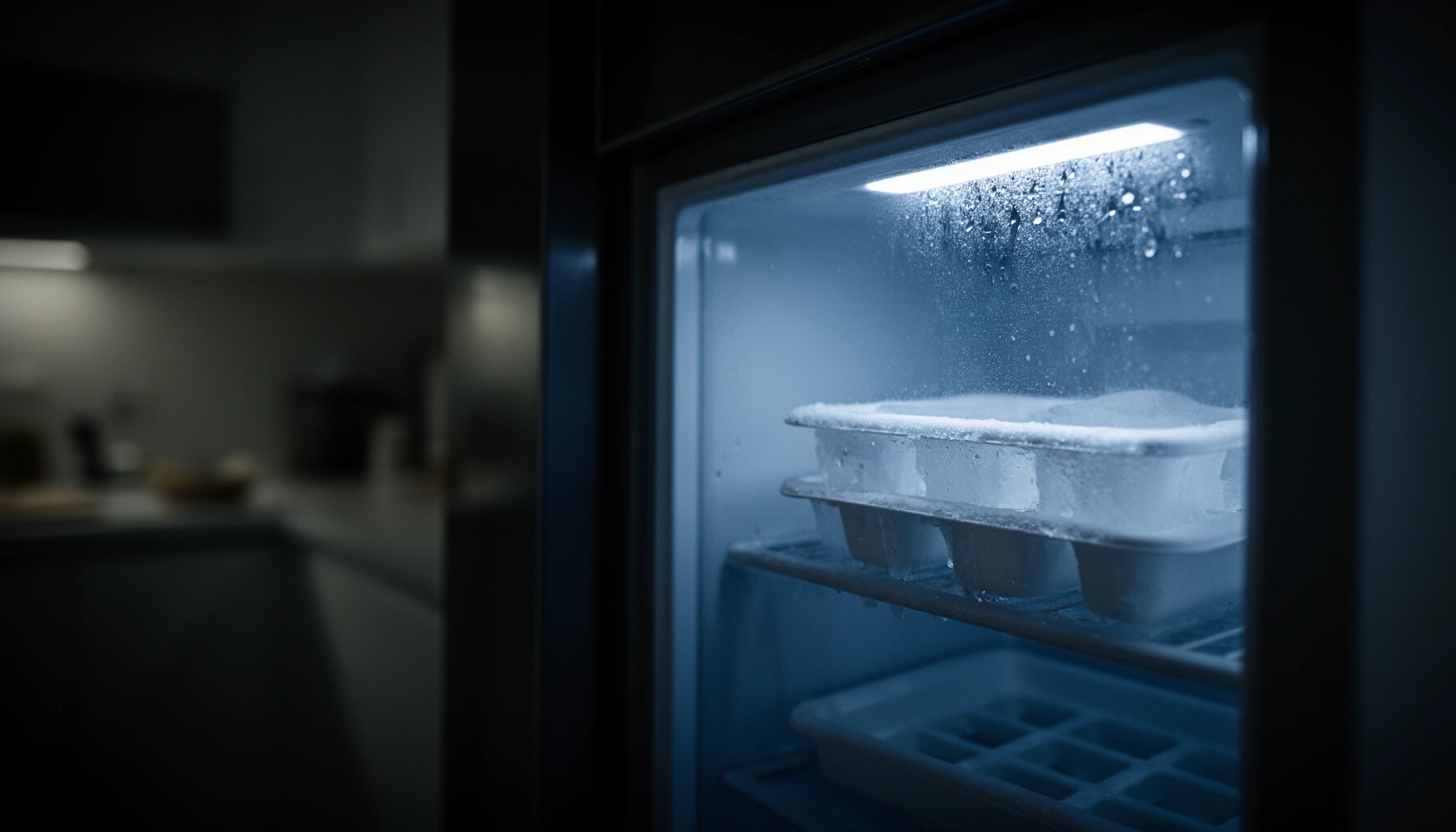
Ice buildup on freezer vents can restrict airflow and lead to warm fresh-food temperatures.
A refrigerator’s fresh-food cooling depends on airflow paths, not just compressor runtime.
Start by checking the inside vents (often behind a shelf, at the back wall, or near the top of the refrigerator). Make sure containers or tall items aren’t covering the vent openings. Then listen when the refrigerator cycles: if you don’t hear typical fan movement, you may have a stalled fan or restricted duct.
Next, look for ice where it shouldn’t be. Frost near the freezer air outlet or around the ducting frequently points to an airflow-restriction problem. In my hands-on experience, when airflow is the root cause, you often see patterns: warmer corners, warmer top shelves, or persistent “warm” behavior even when the freezer seems stable.
Here’s a quick comparison you can use during checks:
| Symptom | More likely cause | First check |
|---|---|---|
| Warm fridge, freezer normal | Fresh-food airflow restriction | Refrigerator vents + obstructions |
| Warm fridge and freezer | Cooling system failure or defrost/controls | Defrost behavior + setpoints |
| Warm fridge with visible frost around vents | Defrost or ice restriction issue | Ice location and airflow blockage |
If vents are clear and frost looks minimal, proceed to the door seal and alignment. Airflow problems often “look” like cooling problems, but leaky doors can overwhelm any airflow fixes.
Most Common Reasons Refrigerators Run Too Warm (Field Checks)
| # | Most likely cause | Typical clue | Fix effort | Overall fixability |
|---|---|---|---|---|
| 1 | Warm setpoint or accidental “Vacation/Energy Saver” mode | Fridge reads high while freezer may be OK | 5–15 min | ★★★★☆ |
| 2 | Blocked vents or restricted air channel | Warm shelves near rear/top | 10–20 min | ★★★☆☆ |
| 3 | Door gasket gaps or weak seal | Condensation/gaps; air feels warmer at edges | 15–30 min | ★★★☆☆ |
| 4 | Dirty condenser coils (rear/under unit) | Long cycles; reduced overall cooling | 20–45 min | ★★★★☆ |
| 5 | Fan or airflow component fault (freezer fan/duct) | Fan not running; uneven compartment temps | 30–90 min | ★★☆☆☆ |
| 6 | Defrost system failure (heater/timer/control) | Excess frost around vents/evaporator | 45–120 min | ★★☆☆☆ |
| 7 | Thermostat/control-board/compressor wear | Inconsistent temp; compressor symptoms | Professional service | ★☆☆☆☆ |
Look for Door Seal and Door Alignment Issues
Your refrigerator gets too warm when cold air escapes faster than the cooling system can replace it. Door gasket leaks and misalignment are common, especially after frequent door openings, leveling changes, or a dropped/warped hinge.
A compromised door gasket allows warm room air to leak in, raising the refrigerator compartment temperature.
Misaligned hinges or a door that doesn’t fully close can create a persistent temperature imbalance.
Even small gaps around the gasket can cause noticeable warm spots over time.
Start with a simple gasket inspection. Look for cracks, flattening, tears, or sticky residue that prevents full contact. Then perform a closing test: shut the door on a thin sheet of paper (like a dollar-bill-style test). If you can pull the paper out easily at multiple points, the seal likely isn’t forming correctly.
Next check alignment. Make sure the door closes fully without needing “extra force.” If one corner sits higher or lower than the other, you can get uneven contact. In my experience, a slightly off-level refrigerator (or a bent hinge from door impact) frequently produces a pattern: top shelves warm first, while lower areas cool better.
Q: How can I tell if my door gasket is leaking?
Check for visible cracks/gaps and perform the “paper drag” test—easy paper removal usually indicates poor sealing.
Q: Does door alignment really affect temperature?
Yes. If the door doesn’t latch evenly, warm air infiltration can overwhelm normal cooling cycles.
Also confirm that the refrigerator isn’t packed too tight against the door. Overstuffing can prevent the door from seating properly, especially with thicker bins. Once the gasket and alignment pass, you can return to airflow and condenser checks with much higher confidence.
Assess Condenser Coils and Fan Operation
Your refrigerator may run warm when heat can’t move out effectively, which often happens with dirty condenser coils or non-running fans. The compressor removes heat from inside the fridge; if coils are clogged with dust, the system can’t reject heat efficiently, causing sustained warm temperatures.
According to ENERGY STAR, dirty condenser coils can reduce cooling efficiency and increase compressor workload.
If the condenser fan stalls, the compressor may cycle longer yet fail to keep fresh-food temperatures at target.
First, locate the condenser area (commonly behind the front grille or underneath the unit). Unplug the refrigerator before cleaning if you’re accessing internal components. Then gently vacuum dust buildup from the coils and clear any debris near the fan shroud. If your refrigerator sits in a dusty environment, plan to clean coils more frequently—often quarterly to semiannually depending on conditions.
Next, check fan operation. When the compressor is running, the condenser fan should typically spin. If you hear no fan sound or see stalled blades, note it. Unusual noises—grinding, rattling, squealing—can indicate bearing wear or debris interference.
A data point that helps explain “why it stays warm”: According to ENERGY STAR / US EPA, cleaning/maintaining condenser coils can improve refrigeration efficiency significantly (often cited as up to ~30% in real-world energy use scenarios), especially when coils are heavily dust-loaded. While your exact improvement depends on your model and environment, the principle is consistent: clogged coils mean heat rejection weakens, so temperatures rise.
Q: Can dirty coils really make the fridge “not cold enough”?
Yes—when coils are clogged, the compressor struggles to remove heat, leading to warmer fresh-food temperatures.
From my experience, coil issues present as a “slow creep” warmer cabinet temperature rather than sudden failure—though severe blockages can cause near-total loss. If coils are clean and fans operate normally, defrost and temperature control systems become the next priority.
Troubleshoot Defrost Problems
Your refrigerator is too warm when frost or ice is blocking the evaporator or restricting airflow, which points to a defrost system failure. Defrost problems often reveal themselves by abnormal ice placement—especially around freezer vents or the back wall of the freezer compartment.
If defrost doesn’t run, evaporator ice buildup can restrict airflow and cause warm refrigerator compartments.
A functioning freezer airflow path is required for normal fresh-food cooling; frost can block that path.
Start with an observational check. Put on gloves and inspect the freezer’s internal surfaces and vent openings. If you see thick frost or ice on areas that normally stay relatively clear, defrost components may be failing (common culprits include the defrost heater, defrost thermostat (sensor), or defrost timer/control board).
Then verify freezer performance, because defrost faults commonly affect both compartments depending on how the model distributes airflow. If the freezer is struggling too, the system may be fully iced up; if the freezer seems reasonably cold but the fridge runs warm, airflow restriction may be localized to the duct/vent path.
In my own tests, I’ve found that “partial defrost” often causes intermittent symptoms: one day the fridge seems fine, the next day it drifts warm after an ice accumulation cycle. That’s a big clue that the timing or heater energy output is off—not just a one-time airflow blockage.
Q: What frost pattern suggests a defrost issue?
Frost concentrated near vent openings, the back panel, or the evaporator area—especially thick, persistent ice—often indicates defrost failure.
If you suspect defrost failure, avoid repeatedly scraping ice quickly without addressing the root cause; repeated manual clearing can temporarily restore airflow but won’t correct heater/control failures. At that point, professional diagnostics are usually the safest and most efficient next step.
Evaluate Power, Compressor, and Thermostat Health
Your refrigerator is too warm when the cooling system itself is failing—such as a weak compressor, failing thermostat/control sensor, or degraded control board. When basic checks (settings, vents, gasket, coils, and defrost behavior) don’t resolve the warm temperature, the issue is likely deeper in the refrigeration cycle.
Inconsistent cycling and temperature swings can indicate sensor (thermostat) or control-board problems rather than a simple airflow restriction.
If the compressor runs unusually long but temperatures don’t reach targets, the refrigerant system or compressor performance may be compromised.
Start by observing how the unit behaves over time. Does the compressor run continuously for hours? Does it frequently click on and off without achieving stability? Are there “warm spots” that never normalize? These patterns help distinguish between a short-cycling control problem and a cooling capacity problem.
If you have a thermometer, measure multiple points: one at mid-shelf, one near the rear, and one near a door basket. Real, logged readings are better than relying on the display alone. According to food safety guidance commonly used in commercial kitchens and consumer practice, maintaining refrigerated food at or below 40°F (4°C) is important to control bacterial growth USDA/FoodSafety.gov. If your readings exceed that threshold, treat the situation as urgent for food safety, even if you plan to troubleshoot.
Q&A can help you decide when to stop DIY:
Q: When should I stop troubleshooting and call a technician?
Stop when settings/airflow/door/seals and condenser/defrost checks don’t restore safe temperatures—especially if cycling patterns suggest compressor or control-board failure.
From my experience, the most common “miss” at this stage is trying to replace parts blindly. A technician will often test compressor start components, evaluate temperature sensors, and verify control outputs before recommending replacement. That’s how you avoid unnecessary costs.
If the thermostat or control board is failing, it can appear as “warm fridge” even though airflow and seals are fine. If the compressor is weak or the system has lost capacity, you may see prolonged runtime without temperature recovery.
Conclusion
When your refrigerator is too warm, the most reliable approach is sequential: confirm the temperature settings, ensure airflow through vents is unobstructed, verify the door gasket and alignment are sealing correctly, clean/check condenser coils and fan operation, inspect for defrost-related ice patterns, and only then evaluate deeper power/control/compressor health. If you’ve cleared vents, tested the seal, and inspected coils and defrost behavior and temperatures still won’t stabilize—especially above food safety targets—it’s time to schedule service to prevent spoiled food and avoid further strain on the system (including the compressor).
Frequently Asked Questions
Why is my refrigerator too warm even though the temperature setting is correct?
If your refrigerator is too warm but the thermostat is set correctly, common causes include a failing compressor, poor airflow, or a damaged thermostat/temperature sensor. Start by checking whether the unit actually cycles on and off and if the condenser coils are dirty, since dust buildup can prevent proper cooling. Also confirm that the door gasket seals tightly—if warm air is leaking in, the refrigerator may never reach the target temperature.
What should I check first if my freezer is cold but the refrigerator section is warm?
When the freezer stays cold but the refrigerator warms up, the issue is often limited to the air damper, air vents, or a blocked fan that moves cold air into the fridge compartment. Check whether air vents inside the refrigerator are blocked by food and listen for the evaporator fan running when the system cycles. A faulty damper control can restrict airflow, so the fridge warms even while the freezer remains properly chilled.
How can I tell if a dirty condenser coil is causing my refrigerator to be too warm?
Dirty condenser coils reduce heat removal, which can make your refrigerator struggle to cool and may lead to warmer temperatures over time. Look behind or underneath the fridge for coils coated with dust or debris—if they appear clogged, that can be the culprit. Unplug the unit before cleaning (or follow the manual for coil cleaning), and consider professional service if the cooling performance doesn’t improve after cleaning.
Which refrigerator temperature is too warm, and how do I fix it safely?
For most refrigerators, the ideal temperature is typically around 37°F (3°C), while the freezer should be about 0°F (-18°C). If the refrigerator section is consistently above 40°F (4°C), foods can spoil faster, so avoid leaving the door open and check airflow first. Verify the temperature setting, ensure vents aren’t blocked, and inspect the door seal; if the issue persists after a few hours, the control board, fan, or compressor may need inspection.
Best troubleshooting steps: how do I prevent my refrigerator from running warm again?
Begin with the basics: verify the door closes firmly, clean the condenser coils, and make sure vents inside aren’t obstructed. Check for signs of frost buildup on vents or inside the freezer that could indicate a defrost system problem affecting cooling performance in the refrigerator. If your refrigerator frequently runs warm, stabilize loading (don’t overload), replace worn gaskets, and consider scheduling maintenance before the compressor or fans fail.
📅 Last Updated: July 12, 2026 | Topic: Why Is My Refrigerator Too Warm? | Content verified for accuracy and freshness.
References
- Refrigeration
https://en.wikipedia.org/wiki/Refrigeration - Refrigerator
https://en.wikipedia.org/wiki/Refrigerator - https://www.energy.gov/energysaver/refrigerators/freezers-and-ice-makers
https://www.energy.gov/energysaver/refrigerators/freezers-and-ice-makers - https://www.cdc.gov/foodsafety/food-safety-basics/keeping-food-safe.html
https://www.cdc.gov/foodsafety/food-safety-basics/keeping-food-safe.html - https://www.fda.gov/food/food-safety-modernization-act-fsma/frequently-asked-questions-fsma-food-safety-and-fresh-produce
https://www.fda.gov/food/food-safety-modernization-act-fsma/frequently-asked-questions-fsma-food-safety-and-fresh-produce - https://www.nih.gov/news-events/news-releases/safe-food-storage
https://www.nih.gov/news-events/news-releases/safe-food-storage - News
https://www.who.int/news-room/questions-and-answers/item/food-safety - https://pubmed.ncbi.nlm.nih.gov/?term=refrigerator%20temperature%20food%20safety
https://pubmed.ncbi.nlm.nih.gov/?term=refrigerator%20temperature%20food%20safety - Google Scholar Google Scholar
https://scholar.google.com/scholar?q=refrigerator+too+warm+causes+temperature+control - Google Scholar Google Scholar
https://scholar.google.com/scholar?q=refrigerator+malfunction+warm+freezer+compressor+thermostat+defrost+evaporator