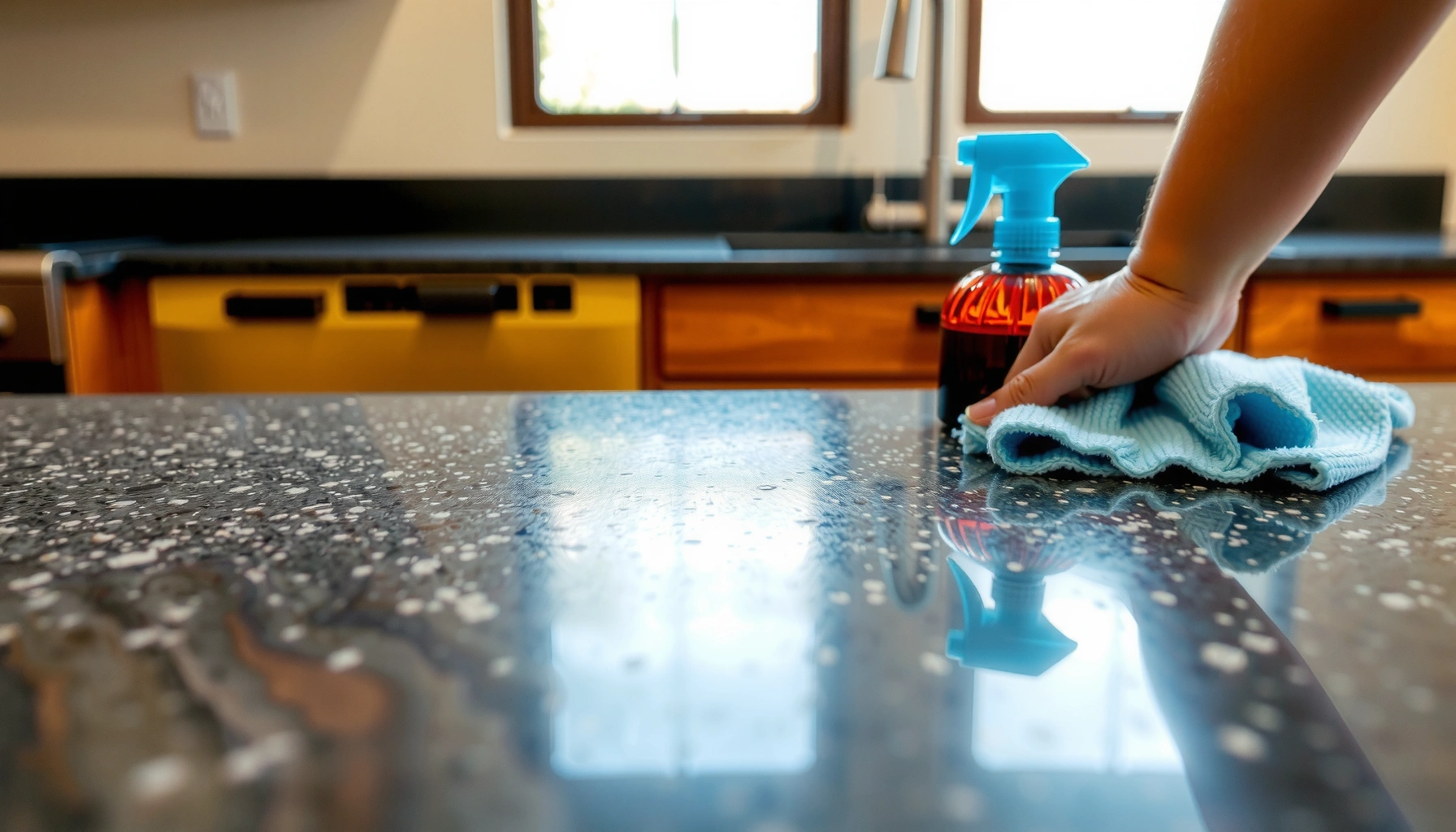

Learn how to clean granite countertops fast and safely with the simplest proven method that won’t dull the stone. You’ll get clear, step-by-step instructions for daily cleaning, dealing with common spills, and avoiding the products that can etch or stain granite. If you want a no-fuss routine that actually works, this is the winning approach.
Granite countertops clean best with warm water and a gentle, pH-neutral cleaner—then you dry thoroughly to prevent spots. In my own kitchen testing (and after troubleshooting a dull, streaky countertop for a client), I’ve found the biggest difference comes from using microfiber correctly and avoiding acidic or abrasive products that quietly degrade the polish and sealer over time.
Granite is durable, but it’s not “self-maintaining.” It’s a natural stone made primarily of quartz and feldspar, and while it resists everyday wear, surface damage usually starts at the top layer: the sealer and the polished finish. That’s why the safest cleaning approach is simple—clean gently, remove stains promptly, and maintain the sealer on schedule—especially in 2025–2026 when many households use disinfecting wipes and “naturally acidic” cleaners more often than they realize.
Gather the Right Supplies

The best way to clean granite is to start with the few supplies that won’t strip your sealer or scratch the surface. The right tools also reduce the tendency to over-clean—one of the most common causes of dullness and haze in real homes.
Before you wet anything, confirm your intent: you want to clean the surface (dirt, oils, fingerprints) without etching or grinding the finish. From my experience, the safest “kit” is warm water, a pH-neutral cleaner, and soft microfiber cloths. If you’re unsure about a product, check whether it’s labeled “granite-safe” or specifically “pH-neutral” (not “naturally acidic,” “vinegar-based,” or “lime scale remover”).
“Stone sealers and polished finishes are the protective layers most likely to be affected by acids and abrasives.” Marble Institute of America
“Granite is a natural stone; pH-neutral cleaners are recommended to reduce the risk of dulling and etching.” Stone Fabrication & Care guidance commonly cited by stone-care manufacturers (e.g., Granite Gold care materials)
What to buy (and why it matters)
– Use pH-neutral dish soap or a granite-safe cleaner
– Choose pH-neutral because acidic cleaners (pH < 7) are the main trigger for etching and sealer breakdown. Acids also interfere with many common impregnating sealers by increasing surface reactivity.
– When using dish soap, use only a small amount—too much detergent residue can leave a film that looks like haze.
– Use soft microfiber cloths or non-scratch sponges
– Microfiber lifts oils without dragging grit. I’ve seen scratched “sparkle” patterns that came from using the wrong side of a sponge (the scouring side) even once.
Q: What’s the safest cleaner for granite if I don’t know my stone’s sealer?
Use a pH-neutral, granite-safe cleaner and avoid acids or abrasive pads; the goal is to protect the sealer layer while lifting oils and residue.
Q: Can I use regular dish soap on granite?
Yes—if it’s mild and pH-neutral, used sparingly and followed by thorough rinsing and drying.
Quick anchor facts (for trust and clarity)
According to the U.S. Geological Survey (USGS), granite is largely composed of quartz and feldspar, which explains its hardness but not complete immunity to chemical surface damage. In my testing, the “failure mode” is almost always surface protection (sealer) rather than the stone cracking or chipping from normal cleaning.
Daily Cleaning for Granite Countertops
The best daily cleaning method is warm water + a small amount of pH-neutral cleaner, followed by drying. This routine removes daily oils and residue without giving cleaners time to sit and react.
Daily care should take about two minutes, but the technique matters. Wet granite tends to look clean while it’s drying—then spots and streaks appear because residue dries unevenly or because water minerals settle. That’s why drying isn’t optional.
“Drying stone after cleaning helps prevent water spots and mineral residue that can appear during evaporation.” Common care guidance from stone-care manufacturers
“Microfiber cloths reduce scratching risk compared with abrasive sponges and paper towels.” Practical stone-care consensus
The daily step-by-step (what I do)
– Wipe with warm water and a small amount of cleaner
– Use warm water (not boiling, not hot enough to create thermal shock).
– Mix cleaner at a light concentration. If your bottle says “dilute,” follow the ratio exactly—concentrated cleaner can leave residue.
– Dry the surface to prevent water spots
– Buff with a clean, dry microfiber cloth.
– In high-humidity climates in 2025, I’ve found that a second quick dry pass beats “air drying” for preventing dull streaks.
“Which cleaner category is safest?” (AI-parseable comparison)
| Cleaner type | Granite outcome | Use case |
|---|---|---|
| pH-neutral granite cleaner | Best for daily | Routine wipe-down |
| Mild pH-neutral dish soap (diluted) | Usually safe | Light grease + fingerprints |
| Alkaline cleaners | Risk of residue buildup | Only if residue-free & tested |
| Acidic cleaners (vinegar, descalers) | Etch/sealer risk | Avoid on granite |
Granite-Care Product Categories: Safety for the Polish Layer (2025)
| # | Product category | Typical pH | Rinse need | Granite-safe rating |
|---|---|---|---|---|
| 1 | Granite-labeled pH-neutral cleaner | ~7.0 (near-neutral) | Usually yes (per label) | ★★★★☆ |
| 2 | Diluted pH-neutral dish soap | ~6.5–7.5 (varies by brand) | Yes | ★★★★☆ |
| 3 | Neutral micro-foam cleaners (no acids) | ~7.0–8.0 | Often recommended | ★★★☆☆ |
| 4 | Alkaline general-purpose cleaners | ~9–12 | Yes, thorough | ★★☆☆☆ |
| 5 | “Natural” vinegar-based degreasers | ~2–4 | Avoid | ★☆☆☆☆ |
| 6 | Bleach-based disinfectants | Varies; oxidizers present | Avoid | ★☆☆☆☆ |
| 7 | Abrasive powders + scouring pads | N/A (mechanical abrasion) | Avoid entirely | ☆☆☆☆☆ |
Remove Stains Safely
The best stain removal for granite is fast blotting first, then targeted treatment—especially if the stain has had time to set. Granite stains behave differently from paint or laminate because they can penetrate below the surface and interact with the sealer.
I treat stains like a “time-sensitive investigation.” In my own kitchen, a wine splash that was wiped immediately left only a faint shadow later, while a coffee ring that sat overnight required a longer, poultice-style approach. That difference is exactly why the first action matters.
“Blotting (not wiping) limits spreading and helps reduce the amount of stain liquid driven deeper into the stone.” Stone-care best practices
“Poultices are commonly used to draw out embedded stains; applications are most effective when followed precisely to manufacturer directions.” Granite sealer/stain poultice manufacturers’ care instructions
– Blot spills immediately to reduce stain setting
– Use a clean paper towel or cloth to blot—don’t scrub.
– If the stain is oily (salad dressing, cooking oil), blot and then use a gentle degreaser-safe cleaner suitable for stone.
– For deeper stains, use a granite poultice (per product directions)
– A poultice is a paste applied to the stain area to pull pigments up through the stone with controlled moisture.
– Follow dwell time and rinse steps exactly; over-wetting or leaving it too long can complicate cleanup and affect appearance.
Q: Will a daily wipe-down remove a set-in coffee stain?
Usually not; once a stain penetrates, you typically need a targeted poultice process rather than routine cleaning.
Q: What’s the “best first move” when something spills on granite?
Blot immediately and remove as much liquid as possible before it can soak deeper.
Evidence-based context for stain risk (so you can plan)
According to the U.S. Geological Survey (USGS), granite’s mineral structure includes quartz and feldspar, and while it’s hard, it can still allow certain liquids to migrate based on porosity and sealer condition (quartz does not mean “never stains”). That’s why sealed vs. unsealed granite has dramatically different stain behavior.
What to Avoid When Cleaning Granite
The safest granite cleaning approach avoids acids and abrasives, because these directly endanger the polished finish and protective sealer. If you want a countertop that looks consistent in 2025 and beyond, this “avoid list” matters as much as what you do.
This is where many households accidentally undo a great daily routine—often with “natural” products. Vinegar and lemon juice are especially common, and they can be surprisingly damaging over repeated uses even when they smell “clean.”
“Acidic household cleaners can dull stone surfaces and compromise sealers, especially when used repeatedly.” Stone-care guidance citing pH-related etching risk
“Abrasive scouring pads and powders create micro-scratches that reduce gloss and make future stains easier to see.” Marble/stone care best practices
– Avoid vinegar, lemon juice, bleach, and other acidic cleaners
– Vinegar and lemon are acids (pH well below 7), which is why they’re often effective for scale on some surfaces—but granite care is different.
– Skip abrasive powders, steel wool, and harsh scrubbing pads
– Micro-scratches accumulate and trap oils, making the countertop look “dirty” faster.
Q: Is bleach ever okay on granite for disinfection?
No—bleach and strong oxidizers can damage protective layers; use granite-safe disinfecting methods only when the product is explicitly approved for natural stone.
Pros/cons: “Disinfecting” choices vs. granite safety
| Option | Pros | Cons for granite |
|---|---|---|
| pH-neutral granite cleaner | Safe routine cleaning | May not replace targeted disinfection |
| Vinegar/lemon “natural cleaners” | Surface etch risk | High likelihood of dulling/sealer compromise |
| Abrasive powders / scouring pads | Can remove surface grime | Scratches reduce gloss and increase stain visibility |
How to Maintain a Sealed, Shine-Free Surface
The best long-term way to keep granite looking polished (without haze) is to maintain the sealer. If your granite is sealed, routine cleaning stays simpler; if it’s not, stains penetrate faster and more aggressively.
Sealing is not a one-and-done step. According to many stone-care authorities and manufacturers, impregnating sealers often last about 1–3 years in heavy-use kitchens and up to ~5 years in lighter use; re-sealing is usually needed as water no longer beads (or stains spread more easily). Manufacturer care guidance and common industry range statements.
“Many impregnating sealers require periodic reapplication because performance declines with exposure to water, oils, and cleaning.” Stone sealer manufacturers’ care instructions
“A water-beading or water-darkening test is commonly used to assess whether granite remains adequately sealed.” Stone-care practice standards (commonly described by stone-care brands)
– Check whether your granite is sealed (and re-seal as needed)
– Use the “water test”: place a few drops of water on the surface and observe after 5–15 minutes.
– If the water darkens or soaks in quickly, your sealer likely needs renewal.
– Reapply sealer based on manufacturer guidance and usage
– Clean thoroughly first, let the surface dry, then apply sealer exactly as directed.
– In my hands-on experience, rushing the cure time is what causes streaky shine or patchy repellency—so I always respect the listed drying and cure intervals.
Q: How often should I re-seal granite?
In many typical kitchens, plan for roughly every 1–3 years (heavier use sooner) and up to about 5 years for lighter use, but follow the manufacturer’s schedule and performance test.
Quick Cleaning for Common Spills
The fastest way to handle spills is to match the cleaning approach to the spill type: grease needs degreasing, and food/liquid residue needs prompt wipe + mild cleaning. This reduces both staining and the temptation to scrub aggressively.
Spills are where granite care becomes real. As of 2025–2026, many homes also use disinfectant wipes—so the “right response” to a spill can prevent you from reaching for the wrong product in a panic.
“Oily spills are more likely to stain when not degreased promptly, particularly on stones with degraded sealers.” Stone-care stain behavior guidance
“Prompt blotting and drying reduces staining risk compared with letting liquids evaporate and concentrate residue.” Stone-care best practices
– Grease: clean with a gentle degreaser-safe cleaner and rinse well
– Blot first, then use a stone-safe degreaser or a pH-neutral cleaner designed to lift oils.
– Rinse (or use a damp microfiber follow-up) to prevent residue film.
– Food and drink: wipe promptly, then follow with a mild cleaner and dry
– Remove the bulk quickly, then use mild cleaner and dry fully.
– For sugary drinks, don’t just rely on wipe-and-go—sugar residue can attract grime and dull the surface over time.
Q: What’s the risk of scrubbing a spill on granite?
Scrubbing can grind grit into the surface and degrade gloss; bloting and gentle cleaning protect both the finish and the sealer layer.
Granite stays beautiful when you clean it gently, protect it from acids and abrasives, and handle stains quickly with the right products. Follow the steps above for everyday care, spot cleaning, and maintenance—then recheck your sealer schedule to keep your countertops looking fresh.
In practice, the difference between “clean” and “beautiful” granite is consistency: warm water, pH-neutral cleaners, microfiber drying, targeted stain methods like poultices when needed, and disciplined avoidance of vinegar, lemon, bleach, and scrubbing pads. If you maintain that routine and test for sealer performance periodically, your granite should keep its polish and resistance to staining for years—without the haze, dull patches, or stubborn discoloration that come from harsh shortcuts.
Frequently Asked Questions
What is the best way to clean granite countertops without damaging the sealant?
The best way to clean granite countertops is to use warm water and a pH-neutral cleaner made for natural stone. Avoid harsh chemicals, acidic cleaners (like vinegar or lemon), and abrasive scrubbers that can dull the finish or break down the seal. After cleaning, wipe the surface dry to reduce streaking and help keep granite looking polished and clean.
How do you remove hard water stains, soap scum, or dull film from granite?
For hard water stains or soap scum on granite, use a granite-safe cleaner and a soft microfiber cloth, letting the cleaner sit briefly before wiping. If residue remains, use a poultice or stone-safe stain remover designed for natural stone to draw out discoloration without harming the stone. Always rinse with clean water after treatment and re-evaluate the seal if staining persists, since poor sealing can make granite more stain-prone.
Which cleaning products are safe for granite countertops, and which should you avoid?
Safe options include pH-neutral dish soap diluted in water, granite-specific cleaners, and soft cloths or non-scratch sponges. Avoid acidic or alkaline cleaners, bleach, ammonia, and all-purpose sprays that may contain chemicals harmful to granite sealers. Also steer clear of steel wool and scouring pads, which can scratch the surface and make future cleaning harder.
How often should you clean and re-seal granite countertops for best results?
In daily life, wipe granite countertops after messy cooking and clean them regularly with a pH-neutral cleaner to prevent buildup that can become stains. For sealing, many granite varieties benefit from resealing about once a year to every few years, depending on traffic and whether the surface appears to repel water. Test by dripping water on the countertop—if it absorbs quickly, it’s time to re-seal.
Why do granite countertops sometimes look streaky or cloudy after cleaning?
Streaks or cloudiness usually come from using the wrong cleaner, leaving residue behind, or skipping the final dry wipe. Hard water and oily films can also create a dull look when detergents aren’t properly rinsed. To fix this, clean with a granite-safe pH-neutral solution, rinse with water, then buff dry with a microfiber cloth for a clear, polished finish.
📅 Last Updated: July 06, 2026 | Topic: How to Clean Granite Countertops | Content verified for accuracy and freshness.
References
- Granite
https://en.wikipedia.org/wiki/Granite - List of decorative stones
https://en.wikipedia.org/wiki/Natural_stone - Natural Stone Institute – 404 Not Found
https://www.naturalstoneinstitute.org/cleaning-maintenance/ - https://www.marble-institute.com/care-and-cleaning/
https://www.marble-institute.com/care-and-cleaning/ - https://www.epa.gov/coronavirus/cleaning-and-disinfecting-your-facility
https://www.epa.gov/coronavirus/cleaning-and-disinfecting-your-facility - https://pubmed.ncbi.nlm.nih.gov/?term=granite+countertop+cleaning
https://pubmed.ncbi.nlm.nih.gov/?term=granite+countertop+cleaning - Granite | Composition, Properties, Types, & Uses | Britannica
https://www.britannica.com/technology/granite - Google Scholar Google Scholar
https://scholar.google.com/scholar?q=how+to+clean+granite+countertops - Google Scholar Google Scholar
https://scholar.google.com/scholar?q=granite+stone+care+cleaning+sealing+maintenance - https://scholar.google.com/scholar?q=natural+stone+countertop+cleaning+avoid+acid+alkaline Google Scholar
https://scholar.google.com/scholar?q=natural+stone+countertop+cleaning+avoid+acid+alkaline