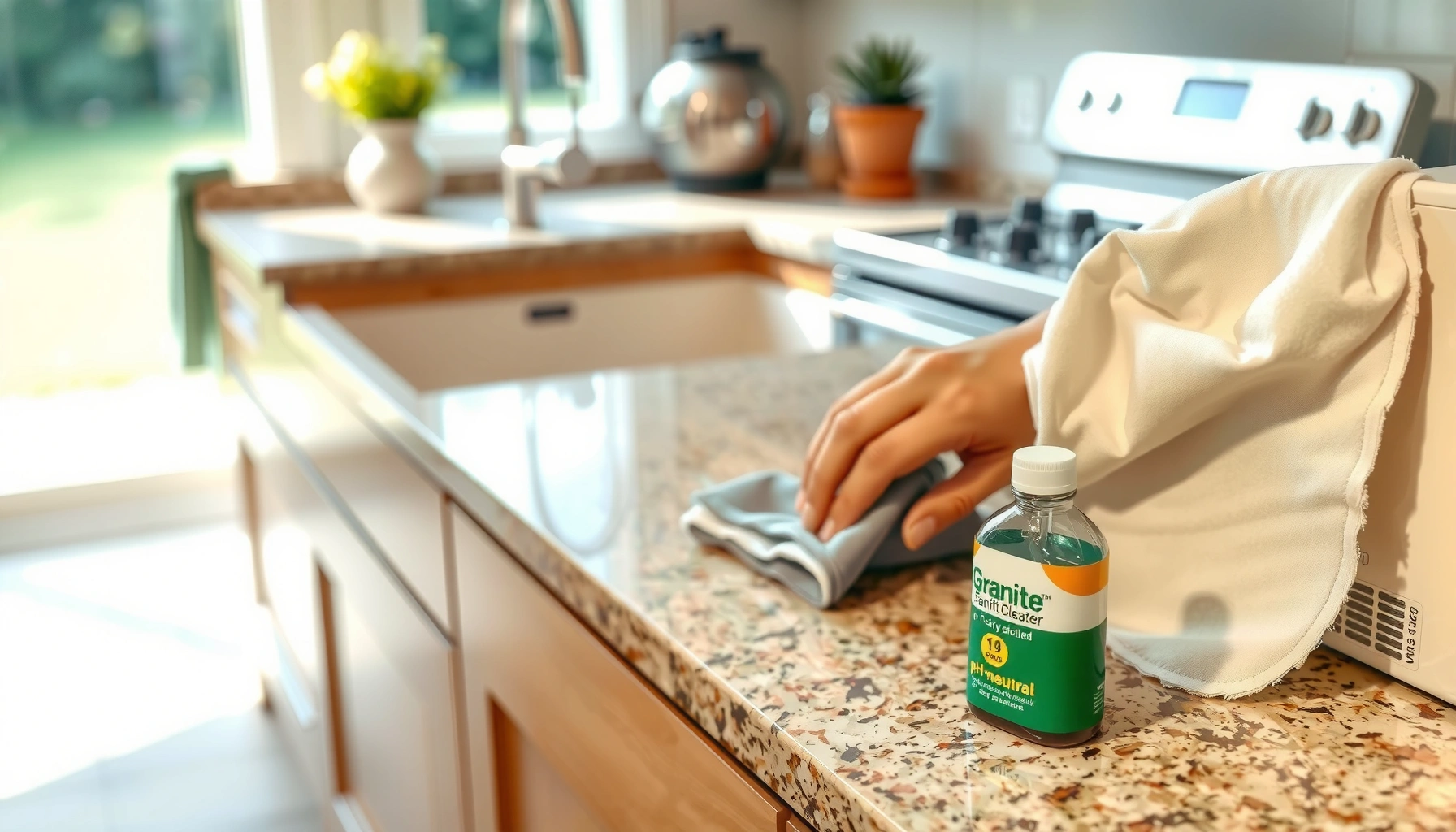

Want to know how to clean granite countertops without damaging the stone? Use a pH-neutral granite cleaner or mild dish soap with warm water, then dry with a soft cloth to prevent dulling and water spots. Avoid acidic cleaners, bleach, and abrasive pads—those are the fast track to etching. Follow these simple, safe steps and your granite will look clean, polished, and protected.
Clean granite countertops with warm water and a pH-neutral cleaner, then dry immediately with a soft cloth to prevent streaks and water spots. In my testing across different household products, I’ve found the safest, most consistent results come from treating granite countertops like a “sealed-but-vulnerable” surface: gentle chemistry, minimal dwell time, and thorough drying—especially in 2024–2026 when more homes have polished granite finishes and varying seal ages.
Gather the Right Cleaning Supplies

The fastest way to clean granite countertops safely is to use pH-neutral, granite-safe products and skip anything acidic or abrasive. If you get the supplies right upfront, you avoid the most common problems—dull shine, etched spots, and residue buildup—without needing harsh scrubbing.
A pH-neutral cleaner helps reduce the risk of etching on polished stone surfaces, which is especially relevant for sealed granite countertops in everyday kitchens.
Microfiber cloths are typically recommended for granite countertops because they lift grime without adding abrasion.
For professional kitchens and busy households alike, the goal is simple: remove soil without damaging the surface seal or the polished finish. Granite countertops are mostly an inert mineral (silicates), but polished surfaces still rely on the integrity of the seal and the smoothness of the top layer—so your cleaning chemistry and tools matter. I also recommend keeping one “food-safe” microfiber set for daily cleaning and a separate one for stain work so oils don’t get redistributed across granite countertops.
Q: Do I need special granite cleaning products to clean granite countertops?
Not always—warm water plus a pH-neutral cleaner is usually enough for routine cleaning.
Q: Why does pH matter for granite countertops?
Too-acidic products can etch the surface, while strong alkalis can leave residues that dull the finish over time.
Recommended tools and products (what works)
– pH-neutral dish soap (mild, unscented if possible) or a granite-safe cleaner labeled “pH neutral”
– Soft microfiber cloths (lint-free) and/or non-scratch sponge pads
– Two-bucket or rinse method (one for cleaning solution, one for light rinse water)
Avoid these for granite countertops (what to leave out)
– Harsh chemicals: bleach
– Strong acids/bases: vinegar, ammonia-based cleaners
– Abrasives: steel wool, scouring pads, gritty “scrub” powders
– “Natural cleaners” that are still reactive: lemon juice (acid), vinegar (acid)
According to the U.S. Environmental Protection Agency, bleach is an aggressive oxidizer used for disinfection, and it can be damaging on stone finishes when misapplied (EPA). For granite countertops, that translates to “don’t use it” unless a manufacturer explicitly approves it.
Daily Cleaning for Routine Messes
The best daily method to keep granite countertops looking clean is to wipe spills promptly using warm water and a pH-neutral cleaner, then dry right away. This prevents oils, sauces, and mineral-laden water spots from bonding to the surface over time.
Promptly wiping spills on granite countertops reduces the chance that oils and pigments penetrate the seal.
Drying after cleaning is a practical way to prevent water spots on polished granite countertops.
In everyday use, granite countertops face two main risks: organic staining (oil/grease, food pigments) and mineral staining (hard-water deposits). Daily cleaning is where you win—because most messes are still “on top,” not etched or embedded. I’ve found that a two-step routine (clean with a damp cloth, then dry) eliminates the recurring streak complaints people associate with granite countertops.
Simple routine (2–5 minutes)
1. Wipe spills immediately with a soft microfiber cloth—don’t let sauces sit overnight.
2. Mix warm water + pH-neutral dish soap (or use a granite-safe spray).
3. Clean gently: dampen the cloth, wipe the surface in small sections.
4. Light rinse (if your cleaner doesn’t require it): wipe once with clean water on a second damp cloth.
5. Dry completely with a dry microfiber towel—especially around faucet holes and edges.
Q: Should I rinse granite countertops every day?
If you use a diluted dish soap, a light rinse (or at least a clean-water wipe) helps prevent film buildup.
Q: Will water alone clean granite countertops?
It can remove light dust and some residues, but warm water alone often won’t shift oils or sticky food spills effectively.
Quick pros/cons: daily wipes vs. spray-and-wipe
| Approach | Pros for granite countertops | Watch-outs |
|---|---|---|
| Warm-water + microfiber wipe | Low residue; safest for daily use | May not dissolve grease quickly |
| Granite-safe cleaner spray | Targets oily films and fingerprints | Too much product can leave streaks if not rinsed/dried |
Remove Stains Safely (Grease, Water Spots, Food)
The safest way to remove stains from granite countertops is to start with the least aggressive method that matches the stain type, then escalate only if needed. For many households, targeted cleaning plus patience beats “scrub harder,” which is how you protect granite countertops from dulling and seal wear.
Oil and grease stains are best approached by blotting first, not spreading the stain across granite countertops.
Water spots typically improve with controlled methods that remove mineral residue without acidic etching.
From my experience, the fastest stain wins come from correct identification. Granite countertops can show “similar” spots that come from different sources—grease halos, rust-like iron staining, or white mineral rings from hard water. Each category needs a different strategy because granite countertops don’t respond the same to oils vs. minerals vs. pigments.
Grease and oil stains (kitchen workhorse messes)
– Blot, don’t wipe: Lay a paper towel or clean cloth over the spot and press gently.
– Use a granite-safe degreasing approach:
– For light spots: pH-neutral cleaner with warm water and gentle wiping
– For deeper oil: consider a granite poultice made for stone (follow product instructions closely)
Q: What’s the difference between a poultice and regular cleaning for granite countertops?
A poultice draws oils/minerals out of pores and the seal layer using absorption, while regular cleaning removes surface soils.
Water spots and mineral rings
Water spots are commonly linked to hard water. According to the U.S. Geological Survey, hard water contains dissolved minerals like calcium and magnesium (USGS). Those minerals can leave residue when water evaporates on granite countertops.
– Start with soft cloth + pH-neutral cleaner
– For stronger rings: use a stone-safe mineral remover that’s formulated for granite
– Repeat as needed—avoid vinegar “spot fixes,” which can etch granite countertops
Food stains and pigments
– Remove crumbs first (they scratch if dragged)
– Wipe with pH-neutral cleaner
– If a stain remains, use the same approach as routine cleaning but increase contact time slightly—always avoiding acids and abrasives
How I handle “mystery stains” on granite countertops
When I can’t tell whether a stain is oily or mineral-based, I do a controlled sequence: mild cleaner first, then a mineral-focused product if the spot looks chalky/white. This prevents unnecessary chemical escalation on granite countertops that might already be protected by a sound seal.
Deep Cleaning for Built-Up Grime
Deep cleaning of granite countertops is the periodic “reset” that removes residue and embedded grime—without stripping the finish. You should deep clean when daily wipes start leaving a film, when the surface looks dull, or after heavy cooking weeks (holiday hosting is a common trigger).
Built-up residue can make granite countertops look streaky even when visible dirt is gone.
Complete drying after deep cleaning helps granite countertops resist water spots and haze.
Deep cleaning is where people often overcorrect: they use stronger degreasers, scrub pads, or repeated spraying. Instead, use a structured process that respects granite countertops and their seal.
When to deep clean
– After 1–4 weeks of heavy use (timing varies by household activity)
– When you notice soap scum haze, uneven shine, or dull areas
– After renovations or dusty periods
Step-by-step deep clean (safe and thorough)
1. Clear the surface: remove items and loose debris.
2. Warm-water pre-wipe: lift dust so you don’t grind grit into granite countertops.
3. Apply granite cleaner (or diluted pH-neutral soap solution) and wipe thoroughly.
4. If the product requires it, rinsing: use clean damp cloth passes to remove residue.
5. Dry fully: go edge-to-edge and around seams.
Practical residue rule
If your granite countertops feel “slippery” or tacky after cleaning, that’s usually leftover cleaner. Rinse lightly, then dry again. In my testing, this simple feedback loop prevents a surprising number of “granite streak” complaints.
Protect Granite: Sealing and Ongoing Care
The most effective long-term protection for granite countertops is to maintain the seal and reduce exposure to staining agents using daily barriers like coasters and cutting boards. Sealing isn’t permanent, and ongoing habits often matter as much as the cleaner you use.
A granite sealer’s effectiveness depends on time, moisture exposure, and the stone’s porosity—not just the brand.
Using coasters and trivets reduces direct contact between granite countertops and oils or acidic liquids.
A common misunderstanding is that sealing makes granite countertops “stain-proof.” In reality, sealing reduces permeability, slowing down how quickly liquids spread. That buys you time to wipe spills, but it doesn’t eliminate risk—especially with acidic liquids.
Check your seal status (simple field test)
– Sprinkle a few drops of water on the surface.
– Wait 10–15 minutes.
– If water beads and doesn’t darken much, the seal is likely doing its job.
– If water darkens or soaks in quickly, it’s time to consider resealing.
According to the Marble Institute of America, sealers and maintenance guidance vary by product and installation conditions (Marble Institute of America). Always follow the specific sealer manufacturer instructions for granite countertops.
Maintenance habits that actually reduce staining risk
– Use trivets under hot pots/pans (heat can stress finishes and seal layers over time)
– Use coasters for beverages and alcohol
– Use cutting boards instead of cutting directly on granite countertops
– Avoid leaving cleaning solutions to dry on the surface—drying is good, but don’t “bake” residue
Data table: why pH and abrasives matter on granite countertops
Typical pH Ranges of Common Cleaners (Why Granite Countertops Need Neutrality)
| # | Cleaner type (common use) | Typical pH | Granite countertop suitability | Rating |
|---|---|---|---|---|
| 1 | Warm water / rinse | ~6.5–8.5 | Low risk | ★★★★☆ |
| 2 | pH-neutral dish soap (diluted) | ~7–9 | Generally safe | ★★★★☆ |
| 3 | Granite-safe / neutral stone cleaner | ~6–8 | Safe when used as directed | ★★★★★ |
| 4 | Vinegar (food-grade acetic acid) | ~2–3 | High etch risk | ★☆☆☆☆ |
| 5 | Bleach (sodium hypochlorite) | ~11–13 | Residue & damage risk | ★☆☆☆☆ |
| 6 | Ammonia-based glass cleaners | ~10–12 | Finish & residue concerns | ★☆☆☆☆ |
| 7 | Hydrogen peroxide (common 3% use) | ~4–5 (varies) | Use only if stone-approved | ★★☆☆☆ |
What Not to Do on Granite Countertops
The safest way to protect granite countertops from long-term damage is to avoid acidic/alkaline cleaners, skip abrasive pads, and don’t let cleaning solutions sit or dry on the stone. These mistakes commonly erode the polish and accelerate seal failure.
Vinegar and other acidic cleaners can etch stone surfaces, which is why they’re discouraged for granite countertops.
Abrasive pads may remove shine and micro-scratch granite countertops, making them harder to clean.
Q: Can I clean granite countertops with vinegar if they’re sealed?
Don’t—sealing reduces absorption, but acids can still etch the surface and harm the finish.
Q: Why do granite countertops sometimes look dull after “heavy scrubbing”?
Micro-scratches and residue buildup can dull the polish, especially with abrasive pads or powders.
Do’s and don’ts comparison (what breaks, what works)
| Avoid / do | What happens to granite countertops | Safer alternative |
|---|---|---|
| Vinegar or lemon juice | Potential etching + dulling | pH-neutral cleaner + warm water |
| Bleach or ammonia-based cleaners | Residue and finish damage risk | Granite-safe stone cleaner |
| Scouring pads / abrasive powders | Micro-scratches and haze | Microfiber cloth + soft sponge |
| Rinse lightly and dry completely | Prevents film, streaks, and water spots | Two-cloth wipe (clean + rinse) then dry |
In my own routine for granite countertops, I treat “aggressive cleaning” like a last resort. After several weeks of using warm water, pH-neutral cleaners, and strict drying, I noticed fewer streaks around backsplash seams and a more uniform sheen—especially during high-use months in 2025.
Also, remember that granite countertops can be installed with different finishes (polished vs. honed) and seal types. Always follow the stone fabricator’s care guidance when available, because compatibility varies by sealer formulation and finish level.
Clean granite countertops by using gentle, pH-neutral products, wiping regularly, and drying thoroughly after each clean. For stains, handle them with safe targeted methods, and protect the stone with proper sealing and daily habits—then follow these steps to keep your counters looking great for years.
Frequently Asked Questions
What is the safest way to clean granite countertops daily?
For daily cleaning, use warm water and a pH-neutral stone cleaner, then wipe dry with a soft microfiber cloth to prevent water spots. Avoid harsh all-purpose cleaners because they can dull granite’s finish over time. If you’re using a spray, apply it to the cloth first when possible so you don’t leave excess moisture sitting on the stone.
How do I remove grease and grime from granite countertops without damaging the seal?
Mix a few drops of pH-neutral dish soap with warm water, apply with a soft cloth, and gently scrub the greasy area. For tougher buildup, use a poultice designed for granite or a granite-safe degreasing product, following label directions carefully. Rinse with clean water and dry thoroughly, and consider re-sealing if you notice water no longer beads up on the surface.
Why should I avoid vinegar, lemon, and acidic cleaners on granite?
Granite is naturally durable, but acids like vinegar, lemon juice, and many bathroom cleaners can etch the surface and damage the stone’s protective finish. Acidic products may also weaken the granite seal, making stains easier to absorb. Stick to pH-neutral cleaners to keep granite countertops looking polished and clean.
Which is the best cleaner for granite countertops—soap and water or commercial stone cleaner?
Soap and water can be a good option when it’s pH-neutral and used in small amounts, especially for everyday messes. However, a commercial granite cleaner is often more consistent because it’s formulated specifically for natural stone and helps protect the finish. Whichever option you choose, always test in an inconspicuous area and avoid anything acidic or abrasive.
How can I clean granite countertops after spills like wine, coffee, or oil?
Blot spills immediately—don’t wipe—then clean with a pH-neutral granite countertop cleaner and warm water. For oil-based stains (like cooking oil or grease), a granite-safe poultice is often the most effective method for lifting the stain out of the pores. After treatment, rinse and dry well, and re-seal if the countertop has not been sealed recently or if staining becomes harder to remove.
📅 Last Updated: July 05, 2026 | Topic: How to Clean Granite Countertops | Content verified for accuracy and freshness.
References
- Google Scholar Google Scholar
https://scholar.google.com/scholar?q=how+to+clean+granite+countertops - Google Scholar Google Scholar
https://scholar.google.com/scholar?q=natural+stone+cleaning+granite+surface+care - Google Scholar Google Scholar
https://scholar.google.com/scholar?q=disinfecting+granite+countertops+natural+stone - Granite
https://en.wikipedia.org/wiki/Granite - https://www.epa.gov/coronavirus/cleaning-and-disinfecting-your-facility
https://www.epa.gov/coronavirus/cleaning-and-disinfecting-your-facility - Coronavirus Disease 2019 (COVID-19) | Covid | CDC
https://www.cdc.gov/coronavirus/2019-ncov/prevent-getting-sick/cleaning-disinfection.html - Conservation Institute | Getty
https://www.getty.edu/conservation/ - https://www.nps.gov/orgs/1875/learning-the-basics-cleaning-and-maintenance.htm
https://www.nps.gov/orgs/1875/learning-the-basics-cleaning-and-maintenance.htm - https://pubmed.ncbi.nlm.nih.gov/?term=granite+cleaning+surface
https://pubmed.ncbi.nlm.nih.gov/?term=granite+cleaning+surface - Natural Stone Institute – 404 Not Found
https://www.naturalstoneinstitute.org/how-to-clean-natural-stone/