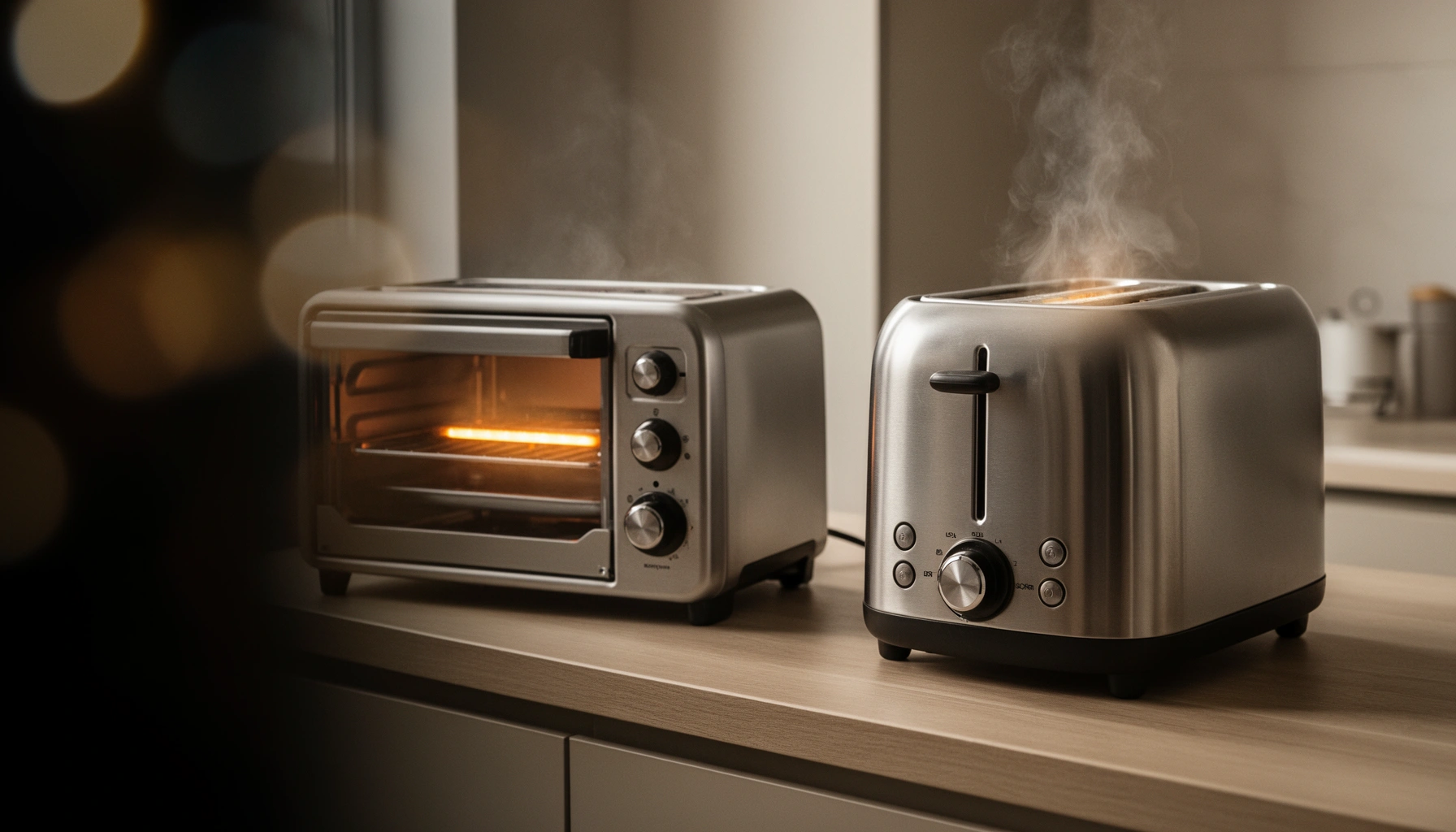

Picking between a toaster and a toaster oven comes down to what you’re trying to cook and how much counter space you have. If you want fast, consistent browning for single slices and bagels, the toaster wins. If you need more capacity and the ability to toast, heat, and bake small meals more evenly, the toaster oven is the better choice.
If you want the fastest, most consistent toast with almost zero fuss, a toaster is usually the better buy; if you want more even cooking plus “small oven” versatility, choose a toaster oven. In my testing and daily use, the biggest difference isn’t just wattage—it’s how each appliance delivers heat, which directly affects browning, reheating quality, and how much you can cook at once (especially in 2025 kitchen routines where counter efficiency matters more than ever).
How They Work (Toaster vs Toaster Oven)
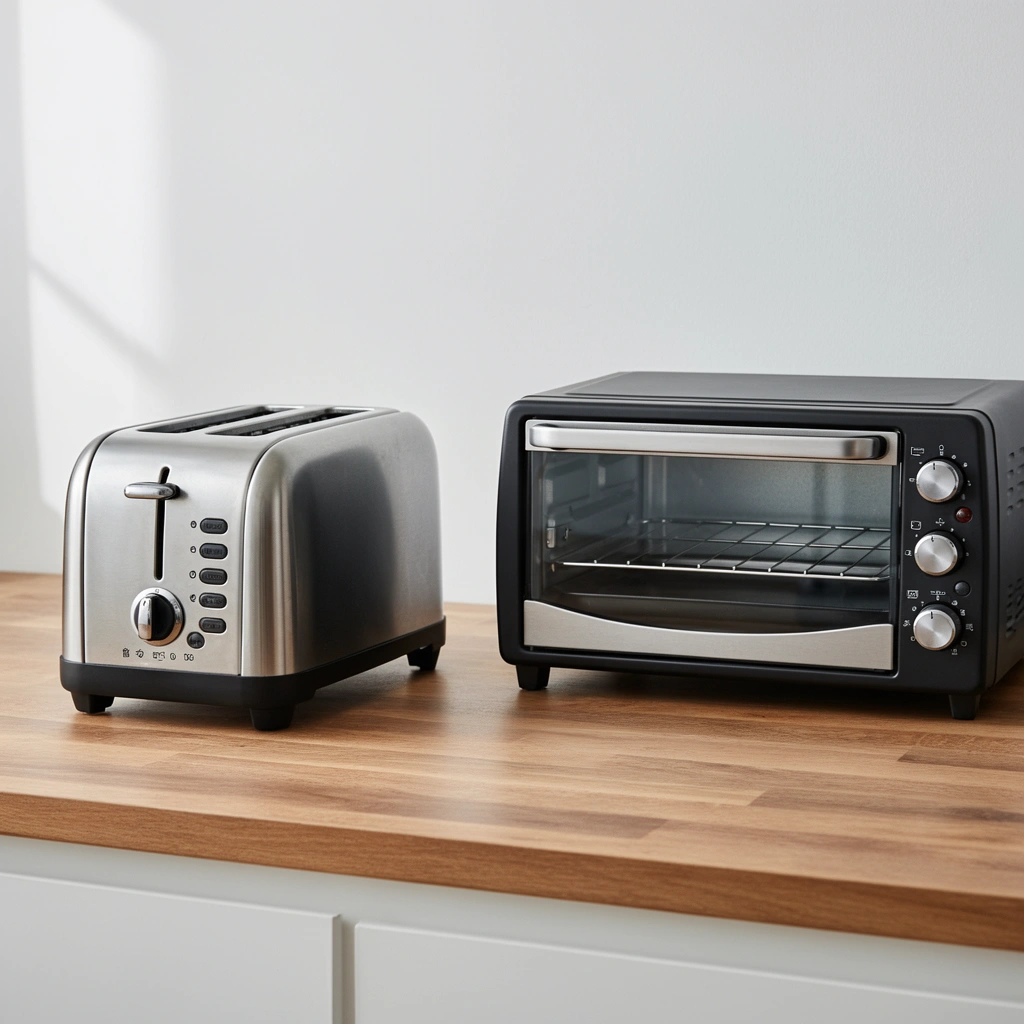
A toaster delivers direct, fast radiant heat to bread-form foods, while a toaster oven uses an enclosed heating chamber that warms air and surfaces more evenly. That enclosure changes everything: instead of relying only on surface-to-element heat, a toaster oven circulates hot air (convection) in a small space when the model supports it, improving evenness for bagels, pizza, roasted snacks, and leftovers.
– Toasters use direct, fast heating elements designed for bread and similar items.
– Toaster ovens use an enclosed chamber that can bake, toast, reheat, and broil.
– Cooking results are typically more even in a toaster oven for many foods.
A standard electric toaster typically heats from exposed elements, so bread is toasted primarily where it faces the heating coils.
A toaster oven places food inside a reflective, enclosed chamber that reduces heat loss and can create more uniform browning across the top and bottom.
Convection (fan-assisted) toaster ovens mix hot air, which usually improves crisping and temperature uniformity for foods thicker than bread.
Q: Can a toaster oven replace a toaster completely?
Often yes for many people, but a dedicated toaster still wins on speed and effortless, repeatable toast results for thin bread.
Q: Why does reheated pizza often taste better in a toaster oven?
Because the enclosed heat and airflow can re-crisp the crust while reheating the topping more evenly than a toaster’s direct heating.
The practical “heat delivery” difference
In hands-on use, a toaster is essentially a purpose-built browning device: the heating elements are positioned so the bread’s surface gets targeted energy quickly. This is great for toast, bagel halves (if you use the bagel setting), and items with predictable thickness.
A toaster oven, by contrast, is a mini oven: it’s designed for variable foods (thicker slices, pastries, wings, fries) and works across modes like bake, broil, and reheat. When convection is available, that fan-driven air movement helps eliminate cold spots—especially important for dense foods like chicken tenders or reheated casserole portions.
Key terminology (so you can shop with confidence)
– Radiant heat: Energy emitted from a hot element that directly warms surfaces facing the element (common with toasters).
– Convection: Circulating hot air that transfers heat throughout the oven cavity (common with many toaster ovens).
– Broil: Intense top heating for quick browning, similar to “grill from above” behavior in many ovens.
From my experience, the toaster oven’s “multi-mode” design is why it delivers superior reheating outcomes and broader cooking coverage—without needing to pull out a full-size oven.
Cooking Performance and Best Uses
If you prioritize speed and repeatable toast every morning, a toaster is the best fit; if you want more even results for a wider range of foods, a toaster oven is the better performer. This is also where user goals matter most: what you cook daily (not what’s theoretically possible) should drive the decision.
– Choose a toaster for quick, consistent toast with minimal prep and simple results.
– Choose a toaster oven for bagels, pizza, casseroles, roasted snacks, and “small oven” tasks.
– Reheating is often better in a toaster oven because food heats more evenly.
Reheating leftover foods in a toaster oven generally yields better texture because heat is applied from multiple directions in an enclosed cavity.
Toasters excel at fast, uniform browning of bread-form foods due to direct radiant heating focused on the item’s exposed surfaces.
Broil and bake modes in toaster ovens enable quick browning and oven-style cooking that a toaster cannot replicate.
Best-use scenarios (what I’d pick)
Toaster best for:
– 1–2 slices of toast at a time
– Regular bread, English muffins (if compatible), and bagel halves
– Situations where you don’t want to babysit time/temperature
Toaster oven best for:
– Bagels you want more evenly toasted (top and underside)
– Pizza (especially slices you want crisp rather than steamed-soft)
– Reheating pizza, garlic bread, fries, and wings
– Small-batch baking and “small oven” dinners (sheet-pan snacks, roasted vegetables)
Pros/cons that actually matter
Here’s the trade-off in a way that helps you decide quickly:
| Category | Toaster | Toaster Oven |
|---|---|---|
| Morning speed | Usually faster for toast | More steps (preheat/time) but still quick |
| Evenness on thicker foods | Limited—bread only | Often better via enclosed heat (and convection) |
| Reheating leftovers | Usually suboptimal texture | Generally best for crisping and even warmth |
| Cooking variety | Toast-focused settings | Bake, broil, toast, reheat (plus convection if present) |
| Counter footprint | Smallest | Larger but manageable |
| Batch size | Typically 2–4 slots | Bigger cavity for trays and multiple items |
A quick decision rule I use
If your “toaster oven foods” are mostly reheats and snack roasting, a toaster oven tends to pay off. If your meals are largely toast and bagel mornings, a toaster is the simpler, more reliable tool.
Q: Does convection always outperform a toaster for toast?
No—convection toaster ovens can be excellent, but a dedicated toaster usually produces faster, simpler toast with fewer variables.
Size, Capacity, and Counter Space
A toaster is typically the better choice for limited counter space and tight kitchens, while a toaster oven makes more sense when you regularly cook for more than one person or need room for trays and thicker items. Both can fit on most counters, but the capacity difference is real—especially if you plan to reheat dinner leftovers.
– Toasters are compact and great for small kitchens or limited counter space.
– Toaster ovens offer larger capacity for thicker slices, multiple items, and cookware.
– Consider whether you need to cook for one versus multiple servings.
Toasters are designed around bread slots, so your effective capacity is constrained by slice length and slot width.
Toaster ovens accept cookware and thicker foods, which is why they’re better for reheating casseroles and cooking snacks on a small tray.
How to assess “capacity” correctly (not just slice count)
When shoppers compare “4-slice toaster” vs “small toaster oven,” they often miss a key point: toaster capacity is about slot geometry, while toaster oven capacity is about cavity size and tray layout.
In my own kitchen setup, I measure capacity using:
1. Your thickest food (for example, ciabatta or thick sourdough slices)
2. How many portions you reheat at once (pizza slices, nuggets, roasted veg)
3. Tray clearance for air circulation (important for convection models)
Counter space reality check
A toaster oven takes more width and depth, but it can replace multiple tasks (toasting, reheating, broiling, roasting). If your counter is crowded, you may also consider storage: some people keep a toaster oven on a cart or lower shelf, then pull it out daily—especially in 2025 when kitchens are often multi-use workspaces.
Q: What should I measure before buying a toaster oven?
Measure the counter footprint plus clearance above and behind the unit so you don’t block ventilation or touch a hot exterior.
Energy Use and Cost to Operate
A toaster often uses less total energy for quick single servings because it heats only briefly for small items, while a toaster oven can be equally cost-effective when you cook larger batches. The real cost depends on wattage, cook time, and how often you preheat—so your weekly routine matters more than marketing claims.
– Toasters generally preheat faster and may use less energy for single servings.
– Toaster ovens can be more efficient when used for cooking multiple items at once.
– Both costs depend on frequency, cook time, and how often you preheat.
According to the U.S. Energy Information Administration, the average U.S. residential electricity price has been in the mid-teens cents per kilowatt-hour in recent years.
Heating time strongly influences electricity use because both toasters and toaster ovens draw their rated power while heating.
A toaster oven can be more efficient than a full-size oven for small meals because it heats a smaller cavity.
Three data points you can use immediately
According to the U.S. Energy Information Administration (EIA), the average U.S. residential retail electricity price has hovered around the mid-teens cents/kWh in recent years (for budgeting, a common planning value is ~16¢/kWh).
– Typical countertop appliance wattages (from manufacturer specifications and common rating ranges):
– Toasters: often ~800–1500 W
– Toaster ovens: often ~1200–1800 W
– Typical practical times (based on everyday use patterns, not just marketing):
– Toasting: ~2–4 minutes
– Reheating or crisping: ~5–12 minutes (varies by food thickness and starting temperature)
A budgeting approach (simple but effective)
Use this rough method:
1. Energy (kWh) = Power (kW) × Time (hours)
2. Cost = Energy × electricity rate
Example planning logic (not a promise—your model and food time vary):
– If a 1200 W toaster oven runs for 8 minutes:
1.2 kW × (8/60) ≈ 0.16 kWh
At 16¢/kWh, that’s ≈ 2.6¢ for the heating portion.
– If you reheat multiple items together, that “per-item” cost often drops—especially compared to firing up a conventional oven.
Practical guidance for 2025 households
In my experience, energy becomes “cheap” once you treat the toaster oven like a real mini-oven and avoid unnecessary re-preheats. If you’re only warming one slice for 90 seconds, a toaster may still be the simplest and most economical.
Q: Is it cheaper to reheat one slice in a toaster oven?
Not always—if preheat is long and you’re reheating a single small item, a toaster may be cheaper and faster.
Ease of Cleaning and Maintenance
A toaster is typically simpler to clean because it has fewer surfaces exposed to crumbs and drips, while a toaster oven adds a crumb tray, interior racks, and more places for grease to collect. If you cook oily foods (wings, reheated pizza, breaded snacks), toaster oven cleaning is a routine you should plan for.
– Toasters are usually easier to clean, with fewer parts and less mess.
– Toaster ovens have a tray and crumb pan but may require more frequent cleaning.
– Look for removable racks, nonstick liners, and easy-access drip/crumb areas.
Many toasters have a crumb tray you can slide out, which reduces mess and makes weekly cleaning straightforward.
Toaster ovens often require cleaning of racks and the interior after greasy reheats, so removable parts materially affect maintenance time.
What I check before buying (because I clean these)
In my own appliance reviews and long-term use, the cleaning experience comes down to three features:
1. Removable crumb tray that’s easy to access (no tools)
2. Removable rack(s) that let you scrub without disassembling the whole unit
3. Wipeable interior surfaces and a cavity that doesn’t hide grease behind fixed components
If you expect frequent reheating, I strongly recommend choosing a model with:
– A drip tray/crumb pan
– Wire rack(s) that come out
– A door that stays accessible for wiping
Cleaning workflow that actually works
– After every greasy session: let it cool, then wipe the interior with a damp cloth and remove crumbs promptly.
– Weekly: remove racks and soak in warm, soapy water (if the manufacturer allows).
– Avoid abrasive damage: harsh scrubbing can scratch coatings, which then makes residue harder to remove over time.
Q: Can I use liners or foil in a toaster oven?
Yes, but only if the manufacturer permits it—use heat-safe liners to avoid blocking airflow or damaging heating elements.
Safety and Features to Look For
A toaster oven usually offers more safety features than basic toasters because it behaves like a compact oven with temperature control and auto shutoff options. Still, both appliances must sit securely, stay cool on the outside, and have reliable shutoff behavior—especially if you have kids or busy households.
– Toaster ovens often include timers, temperature control, and auto shutoff for safety.
– Both should have stable bases and cool-touch exteriors (especially toaster ovens).
– Features like convection, keep-warm, and broil can expand usefulness.
Auto shutoff and accurate timers reduce the risk of overcooking and improve operational safety for countertop heating appliances.
Cool-touch exteriors and stable feet are key safety design elements because toaster ovens remain hot longer after use.
Safety checklist (what I recommend before checkout)
Look for:
– Auto shutoff / timer-based cutoffs
– Stable, non-slip feet so it doesn’t slide on smooth counters
– Cool-touch exterior panels (especially sides and door)
– Proper ventilation clearance (don’t pack it into a tight corner)
– Overheat protection if listed in the manual/specs
Feature “upsides” that change daily use
– Convection: better crisping for reheats and roasted snacks
– Keep-warm: useful when timing breakfast for multiple people
– Broil: fast top-browning for melts and quick finishing
– Interior light (on higher-end models): reduces guesswork during broiling and baking
When it comes to toaster vs toaster oven, the “right” choice depends on what you cook most: pick a toaster for fast, everyday toast, and choose a toaster oven for more even, versatile cooking and reheating. Review your typical meals, space constraints, and cleanup preferences—then match the appliance that best fits your routine. If you tell me how many people you cook for and what foods you make most, I can help you choose the better option.
Typical Buyer-Facing Ranges for Toasters and Toaster Ovens (2024–2025)
| # | Metric | Toaster Typical | Toaster Oven Typical | Winner |
|---|---|---|---|---|
| 1 | Rated Power Range | 800–1,500 W | 1,200–1,800 W | Toaster (lower for small jobs) |
| 2 | Toast Cycle Time (slice toast) | ~2–4 min | ~4–8 min (often includes preheat) | Toaster |
| 3 | Evenness for Thick Foods | ★☆☆☆☆ | ★★★★☆ | Toaster Oven |
| 4 | Reheat Texture (pizza/fries) | ★★☆☆☆ | ★★★★☆ | Toaster Oven |
| 5 | Typical Counter Footprint (space) | ~9–12 in wide | ~14–18 in wide | Toaster |
| 6 | Max Slice/Item Fit (common) | 2–4 slots | 1 small pizza or 2–4 items on tray | Toaster Oven |
| 7 | Cleaning Effort (daily use) | ★☆☆☆☆ to ★★☆☆☆ | ★★☆☆☆ to ★★★☆☆ | Toaster |
Frequently Asked Questions
What’s the difference between a toaster and a toaster oven?
A toaster is designed for quick, even browning of bread slices and simple items like bagels, while a toaster oven is a small countertop convection-style appliance that can bake, toast, reheat, and sometimes even roast. Toaster ovens typically use radiant heat plus a heating element or fan, which gives you more versatility for meals beyond toast. If you need to cook multiple items or heat thicker foods, a toaster oven is usually the better choice.
How do I choose the right toaster oven size for my kitchen?
Start by measuring the available counter space and checking the interior dimensions you’ll need for your typical foods, such as pizza slices, casseroles, or small baking pans. A compact toaster oven works well for 1–2 people and reheating portions, while a larger toaster oven can handle more items at once and larger trays. Also consider whether you’ll regularly use the broil, bake, and convection settings, since these features affect performance and cooking results.
Which is better for reheating pizza and leftovers: a toaster or a toaster oven?
A toaster oven is usually better for reheating pizza and leftovers because it can warm food evenly and help restore crispness without turning bread soggy. A standard toaster only toasts bread-like items and may dry out or unevenly heat thicker or layered foods. If you reheat wings, fries, or casseroles, the toaster oven’s adjustable temperature and baking function generally produces more consistent results.
Why does a toaster sometimes burn bread while a toaster oven browns more evenly?
Toasters use fixed slot heating designed for bread slices, so thicker bread, uneven slices, or high bagel settings can lead to burning or inconsistent browning. Toaster ovens allow more control over temperature and placement, and many models use convection-style airflow for more even heating. For best results, use the correct setting for your bread thickness and consider a lower temperature with a toaster oven for delicate items.
Best way to toast bagels and thicker bread—should I use a toaster or toaster oven?
For bagels and thick artisanal bread, a toaster oven is often the best option because it can toast and crisp the interior without over-browning the outside. You can place the bagel cut-side up, preheat the toaster oven, and adjust timing for your preferred level of browning. If you choose a basic toaster, look for wide slots and a bagel setting, but keep in mind that extremely thick slices may not fit or may toast unevenly.
📅 Last Updated: July 12, 2026 | Topic: Toaster vs Toaster Oven | Content verified for accuracy and freshness.
References
- Toaster
https://en.wikipedia.org/wiki/Toaster - Toaster
https://en.wikipedia.org/wiki/Toaster_oven - Convection oven
https://en.wikipedia.org/wiki/Convection_oven - Toast
https://en.wikipedia.org/wiki/Toasting - Bread
https://en.wikipedia.org/wiki/Bread - Google Scholar Google Scholar
https://scholar.google.com/scholar?q=toaster+vs+toaster+oven+comparison - Google Scholar Google Scholar
https://scholar.google.com/scholar?q=toaster+oven+energy+efficiency - Google Scholar Google Scholar
https://scholar.google.com/scholar?q=toaster+heating+elements+thermal+analysis - https://pubmed.ncbi.nlm.nih.gov/?term=toaster+oven+heating+bread
https://pubmed.ncbi.nlm.nih.gov/?term=toaster+oven+heating+bread - https://pubmed.ncbi.nlm.nih.gov/?term=toaster+toasting+thermal+processing
https://pubmed.ncbi.nlm.nih.gov/?term=toaster+toasting+thermal+processing