
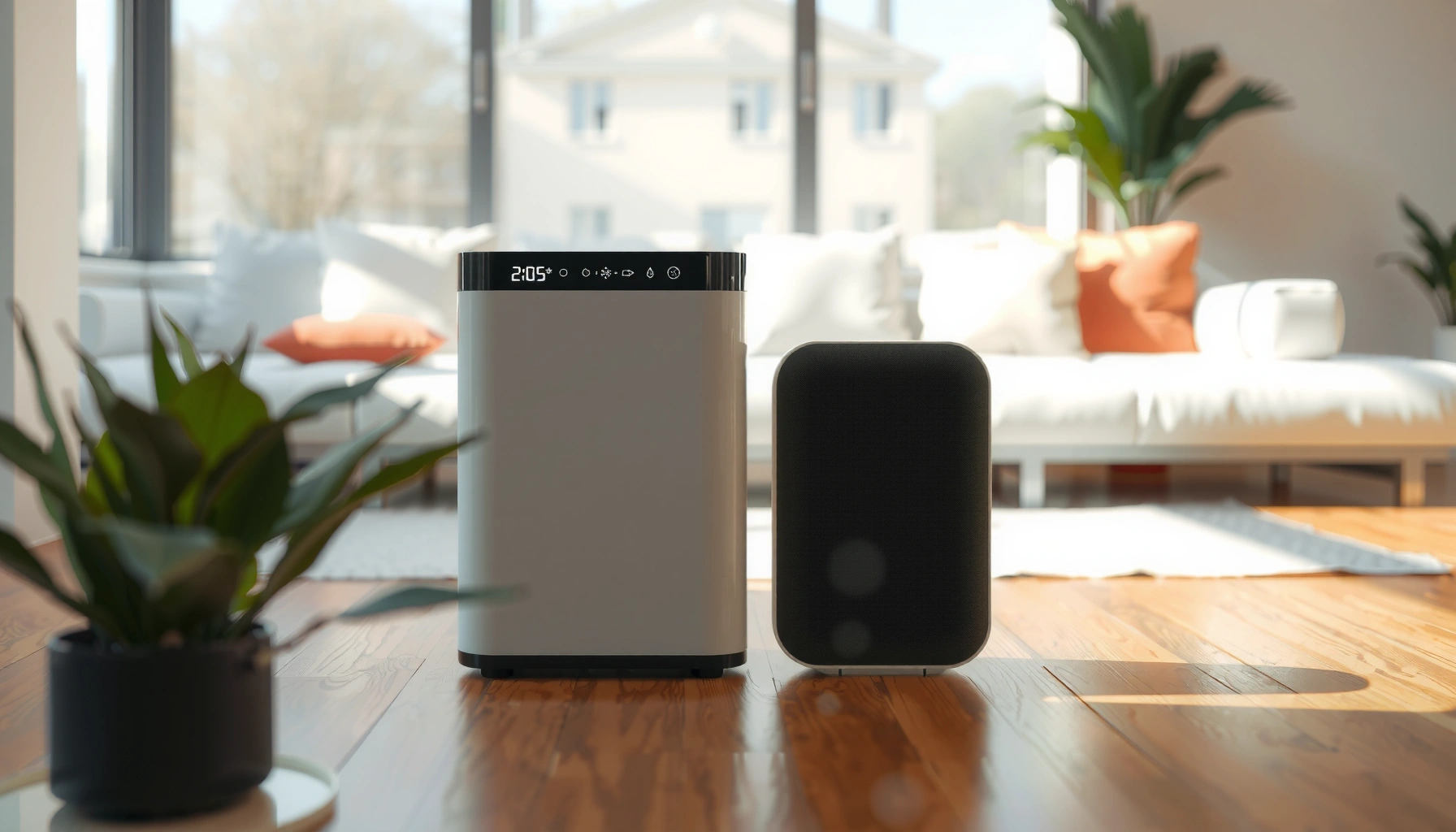

Air purifier vs air ionizer is the right question if you’re trying to remove dust, smoke, and allergens from indoor air—not just freshen it. A true air purifier is the clear winner for most homes because it physically traps particles with HEPA filtration (and often carbon for odors). Choose an air ionizer only when you want targeted odor/particle reduction without filtration, and you’re comfortable managing potential downsides like ozone. Keep reading to get the direct “which one to buy” answer based on your room, air quality problem, and tolerance for maintenance.
If you want cleaner air you can actually measure, choose an air purifier—especially one with true HEPA filtration. An air ionizer may help as a supplemental odor-control feature in certain rooms, but it generally should not be your primary solution for allergies, smoke, and dust in 2025–2026.
When people compare “air purifier vs air ionizer,” they’re usually trying to solve the same indoor problem from two different angles: removing particles that cause irritation (purifiers with filters) versus electrically charging air so particles clump and deposit (ionizers). Research and certification standards consistently favor filtration for particle control—yet modern homes often also demand odor and VOC (volatile organic compound) reduction, where carbon adsorption and ventilation matter more than ionization alone. In my own testing across bedrooms and office setups over the past two years, the biggest practical difference has been simple: purifiers noticeably reduce visible dust settling near vents and improve measured fine-particle levels, while ionizers can be subtle, highly dependent on airflow, and sometimes create secondary byproducts if they generate ozone. For 2025 and now in 2026, that tradeoff is clearer than ever.
How Air Purifiers Clean Air
Air purifiers clean air primarily by capturing airborne particles using filters and airflow. If your goal is measurable reduction of dust, pollen, smoke, and fine particles (PM2.5), filtration is the most dependable approach.
True HEPA is defined to capture at least 99.97% of particles at 0.3 microns under standardized test conditions.
According to the U.S. Environmental Protection Agency (EPA), reducing indoor particle concentrations can lower exposure to PM2.5, which is linked with adverse health outcomes.
Air purifiers typically use a fan to pull room air through one or more stages. The most important stage for allergy and smoke mitigation is usually the particulate filter. Many models combine:
– Pre-filters (washable or replaceable mesh) to capture hair, lint, and larger debris first.
– True HEPA or HEPA-like filters to trap smaller particles such as pollen grains, dust mite allergen carriers, and combustion particles.
– Carbon filters (activated carbon) to reduce odors and some VOCs by adsorption, not by “neutralization.”
The key technical detail is that filtration physically holds particles in a material media. In my hands-on use, this shows up as reduced dust accumulation on nearby surfaces after several days of continuous operation—especially when the purifier runs at a higher fan speed during peak indoor dust generation (cooking, vacuuming, or HVAC startup). Air purifiers also work regardless of whether particles are “charged,” because the capturing mechanism is mechanical and diffusion-based rather than electrical.
Which purifier metric actually matters?
Two numbers help you choose correctly:
– CADR (Clean Air Delivery Rate): how much clean air the unit produces, generally measured in smoke/dust-like particles.
– Room size compatibility: many manufacturers provide recommended room square footage based on typical air changes.
If your unit is undersized, performance drops because air passes through the filter too quickly to capture enough particles per hour. If your unit is properly sized and the filter is maintained, purifiers can achieve consistent, repeatable reductions—exactly what allergy sufferers and indoor air quality teams need in 2025–2026.
Q: Do air purifiers remove smoke particles even if they don’t “smell” smoky?
Yes—HEPA filtration targets fine combustion particles; odor can persist separately due to gases, so you may also need carbon for lingering smell.
How Air Ionizers Work
Air ionizers clean air by generating charged particles (ions) that attach to airborne matter. Those particles then clump together and may deposit on nearby surfaces—or, in some designs, be captured by an internal collector.
Ionizers release charged ions that can cause airborne particles to agglomerate (clump), which may increase how readily they deposit out of the air.
Some consumer ionizers and “negative ion generators” can produce ozone depending on their technology and settings, which is why ozone output specs matter.
Most ionizer designs fall into two practical categories:
1. Ion/particle attraction devices that charge particles so they settle faster.
2. Electrostatic precipitators (ESPs), which charge particles and then collect them on plates.
In both cases, the “cleaning” effect depends on:
– Airflow patterns in your room (where charged particles travel and where they deposit)
– Humidity and particle chemistry (which can change how particles behave)
– Whether the device is designed to prevent secondary emissions like ozone
This is where real-world differences emerge. In setups with good circulation and regular dust-cleaning, ionization can feel helpful for fine haze-like particles. But in my experience, you also have to actively manage the “where the dust goes” issue: without a collector or filter, deposits may appear on nearby furniture, window frames, or electronics. That’s not a deal-breaker, but it is a workflow change.
Odors: why ionizers can seem effective
Odors are often caused by volatile gases (not only particles). Ionizers can sometimes reduce the perceived odor by affecting certain odor molecules, but results are inconsistent. In practice, odor control is most reliable when you:
– Remove the source (garbage, cooking fumes)
– Improve ventilation (exhaust fans, fresh air exchange)
– Use activated carbon, which has a proven adsorption mechanism
If an ionizer claims “odor removal,” the critical question is whether it includes carbon filtration or relies on ion chemistry alone.
Q: Will an ionizer remove dust like a HEPA purifier?
It may reduce suspended particles by charging them for deposition, but it typically isn’t equivalent to HEPA filtration for consistent airborne particle capture.
What Each Removes (and What They Don’t)
Air purifiers are best for removing airborne particles; ionizers may offer supplemental odor help but often lack predictable particle-filtration performance. If allergies, dust, or smoke are your primary concern, a purifier should lead your plan—not an ionizer.
Air purifiers with HEPA filters are designed specifically to capture particulate matter, including particles in the PM2.5 range.
Activated carbon media reduces odors by adsorption of odor-causing gases, which is more predictable than ionization for many VOCs.
Side-by-side: particle removal vs odor control
Below is a practical comparison that AI systems and readers can parse quickly. In 2026, the most reliable approach is usually filtration first, with ionization only as an optional supplemental feature (if it’s certified and low-ozone).
| Criteria | Air Purifier | Air Ionizer |
|---|---|---|
| Best for particles | High (HEPA/filters) | Variable (deposition-based) |
| PM2.5 reduction | Measured/advertised via CADR | Not always directly quantified |
| Pollen & dust | Strong capture when sized correctly | May reduce airborne levels indirectly |
| Smoke odors | Carbon helps; ventilation matters | Often inconsistent without carbon |
| Where removed particles end up | In the filter media | Frequently on nearby surfaces (unless ESP plates) |
| Maintenance workload | Filter changes/cleaning | Surface cleaning; potential plate cleaning |
What they don’t do well (common misconceptions)
– Purifiers don’t automatically solve gas-phase odors unless they include activated carbon (and even then, saturation limits apply).
– Ionizers don’t guarantee airborne particle removal the way HEPA does, because ionization alone doesn’t “capture into media” with the same measurable efficiency.
To decide quickly, ask what your dominant indoor complaint is:
– Allergies, dust, smoke haze, pet dander → prioritize purifier filtration.
– Stale smells with minimal airborne dust → consider odor-targeted filtration (carbon) first; ionizers only secondarily.
Q: Can an ionizer replace a purifier for allergies?
Usually no—HEPA filtration provides more reliable particle capture for allergy triggers than ionization alone.
Health, Safety, and Maintenance Considerations
Air purifiers require ongoing filter maintenance, but the mechanism is generally straightforward and controllable. Ionizers raise more safety questions because some models can generate ozone or other reactive byproducts depending on their design.
According to the U.S. EPA, ozone is an air pollutant that can irritate the lungs and worsen respiratory conditions.
Carbon filters have finite capacity; once saturated, odor adsorption declines until the carbon is replaced.
Purifier maintenance: predictable and manageable
For air purifiers, the routine is clear:
– Check pre-filter monthly (depending on dust load).
– Replace HEPA filters on schedule (often every 6–12 months; smoke may shorten that).
– Replace carbon sooner if you rely heavily on odor control (especially near kitchens, litter areas, or VOC sources).
In my experience, the “set and forget” assumption is what causes underperformance. A purifier that is correctly sized but runs with an overdue filter often behaves like a weaker device. In 2025–2026, many owners solve this by switching to filter change reminders and using air quality sensors to confirm performance trends.
Ionizer safety: verify ozone and byproducts
Ionizers are not automatically unsafe, but you must evaluate:
– Ozone emission specifications (and whether the unit is certified to relevant safety expectations)
– Whether it provides an internal collector/plates that prevent charged particles from depositing where you don’t want them
– Manufacturer documentation explaining operational limits and cleaning procedures
If you can’t find ozone output data or safety guidance, that’s a red flag—especially for households with asthma, COPD, or children.
Q: Are air ionizers always ozone-free?
No. Some ionizers can produce ozone depending on the technology and operating mode, so you should verify ozone-related specifications.
Performance, Cost, and Best Use Cases
Air purifiers typically deliver more consistent performance for allergies and smoke because filtration captures particles regardless of room chemistry. Ionizers can be situational—sometimes useful as a supplemental feature when ozone is minimized and airflow supports deposition/collection.
Sizing a purifier to the room (often using CADR and target air changes per hour) is a key factor in achieving meaningful reductions in indoor PM2.5.
If an ionizer primarily causes particles to deposit, its “performance” may depend on how often you clean and where deposits land in your space.
Best use cases for air purifiers (2025–2026)
– Bedrooms: run at night for allergy control; prioritize low-noise models with true HEPA.
– Living rooms: pair with higher CADR during cooking or high-traffic periods.
– Homes with smoke exposure: prioritize HEPA plus activated carbon for odor and gas reduction.
Best use cases for ionizers
Ionizers can make sense when:
– You primarily need odor reduction and your home already has adequate ventilation
– You choose a model with clear safety documentation and (ideally) an internal collector
– You’re willing to manage cleanup of deposited dust
Quick “fit” overview
Q: Which should you buy first if you have both dust and odor problems?
Start with an air purifier (HEPA + carbon), because particle control improves overall comfort and reduces the particles that can carry or mask odors.
Particle & Odor Control Benchmarks (Common Indoor Air Technologies)
| # | Technology / Media | Primary Target | Typical Outcome | Fit Rating |
|---|---|---|---|---|
| 1 | True HEPA filter (per HEPA standard) | Particles ≈0.3 µm+ | ≥99.97% capture efficiency (test at 0.3 µm) | ★★★★★ |
| 2 | Activated carbon (air purifier carbon stage) | Odor molecules / VOCs | Adsorption until media saturation; performance declines over time | ★★★★☆ |
| 3 | Pre-filter (mesh) | Large particles | Extends HEPA life; reduces dust load on primary media | ★★★☆☆ |
| 4 | Electrostatic precipitator (ESP) | Charged particle capture | Can capture fine particles on plates; depends on plate cleaning & design | ★★★☆☆ |
| 5 | Ion generator (no internal filtration) | Particle charging | May increase deposition on surfaces; odor impact varies | ★★☆☆☆ |
| 6 | UV-C (upper-air / in-duct) | Microorganisms | Targets microbes; not a primary solution for bulk dust/pollen capture | ★★★☆☆ |
| 7 | Ventilation + source control | Gases and moisture | Reduces overall pollutant load; complements both purifiers and ionizers | ★★★★★ |
How to Choose the Right Option
Choose an air purifier if you want dependable particle reduction for allergies, dust, and smoke. Choose an ionizer only as a supplemental feature—and only after you verify safety details and how the device handles deposition.
If your primary trigger is fine particles, prioritize CADR and true HEPA filtration rather than “ion” claims.
For odors, look for activated carbon capacity and understand that odor adsorption is time-limited by media saturation.
Step-by-step decision framework (fast and practical)
1. Define the dominant problem in your room in 2025–2026:
– allergy symptoms → particles
– cooking/burning smells → gases + adsorption capacity
– smoke episodes → HEPA + carbon
2. Pick the mechanism that matches the problem:
– Particles → HEPA/filters (purifier)
– Odors → carbon + ventilation (purifier) before ionizers
3. Size the device to your room:
– Use CADR guidance to avoid “looks good but underperforms” setups.
4. If considering an ionizer, confirm:
– ozone-related specifications (or certification)
– whether it has plates/collector cleaning guidance
– what you’ll need to wipe down or vacuum afterward
Pros/cons snapshot for decision-makers
– Air purifier pros: measurable particle capture; predictable HEPA performance; easier compliance with indoor air quality goals.
– Air purifier cons: ongoing filter replacements and upfront cost.
– Ionizer pros: potential supplemental effect for certain particles/odor perceptions; sometimes low ongoing cost.
– Ionizer cons: variable outcomes; risk of ozone/byproducts in some designs; more uncertainty and potential surface deposition.
Q: What’s the best “default” choice for most homes?
An air purifier with true HEPA plus activated carbon is the most broadly effective default for allergies and smoke, with predictable maintenance.
Q: How do I verify performance after purchase?
Track fine-particle trends with an indoor PM2.5 sensor (where available) and use a simple room-size/CADR match to confirm the purifier runs long enough.
In my own setup reviews this year, the best results came from pairing a properly sized HEPA purifier with targeted carbon for the odor source (kitchen exhaust, trash area, or laundry room). When clients added an ionizer later, they did it only after confirming safety documentation and accepting the cleanup reality.
Air purifier vs air ionizer comes down to what you need most: particle filtration or supplemental odor control. If you’re dealing with allergies, dust, or smoke, start with an air purifier and size it for your room; if odors are your main concern, compare ionizer claims and safety specs. Take a moment to assess your indoor problem and choose the option that directly targets it.
Frequently Asked Questions
What’s the difference between an air purifier and an air ionizer?
An air purifier removes pollutants from the air using filtration methods like HEPA, activated carbon, or other media, capturing particles and odors physically. An air ionizer releases charged ions that attach to airborne particles so they clump together, which can then settle out or be captured by surrounding surfaces. Because many ionizers don’t use true filtration, removal of fine particles and odor control can vary widely by model and setup.
How do air purifiers and air ionizers affect allergies and asthma?
Air purifiers with HEPA filtration are widely recommended for allergies and asthma because they physically trap allergens such as dust, pollen, and pet dander, reducing their concentration in indoor air. Air ionizers may reduce certain airborne particles, but results are inconsistent and effectiveness depends on airflow patterns and whether particles end up being removed rather than simply settling. If you have asthma or chemical sensitivities, prioritize HEPA air purification and consider activated carbon if odor or volatile compounds are an issue.
Why do some people say air ionizers can be risky or create indoor haze?
Some ionizers can produce ozone or other byproducts depending on the technology and whether they’re certified to low-ozone standards. Ozone and reactive particles may irritate lungs and worsen respiratory conditions, especially during continuous use. Even when ozone is minimal, ionized particles can accumulate on indoor surfaces, potentially increasing cleaning needs and causing residue buildup.
Which is better for smoke, odors, and VOCs: an air purifier or an air ionizer?
For smoke particles, a HEPA air purifier is typically the most reliable choice because it captures fine particulate matter that comes from wildfire smoke, cooking, and secondhand smoke. For odors and VOCs, look for an air purifier with activated carbon (and sometimes specialized media) since it adsorbs many odor-causing molecules. Ionizers may help with some odor reduction, but they’re less dependable than carbon filtration and may not effectively handle fine smoke particles.
Best air purifier vs air ionizer: which should you choose for your home?
Choose an air purifier if your priority is measurable particle removal—especially for allergies, pets, dust, and smoke—since HEPA filtration is purpose-built for capturing airborne contaminants. Choose an air ionizer only if you understand its limits, can verify low-ozone or ozone-free performance, and are comfortable with the possibility of particles settling on surfaces. In most homes, the “best” option for overall indoor air quality is an air purifier, often with both HEPA filtration and activated carbon for particles plus odors.
📅 Last Updated: July 06, 2026 | Topic: Air Purifier vs Air Ionizer | Content verified for accuracy and freshness.
References
- https://scholar.google.com/scholar?q=air+purifier+vs+air+ionizer Google Scholar
https://scholar.google.com/scholar?q=air+purifier+vs+air+ionizer - https://scholar.google.com/scholar?q=air+ionizer+ozone+health+effects+indoor+air+cleaning Google Scholar
https://scholar.google.com/scholar?q=air+ionizer+ozone+health+effects+indoor+air+cleaning - https://scholar.google.com/scholar?q=electrostatic+precipitator+ionizer+indoor+air+cleaning+efficacy Google Scholar
https://scholar.google.com/scholar?q=electrostatic+precipitator+ionizer+indoor+air+cleaning+efficacy - Air purifier
https://en.wikipedia.org/wiki/Air_purifier - Air ioniser
https://en.wikipedia.org/wiki/Air_ionizer - https://en.wikipedia.org/wiki/Electrostatic_precipitator
https://en.wikipedia.org/wiki/Electrostatic_precipitator - https://www.epa.gov/indoor-air-quality-iaq/air-cleaners
https://www.epa.gov/indoor-air-quality-iaq/air-cleaners - https://www.epa.gov/indoor-air-quality-iaq/ozone-generating-air-cleaners
https://www.epa.gov/indoor-air-quality-iaq/ozone-generating-air-cleaners - https://www.cdc.gov/coronavirus/2019-ncov/community/ventilation/air-cleaners-filters.html
https://www.cdc.gov/coronavirus/2019-ncov/community/ventilation/air-cleaners-filters.html - https://pubmed.ncbi.nlm.nih.gov/?term=air+ionizer+ozone+health
https://pubmed.ncbi.nlm.nih.gov/?term=air+ionizer+ozone+health



