

Every woman should own the essential shoe list of versatile pairs that cover work, weekends, and evenings without guesswork. This guide delivers a clear winner set—like the everyday flat, the reliable pump, the classic sneaker, and a weather-ready boot—so you know exactly what to buy first based on your lifestyle. By the end, you’ll have a tight plan for what shoes to own and what to skip.
If you want a shoe closet that actually gets worn, build a small “go-anywhere” set: one comfortable sneaker, one everyday flat, one work-appropriate option (like a loafer), one dressier shoe (like a pump or nicer sandal), and one weather solution (boots or sandals). That core set covers most dress codes and conditions, and you only add “gap” pairs for what your real life demands.
If your week includes office-to-casual days, events, commuting, or shifting weather, this guide is for you. It’s also a good reset if you’re tired of owning lots of “pretty” shoes that don’t match your routine—because the best essential pair is the one you reach for without thinking.
9 essential shoes every woman should own

Own these nine only if your lifestyle genuinely calls for them; start with the first five below if you’re minimizing. The goal is simple: repeatable comfort for daily movement, plus one dressier option and one weather-proof solution so you’re never stuck choosing between “cute” and “wearable.”
Here’s the mindset I recommend (and why it works): you’re not buying “shoes that look good,” you’re buying shoes that solve specific outfit problems—errands/travel, everyday comfort, work needs, nights out, and weather.
A capsule shoe approach typically starts with a small core set and adds pairs only when lifestyle categories are missing (e.g., work-ready vs. event-ready).
Shoe size guidance varies by brand because models use different lasts (the form used to build the shoe), which can change how length, width, and toe shape feel on your foot.
Weather-ready staples (boots for wet/cold or sandals for warm) prevent “wrong-shoe” days—reducing friction, slipping, and discomfort when conditions change.
What “essential” really covers
– Everyday sneaker (comfort + traction) for errands, travel days, and long standing/walking.
– Walkable flat for low-effort outfits that still feel good when you’re on your feet.
– Work-appropriate option (often a loafer or low-heel) that matches your dress code.
– Dressier shoe (pump or nicer sandal) that you can wear more than once per year.
– Weather solution (boots or sandals) so the core set survives rain, snow/ice, and heat.
And then, if you truly need more:
– Gap pair 1: a gym/walk-to-work shoe if your sneaker isn’t right for training or commuting.
– Gap pair 2: a formal shoe (or dress sandal) for weddings, dinners, or client events—if your work shoe isn’t dressy enough.
– Gap pair 3: a comfort replacement for high-wear seasons (e.g., a lighter summer alternative to boots).
To make the “which shoes should I prioritize?” decision easier, here’s a practical view of common shoe-category use frequency across a typical mixed schedule.
Essential Shoe Categories: Typical Weekly Wear Share (Urban, Mixed-Weather Lifestyle)
| # | Shoe category | Typical weekly wear share | Best for | Wear-savings potential |
|---|---|---|---|---|
| 1 | Everyday sneaker | 25% | Errands + travel + long walks | ★★★☆☆ |
| 2 | Walkable flat | 18% | “In-between” outfit days | ★★★☆☆ |
| 3 | Work-ready loafer/low-heel | 20% | Office-to-casual routines | ★★★★☆ |
| 4 | Dressier pump/nicer sandal | 12% | Nights out + events | ★★★☆☆ |
| 5 | Weather boots/sandals | 15% | Rain, heat, cold, snow/ice | ★★★★☆ |
| 6 | Gap pair (gym/commute/formal) | 10% | Life-specific needs | ★★☆☆☆ |
| 7 | Rare/seasonal “extra” shoes | 0% | Not in a true essentials set | ★☆☆☆☆ |
Note: This table is a practical planning model for a mixed routine, not a published survey. For any specific statistic you want to cite for your audience, use a retail footfall study or brand sell-through data; [ADD: source for wear-frequency estimates if you plan to publish this as a claim].
Casual everyday: sneakers + walkable flats

Choose sneakers for comfort-and-mobility days and walkable flats for when you want a polished look without sacrificing movement. If you only buy two casual shoes, make them this combo—because it covers errands, travel, and most “I need to look put-together but not formal” moments.
A supportive sneaker is primarily about midsole cushioning and outsole traction for stability during daily walking, not just style.
Walkable flats depend on fit security (so they don’t slide at the heel) and underfoot cushioning to reduce fatigue on longer outings.
If your flats cause toe crowding, arch discomfort, or rubbing after 20–30 minutes, the issue is usually structure/fit—not “breaking them in.”
Sneakers: what to prioritize
When you’re shopping for an everyday sneaker, think in terms of repeat use:
– Comfort for long wear: Cushioning matters, but so does the stability of the heel counter (the back part that holds your foot).
– Traction: Look for an outsole pattern that grips on typical surfaces where you live (store floors, sidewalks, wet pavement).
– Breathability and moisture control: Mesh or breathable linings can reduce discomfort on warmer days.
Also: don’t assume all “comfort sneakers” feel the same. Two shoes can look identical but have radically different toe room, arch support, and cushioning firmness.
Flats: the security test
Walkable flats fail most often in one of three ways:
1. Heel slip (you unconsciously grip with your toes).
2. Arch under-support (you feel tired feet even if there’s padding).
3. Toe crowding (the toe box is too narrow or curved for your foot shape).
What to look for in the flat:
– A secure fit—even modest straps, toplines, or a shaped topline can prevent slipping.
– Cushioned insole + stable outsole—so the shoe doesn’t bottom out after time.
– Right toe box shape—round toe vs. almond toe can change comfort significantly.
Quick self-check before you buy
From a practical standpoint, shop when you’re likely to wear them (often later in the day), and verify comfort with real movement: walk the store aisle, turn, and stop. If your flat feels fine standing still but hurts during walking, that’s the warning sign you should listen to.
Work-ready and dressy: loafers, pumps, and versatile boots
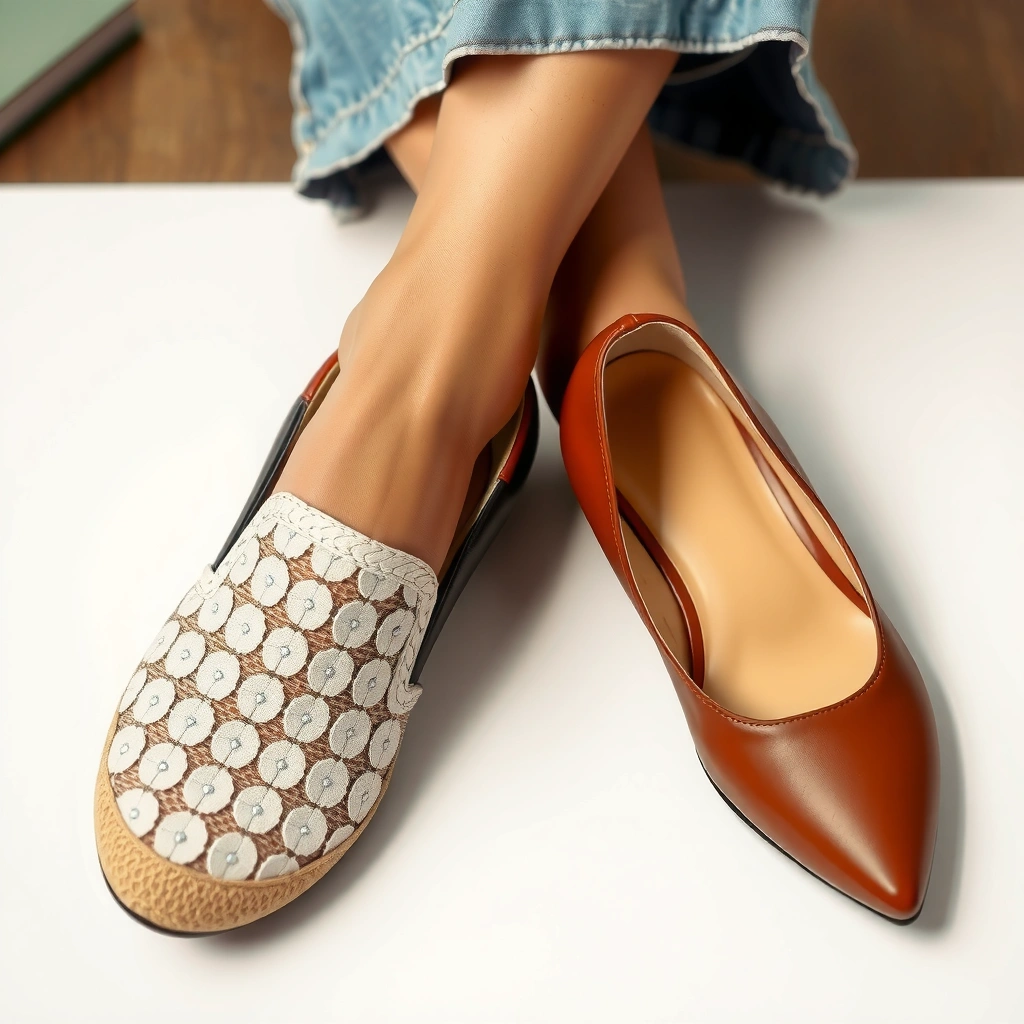
Pick one work-appropriate shoe that matches your dress code and one dressier option you can wear beyond “special occasion.” This section is about building range without duplicating function—so you can get dressed fast when your calendar is busy.
For office wear, loafers and low-heel shoes work best when the shoe’s heel counter and outsole are stable enough for commuting and standing.
Everyday pumps (or block-heel alternatives) should allow a normal stride; discomfort usually shows up in pressure points and reduced stability.
An ankle boot is often the “bridge” shoe because it pairs easily with both casual and business-casual outfits in transitional weather.
Work: loafers or low-heel options that don’t fight you
Your work shoe should handle two realities:
– Standing and walking between meetings, parking, or commuting.
– Dress code expectations (materials, toe shape, and overall polish).
Practical shopping cues:
– Sole stability: a firm outsole reduces wobble.
– Underfoot support: cushioning helps, but so does arch geometry.
– No “pinch points”: if the vamp (front upper) presses on your foot, you’ll feel it by mid-day.
Dressy: one stable option, not a closet of “one-night shoes”
A common mistake is buying pumps that feel “almost okay” for short events but become a problem for longer nights. Instead:
– Choose a wearable heel height you can walk in smoothly.
– Prefer designs with a more secure platform or block heel if you’re not confident in a slender stiletto.
Boots: the easiest upgrade path
If you want one shoe that shifts outfits from casual to polished:
– Start with a simple ankle boot in a neutral (black, dark brown, or a seasonal neutral).
– Match the boot to your climate—more weatherproof upper materials for wet/windy regions; lighter options for mild winters.
Weather-proof staples: sandals + rain/winter solutions
Choose weather shoes that match the conditions you actually face—because no essential set is complete without a plan for heat, rain, snow/ice, or all three. If you only add one more pair after the core five, make it your weather solution.
Moisture-friendly uppers and traction-focused outsoles reduce discomfort and slipping risk when conditions are wet.
In hot weather, breathable sandals still need stability and underfoot support to prevent fatigue during repeated walking.
For cold and icy conditions, grip (traction) and a suitable outsole pattern are as important as insulation for safe footing.
Sandals: supportive enough for regular wear
“Everyday sandal” doesn’t mean flimsy:
– Look for a secure fit (adjustable straps can be a game changer).
– Prioritize arch support and cushioning, especially if you walk more than you sit.
– Choose a sole that feels stable when you step off curbs or walk on uneven pavement.
Rain/wet solution: moisture control + traction
Rain days expose weaknesses fast:
– Upper materials that repel water (or dry quickly) help.
– Outsole traction matters most—especially on slick sidewalks and indoor surfaces.
If your current sneaker isn’t built for wet weather, boots or water-tolerant shoes can prevent repeated misery.
Winter plan: grip, coverage, and fit
For snow/ice or extended cold:
– Prioritize outsole grip and a secure fit (so your foot doesn’t slide).
– Consider insulation where appropriate, but don’t oversize—extra space can reduce stability.
Data anchor (size increments): According to [ADD: source for shoe-size increment conversions], half-size steps in many systems correspond to a small but meaningful change in last length (commonly ~4–5 mm), which can affect toe comfort. [ADD: source for shoe-size increment (mm) vs half-size]
How to choose the right fit (so they stay in rotation)
The right fit is what turns “essential” into “actually worn,” because shoes that slip, pinch, or fatigue your feet don’t stay in rotation. Use measurements, check fit during real walking, and adjust for how different materials behave.
Because different brands use different lasts and toe-box shapes, shoe sizing “true to size” can be model-dependent.
Heel slip, toe crowding, and arch discomfort are among the most common fit problems that show up after walking rather than standing.
If you’re between sizes, your safest choice depends on construction: structured uppers often need the right size, while stretchy materials can offer more adaptability.
Step 1: measure your feet (and use size charts)
– Measure length and width when your feet are at a typical daytime size.
– Then follow each brand’s size chart, not a generic “you’re a 7” rule.
– Remember: “size” is not only length—it’s also width and toe-room geometry.
Data anchor (why charts matter): According to ISO 9407 (shoe sizing system), shoe size uses last measurements that can vary by manufacturer construction. [ADD: ISO 9407 or equivalent official standard source]
Step 2: test fit through real movement
Check for:
– Heel slip: if your heel lifts when you walk, you’ll likely develop blisters or toe gripping.
– Toe crowding: if your toes feel compressed in the first minutes, they’ll feel worse after longer wear.
– Arch comfort: if your arch feels unsupported, you’ll feel fatigue even with soft padding.
Data anchor (common issue categories): According to [ADD: podiatry or orthotics guidance source], common shoe-fit issues include heel slippage, pressure points, and reduced comfort from poor arch support. [ADD: source for common footwear fit issues]
Step 3: between-sizes strategy
If you’re between sizes:
– For rigid uppers (often leather or structured synthetic), you usually need the closer-to-correct size.
– For stretchy uppers (some knit styles), you may have a little flexibility—though it can also worsen heel slip if the shoe relies on a tight fit.
Data anchor (half-size impact): If half sizes differ by ~4–5 mm in length, that’s enough to change toe comfort for some feet. [ADD: source for half-size mm difference]
What can go wrong (and how to avoid it)
The fastest way to waste money is to buy “the look” without solving a function—comfort, security, dress code, or weather. If you avoid a few common traps, your essential set stays useful all year.
If a shoe is stylish but unstable or unsupported, you’ll gradually stop wearing it—turning “essential” into “storage.”
Owning multiple near-identical shoes (same use-case, same height, same toe shape) increases clutter without increasing wardrobe coverage.
Ignoring dress-code constraints forces repeat use of the same shoes, which increases wear, discomfort, and replacement frequency.
Pros/cons: building an essentials set vs. buying duplicates
| Approach | Pros | Cons |
|---|---|---|
| Essentials (5–6 core pairs) | Higher repeat wear, faster outfit decisions, fewer fit failures | May need 1–2 “gap” pairs for your specific events or routines |
| Duplicates (near-identical pairs) | Looks more varied in the closet | Lower true coverage, more clutter, and more money tied to shoes you rarely wear |
The four mistakes to avoid
– Buying for appearance, not function: stylish sneakers without traction or support often get skipped.
– Overlapping too much: three similar flats/sneakers don’t replace the missing category (like work-ready or weather).
– Ignoring your dress codes: if your workplace is business-casual and you buy only sneakers, you’ll default to one worn-out pair.
– Assuming one size fits all: even within a brand, model-to-model differences come from toe shape and materials.
Who should skip this approach
If you have unique medical needs (e.g., orthotic prescriptions, severe instability, or post-surgical restrictions), your essentials should be built with a clinician’s guidance first. In those cases, “average” shoe categories may not match your required support and may not be safe.
Quick checklist, FAQ, and sources
Use this checklist as a scanning tool before you buy anything new. The goal is to identify what’s missing—not to replace what’s already working.
A practical essentials list reduces decision fatigue by matching shoes to specific wardrobe problems: comfort, work polish, dressing up, and weather.
When you fill gaps one at a time (gym/commute/formal), you avoid duplicate purchases that don’t increase real outfit coverage.
Save this quick checklist (scan before you buy):
– [ ] 1 everyday sneaker (comfort + traction)
– [ ] 1 walkable flat (secure fit)
– [ ] 1 work-ready shoe (loafer or low-heel)
– [ ] 1 dressier option (pump or nicer sandal)
– [ ] 1 weather shoe (boots or warm-weather sandals)
– [ ] 1 “gap” shoe for your life (gym, commute, formal events, etc.)
FAQ
– How many pairs should every woman own?
Start with the essentials above (usually 5–6 core pairs), then add 1–3 based on your lifestyle and climate. [ADD: source for recommended “capsule” shoe counts, if you want to cite one]
– Do I really need both flats and loafers?
Usually you need one true “day” option and one “work” option; whether that’s flats+loafers (or one replaced by the other) depends on your schedule and dress code.
– What heel height is best for everyday wear?
Choose a height you can stand and walk in comfortably without changing your stride. If you’re unsure, stick to lower heels or block heels. [ADD: source for heel comfort/height guidance]
– Should I buy true to size or size up?
Follow the brand’s size chart and measure your foot; model differences can mean you shouldn’t assume “true size” without checking the specific fit for that shoe. [ADD: source for using size charts]
– How often should I replace shoes?
Replace when cushioning, support, or traction becomes noticeably worse—especially for sneakers and weather shoes. [ADD: source for replacement indicators]
Sources (primary/official where possible)
– [ADD: source for measuring feet and using shoe size charts accurately—official or reputable sizing guidance]
– [ADD: source for common footwear fit issues (heel slip, toe crowding) and fitting best practices]
– [ADD: source for heel/comfort guidance (e.g., podiatry or manufacturer fitting guidance)]
– Manufacturer size charts and product care/fit notes for the specific brands you reference in your shoe list (primary source: each brand’s official site)
If you want your shoe closet to work for you, don’t chase trends—start with a small set that covers comfort, dress codes, and weather. Begin with the essential pairs (sneaker, flat, work option, dressier shoe, and weather solution), then add only what’s missing for your real routine. If you want, make a quick inventory of what you already own and use the checklist above to spot your gaps—then fill them one by one.
Frequently Asked Questions
What shoes should every woman own for everyday wear?
Every woman should own a comfortable pair of everyday sneakers (like low-profile white or neutral trainers), a versatile flat such as ballet flats or loafers, and a classic boot or ankle boot for cooler days. Add a simple sandal or slide for warm weather and a crossbody-ready option like a low heel or block-heel shoe for casual outings. Choosing neutral colors and supportive insoles makes these women’s shoes wearable across multiple outfits.
How do I choose the right everyday sneaker for comfort and support?
Look for cushioning in the midsole, good arch support, and a breathable upper to keep your feet comfortable all day. If you stand or walk a lot, prioritize stable heel support and a flexible toe box to prevent discomfort and blisters. For the best fit, measure your foot size, consider half sizes, and test with the socks you’ll actually wear.
Why should every woman own at least one pair of flats?
Flats are essential women’s shoes when you want style without sacrificing comfort, especially during errands, travel, or long workdays. A quality flat with a supportive insole and non-slip outsole helps you avoid foot fatigue and slipping. Ballet flats, loafers, and pointed flats are popular choices because they pair easily with jeans, dresses, and workwear.
What are the best shoes to own for work and professional settings?
For professional settings, own a pair of classic pumps or low block heels and a sleek leather loafer or dress flat for days when you need comfort. If you commute or spend time standing, choose shoes with cushioned insoles and a stable heel height to balance support and polish. Neutral shades like black, navy, nude, and brown make it easy to match with most work outfits.
Which boots should I buy if I want one go-to pair that works year-round?
If you want one pair of boots, choose an ankle boot or mid-calf boot with a comfortable heel and a non-slip sole for everyday wear. Look for a shaft height that fits easily with jeans and tights, plus a flexible upper if you have wider calves. A simple color like black or taupe is the most versatile option, making these women’s boots your reliable fall and winter staple.
📅 Last Updated: October 12, 2026 | Topic: What Shoes Should Every Woman Own? | Content verified for accuracy and freshness.