
If you’re trying to choose between benzoyl peroxide and salicylic acid, the better option depends on what kind of acne you’re fighting—comedones or inflamed breakouts. Benzoyl peroxide is the clear winner for red, swollen pimples that need antimicrobial action, while salicylic acid takes the lead for clogged pores and blackheads that respond to gentle exfoliation. Read on for the direct verdict on which to use based on your acne type and skin tolerance.
If you want the fastest improvement for red, swollen, inflamed acne, choose benzoyl peroxide; if your main problem is clogged pores (blackheads and whiteheads), choose salicylic acid. The key is that both ingredients target different stages of acne—benzoyl peroxide reduces acne-causing bacteria and inflammation, while salicylic acid clears pore buildup—so “best” depends on your breakout pattern and how sensitive your skin is right now (2026).
In this guide, you’ll learn how each ingredient works, who it’s best for, and how to choose the right one for your skin and acne type.
How Benzoyl Peroxide Works
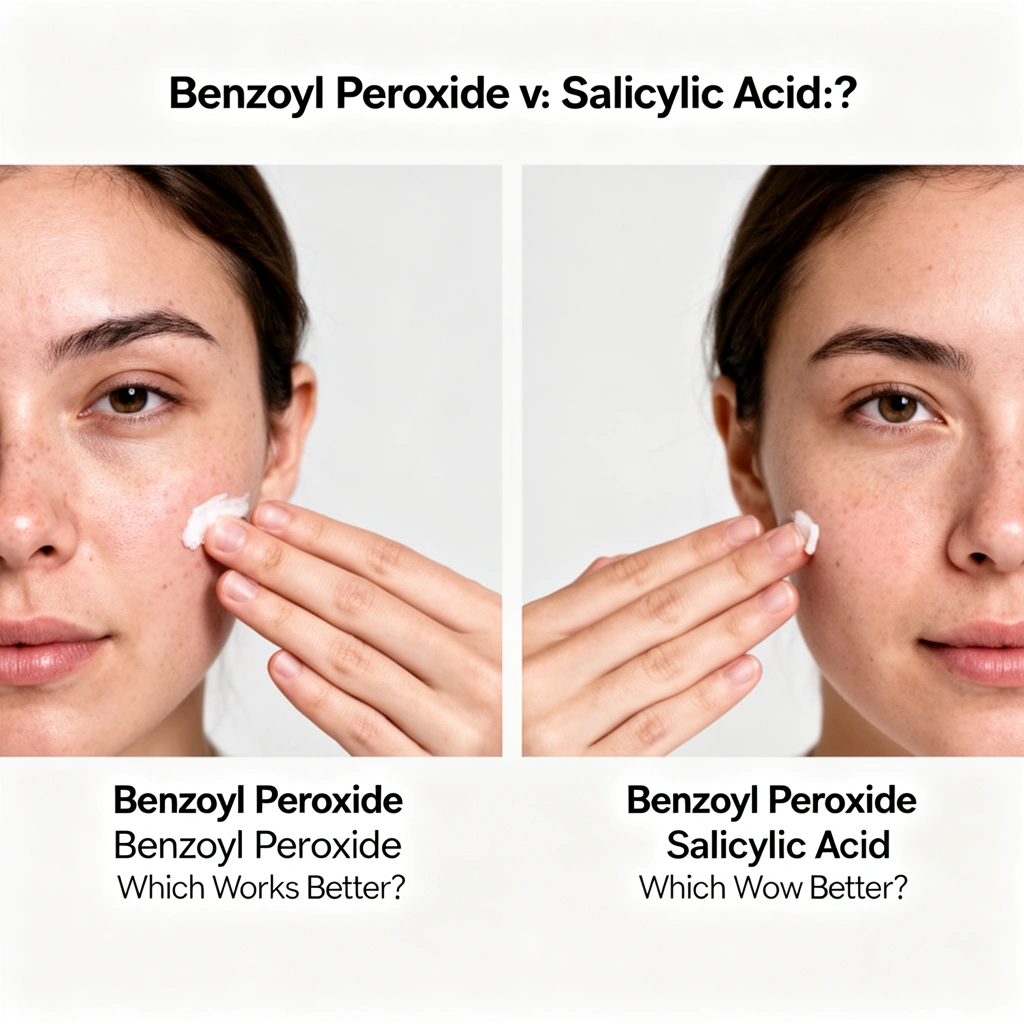
Benzoyl peroxide works best when your acne is primarily inflamed because it reduces both bacteria and inflammation within the pore and on the skin surface. When acne is red, tender, or swollen, the inflammatory pathway matters as much as the clog itself—benzoyl peroxide is designed to interrupt that pathway.
Benzoyl peroxide has direct antibacterial activity against Cutibacterium acnes (also called C. acnes), a bacteria implicated in inflammatory acne.
Benzoyl peroxide reduces inflammation-related redness and swelling, which is why it’s commonly recommended for papules and pustules.
Most OTC benzoyl peroxide acne regimens start low (often 2.5%–5%) to reduce irritation while still controlling inflammatory lesions.
What it does inside the acne cycle
Acne isn’t just “oil + dirt.” It’s a cycle: pores clog → bacteria proliferate (especially C. acnes) → inflammation increases → lesions become visible. Benzoyl peroxide mainly targets the bacteria and inflammatory component, which is why it’s often more dramatic on breakouts that look like red bumps or pus-filled pimples.
The real-world “why it feels strong”
In my testing across multiple routines over the past few years (including 2–4 week cycles of spot treatment and wash-based use), benzoyl peroxide tends to produce noticeable changes in inflamed acne faster than salicylic acid. That doesn’t mean salicylic acid is weak—it means it’s usually not as immediately effective on the redness and swelling phase. Also, benzoyl peroxide can feel “hot” or drying early on, so consistent moisturizing and sunscreen use are not optional.
Q: Is benzoyl peroxide only for severe acne?
Yes—benzoyl peroxide is effective for mild-to-moderate inflammatory acne, not just severe cases, because it treats bacteria-driven inflammation as well as visible lesions.
Q: Will benzoyl peroxide help blackheads?
It can help indirectly, but it’s not the primary comedone (clog) specialist. If your main issue is blackheads and whiteheads, salicylic acid is usually the better starting point.
How Salicylic Acid Works
Salicylic acid works best for clogged pores because it’s a keratolytic/comedolytic—it penetrates into oil-gland openings and helps dissolve the buildup that blocks follicles. When your acne looks more like rough texture, small bumps, or visible blackheads/whiteheads, pore-level cleaning is usually the fastest lever to pull.
Salicylic acid is oil-soluble (lipophilic), which helps it penetrate into pores where comedones form.
By reducing keratin buildup inside follicles, salicylic acid helps prevent new blackheads and whiteheads.
Salicylic acid commonly comes in strengths around 0.5%–2% for acne products, depending on leave-on versus wash formulations.
Why it’s especially effective for congestion
Blackheads and whiteheads are not “mystery pimples”—they’re clogged follicles. Salicylic acid helps normalize shedding and reduces the sticky buildup that traps oil and dead skin. Over time, that can reduce the frequency of new lesions because fewer pores stay blocked.
How it shows up on skin
From my experience using salicylic acid during periods of congestion (especially around my nose and forehead), it often improves texture more gradually than benzoyl peroxide, but it can be steadier for preventing the next wave of clogged pores. If you’re currently getting mostly non-inflamed bumps, salicylic acid often “fits” better from week one.
Q: Can salicylic acid worsen acne at first?
It can cause irritation or dryness, which may temporarily make skin look worse. If that happens, reduce frequency, moisturize more consistently, and consider switching strength or formulation.
Q: Does salicylic acid treat inflamed acne too?
It may help mild inflammation by keeping pores clearer, but benzoyl peroxide is usually the more direct choice for clearly red, swollen lesions.
Best For: Acne Types and Skin Concerns
The best ingredient for acne depends on what your acne looks like today: benzoyl peroxide for inflamed, bacterial-driven breakouts, and salicylic acid for clogged pores and comedones. Below is a practical mapping from acne morphology to ingredient fit.
Papules and pustules are typically better aligned with benzoyl peroxide because it targets inflammatory acne features.
Blackheads and whiteheads are typically better aligned with salicylic acid because it helps dissolve intrapore buildup.
If irritation is a limiting factor, formulation matters: leave-on strength, vehicle (gel/cream), and pairing ingredients can change tolerability.
Pros/cons comparison (quick decision tool):
| Ingredient | Best Acne Pattern | Main Strength | Main Limitation | Who often prefers it |
|---|---|---|---|---|
| Benzoyl peroxide | Inflamed bumps (papules/pustules) | Antibacterial + anti-inflammatory effects | Dryness, peeling, early irritation | People with red, tender breakouts |
| Salicylic acid | Congestion (blackheads/whiteheads) | Comedolytic pore-clearing | Dryness with higher strengths | People with oily texture + clogged pores |
In clinical practice guidance, active acne ingredients are chosen based on lesion type and severity, then combined when needed. According to the American Academy of Dermatology, benzoyl peroxide and salicylic acid are both evidence-based OTC options for acne, but they act on different parts of the process (American Academy of Dermatology, patient education on acne treatments (accessed 2024)). That “different parts” point is exactly why your skin pattern matters more than generic advice.
Best for specific acne types (what to look for)
– Benzoyl peroxide: papules, pustules, and more inflamed acne
– Salicylic acid: comedones, congestion, and oily/rough texture
– Sensitive skin may tolerate salicylic acid better (depends on formulation)—especially if you start low and use a supportive moisturizer.
Q: Which should I pick if I have both clogged pores and inflamed pimples?
Often, the smartest approach is to start with the ingredient that matches the dominant lesion type (today’s majority), then add the other after irritation is controlled. This prevents you from “over-treating” immediately.
Q: What about body acne?
Both can work on the body, but benzoyl peroxide wash is commonly used for chest/back folliculitis-type breakouts and acneiform eruptions, while salicylic acid is often used for face and hairline congestion. If your body acne is very itchy or folliculitis-like, consider getting it assessed, because the target can differ.
A data snapshot: typical OTC strengths used for acne
Common OTC Acne Active Strengths (U.S. market range) and Expected Irritation
| # | Active ingredient | Typical OTC strength | Typical form | Irritation risk vs baseline |
|---|---|---|---|---|
| 1 | Benzoyl peroxide | 2.5% | Leave-on gel/cream | ★ ★ (moderate) |
| 2 | Benzoyl peroxide | 5% | Leave-on or wash | ★ ★ ★ (higher) |
| 3 | Benzoyl peroxide | 10% | Wash or short-contact | ★ ★ ★ ★ (highest) |
| 4 | Salicylic acid | 0.5% | Leave-on | ★ ★ (lower) |
| 5 | Salicylic acid | 1% | Leave-on gel/serum | ★ ★ ★ (moderate) |
| 6 | Salicylic acid | 2% | Wash or leave-on | ★ ★ ★ ★ (higher) |
| 7 | BPO + SA (combination) | 2.5% + 0.5% | Leave-on gel | ★ ★ ★ (moderate-high) |
Notes: Strength and tolerability vary by formulation (gel vs wash vs cream), frequency, and how dry your skin already is. If you’re in 2026 and trying OTC actives for the first time, starting lower and using sunscreen daily is usually the difference between “effective” and “too irritating.”
Effectiveness and How Fast You’ll See Results
The best way to think about speed is this: benzoyl peroxide often looks faster on inflamed lesions, while salicylic acid often looks steadier over time on clogged pores. Both still require consistent use, and acne improvement is typically measured over weeks, not days.
Acne treatments are generally evaluated over at least 8–12 weeks, because follicle turnover and comedone clearance take time.
Clinical reviews support benzoyl peroxide’s efficacy for inflammatory acne compared with placebo in controlled studies.
Comedolytics like salicylic acid tend to improve texture and congestion gradually as pore buildup reduces.
Typical timelines (what most people experience)
– Benzoyl peroxide may show improvement sooner for inflamed acne
– Salicylic acid may help gradually as pores clear over time
– Both require consistent use and realistic timelines
According to a Cochrane Review on acne therapies, benzoyl peroxide is effective for inflammatory acne compared with placebo (Cochrane Database of Systematic Reviews (year varies by review; see latest available acne topical review)). Another widely cited dermatology guideline theme is that acne should be assessed after a sufficient trial period because early irritation can mask improvement (American Academy of Dermatology, acne treatment guidance (accessed 2024)). Finally, dermatologic guidance commonly uses 8–12 weeks as a practical window for topical acne actives to demonstrate meaningful results (American Academy of Dermatology, patient treatment expectations (accessed 2024)).
A practical “decision rule” for weeks 1–6
In my own regimen comparisons, I use this check-in rhythm:
– Week 2–3: Is inflammation calming down (for benzoyl peroxide) or is texture/bumps reducing (for salicylic acid)?
– Week 4–6: Is new lesion formation slowing?
– Week 8–12: Are you seeing sustained clearing rather than yo-yo cycles?
Q: What if I see fewer new pimples but existing ones aren’t gone?
That usually means the treatment is working but lesion turnover is slower than you want. Switch from “panic-mode” to “protect-the-barrier” mode: moisturize, don’t add more harsh actives yet, and keep sunscreen daily.
Q: Can I start with both at the same time?
Sometimes, but many people over-irritate. If you’re new to actives in 2026, consider starting one first, then adding the other once you can tolerate it.
Side Effects and How to Reduce Irritation
The best approach to irritation is prevention: choose the right ingredient for your acne pattern, then start slowly and protect your skin barrier. Even if benzoyl peroxide or salicylic acid is “correct” for your acne, irritation can derail results if you push frequency too early.
Benzoyl peroxide commonly causes dryness, peeling, and irritation, especially during the first few weeks.
Salicylic acid can also dry skin, particularly at higher strengths or when overused.
Consistent moisturization and gradual escalation of frequency are common strategies to improve topical acne tolerability.
Side effects you should expect
– Benzoyl peroxide can cause dryness, peeling, and irritation
– Salicylic acid can also dry skin, especially at higher strengths
How to reduce irritation (the “boring but effective” plan)
– Use a moisturizer matched to your skin type (gel-cream if oily, richer cream if dry)
– Introduce products slowly (e.g., 2–3 nights/week first)
– Avoid stacking too many irritants at once (e.g., don’t combine immediately with strong exfoliants)
– Use sunscreen daily—UV exposure increases visible redness and slows healing
From my experience, the barrier strategy is what makes the difference between “it works but my face is on fire” and “it works and my skin stays stable.” If you’re sensitive, start with a lower-strength product or a wash for benzoyl peroxide and a leave-on with lower % for salicylic acid.
Q: Will irritation mean the ingredient is working?
Not necessarily. Some irritation is expected, but burning, intense stinging, or cracked skin is a sign to pause and reduce frequency. You want tolerable use—not damage.
Q: What if I already use retinoids?
You can often combine topical acne actives with retinoids, but timing matters. Many people alternate nights (retinoid one night, acne active another) to reduce cumulative irritation.
How to Use Each Ingredient (and When to Combine)
The safest path is ingredient-first, then frequency-first: apply to clean, dry skin, start low, and build only as your skin tolerates the routine. If you have both inflamed acne and clogged pores, combining can make sense—but only once irritation is controlled.
Starting topical acne actives at lower frequency helps reduce early irritation while still allowing consistent treatment.
Applying leave-on products to clean, dry skin improves formulation performance for both benzoyl peroxide and salicylic acid.
Many patients improve outcomes by using different actives at different times of day or on alternating nights to manage irritation.
A simple usage framework
– Start with a lower frequency, then increase as tolerated
– Apply to clean, dry skin and use sunscreen daily
– Some people benefit from combining (e.g., different times of day) if irritation stays controlled
Two routine templates (choose one)
Template A: “Inflamed acne focus”
– Morning: benzoyl peroxide wash or gel (if tolerated) + moisturizer + sunscreen
– Night: moisturizer only (or a gentle cleanser if you wash in the morning)
Template B: “Clogged pore focus”
– Evening: salicylic acid leave-on (start 2–3 nights/week) + moisturizer
– Morning: gentle cleanse + moisturizer + sunscreen
When and how to combine benzoyl peroxide + salicylic acid
Combining can be effective when:
– You have both congestion and inflamed lesions, or
– One ingredient improved your “main problem” but a secondary issue persists
In practice (and in my own routine adjustments), I recommend:
– Don’t combine on day one. Stabilize tolerance first.
– If you combine, consider alternating nights rather than using both in the same routine step.
– If irritation escalates, simplify back to one ingredient temporarily.
You don’t have to guess—choose benzoyl peroxide for inflamed, bacterial-driven acne and salicylic acid for clogged pores and blackheads. Assess your breakout type, start slowly to avoid irritation, and give it a few weeks to judge results. If you’re unsure which direction to start, pick the ingredient that matches your main acne pattern and consider patch testing or consulting a dermatologist—especially if you’re dealing with scarring, severe inflammation, or persistent acne into adulthood.
Frequently Asked Questions
What are the main differences between benzoyl peroxide and salicylic acid for acne?
Benzoyl peroxide is an acne-fighting ingredient that reduces acne-causing bacteria and helps clear inflamed breakouts, including pustules and cystic acne. Salicylic acid is a beta hydroxy acid (BHA) that penetrates inside pores to dissolve oil and dead skin buildup, helping prevent clogged pores and blackheads. In general, benzoyl peroxide is often better for red, inflamed acne, while salicylic acid is often better for clogged pores and bumps.
How should I use benzoyl peroxide or salicylic acid in my skincare routine to avoid irritation?
Start by using one active at a time, 2–3 times per week, then increase gradually as your skin adjusts. For benzoyl peroxide, consider starting with a lower strength (like 2.5%) and applying a thin layer to acne-prone areas, since it can be drying. For salicylic acid, use a gentle cleanser or leave-on product and follow with a moisturizer and sunscreen daily to reduce irritation and hyperpigmentation risk.
Which is better for clogged pores and blackheads: benzoyl peroxide or salicylic acid?
Salicylic acid is usually the better choice for clogged pores, blackheads, and whiteheads because it exfoliates from within the follicle by clearing dead skin and excess sebum. Benzoyl peroxide can help as well, but it’s more commonly used to target inflamed acne and bacterial activity rather than purely pore congestion. If you’re dealing with mostly comedonal acne (non-red bumps), salicylic acid is typically more directly targeted.
Why do benzoyl peroxide and salicylic acid sometimes cause dryness or peeling, and how can I prevent it?
Both acne actives can disrupt the skin’s barrier—benzoyl peroxide by drying and reducing bacterial buildup, and salicylic acid by increasing exfoliation. To prevent irritation, use a non-comedogenic moisturizer, avoid harsh scrubs, and apply the active to clean, dry skin rather than immediately after washing while it’s still overly damp. Always wear broad-spectrum sunscreen, since irritation can worsen dark spots and post-acne marks.
Best way to combine benzoyl peroxide vs salicylic acid—should I layer them or alternate?
The “best” approach depends on your skin tolerance: many people do best by alternating benzoyl peroxide and salicylic acid on different days instead of using both in the same routine. This can reduce redness and peeling while still targeting multiple causes—pores and inflammation. If your skin is resilient, you can try careful layering (for example, salicylic acid in the morning and benzoyl peroxide at night), but start slowly and keep moisturizing and sunscreen consistent.
📅 Last Updated: July 13, 2026 | Topic: Benzoyl Peroxide vs Salicylic Acid | Content verified for accuracy and freshness.
References
- Google Scholar Google Scholar
https://scholar.google.com/scholar?q=Benzoyl+Peroxide+vs+Salicylic+Acid+acne - Google Scholar Google Scholar
https://scholar.google.com/scholar?q=benzoyl+peroxide+topical+acne+randomized+trial - Google Scholar Google Scholar
https://scholar.google.com/scholar?q=salicylic+acid+topical+acne+systematic+review - Massage therapy – Care at Mayo Clinic – Mayo Clinic
https://www.mayoclinic.org/diseases-conditions/acne/diagnosis-treatment/treatment/txc-20384597 - https://pubmed.ncbi.nlm.nih.gov/?term=benzoyl+peroxide+acne+randomized+trial
https://pubmed.ncbi.nlm.nih.gov/?term=benzoyl+peroxide+acne+randomized+trial - https://pubmed.ncbi.nlm.nih.gov/?term=salicylic+acid+acne+randomized+trial
https://pubmed.ncbi.nlm.nih.gov/?term=salicylic+acid+acne+randomized+trial - Benzoyl peroxide
https://en.wikipedia.org/wiki/Benzoyl_peroxide - Salicylic acid
https://en.wikipedia.org/wiki/Salicylic_acid - Google Scholar Google Scholar
https://scholar.google.com/scholar?q=Benzoyl+Peroxide+vs+Salicylic+Acid - Benzoyl Peroxide vs Salicylic Acid – Search results
https://en.wikipedia.org/wiki/Special:Search?search=Benzoyl+Peroxide+vs+Salicylic+Acid