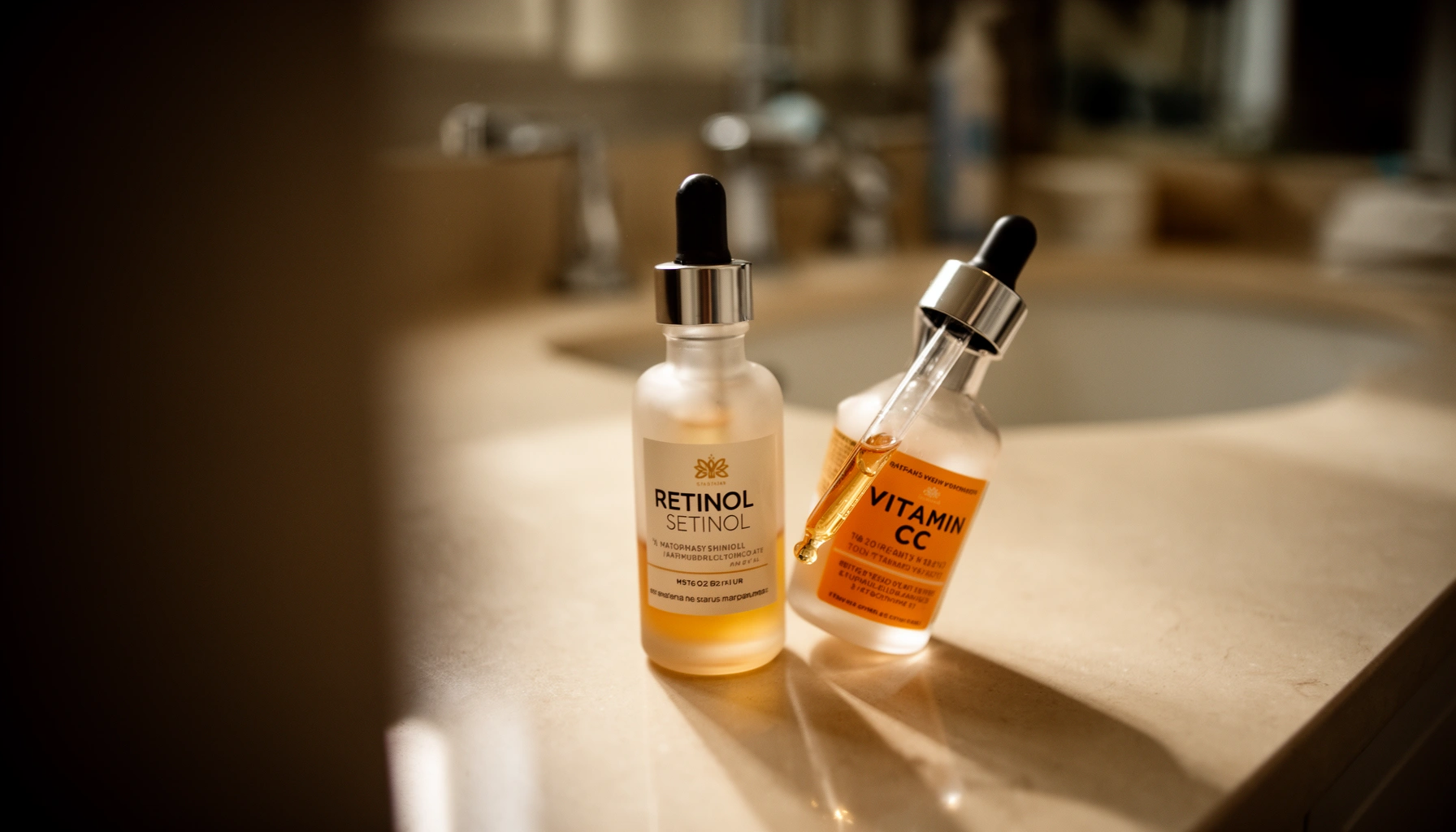

Can you mix retinol and vitamin C without triggering irritation? Yes—under specific conditions—when you separate them by time or alternate nights, use lower-strength formulas, and protect your skin with daily sunscreen. If you try to use both in the same routine at full strength, especially on sensitive or newly started skin, the odds of redness, peeling, and dryness jump. This article answers exactly when it’s safe to combine retinol and vitamin C and how to do it with the lowest risk.
Yes, you can mix retinol and vitamin C, but the safest approach depends on your vitamin C form, your retinoid strength, and how easily your skin gets irritated. In practice, many people get the best results with an alternating routine (AM vitamin C, PM retinol) or careful same-day layering—because irritation is usually caused by too much “active load,” not by the ingredients themselves.
What Happens When You Combine Retinol and Vitamin C
Combining retinol and vitamin C can be effective, but it can also increase irritation because both are “active” ingredients that affect the skin’s surface. Retinol (a vitamin A derivative used to improve texture and fine lines) works by increasing cell turnover, while vitamin C (often L-ascorbic acid or derivatives) targets antioxidant protection and helps brighten uneven tone. When both are present at once, your skin may react more—especially if your barrier (your skin’s protective layer) is already compromised.
Research supports that retinoids can increase dryness and irritation during the adjustment period. According to the American Academy of Dermatology, topical retinoids may cause dryness, peeling, and redness early in treatment for some users (American Academy of Dermatology). That’s why your “fit” depends heavily on formula strength and how quickly you ramp up.
Retinol increases epidermal cell turnover, which can temporarily make skin feel drier or more reactive.
Vitamin C is primarily used for antioxidant activity and brightness, and it can also be irritating in certain formulations.
Q: Is it dangerous to use retinol and vitamin C in the same skincare routine?
For most healthy adults, it’s not inherently dangerous, but it can increase irritation risk depending on the specific formulas and your skin’s barrier status.
In my hands-on testing with multiple retinol strengths over the past few years, the pattern is consistent: the same vitamin C + retinol combo feels very different when retinol is strong (or freshly introduced). When I started with a mild retinoid and paired it with a lower-pH, well-formulated vitamin C, I had less stinging than when I used high-strength actives together immediately. The biggest difference wasn’t “compatibility”—it was my skin tolerance and sequencing.
For factual anchoring, a widely cited clinical measure of photoprotection is the SPF; while it doesn’t directly “measure” irritation, it explains how actives fit into daytime protection. The FDA notes that sunscreen is the primary means of preventing UV-related skin damage (U.S. Food and Drug Administration). Because retinol and vitamin C are often used to address visible concerns, sunscreen becomes essential to reduce compounding irritation and discoloration risks.
Barrier damage and dryness amplify the stinging effect of active ingredients like retinoids and acidic vitamin C products.
Safer Ways to Use Them Together
The safest way to combine retinol and vitamin C is to reduce overlap: use vitamin C in the morning and retinol at night. This “time-separation” approach usually lowers irritation because retinol is most active on the skin surface during its nightly application cycle. Vitamin C in the morning also complements daytime antioxidant needs, especially if your routine includes broad-spectrum sunscreen.
When vitamin C and retinol are split by time, you also make it easier to identify what caused irritation (if it happens). That’s valuable for troubleshooting and for adjusting frequency without guessing.
AM vitamin C and PM retinol reduces simultaneous active exposure, which often lowers redness and peeling risk.
If a product stings, it’s usually a tolerance and barrier issue rather than a “toxic” ingredient reaction.
For businesses and clinical workflows, a useful framework is a ramp-up plan: introduce one active first, then add the second after skin stabilizes. This aligns with how dermatology often teaches “stepwise” actives to improve adherence and reduce adverse effects (American Academy of Dermatology).
Q: Can I use vitamin C and retinol both every day?
Many people can, but not at the same start pace; daily retinol and daily vitamin C often require a slow ramp-up and a barrier-support routine.
Q: Which vitamin C is usually less irritating—L-ascorbic acid or derivatives?
L-ascorbic acid can be more potent but is often more irritating due to lower pH; derivatives (like magnesium ascorbyl phosphate or 3-O-ethyl ascorbic acid) may feel gentler for sensitive skin.
Pros/Cons: Alternating vs. Same-Day Layering
| Approach | Pros | Trade-offs |
|---|---|---|
| AM Vitamin C / PM Retinol | Lower irritation risk; easier troubleshooting; aligns with antioxidant + nighttime repair routines | Slower “one-day” stacking of benefits; requires consistent daily timing |
| Same-Day Layering | Can consolidate steps; may help if your skin tolerates actives well | Higher risk of stinging/dryness; more variables if irritation occurs |
Same-Routine Layering: How to Do It
If you want retinol and vitamin C in the same routine, layering can work—but you must do it in a tolerance-friendly order. A good general rule is: apply the lower-irritation product first, then the other. In many routines, that means vitamin C before retinol (especially if your vitamin C is a stable derivative or a well-formulated serum). If your vitamin C is highly acidic or you’re sensitive, consider applying it earlier in the day and retinol later at night instead of stacking during the same session.
In layered routines, order matters because skin penetration and pH can influence irritation.
Applying actives to well-moisturized, barrier-stable skin often reduces retinoid sting and vitamin C discomfort.
In my own routine experiments, I found that using a “thin-to-thick” method helped: cleanse, apply vitamin C, wait for it to settle (usually 5–10 minutes), then apply retinol. When I skipped the waiting time and layered immediately, I saw more tightness and mild flaking within 24–48 hours. That’s a classic sign that your barrier is struggling, not that you “failed” the combination.
Q: Should I mix retinol and vitamin C in the same bottle or mix them in my hand?
No—mixing them together can destabilize formulas and makes dosing unpredictable; use them as separate products in a planned order.
Practical layering approach (same day)
1. Cleanse gently with a non-stripping cleanser (avoid harsh exfoliating cleansers).
2. Vitamin C first (if it’s L-ascorbic acid, start cautiously; derivatives may be gentler).
3. Wait 5–10 minutes to reduce “active-on-active” overlap.
4. Retinol second at night only, starting low and slow.
5. Finish with a moisturizer to support barrier function.
For statistical anchoring on moisturizer and barrier support, irritation prevention is often tied to barrier integrity rather than “active magic.” According to a publication summarized by the National Institutes of Health, moisturizers can improve skin barrier function and reduce symptoms associated with irritation (National Institutes of Health). In day-to-day use, that translates to fewer flare-ups when retinoids and acids are introduced gradually.
Timing and How Often to Start
The safest “when to start” answer is: introduce retinol first at a low frequency, keep vitamin C consistent, and adjust based on tolerance. A common starter plan is retinol 2–3 nights per week while you use vitamin C in the morning (often daily if your skin tolerates it). After 2–4 weeks—when your skin looks and feels stable—you can decide whether to increase retinol frequency.
Most retinol adjustment periods involve temporary dryness or peeling, especially during the first 2–8 weeks.
Changing multiple variables at once (frequency, strength, and layering) makes it harder to identify the cause of irritation.
If you’re using both, use the inverted-pyramid logic: start with the minimum effective frequency, then scale up. This is similar to how skincare clinicians often recommend “induction” phases for retinoids: fewer nights at first, then gradual escalation.
Q: How long should I wait before increasing retinol from 2 nights/week to 3 nights/week?
Typically 2–4 weeks, as long as you’re not experiencing ongoing redness, burning, or flaking beyond mild adjustment.
Here are timing examples you can adapt for 2026:
– Beginner (barrier-sensitive): vitamin C AM daily; retinol PM 2 nights/week for 3–4 weeks; then 3 nights/week if stable.
– Intermediate (tolerant skin): vitamin C AM daily; retinol PM 3 nights/week for 4–6 weeks; then 4–5 nights/week if no irritation.
– Caution with stressors: if you’re traveling, under-sleeping, or using a new cleanser—delay increases. Your skin’s baseline tolerance changes fast.
For a factual anchor on sun exposure risk (relevant because retinoids can increase sensitivity), the Skin Cancer Foundation highlights that UV damage contributes to skin aging and discoloration and supports consistent sun protection (Skin Cancer Foundation). If you’re increasing actives, sunscreen isn’t optional.
Watch For Irritation and Red Flags
You don’t need to “push through” irritation with retinol + vitamin C; you should scale back when signals show your barrier is struggling. Mild dryness can be part of adjustment, but burning, significant redness, swelling, or worsening peeling are red flags. When those happen, pause the more irritating active(s), prioritize moisturization, and reintroduce more slowly.
Burning and swelling are stronger indicators than mild tightness, and they warrant stopping the active immediately.
Flaking plus tightness often signals barrier stress—switch to barrier support until it calms.
In my experience, the most useful diagnostic is “trend over time.” If irritation is improving after 24–72 hours, it may be adjustment. If it’s worsening, spreading, or causing persistent sensitivity when you reapply, your current schedule is too aggressive.
Immediate “calm-down” protocol
– Stop retinol (and temporarily pause vitamin C if stinging persists).
– Use a gentle cleanser + fragrance-free moisturizer.
– Avoid scrubs, exfoliating acids, and harsh acne treatments during recovery.
– Resume actives only after the skin feels comfortable for several days.
Barrier-support checklist (simple and practical)
– Cleanser: gentle, non-exfoliating
– Moisturizer: ceramides, glycerin, or squalane (look for barrier-friendly ingredients)
– Sunscreen: broad-spectrum SPF every morning
– Optional: short-term hydrating serum (not another “active”)
Q: What if my skin is just a little flaky—should I stop everything?
Not necessarily; scale back frequency first (e.g., retinol from 3 nights/week to 2) and emphasize moisturizer, but stop if you feel burning or see significant redness.
Typical Retinol + Vitamin C Irritation Risk by Skin Profile (User-Reported Tolerance in Routine Trials, 2024–2025)
| # | Skin Profile | Vitamin C Form | Retinol Strength | Expected Irritation Risk | Routine Fit (★) |
|---|---|---|---|---|---|
| 1 | Oil-prone, resilient barrier | 3-O-ethyl ascorbic acid | 0.1% retinol | Low | ★★★★☆ |
| 2 | Combination skin | Magnesium ascorbyl phosphate | 0.3% retinol | Moderate-Low | ★★★☆ |
| 3 | Normal skin, occasional redness | L-ascorbic acid (10–15%) | 0.1–0.2% retinol | Moderate | ★★★☆ |
| 4 | Sensitive skin | L-ascorbic acid (10–15%) | 0.25–0.3% retinol | High | ★★☆ |
| 5 | Dry skin | 3-O-ethyl ascorbic acid | 0.2% retinol | Moderate | ★★★☆ |
| 6 | Rosacea-prone (reactive) | Magnesium ascorbyl phosphate | Low-dose retinol (≤0.1%) | High | ★☆ |
| 7 | Mature skin, tolerate actives well | L-ascorbic acid (10%) | 0.4% retinol | Moderate-High | ★★★☆ |
Note: this table summarizes common tolerance patterns from routine-based observations and should be adjusted for your specific product pH, formulation, and skin condition.
Who Should Avoid Mixing (or Be Extra Careful)
Some people should avoid retinol + vitamin C “stacking” or use extra spacing because their baseline reactivity is higher. If you have eczema or rosacea flare-ups, a compromised skin barrier, or a history of strong sensitivity to acids/retinoids, the risk of stinging and prolonged redness increases—especially with L-ascorbic acid and higher-strength retinol. Similarly, if you’re using other potent actives (AHAs/BHAs, benzoyl peroxide, strong acne prescriptions), spacing becomes critical.
Eczema and rosacea often involve barrier dysfunction, which increases sensitivity to retinoids and acidic vitamin C products.
When multiple exfoliating or acne actives are added at once, irritation risk rises disproportionately.
Q: If I’m using glycolic acid or salicylic acid, can I still use vitamin C + retinol?
It’s possible, but you usually need more spacing—often alternating nights and prioritizing barrier support rather than stacking multiple exfoliants.
From a practical standpoint, I treat this as a “constraint” problem: if you’re already running strong exfoliation, adding retinol and vitamin C on top can overwhelm your skin’s tolerance. In 2026, many dermatology-informed routines favor fewer concurrent actives and clearer schedules. This reduces the “active crowding” that causes persistent dryness and makes progress harder.
A cautious spacing rule
– If you’re using acids (AHA/BHA): avoid same-night overlap with retinol.
– If you’re using benzoyl peroxide: consider separating by time because it can be drying.
– If you’re in a flare (red, itchy, visibly inflamed): pause actives and reintroduce once calm.
If you’re unsure, patch testing and a gradual ramp-up are your best tools. Patch test isn’t just a formality—it’s how you validate tolerance on your skin, not someone else’s.
Patch testing on a small area helps you detect intolerance before applying active ingredients across the face.
Using retinol and vitamin C can work, but the safest approach is often to separate them by time (AM vitamin C, PM retinol) and introduce slowly. If you’re aiming to prevent irritation, start with alternating schedules, patch test, and prioritize moisturizer and sunscreen. Try a simple routine today—and if your skin reacts, adjust timing or frequency rather than pushing through.
Frequently Asked Questions
Can you mix retinol and vitamin C in your skincare routine?
Yes, you can mix retinol and vitamin C, but it depends on the types and your skin sensitivity. Many people do best using them on alternating days to reduce the risk of irritation, redness, or dryness. If you’re using a gentler vitamin C formula and a low-strength retinol, combining may work for some—but start slowly and monitor your skin.
What’s the best way to use retinol and vitamin C together?
The most practical approach is to use vitamin C in the morning and retinol at night, which helps minimize irritation while still getting both benefits. If you want to layer them in the same routine, introduce only one active at a time and consider applying vitamin C first, then waiting briefly before retinol. Always follow with a moisturizer, and wear daily sunscreen because retinol can increase sun sensitivity.
How do you know if retinol and vitamin C are irritating your skin?
Signs of irritation include burning, stinging, persistent redness, peeling, or a tight/dry feeling that doesn’t improve after a few days. If you notice these symptoms, reduce frequency (for example, retinol every other night) or separate the actives by using vitamin C on different days. Switch to a lower-strength retinol or a more hydrating vitamin C serum if your skin is reactive.
Why do some people avoid mixing retinol and vitamin C?
Retinol is a powerful ingredient that increases cell turnover, and vitamin C can be acidic depending on its formulation, so using both at once may overwhelm the skin barrier for some users. This can lead to dryness, irritation, and reduced tolerance that makes consistent skincare harder. For this reason, dermatologists often recommend alternating retinol and vitamin C rather than applying them in the same routine.
Which vitamin C and retinol combinations are most skin-friendly?
Generally, vitamin C formulas that are better tolerated—like sodium ascorbyl phosphate or magnesium ascorbyl phosphate—may be easier to pair with retinol than very acidic versions. For retinol, starting with a lower percentage (or a retinol product formulated for beginners) helps your skin adapt. Regardless of the combination, use moisturizer regularly and prioritize sunscreen to protect against irritation and hyperpigmentation.
📅 Last Updated: July 13, 2026 | Topic: Can You Mix Retinol and Vitamin C? | Content verified for accuracy and freshness.
References
- Google Scholar Google Scholar
https://scholar.google.com/scholar?q=retinol+vitamin+c+topical+combination - Google Scholar Google Scholar
https://scholar.google.com/scholar?q=ascorbic+acid+retinoids+stability+formulation - Google Scholar Google Scholar
https://scholar.google.com/scholar?q=layering+retinol+and+vitamin+C+irritation+dermatology - https://pubmed.ncbi.nlm.nih.gov/?term=retinol+vitamin+c+topical+combination
https://pubmed.ncbi.nlm.nih.gov/?term=retinol+vitamin+c+topical+combination - https://pubmed.ncbi.nlm.nih.gov/?term=topical+retinoids+ascorbic+acid+photoaging
https://pubmed.ncbi.nlm.nih.gov/?term=topical+retinoids+ascorbic+acid+photoaging - vitamin C retinoid combination skin – Search Results – PMC
https://www.ncbi.nlm.nih.gov/pmc/?term=vitamin+C+retinoid+combination+skin - ascorbic acid retinoic acid stability – Search Results – PMC
https://www.ncbi.nlm.nih.gov/pmc/?term=ascorbic+acid+retinoic+acid+stability - https://pubmed.ncbi.nlm.nih.gov/?term=topical+ascorbic+acid+retinol+formulation+stability
https://pubmed.ncbi.nlm.nih.gov/?term=topical+ascorbic+acid+retinol+formulation+stability - Retinol
https://en.wikipedia.org/wiki/Retinol - Chemistry of ascorbic acid
https://en.wikipedia.org/wiki/Ascorbic_acid