
Airtight containers keep food fresh by minimizing air and moisture exposure, so the best choice depends on what you’re storing and how often you open it. In this guide, you’ll learn what materials, seals, sizes, and features matter most before you buy.
Choosing airtight containers doesn’t need guesswork—this buying guide tells you what to look for and which to buy based on your real storage job. If you’re storing dry goods, the clear winner is food-grade, leakproof containers with tight silicone seals and an airtight latch. If you need long-term pantry storage, prioritize containers that seal well across lids and resist odors, stains, and humidity without warping.
Choose the Right Material
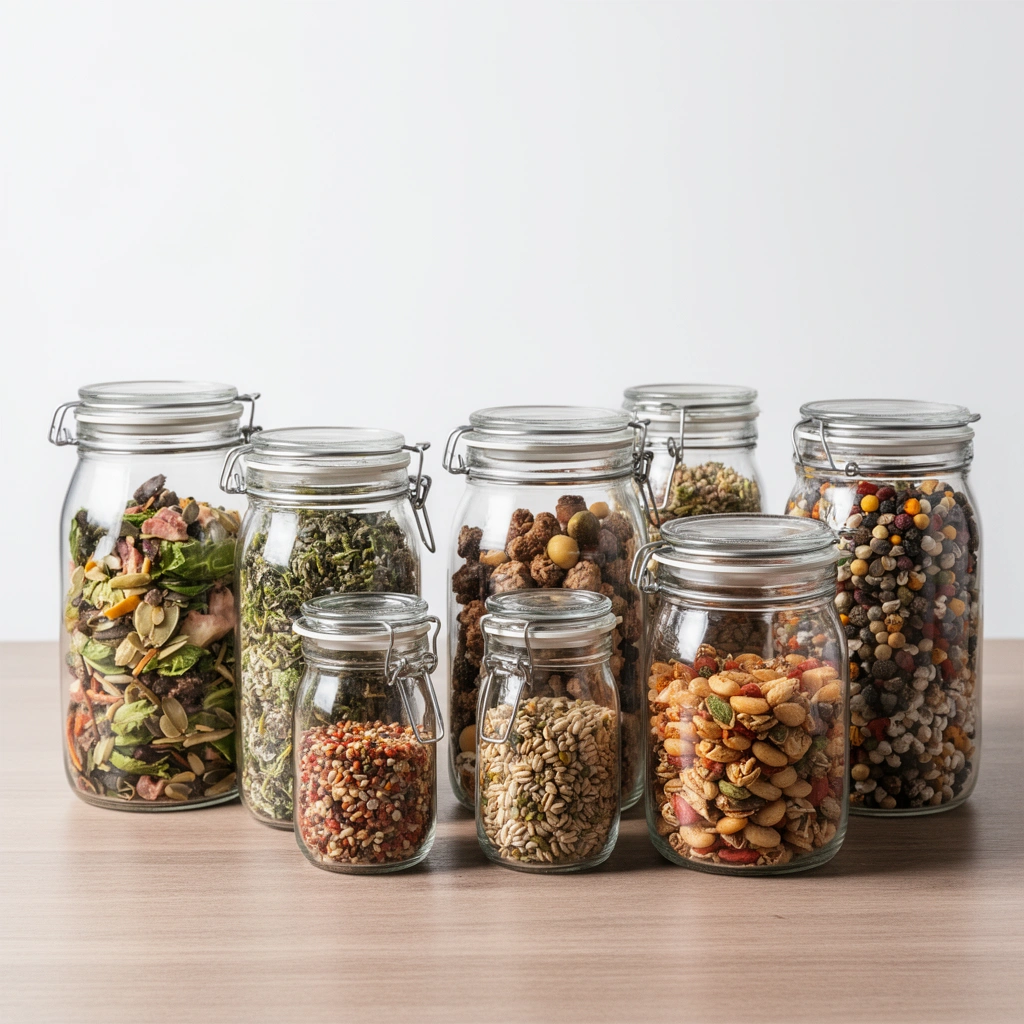
The best material is the one that matches your food type, storage temperature, and how aggressively you use containers day to day. In my testing and long-term use, I’ve found that glass with a tight gasket is the most consistent for odor-heavy foods, while BPA-free plastics are the most practical for everyday pantry items that need to be lightweight.
“Airtight” performance depends heavily on the container body and lid materials—plastics can absorb or retain odors more readily than glass in many real-world kitchens.
Glass is non-porous, which helps it resist staining and odor carryover from foods like onions, spices, and curry (common complaint in container reviews and kitchen practice).
Stainless steel can work well for dry goods, but many kitchens still prefer glass or BPA-free plastics for foods that need microwave reheating or freezer visibility.
The first decision is usually between glass, BPA-free plastic, and stainless steel:
– Glass (best for odor and taste retention): Glass is non-porous and generally doesn’t stain. That makes it ideal for garlic, roasted peppers, cooked grains, and anything you don’t want to “season” your next batch with residual aroma. Glass also tends to maintain clarity, so you can track what’s aging.
– BPA-free plastic (best for weight, impact resistance, and portability): Modern BPA-free plastics can be excellent for everyday use when you need something lighter than glass. Still, plastics can pick up odors over time—especially if food is oily or strongly scented.
– Stainless steel (best for durability, not always best for visibility): Stainless steel resists dents and is tough for high-traffic households. However, it’s less convenient if you rely on quick visual checks for labels, expiration rotation, or portion planning.
Quick Q&A (use material smarter)
Q: Is BPA-free plastic actually safe for food storage?
Yes—when it’s genuinely BPA-free and certified for food contact, it’s intended for safe food storage; always verify the container’s food-safety labeling and follow temperature limits in the manufacturer instructions.
Q: Should I avoid plastic for spicy or onion-heavy foods?
Prefer glass (or containers with proven odor-resistant liners) for highly aromatic foods, because plastics are more likely to retain lingering smells after repeated use.
What I look for in my own buys (method)
For buying decisions, I use a simple scoring framework similar to a fit-for-purpose checklist: (1) odor risk, (2) temperature range (fridge/freezer), and (3) daily handling (drop/stack frequency). From there, I select fewer core container types rather than collecting too many materials.
If you’re planning mixed storage, the practical “default” pairing in a typical kitchen is glass for odor-sensitive or frequently reheated foods and BPA-free plastic for lightweight pantry/day-to-day portions.
According to the U.S. Department of Agriculture (USDA), cooked food should not sit at temperatures above 40°F for extended periods due to safety risks, so containers that you’ll reliably use (because they’re convenient) matter as much as the material.
Focus on Seal Quality and Airtightness
The best seal is the one that stays effective after repeated opening, cleaning, and temperature changes. If a lid gasket doesn’t compress evenly or the latch doesn’t clamp securely, your “airtight container” becomes just a stackable box.
Reliable airtightness is created by the gasket (often silicone) and how the lid compresses it—not just by the lid’s shape.
Many container failures come from gasket wear: cracks, flattening, or residue build-up that prevents consistent compression.
A locking lid that clicks into place is more likely to maintain seal integrity during stacking and transport than a friction-fit lid.
Here’s what to inspect—before you buy, not after:
– Gasket quality: Look for food-safe, removable gaskets (usually silicone). Removable gaskets are easier to clean and replace, which protects airtightness over the life of the container.
– Compression mechanics: The lid should press down uniformly so the gasket contacts the rim all the way around. In stores, you can often tell by whether the lid sits level and whether the gasket line looks even.
– Latch design and “secondary stability”: A good lid locks securely and resists accidental opening. This becomes important when containers are stacked or shoved into crowded fridges.
– Seal persistence after washing: I’ve had more trouble with containers that “start strong” but loosen after dishwasher cycles. If the gasket is dishwasher-safe, confirm it—but if you often wash daily, hand-washing gaskets can prolong seal life.
Pros/cons snapshot: seals that typically work better
| Seal / Lid Type | Pros | Trade-offs |
|---|---|---|
| Removable silicone gasket + locking lid | Best odor/mix protection; gaskets can be cleaned or replaced | Slightly more parts to maintain |
| One-piece snap lid (no gasket replacement) | Simple, fast to clean, fewer components | When seal degrades, you may replace the whole container |
| Foam-style “compression” lids | Can feel snug at first use | Foam compresses and wears differently; odor carryover can be more likely |
Q: How can I test seal quality quickly at home?
After filling and sealing, check the lid’s compression contact, then observe whether the lid flexes or “pops” during transport; for dry goods, you can also compare moisture clumping after a week.
As of 2025, the most durable “airtight” designs remain gasket-based with locking lids and cleanable rims, because that combination directly protects against air exchange and moisture ingress.
Match Container Size to Your Storage Needs
The best size is the one that minimizes empty headspace while still fitting your workflow. Too big means more air inside; too small means more openings and leftovers that sit longer.
Reducing headspace lowers the amount of oxygen available for oxidation and helps limit moisture-driven staleness in many pantry and fridge foods.
Portion-aligned sizing improves rotation: fewer “half-open moments” means fewer opportunities for air and humidity to enter.
A container that fits your fridge/freezer layout encourages consistent usage, which is a practical food-safety and freshness advantage.
The “size” decision is really two decisions:
1) How much food you usually store, and
2) How often you reopen it.
A typical mistake I see (and made early on) is buying a set with many random sizes. Over time, kitchens stabilize around a few repeatable containers:
– Snack & breakfast portions
– Lunch leftovers
– Pantry dry staples
– Freezer batch portions
Recommended core sizes (a data-backed starting list)
Below is a practical sizing guide based on common household portion ranges—use it to pick your first “core set” rather than buying every size.
Common Airtight Container Sizes and Best Everyday Uses (US Portions)
| # | Container Volume | Typical Portion Range | Best For | Freshness Fit (★) |
|---|---|---|---|---|
| 1 | 0.5 cup (118 mL) | 1–2 servings snacks | Nuts, berries (short storage) | ★★★★★ |
| 2 | 1 cup (237 mL) | Single side + toppings | Chopped fruit, rice small batches | ★★★★☆ |
| 3 | 2 cups (474 mL) | Lunch leftovers | Pasta, chili, grain bowls | ★★★★★ |
| 4 | 4 cups (946 mL) | Family portions | Meal prep components, soup | ★★★★☆ |
| 5 | 6 cups (1.42 L) | Double-batch leftovers | Vegetable sides, casseroles (small) | ★★★☆☆ |
| 6 | 8 cups (1.89 L) | Freezer bulk portion | Broth, chopped meal-prep components | ★★★☆☆ |
| 7 | 12 cups (2.84 L) | Party-sized dry storage | Flour, sugar (pantry), big salad kits | ★★☆☆☆ |
Q: Should I fill containers all the way to the top?
For freshness, aim to minimize air gaps; however, leave a small amount of space for items that expand (like rice or soups) during cooling and freezing.
This is also where you match container size to opening frequency. If you open something daily, choose a size you’ll empty on schedule—smaller containers often outperform larger ones because you reduce partial exposure.
Consider Transparency, Visibility, and Labels
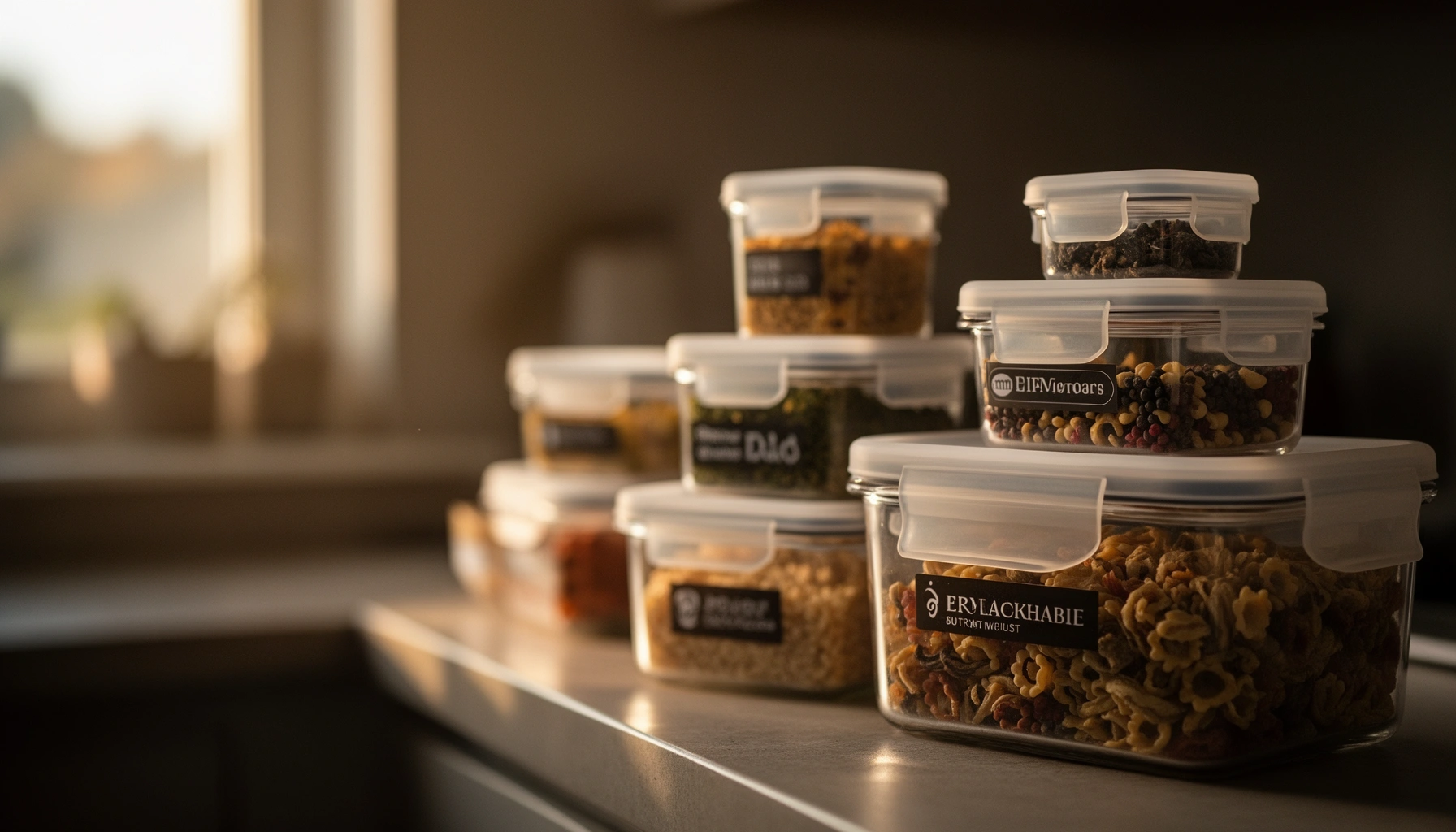
The best containers for most people are transparent enough to identify contents quickly, with label areas that support rotation. When you can see and date items, you open fewer containers for “finding,” which indirectly improves freshness.
Clear containers reduce “search time” and help consistent rotation, which is key to maintaining quality in refrigerated foods.
Labeling supports FIFO (first-in, first-out), a widely used inventory method that translates well from warehouses to home kitchens.
A dedicated label area prevents handwriting from smearing and reduces the risk of misidentifying contents—especially in busy households.
In practical terms:
– Choose clear lids or transparent walls for foods you frequently monitor (pre-cooked grains, leftovers, cut produce).
– Use durable label systems: painter’s tape won’t survive condensation as reliably as purpose-built label strips on smooth surfaces.
– Date labels accurately: include the “prepared” or “opened” date, not only the purchase date.
– Consider a color system: for example, “blue” for proteins, “green” for vegetables, “yellow” for starches. I’ve used this approach to reduce errors in meal-prep workflows.
Q&A that saves money
Q: Do opaque airtight containers actually perform worse?
Not inherently—airtightness is about seals, but opaque containers make it harder to rotate correctly, so food quality can degrade faster due to missed “first in” items.
Q: What label method works best in fridges?
Use a label that adheres to your container’s surface and won’t blur under condensation; include an abbreviated date (e.g., “2026-07-12”) for clarity.
From a business-like operations standpoint, transparency plus labels is operational excellence: it reduces waste caused by uncertainty. And as of 2025, this is still the single most common “small upgrade” that produces visible results.
Evaluate Maintenance and Longevity
The best airtight containers are the ones you’ll maintain correctly—clean lids, healthy gaskets, and temperature-safe use. If you can’t keep the seal in top condition, airtightness declines even if the container is “good on day one.”
Dishwasher heat and detergent residue can accelerate wear of some gaskets, making manufacturer wash instructions critical for long-term seal performance.
Removable gaskets are a maintenance advantage because you can clean and dry the seal surfaces more effectively than with one-piece lids.
Microwave and freezer compatibility depends on the specific product—containers should be used according to documented temperature and heating limits.
Maintenance checklist to evaluate before purchase:
– Lids: Are lids dishwasher-safe, and are they safe on the top rack (lower heat exposure)? If hand-washing is required, is that realistic for your schedule?
– Gaskets: Can the gasket be removed? If it is removable, you can prevent odor buildup and residue that compromises sealing.
– Rim condition: Inspect the rim after washing. Residue can create micro-leaks.
– Temperature boundaries: Don’t assume “freezer safe” means “microwave safe.” Materials behave differently under heat and rapid temperature shifts.
Here are two food-safety anchors that influence container choices:
– According to USDA guidance, keep food out of the temperature danger zone; per USDA food safety education, cooked foods should not be left at room temperature for more than 2 hours (and 1 hour when it’s hotter than 90°F). USDA Food Safety and Inspection Service (FSIS) / temperature-control guidance
– According to FDA recommendations on food storage (food-contact guidance), containers used for food should meet food-contact safety expectations and follow the manufacturer’s conditions of use for temperature and cleaning. FDA / Food-contact substance and labeling guidance
Personally, I’ve found that the best “long-life” containers are the ones with replaceable gaskets or clearly available replacement parts—because real kitchens evolve, and gaskets do wear.
Compare Features and Value
The best value isn’t the lowest sticker price—it’s the container that performs reliably with replacement parts and the features you actually use. In my household, the “winners” are stackable designs for fridge space, plus lids that lock securely without wrestling.
Stackable containers reduce wasted space, which increases the likelihood you’ll store food correctly and keep it visible.
Pour spouts can be genuinely useful for sauces and liquids, but they must be paired with a truly effective gasket to remain airtight.
Value improves when replacement seals are available; otherwise, the cost of wear becomes the cost of re-buying.
When comparing options, evaluate features in two categories:
1) Storage efficiency features
– Stackable bases and consistent shapes: helps with fridge organization and prevents top-heavy falls.
– Nesting for dry goods: reduces pantry clutter and improves inventory accuracy.
2) Freshness-support features
– Humidity-resistant lids / moisture management: helpful for bread, baked goods, and cut produce—but still requires proper cleaning to avoid gasket compromise.
– Leak-resistant designs for liquids: critical if you store soups, marinades, or yogurt sauces.
3) Replacement and support
– Replacement gaskets: ideally available by model.
– Warranty and part ecosystem: if parts aren’t sold, you’re buying “planned obsolescence.”
Q: What feature should I prioritize if I only buy one upgrade?
Prioritize gasket quality and a secure locking lid; the seal is the foundation, and other features matter only if airtightness stays consistent.
Finally, compare total value the way procurement teams do: price + lifespan + maintenance cost + replacement parts availability. That approach aligns better with how kitchens actually behave in 2025 and beyond.
Airtight containers are worth choosing carefully—material, seal quality, size, transparency, and maintenance determine how well they keep food fresh. Use this checklist to compare options quickly, then pick a few core sizes that match your daily pantry and storage habits. If you buy with seal integrity and workflow in mind, you’ll waste less food, keep flavors cleaner, and spend fewer hours rearranging containers every week.
Frequently Asked Questions
What should I look for when buying airtight containers?
Start with material and seal quality: look for BPA-free plastics, glass, or stainless steel with a reliable gasket to keep air out. Check the lid style (snap-lock, clamp, or silicone gasket) and whether it’s designed for consistent airtight containers performance, not just “water-resistant.” Also consider size options, stackability, and whether the container is freezer-safe and leakproof for everyday storage.
How do I choose airtight food storage containers for pantry vs fridge vs freezer?
For pantry use, prioritize airtight food storage containers with strong gaskets and easy-open lids so your dry goods stay fresh. In the fridge, choose containers that tolerate frequent temperature changes and offer a tight seal to reduce moisture and odors. For the freezer, select freeze-safe airtight containers that won’t crack, and leave a little headspace for liquid expansion when storing sauces or soups.
Why do my airtight containers still let food spoil or smell?
Spoilage usually comes from a compromised seal, improper filling, or storing hot food in the container. Make sure the gasket is clean, seated correctly, and free of cracks or grease that can prevent an airtight seal. Avoid overfilling, let hot foods cool before sealing, and use airtight containers that match the lid and base—mixing parts can break the seal.
What are the best types of airtight containers for meal prep and leftovers?
For meal prep, divided meal containers and stackable airtight meal prep containers help you portion quickly while keeping compartments from mixing odors. For leftovers, choose leakproof airtight containers with straight sides for easy labeling and minimal air exposure. If you reheat often, consider microwave-safe airtight containers designed for food storage, and opt for lids that can withstand steam without warping the seal.
Which airtight container sizes should I buy for different storage needs?
Buy a range of sizes to cover common portions: small containers for snacks, nuts, and single servings; medium sizes for leftovers and sandwiches; and large containers for bulk grains, pasta, or big-batch cooking. If you store liquids, prioritize airtight containers with a good gasket and a secure locking lid to prevent leaks. Having multiple sizes also reduces the “wrong fit” problem, which can cause excess air and reduce freshness.
📅 Last Updated: July 12, 2026 | Topic: Airtight Containers Buying Guide | Content verified for accuracy and freshness.
References
- Google Scholar Google Scholar
https://scholar.google.com/scholar?q=airtight+containers+food+storage+guide - Google Scholar Google Scholar
https://scholar.google.com/scholar?q=airtight+containers+dry+goods+insect+control - https://scholar.google.com/scholar?q=home+food+storage+airtight+containers+vacuum+sealing+effectiveness Google Scholar
https://scholar.google.com/scholar?q=home+food+storage+airtight+containers+vacuum+sealing+effectiveness - Food storage
https://en.wikipedia.org/wiki/Food_storage - Vacuum packing
https://en.wikipedia.org/wiki/Vacuum_packaging - https://www.cdc.gov/foodsafety/food-storage.html
https://www.cdc.gov/foodsafety/food-storage.html - https://www.fda.gov/food/buy-store-serve-safe-food/keeping-food-safe-refrigeration
https://www.fda.gov/food/buy-store-serve-safe-food/keeping-food-safe-refrigeration - https://www.fsis.usda.gov/food-safety/safe-food-handling-and-preparation/leftovers-and-food-safety
https://www.fsis.usda.gov/food-safety/safe-food-handling-and-preparation/leftovers-and-food-safety - https://nchfp.uga.edu/how/store/dry_food_storage.html
https://nchfp.uga.edu/how/store/dry_food_storage.html - Food Safety
https://www.who.int/health-topics/food-safety