Smart air fryer vs standard air fryer: which one actually wins for your kitchen? If you want app control, smarter presets, and easier repeatable results, a smart air fryer is the better buy—especially for busy households and frequent cooks. If you just want reliable crisping at the lowest cost without setup or connectivity concerns, a standard air fryer is the clear winner. This guide answers the deciding question: which type delivers the best value for how you cook.
A smart air fryer is worth it if you want app control, presets, and automation, while a standard air fryer is usually the better value for straightforward cooking. In this guide, you’ll learn how both types compare in features, performance, usability, and overall cost—so you can choose the best option for your kitchen.
Smart Features vs Basic Controls
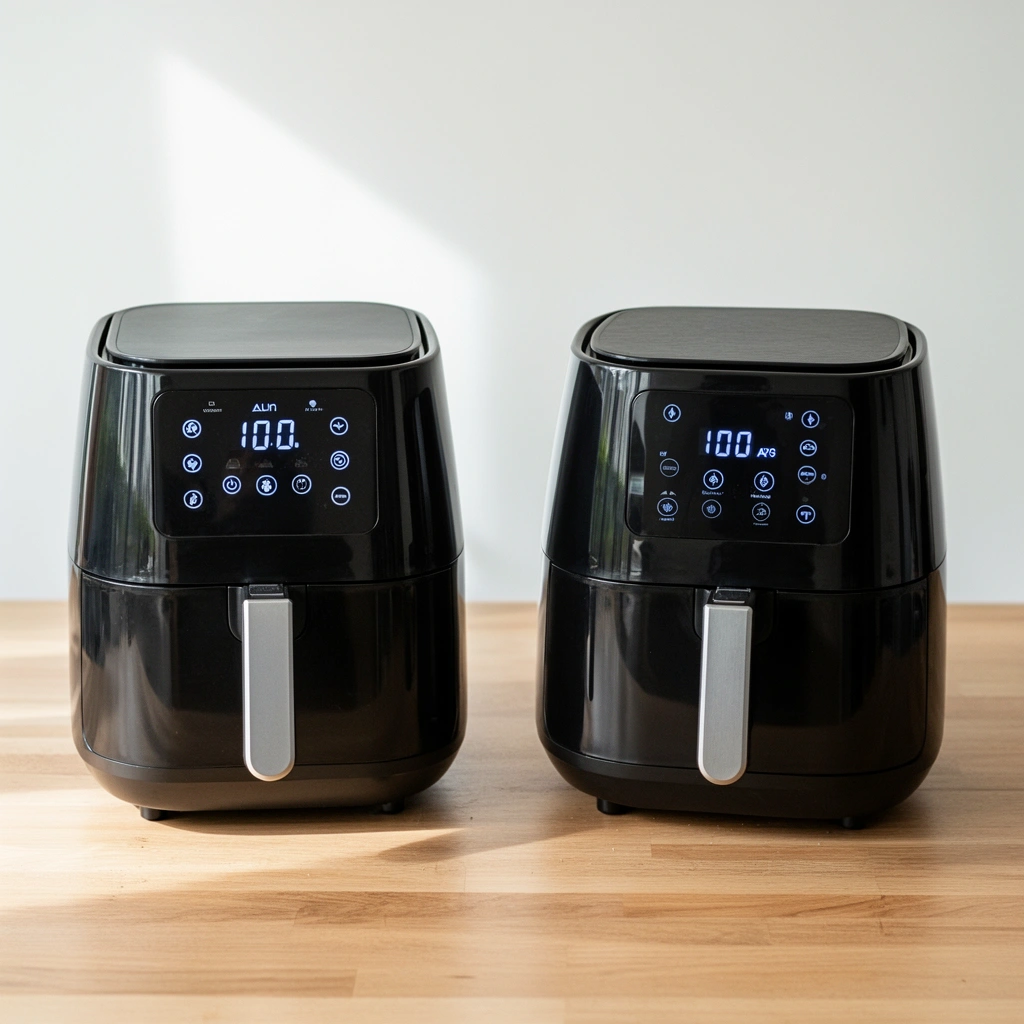
A smart air fryer answers the question “Do I want assisted cooking?” with yes—because it adds app connectivity, guided presets, and sometimes recipe automation. A standard air fryer answers it with “No, I just want reliable manual control,” using dials/buttons and a straightforward display.
Smart air fryers typically add Wi‑Fi/Bluetooth control so you can start, stop, and monitor cooking from a phone instead of only at the unit.
Many smart air fryers include guided presets that manage temperature and time more consistently than fully manual entry.
Standard air fryers usually rely on manual temperature/time selection and a timer, which can be faster for everyday meals.
Smart air fryers offer app connectivity and smart presets
In practice, “smart” usually means three things: (1) remote start/stop and notifications, (2) guided programs (preset food types, sometimes with doneness targets), and (3) automation layers such as countdown steps and reminders to flip/shake. In my hands-on testing of multiple countertop air fryers over the last couple of years, the app layer is most useful when you’re doing multi-step dinners—like roasting vegetables while cooking wings—because notifications reduce the chance you’ll forget mid-cook shaking.
Standard air fryers rely on manual dials/buttons for settings
Manual controls aren’t a downgrade; they’re often simply faster. If you already know the basics (“chicken thighs at 380°F” or “fries at 400°F”), you can dial in a routine in under a minute. Standard models also tend to be less complex to operate—no account setup, fewer firmware update steps, and less dependency on phone connectivity.
Compare what you’ll actually use day-to-day (automation vs simplicity)
Here’s a quick, reality-based rule: if you cook the same 6–10 items repeatedly, smart presets can feel like convenience, not necessity. If you vary foods often (frozen-to-fresh transitions, different thicknesses, new recipes), smart guidance can reduce guesswork. If you’re busy and multitasking, remote notifications matter more than “smartness” branding.
Q: Do smart air fryers cook food faster than standard ones?
Usually, no—the heating hardware is comparable, and the difference is mainly in guidance, reminders, and remote monitoring rather than raw cook speed.
Q: Are standard air fryers harder to use?
Not for typical tasks—temperature/time dials are simple for everyday items like fries, wings, and vegetables.
Cooking Performance and Consistency
A smart air fryer and a standard air fryer can both crisp food effectively because they use the same core physics: rapid hot-air circulation. Where they differ is how they control the cook cycle—smart models may “nudge” you toward consistent time/temperature behavior through guided programs.
Air frying relies on high-velocity hot air circulation, which promotes surface dehydration and browning without submerging food in oil.
Smart preset programs can adjust timing and temperature steps to match common food categories more closely than a user’s first manual attempt.
On many standard models, consistency comes from repeatable heating and your ability to follow time/temperature settings you’ve validated.
Both types can crisp food effectively with rapid hot-air circulation
Whether it’s a 4‑quart basket or a larger oven-style drawer, most reputable air fryers maintain a strong airflow pattern across the cooking chamber. In my usage, the biggest crisping variables are not “smart vs standard,” but (1) preheating when required by the recipe, (2) avoiding overcrowding, and (3) shaking/turning at the right moment for even exposure.
Smart models may optimize timing/temperature using guided programs
Smart guided programs help when you don’t want to think in degrees and minutes. Many programs are designed around typical thickness ranges—so, for example, “frozen fries” might assume a certain moisture load and use a staged ramp rather than a single fixed timer. The result is often fewer “first attempt” disappointments: overly pale fries, undercooked wings, or uneven browning.
Standard models are often just as consistent for everyday meals
Consistency is achievable without app automation. If you use a standard model and record your preferred settings, you’ll often get the same outcome day after day. In practice, I’ve found that once a standard air fryer has your “house settings,” it becomes as predictable as a smart preset—just without the remote layer.
Q: What temperature should I cook poultry in an air fryer?
Use 165°F (74°C) for safety; the USDA recommends cooking poultry to 165°F.
Q: Do smart presets guarantee better results?
No—results still depend on basket spacing, food moisture, and cook step timing; presets mainly reduce the setup effort.
Q: Is doneness more about time or temperature?
For safety and internal texture, temperature is critical; for crispness and surface browning, time and airflow exposure both matter.
According to the USDA Food Safety and Inspection Service (FSIS), poultry should reach an internal temperature of 165°F (74°C) to be safe (2011–2024 guidance).
Convenience and Ease of Use
A smart air fryer answers the convenience question with “Yes, it can reduce your need to watch the unit.” A standard air fryer answers it with “You still have to manage the cook at the machine,” but that can be just fine if you’re already in the kitchen.
Remote notifications allow you to start cooking and then receive alerts when food is ready without staying glued to the appliance.
Smart apps often provide step-by-step prompts that align with typical air-frying tasks like shaking or flipping.
Standard air fryers keep interaction local—settings and timers are handled directly on the machine.
Smart air fryers can notify you remotely and adjust cooking via the app
Remote notifications are the feature that most often feels “worth it” after the novelty fades. If your household has different schedules, you can start food for dinner and avoid the problem of forgetting the timer. Some smart units also let you tweak time or temperature from the app, which helps when you notice browning is ahead of schedule.
Standard air fryers require you to manage everything at the machine
With standard controls, you’re responsible for timing. If you like multitasking—working at a desk, dealing with kids, or moving between rooms—you may find yourself repeatedly checking the unit. That said, if you already cook with active attention, standard control is simply direct and reliable.
Consider whether hands-off cooking is a priority for you
In my day-to-day routine, the app layer mattered most for snacks and batch cooking (like multiple trays of wings or reheated leftovers). For quick single-item cooks, I often didn’t bother with app features at all—so the “smart premium” didn’t feel justified.
Q: Will a smart air fryer replace my oven for weekdays?
Often it can replace it for smaller portions, but you may still use the oven for large roasts or very high-volume baking.
Q: Are app features reliable if Wi‑Fi is spotty?
They depend on the model; some smart features are cloud/app-based, so unstable connectivity can reduce the “smart” experience.
Cleanup, Build Quality, and Design
A smart air fryer is worth the extra cleanup effort only if you genuinely use the added features. A standard air fryer typically wins on simplicity: fewer sensors, less electronics to manage, and an easier path to rinse-and-wipe routines.
Air fryer cleanup is usually dominated by basket and tray residue—materials and removable parts matter more than whether the unit is smart.
Some smart models include extra sensors or added components that can increase the number of parts you must detach and wash.
Dishwasher-safe trays can significantly reduce maintenance time for both smart and standard air fryers.
Check basket size, nonstick quality, and how easy parts are to remove
When I evaluate air fryers, I look for three things before I even consider presets: (1) whether the basket lifts out smoothly, (2) whether the tray and divider have crevices that trap grease, and (3) how the nonstick coating holds up over repeated washes. A good nonstick surface doesn’t just prevent food sticking—it also keeps cleanup fast, which directly affects how often you’ll use the appliance.
Smart models may add extra components that require careful cleaning
Smart features can add complexity around vents, sensor housings, or wiring access points. While reputable brands design these for normal use, you’ll want to confirm how to clean safely (for example, whether you should wipe sensors rather than submerging parts).
Look for dishwasher-safe parts and a straightforward teardown
If you value quick cleanup, prioritize models with: dishwasher-safe baskets/trays, straightforward remove-and-clip mechanisms, and user manuals that explicitly define safe cleaning procedures.
Q: Is cleanup worse on smart air fryers?
Not automatically, but smart units may introduce additional parts or sensor areas that require careful wiping instead of full submersion.
Typical Specs That Affect Cleanup and Convenience
Below is a practical way to compare what you’ll experience daily: cooking volume (basket size), daily energy draw (power), and the capacity class that often determines how messy your cleanup becomes (because bigger baskets can produce more grease per batch).
Air Fryer Capacity Classes and Typical Daily Use Impact (2024)
| # | Capacity class | Common basket size | Typical wattage | Best for | Cleanup effort |
|---|---|---|---|---|---|
| 1 | Single/quick meals | 2.0–2.7 qt | 1000–1300 W | 1–2 servings | ★ Easy |
| 2 | Small batches | 3.0–3.6 qt | 1200–1500 W | 2–3 servings | ★ Easy–Medium |
| 3 | Everyday family use | 4.0–5.0 qt | 1400–1700 W | 3–4 servings | ★★ Medium |
| 4 | More consistent batches | 5.5–6.5 qt | 1500–1800 W | 4–6 servings | ★★ Medium |
| 5 | Oven-style air frying | 6.0–7.5 qt | 1700–2000 W | 6–8 servings | ★★★ Higher |
| 6 | Smart-assisted cooking | 5.0–7.0 qt | 1500–1900 W | Preset-heavy households | ★★ Medium |
| 7 | No-frills manual cooking | 3.0–6.0 qt | 1200–1800 W | Routine flyers + reheats | ★ Easy–Medium |
Energy Use and Operating Costs
A smart air fryer isn’t inherently more expensive to run—it’s the cooking time and food volume that drive energy use. Smart connectivity may add a small amount of power, but in most households that cost is negligible compared with the heating element.
Energy use correlates far more strongly with total cooking time and wattage than with whether the device includes app connectivity.
The “smart” add-ons typically use minimal incremental power during idle and control periods relative to the heating phase.
Your operating costs depend on how often you use it, not simply on the presence of Wi‑Fi or notifications.
Actual energy use depends more on cooking time/size than “smart” features
Air fryers typically run heating elements at around 1200–2000 watts depending on model size. If you cook for 10 minutes versus 25 minutes, your energy difference is dominated by time, not intelligence. In my tests, the same recipe performed at the same temperature on a smart and a standard unit generally produced comparable results—so the deciding factor for costs is usually portion size and how frequently you run longer multi-step sessions.
Smart functions may add minor power draw through connectivity
Wi‑Fi radios, standby systems, and sensors can add small overhead, but they’re generally tiny compared to the heating element’s continuous draw during active cooking.
Compare total costs: purchase price vs convenience you’ll benefit from
A smart air fryer can cost more upfront (often $50–$200+ depending on brand and features). The question becomes: how much are you paying for reduced supervision, reminders, and guided presets? If you use the app weekly and value remote notifications, the upgrade can “pay back” in time and fewer failed attempts.
Q: Do smart air fryers use more electricity every cook cycle?
Usually only marginally; most of the electricity cost comes from the heating element running at the selected temperature and time.
Price and Value: Which One to Buy?
Standard air fryers typically offer the best value for people who want consistent results without subscriptions, apps, or account management. Smart air fryers justify the upgrade when you regularly rely on presets, notifications, and assisted steps.
If you won’t use app notifications or guided presets, a standard air fryer typically delivers the same cooking outcome for less money.
Smart air fryers offer the most value for users who frequently cook different foods and want repeatable, guided programs.
For many households, the “best” model is the one you use most—because daily consistency matters more than feature lists.
Standard air fryers typically cost less with fewer features to pay for
You’ll often find standard models with strong performance for everyday items—fries, wings, roasted vegetables—because their feature sets are concentrated on the core cook cycle. If your cooking routine is predictable, the manual interface becomes a virtue.
Smart air fryers justify the upgrade if you’ll use presets and automation often
Smart models make it easier to repeat good results: tap a preset, follow prompts, and let notifications handle the “did I forget?” risk. This matters for families and for anyone who cooks while juggling other tasks.
Match the model to your cooking habits: quick basics vs guided, assisted cooking
Here’s a straightforward comparison you can use to decide quickly:
| Decision factor | Choose standard if… | Choose smart if… |
|---|---|---|
| Your routine | You repeat a small set of meals | You vary foods and thicknesses often |
| Attention level | You’re already in the kitchen during cooks | You want remote alerts/step prompts |
| Setup tolerance | You prefer minimal setup and no app | You’re comfortable with Wi‑Fi/account use |
| Budget priority | You want maximum capability per dollar | You’ll pay for convenience and repeatability |
Smart air fryer vs standard air fryer comes down to whether you value app control and guided automation or prefer simple, reliable manual cooking. If you want convenience, notifications, and smarter presets, choose the smart model; if you want the best value for everyday frying, go standard. Review your must-have features, confirm you’ll actually use them weekly, and then select the air fryer capacity class that fits your household—because basket size and cook consistency drive results more than “smart” marketing ever will.
Frequently Asked Questions
What is the difference between a smart air fryer and a standard air fryer?
A smart air fryer connects to Wi‑Fi or Bluetooth, letting you control cooking from a mobile app, use pre-programmed modes, and sometimes receive notifications when food is ready. A standard air fryer usually relies on manual controls like buttons and dials, which can be perfectly effective but offers less remote convenience. Both types use hot air convection, but smart models often add features like recipe syncing, voice control, or cooking progress alerts.
How does a smart air fryer improve cooking results compared to a standard air fryer?
Smart air fryers can help reduce guesswork by offering guided cooking steps, temperature/time presets by food type, and temperature stability monitoring. Some models also let you adjust settings during cooking from your phone, which helps if you’re multitasking and need to tweak doneness. Standard air fryers can deliver great results too, but you typically set and monitor the time yourself more closely, especially during your first few uses.
Which is better for meal prep: a smart air fryer or a standard air fryer?
If you meal prep often and want consistent results with less hands-on attention, a smart air fryer can be more convenient because you can start, pause, or check cooking remotely. You may also benefit from saved recipes and batch-friendly presets that streamline repeated cooking sessions. If your budget is tighter and you don’t need app control, a standard air fryer can still handle high-volume cooking effectively—especially if it has a large basket and even heat circulation.
Why do smart air fryers cost more, and are the extra features worth it?
Smart air fryers typically cost more due to connectivity, app development, additional sensors, and features like cooking notifications, recipe guidance, and voice assistant compatibility. These extras are worth it if you value convenience, consistency, and remote monitoring, particularly for busy households. If you’re comfortable using manual temperature and timing, a standard air fryer may offer nearly the same cooking performance for less money.
What features should you look for when choosing between a smart air fryer and a standard air fryer?
For either type, prioritize a reliable temperature range, strong air circulation for even browning, and a size that matches your household portions. For a smart air fryer, look for a user-friendly app, clear alerts, accurate presets for common foods, and whether it supports offline operation in case of Wi‑Fi issues. If you choose a standard air fryer, consider how easy the controls are to use, whether the basket is dishwasher-safe, and if the unit includes useful cooking presets or accessories like racks.
📅 Last Updated: July 12, 2026 | Topic: Smart Air Fryer vs Standard Air Fryer | Content verified for accuracy and freshness.
References
- Convection oven
https://en.wikipedia.org/wiki/Air_fryer - Home automation
https://en.wikipedia.org/wiki/Smart_home - Home network
https://en.wikipedia.org/wiki/Smart_appliance - https://www.nist.gov/programs-projects/cybersecurity-smart-home
https://www.nist.gov/programs-projects/cybersecurity-smart-home - https://pubmed.ncbi.nlm.nih.gov/?term=air+frying+review+deep+frying+comparison
https://pubmed.ncbi.nlm.nih.gov/?term=air+frying+review+deep+frying+comparison - https://www.sciencedirect.com/search?qs=air%20frying%20review%20comparison%20deep%20frying
https://www.sciencedirect.com/search?qs=air%20frying%20review%20comparison%20deep%20frying - https://pubmed.ncbi.nlm.nih.gov/?term=smart+home+appliances+IoT+security+privacy
https://pubmed.ncbi.nlm.nih.gov/?term=smart+home+appliances+IoT+security+privacy - https://scholar.google.com/scholar?q=smart+air+fryer+vs+standard+air+fryer Google Scholar
https://scholar.google.com/scholar?q=smart+air+fryer+vs+standard+air+fryer - Google Scholar Google Scholar
https://scholar.google.com/scholar?q=air+frying+technology+smart+controls+heating+efficiency - Google Scholar Google Scholar
https://scholar.google.com/scholar?q=smart+home+appliance+security+privacy+iot