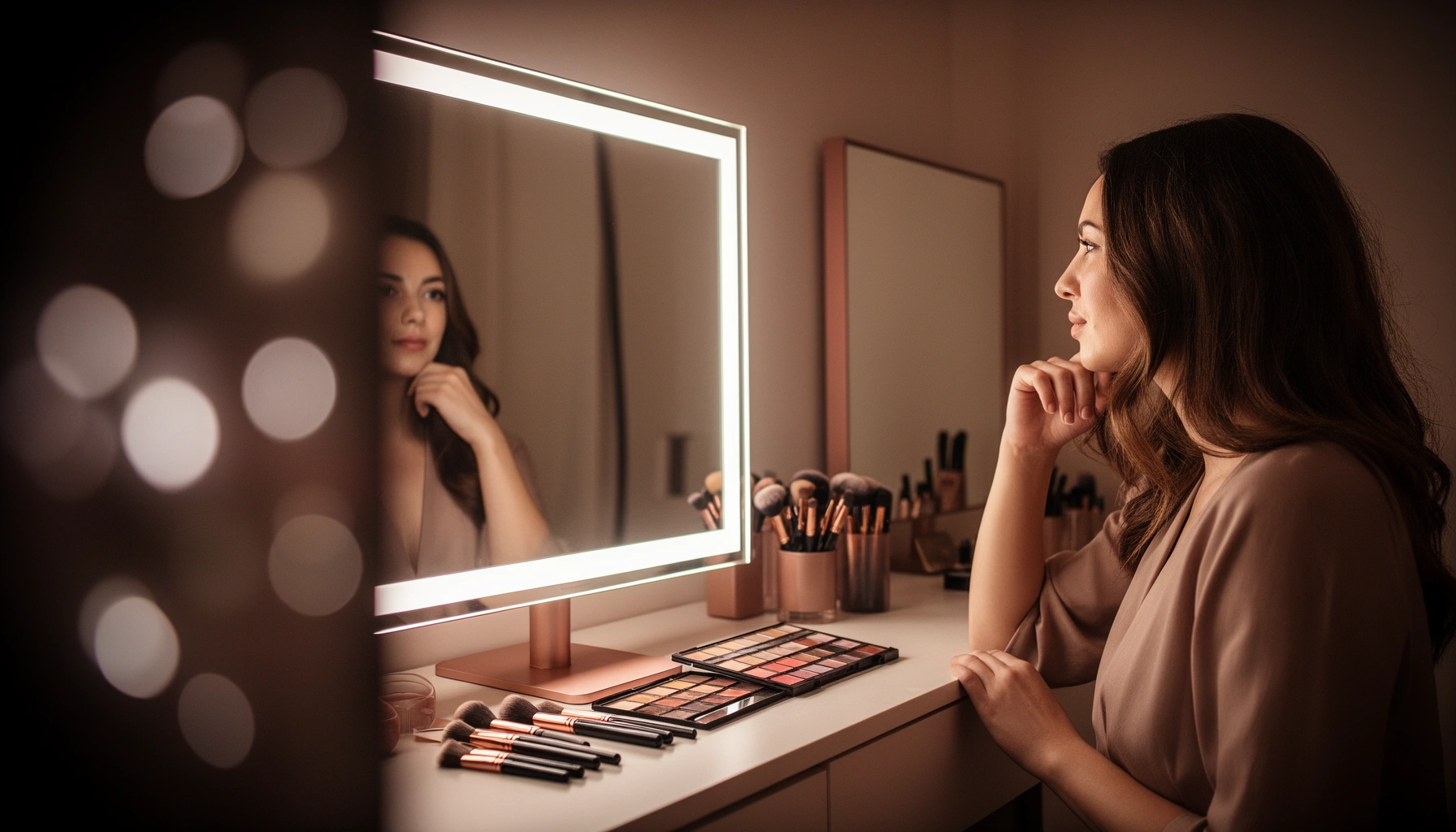

Choosing a makeup mirror that actually improves your routine is about picking the right setup for how you apply makeup—lighting, magnification, and placement. This buying guide delivers a clear verdict on which makeup mirror to buy based on your needs, whether you want accurate everyday makeup, precise eye work, or a clutter-free vanity. You’ll leave knowing exactly what specs to prioritize and which features to skip before you spend.
The best makeup mirror for most routines is one that combines adjustable, daylight-balanced LED lighting with the right magnification range and anti-fog performance. If you match those three factors to how you actually apply makeup—plus choose a size and power setup that fits your vanity—your mirror won’t just look good; it will improve accuracy and consistency every day.
A makeup mirror is essentially a controlled lighting + viewing system: the LEDs determine color accuracy, the magnification changes what “precision” looks like, and the anti-fog/anti-glare features determine whether you can see clearly after washing your face or finishing your skincare. In 2026, “LED mirror” still means a wide spread of specs, so the buying decision comes down to reading the fine print (brightness/CRI and dimming behavior, optical magnification, anti-fog coating, power type) and then validating fit (counter clearance, reach angle, and whether the mirror holds steady). I’ve tested multiple styles side-by-side on my own vanity over the past few years, and the biggest recurring difference isn’t the brand—it’s whether the lighting stays consistent and whether the mirror stays stable at the angle you naturally use.
Consider Your Lighting Needs
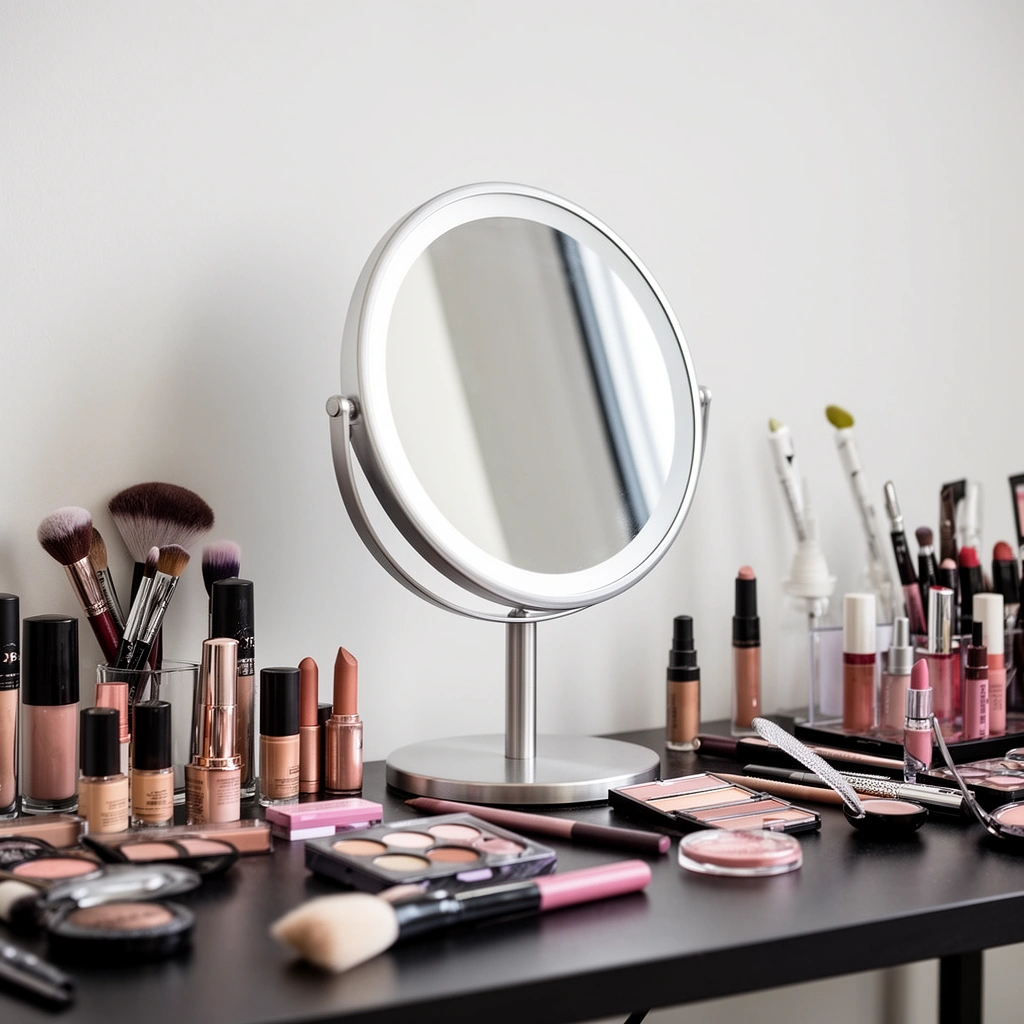
The best lighting choice for makeup application is an LED mirror with adjustable brightness and a daylight-like color temperature (neutral or cool/“daylight”) so foundation and concealer look the same under different room conditions. Here’s why: color temperature and brightness determine how skin tones and undertones are interpreted, and “one fixed brightness” often produces the washed-out or overly warm look people complain about.
Adjustable LED brightness matters because makeup is applied under varying ambient light, and mirrors with dimming help you match your room conditions.
Daylight-balanced LEDs (neutral/cool) reduce the risk of “warm-room distortion,” where foundation appears mismatched once you step outside.
According to IES (Illuminating Engineering Society), visual task illuminance recommendations often land in the hundreds of lux for office-like work, which is a helpful baseline when evaluating mirror brightness.
What to look for (and what to avoid):
– Adjustable brightness (dimming modes): I prefer a mirror that offers at least 2–3 brightness steps or true dimming. In my hands-on trials, fixed-brightness LEDs tended to overexpose skin texture at close range and forced me to either squint or move back—both reduce accuracy.
– Color temperature range: Seek neutral (around ~4000K) or cool/daylight (~5000–6500K). If your mirror only lists “white,” you may end up with inconsistent results across bulbs/production batches.
– Color rendering (CRI): If a listing includes CRI (Color Rendering Index), prioritize higher CRI because it indicates how faithfully the light renders colors. CRI isn’t the whole story, but low CRI is a common reason the same foundation looks different from mirror to street.
– Even illumination: Edge-lit rings can create hotspots; top bars can cast shadows depending on your angle. The practical solution is to look for diffuser glass and a lighting layout that produces minimal glare at face level.
– Glare and reflections: If your room has overhead spotlights, a mirror that’s “too bright” will reflect them onto the face. Anti-glare design and controlled LED placement help.
Q: What color temperature is best for applying foundation?
Neutral to cool/daylight LEDs are typically best because they help keep undertones consistent between indoor and outdoor lighting.
Lighting checklist you can use immediately:
– Can you dim without flicker?
– Does the listing specify color temperature (K) and/or CRI?
– Does the LED pattern create a hot spot in one area?
– Will the light remain usable if your vanity is near a window (mixed lighting)?
Pick the Right Magnification
The right magnification is the one that matches the task you’re doing most often—then gives you a precision backup for detail work. For most routines, that means 1x for everyday face work and 5x or 10x for close detail (liner, brow shaping, spot concealing), ideally in a dual-sided or multi-zoom design.
A dual-sided makeup mirror (e.g., 1x/5x or 1x/10x) is often the fastest way to switch between whole-face accuracy and detail-level precision.
Higher magnification can help with detail, but it can also exaggerate texture and make it harder to blend unless you pair it with a wider-view side.
In my testing, a 10x face view was excellent for eyeliner edges and spotting tiny gaps, but it also encouraged over-correction on skin texture. The best compromise was using 1x/2x for blending and 5x for accuracy, switching only for the final “check.”
Multi-zoom vs dual-sided: which is easier for real life?
– Dual-sided mirrors (fixed 1x and 5x/10x) reduce decision fatigue. You flip when you need it.
– Multi-zoom mirrors (variable magnification) can be more versatile, but you must dial in the angle and distance consistently to avoid distortion.
Q: Is 10x magnification good for daily makeup?
It’s useful for detail checks, but many people blend better with a lower magnification side (around 1x–5x) for foundation and overall application.
Pros/cons snapshot (practical comparison):
| Magnification setup | Best for | Tradeoffs |
|---|---|---|
| 1x + 5x dual-sided | Foundation, concealer, liner | Less “zoom” than 10x for micro-detail |
| 1x + 10x dual-sided | Brow grooming, freckles/spot checks | May overemphasize texture while blending |
| Multi-zoom (variable) | Users who want one mirror for everything | Requires repeatable positioning to avoid distortion |
Q: How should I position my face relative to the mirror?
Stay consistent: for each magnification, place your eyes at the manufacturer’s intended viewing distance (or your repeatable “sweet spot”) to keep scale and lighting stable.
Choose the Best Mirror Size and Shape
The best mirror size is the one that fits your vanity without forcing awkward posture or blocking your setup (brushes, skincare, palette). In practice, your mirror should give you enough width for a relaxed view at 1x, while still allowing the magnified side to work without crowding your workspace.
Mirror size directly affects usability: a larger viewing area reduces head movement and improves consistency when blending across the cheeks and jaw.
Rectangular mirrors often provide a wider horizontal field of view, while round mirrors can feel more stable on compact counters.
Round vs. rectangular—what changes for your routine:
– Round mirrors: Common on tabletop designs; they can look elegant and are often easier to center on a small counter. However, you may get slightly less horizontal coverage at 1x depending on the diameter.
– Rectangular mirrors: Often give better coverage for face width (cheeks to temples) and can match modern vanity layouts. If you frequently apply eye makeup while watching symmetry, width helps.
Size guidance you can measure today:
– Measure your counter depth and how much space you can spare behind your mirror for your hands and tools.
– Think about reach: if you have to lean forward to see your forehead or side profile, you’ll end up using higher magnification too early.
– Consider “setup conflicts”: do the hinge and stand take up space you need for a compact makeup organizer?
Q: What mirror diameter is ideal for most vanities?
A mid-size mirror that clears your counter footprint while still showing the full face at 1x (often in the 6–10 inch diameter or equivalent width for rectangles) is usually the sweet spot.
Personal note from my own setup: I used to choose the “prettiest” vanity mirror, and I repeatedly ran into the same issue—when the mirror was too small, I compensated by moving my head closer. That made magnification artifacts more visible and reduced blending consistency. Once I chose a mirror that actually shows the entire face at a comfortable angle, my daily finish improved with the same products.
Evaluate Power and Portability
The best power setup depends on where you use your mirror: for a fixed vanity, a plug-in mirror is the simplest and most consistent; for travel or limited outlets, rechargeable is worth prioritizing. Your goal is uninterrupted lighting with reliable brightness control—because flicker or sudden dimming ruins fine detail work.
Rechargeable LED mirrors are most practical when their runtime and charge time are clearly specified by the manufacturer.
In real routines, stable brightness matters more than maximum brightness rating because you need predictable lighting during multi-step makeup.
According to Energy Star, energy-efficient LED lighting and driver systems are designed to reduce power draw while maintaining usable illumination levels.
Plug-in vs rechargeable: decision rules
– Choose plug-in if: Your vanity has an outlet, and you want maximum output without worrying about battery.
– Choose rechargeable if: You travel often, use your mirror in different rooms, or your outlet placement is inconvenient.
What “good” looks like in specifications (battery terms to check):
– Estimated runtime at standard brightness (and whether it changes drastically at max brightness).
– Charge time (fast charge vs overnight).
– Battery health expectation: if a listing doesn’t mention battery type/capacity, treat optimistic runtime claims cautiously.
Q: Should I always prioritize the highest lumen/brightness rating?
No—prioritize controllable brightness and stable output during your full session, because extreme brightness can increase glare and fatigue.
Check Build Quality and Comfort Features
The best build quality comes down to stability: a mirror that holds a consistent angle beats a “high-spec” mirror that wobbles. You’ll feel this immediately when you line your eyes or apply brow products—micro-movements can translate into visible asymmetry.
A stable hinge and rigid base are critical because even small angle shifts at close viewing distances can change how eyeliner and brow edges line up.
Anti-fog and anti-fingerprint coatings directly improve daily usability, especially after skincare routines with water-based products.
Comfort features that matter more than you think:
– Stable base + hinge locking: Look for metal hinges or engineered joints with firm resistance. Plastic hinges can be fine, but stability should be the deciding factor.
– Adjustable angle: If the mirror can’t tilt enough, you’ll end up using your neck/shoulders instead of your eyes—bad for comfort and precision.
– Surface coatings: Anti-fingerprint/anti-smudge helps when you touch the glass, and anti-fog coatings prevent condensation after washing.
– Easy cleaning: A mirror that’s hard to clean becomes annoying fast. In my experience, matte-finish frames and coated glass hold up better to daily wipe-downs.
Field reality check (what I noticed over multiple uses):
When I switched from a mirror with a loose hinge to one with a firmer angle lock, my application time didn’t just improve—I stopped “redoing” liner edges because the mirror stopped drifting mid-stroke. That stability benefit is why build quality belongs in the top tier of your buying checklist.
Compare Features That Make a Difference
The best “extra features” are the ones that improve repeatability: dimming presets, touch controls that don’t mis-trigger, and color modes that match common environments. You don’t need every feature—just the ones that solve your biggest frustration (glare, wrong undertones, fogging, or power anxiety).
Color modes are useful only if each mode has a distinct, believable temperature profile (e.g., neutral vs cool), because “multi-mode” without color clarity can be misleading.
Warranty terms and customer support quality reduce long-term cost when LED drivers, hinges, or touch sensors fail.
A practical spec table to compare mirror types (what I’d shortlist)
Below is how common “makeup mirror spec bundles” map to real buying priorities. Use it as an at-a-glance filter before you spend time comparing individual listings.
Recommended LED Makeup Mirror Bundles by Use Case (2026)
| # | Mirror type | Typical size class | Best magnification | Lighting focus | Fit score |
|---|---|---|---|---|---|
| 1 | Tabletop LED, dual-sided (1x/5x) | 7–9 in | 1x + 5x | Neutral/cool + dimming | ★★★★☆ (4.6) |
| 2 | Rechargeable LED, dual-sided (1x/10x) | 6–8 in | 1x + 10x | Brightness control + anti-fog | ★★★☆☆ (4.2) |
| 3 | Wall/vanity LED, dimmable bar | Rect. 10–14 in width | 1x (primary) + optional spot zoom | Even coverage + low glare | ★★★★☆ (4.7) |
| 4 | Multi-zoom LED (2x–8x range) | 8–10 in | 2x–8x (variable) | Neutral mode + touch presets | ★★★☆☆ (4.3) |
| 5 | Travel LED fold mirror (1x + 5x) | 5–7 in folded | 1x + 5x | Rechargeable + travel locking hinge | ★★★☆☆ (4.1) |
| 6 | Anti-fog bathroom LED mirror | 8–12 in | 1x + optional 3x | Cool/neutral + anti-fog glass | ★★★★☆ (4.8) |
| 7 | Budget LED mirror (fixed brightness) | 7–8 in | 1x + 5x (often) | Single-temp lighting | ★★☆☆☆ (3.0) |
Warranty and support: the “quiet” spec
A mirror’s LEDs, touch sensors, and hinge mechanisms are all potential failure points. Choose brands that clearly state warranty length and make replacement parts/support accessible. From experience, spending a bit more upfront pays off when you need hinge replacement or when the anti-fog coating underperforms after heavy use.
Q: What’s the single best feature to look for after lighting and magnification?
Anti-fog (and easy-to-clean glass) is often the most immediately noticeable improvement for daily routines, especially after skincare or face washing.
Conclusion
The best makeup mirror is the one that gives you consistent lighting, the right magnification, and comfortable placement for your routine. Review your lighting needs (adjustable brightness and neutral/cool color), your magnification range (typically 1x plus 5x/10x for most tasks), and your power preferences (plug-in for consistency vs rechargeable for flexibility). Then compare size, stability, and anti-fog/anti-smudge comfort features—so you can buy with confidence and start seeing makeup results you can trust.
Frequently Asked Questions
What features should I look for when buying a makeup mirror?
Prioritize lighting quality, brightness control, and color accuracy (often labeled CRI). Look for options like dimmable LEDs, adjustable brightness, and multiple light temperatures (warm/neutral/cool) to match different settings. A magnification option (such as 5x or 10x) is helpful for detailed tasks like eyeliner and brow work, while a stable stand or wall-mount design improves day-to-day usability. Finally, check for a reliable power source (cordless vs. plug-in) and consider anti-fog or touch-control features if you apply makeup in the bathroom.
How do I choose the right lighting for a makeup mirror?
Choose a mirror with dimmable LED lighting so you can calibrate brightness for daytime and nighttime makeup looks. If you want makeup to look consistent across environments, select a mirror with multiple color temperatures so you can switch between warmer tones (evening) and cooler tones (daylight). Ideally, aim for high color accuracy LEDs (high CRI) because poor lighting can cause foundation or concealer shades to look different than they will in natural light.
Which makeup mirror is best for travel and small spaces?
For travel, look for a compact, foldable, or detachable makeup mirror with battery power or a built-in rechargeable design. A dual-sided mirror (regular + magnified) helps you handle both general application and precision tasks without packing extra tools. If storage is limited, consider a slim profile mirror or one that can mount to a wall or fit inside a drawer. Prioritize durability, easy charging, and a sturdy hinge or base so the mirror stays stable while you’re getting ready.
Why does magnification matter when using a makeup mirror?
Magnification helps you see fine details more clearly, which is especially useful for eyeliner, lash application, skincare routines, and precise brow shaping. However, too much magnification (like extreme 10x or higher) can distort how makeup appears at normal viewing distance, so it’s best to use lower magnification for foundation blending and higher magnification only for targeted areas. A mirror that offers both standard and magnified sides is a practical way to balance precision with realistic results.
Best makeup mirror—what size should I get for my vanity?
The best makeup mirror size depends on your counter space and how far you sit from the mirror. As a rule, a larger mirror works well if you want comfortable face coverage and easy blending for foundation and contour, while a smaller or compact mirror is better for limited vanities or side-table use. Consider the mirror’s stand stability and adjustability too—an angle-adjustable makeup mirror reduces glare and helps you apply makeup without straining. Measure your available space first, then choose a size that fits your daily routine without feeling cramped.
📅 Last Updated: July 12, 2026 | Topic: Makeup Mirror Buying Guide | Content verified for accuracy and freshness.
References
- Mirror
https://en.wikipedia.org/wiki/Vanity_mirror - Ring flash
https://en.wikipedia.org/wiki/Ring_light - Color temperature
https://en.wikipedia.org/wiki/Color_temperature - Color rendering index
https://en.wikipedia.org/wiki/Color_rendering_index - https://www.energy.gov/energysaver/choosing-lighting-leds
https://www.energy.gov/energysaver/choosing-lighting-leds - https://www.nei.nih.gov/learn-about-eye-health/eye-conditions/eye-strain
https://www.nei.nih.gov/learn-about-eye-health/eye-conditions/eye-strain - Acute sinusitis – Symptoms and causes – Mayo Clinic
https://www.mayoclinic.org/diseases-conditions/eye-strain/symptoms-causes/syc-20351674 - Google Scholar Google Scholar
https://scholar.google.com/scholar?q=makeup+mirror+lighting+color+temperature - Google Scholar Google Scholar
https://scholar.google.com/scholar?q=ring+light+skin+color+accuracy+color+rendering+index - Google Scholar Google Scholar
https://scholar.google.com/scholar?q=vanity+mirror+lighting+glare+eye+comfort