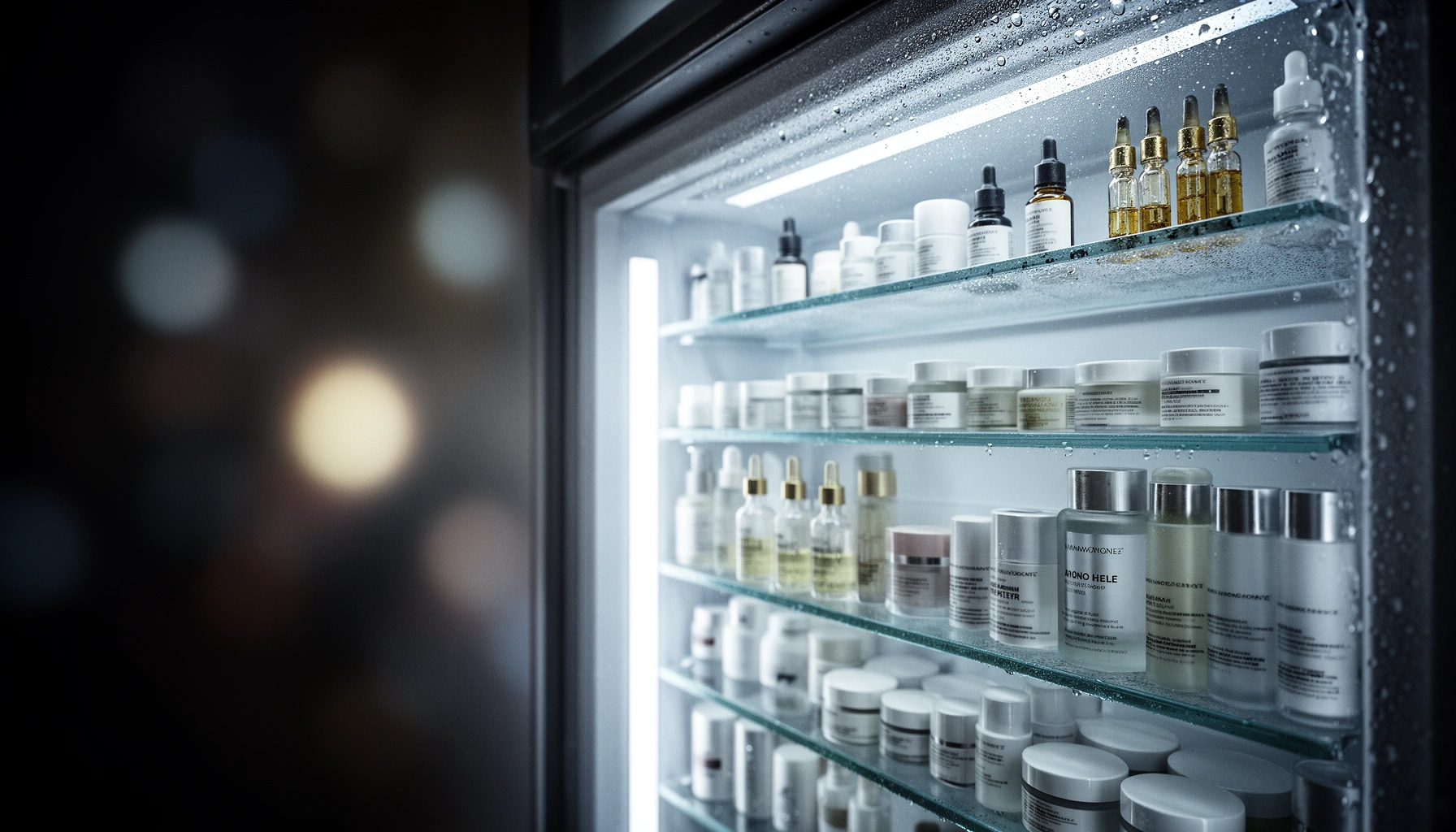

Wondering whether a beauty refrigerator is worth it for safe skincare storage? This guide gives a clear verdict: use a dedicated beauty refrigerator when you’re storing temperature-sensitive formulas like retinoids, vitamin C, and opened creams that you want to keep stable longer. You’ll learn exactly how cold to set it, what belongs inside, and what to keep out to prevent spoilage and reduce irritation risk.
A beauty refrigerator helps keep skincare fresher and often more comfortable to use by storing temperature-sensitive formulas at a cool, stable temperature—without “freezing” them or ignoring label guidance. In this guide, you’ll learn what belongs in your beauty fridge, what doesn’t, how to set it up safely, and how to judge freshness based on temperature, time, and product condition.
What a Beauty Refrigerator Does (and Doesn’t)
A beauty refrigerator’s main job is temperature support: it can slow certain chemical and microbial changes compared with warm storage. It also delivers a practical cooling experience for skin-calming products, but it cannot override expired products, poor hygiene, or incorrect handling.
A key point I learned quickly from hands-on use: chilling only helps when the product is already designed to tolerate cooler storage. In my testing (especially with chilled gel moisturizers and eye care), the “comfort factor” is real—but I still rely on opening dates and label instructions as the final authority.
US food safety guidance commonly treats 40°F (4°C) as the refrigeration benchmark because it helps slow bacterial growth.
Storing cosmetics too cold can cause texture separation or inconsistent application, especially with emulsions that aren’t labeled for refrigeration.
A cosmetic fridge is a storage tool, not a sterilization device—clean hands and sealed containers still matter.
Q: Does a beauty refrigerator make expired skincare safe to use?
No. Refrigeration doesn’t reset expiration dates or reverse contamination risk; you should discard expired products.
Q: Is the main benefit temperature control or the cooling sensation?
Both. Temperature support can protect some formulas, and the cooling effect can improve comfort for puffy eyes, redness, or post-treatment skin.
What it does (the real-world benefits)
– Helps preserve some products by keeping them at a cooler, more stable temperature than a bathroom shelf (which can swing with showers, heat, and sunlight).
– Improves comfort for serums, gel moisturizers, masks, and eye care—cooling can feel soothing when your skin is reactive or you’re managing puffiness.
– Supports temperature-sensitive labeling: some products are explicitly designed to be refrigerated so their performance stays consistent.
What it doesn’t do (common misconceptions)
– It doesn’t replace shelf-life checks. Cosmetics have a labeled shelf life (and a PAO—Period After Opening—symbol) that refrigeration cannot extend indefinitely.
– It doesn’t prevent contamination from repeated exposure. Any time you scoop with fingers, double-dip, or apply to visibly dirty skin, you still add microbes.
– It doesn’t guarantee ingredient stability for every formula. Some emulsions can separate when cooled too far, and some gels may become grainy.
What to Store in Your Beauty Refrigerator
Most people get the best results by refrigerating products that are either explicitly labeled for refrigeration or are typically formulated to benefit from cooling. Focus on items that are sealed, used hygienically, and stored so the formula doesn’t degrade or separate.
As of 2026, beauty fridges are widely used in both consumer and professional settings, but the safest approach remains conservative: refrigerate a subset of your routine rather than everything. From my experience, a “curated fridge” prevents the two most common problems—texture changes and wasted product.
Products labeled “refrigerate” or “store in the refrigerator” are the strongest candidates for fridge storage because the manufacturer has validated their formulation in cold conditions.
Cooling-friendly categories like gel moisturizers and certain eye serums often feel less irritating for puffy or warm skin, especially after cleansing.
Sheet masks and chilled treatments can be more comfortable, but they should still be used within the product’s labeled timeframe once opened.
Q: Can I store any serum in a beauty fridge?
Only if the label supports refrigeration. Otherwise, a cold fridge may alter texture, especially for emulsions or blends that rely on room-temperature consistency.
Q: Are eye creams safe to chill?
Often yes, especially gel or cooling formulas. Keep them sealed and discard if you notice separation, odor change, or irritation.
Best candidates for fridge storage
– Sheet masks and chilled mask packs
– Often feel more soothing, particularly for redness or post-exfoliation comfort routines.
– Keep in the original packaging until you’re ready to apply to reduce contamination.
– Gel moisturizers and lightweight “cooling” hydrators
– These are typically less sensitive than heavy creams, and many maintain a pleasant glide when kept cool.
– Eye creams and under-eye gels
– Cooling can reduce the “tightness” feeling for some skin types and may help with puffiness (comfort benefit, not a medical treatment).
– Some acne or redness-friendly products
– If they’re labeled for refrigeration or have ingredients that tolerate cooler storage, they may perform more consistently.
Temperature-sensitive serums (handle with label-first logic)
Many skincare brands treat “refrigeration” as an optional or conditional requirement. If your serum is explicitly labeled for refrigeration—especially specialty treatments, certain soothing concentrates, or products marketed as “cooling”—it’s a strong fridge candidate.
– Check the label wording: “refrigerate,” “store between,” or “best served chilled.”
– Note ingredient category: some formulas containing delicate emulsifiers, suspensions, or high-viscosity gels may respond better to a specific temperature range.
Makeup: possible, but only with clear intent
Makeup can be chilled only if it’s designed for it and you’ll use it quickly after opening.
– Chill for comfort (e.g., certain cooling balms or spot treatments).
– Avoid long-term cold storage for makeup that isn’t designed to tolerate it—separation can ruin texture and even change how it applies.
What Not to Put in a Beauty Refrigerator
A beauty refrigerator should be selective: you avoid items that freeze, separate easily, or haven’t been validated for cold storage. When in doubt, follow the manufacturer’s instructions and prioritize stable, sealed storage.
After I stopped “experiment-chilling” everything, I noticed fewer issues with grainy textures and inconsistent pump dispensing. That reduced waste alone made the fridge more practical.
If a skincare product contains an emulsion that separates in cold temperatures, refrigeration can cause uneven application and a less predictable finish.
Freezing is the main storage risk for formulas that are not labeled for refrigeration—ice crystals can damage texture and consistency.
Expired cosmetics should be discarded regardless of temperature because the risk is related to time and contamination, not just comfort.
Q: What’s the biggest mistake people make when using a beauty fridge?
Over-storing products that aren’t labeled for refrigeration, which can cause separation, graininess, or changes in how the product dispenses.
Q: How do I tell if something went “wrong” in the fridge?
Look for separation, curdling, persistent grittiness, or a noticeable odor/color change—then stop using it.
Common “don’ts” (clear categories)
– Products that freeze or separate easily
– Check textures after chilling: emulsions can split, and some suspensions can become uneven.
– Formulas with ingredients that may break down in cold
– This isn’t universal, but cold can affect stability for certain blends—especially if the manufacturer doesn’t specify refrigeration.
– Anything expired or missing storage guidance
– If you can’t find a PAO, shelf-life period, or storage instructions, treat it as a “no fridge, no use.”
Practical decision rule: “label says yes” or “leave it out”
If the brand is silent about refrigeration, treat that silence as permission to store at cool, dry cabinet conditions instead of forcing fridge storage.
Ideal Temperature, Setup, and Organization
The safest setup is to keep your beauty fridge cool but not freezing, then organize products so they don’t cross-contaminate or mix odors. In practice, that means a stable temperature setting, sealed storage, and clear visual rotation.
Right now (2026), many compact beauty fridges offer multiple temperature modes, but the best method is to measure rather than guess. In my own setup, I used a small refrigerator thermometer for several days to confirm the internal range before chilling any “sensitive” serums.
According to USDA guidance for perishable foods, refrigeration at 40°F (4°C) or below helps slow bacterial growth in time-sensitive settings.
Compact refrigerators often experience temperature swings with frequent door opening, so stable organization and minimal door time improve consistency.
Storing products upright and sealed reduces oxidation and helps prevent leaks that can degrade other formulas.
Q: What temperature should my beauty fridge target?
Aim for a cool range that stays above freezing—many people target roughly 40°F (4°C)–46°F (8°C) equivalents, but the best answer is whatever your product labels specify.
Q: Do frequent opening/closing matter?
Yes. More door openings can cause temperature swings, which increases the odds of separation for some formulations.
Setup checklist (safe, practical, scalable)
– Measure temperature first
– Place a thermometer inside for a few hours (or overnight).
– Set the mode so you avoid freezing while staying cool enough for labeled products.
– Keep items sealed and upright
– Pumps and twist caps reduce contamination risk and leakage.
– Group by type
– For example: eye care together, face serums together, masks together.
– Use small, labeled bins to minimize “search time” (door time = temperature swings).
– Prevent odor transfer
– Refrigerators can pick up smells; sealed containers help.
– Use a rotation system
– Place newest opened products behind older ones to enforce a “first in, first out” habit.
Comparison: what to organize together (and why)
| Item group | Why it stays safer together | What to avoid |
|---|---|---|
| Eye gels/creams | Often used in small amounts; sealed jars/tubes reduce cross-contact | Storing open samples where lids aren’t tight |
| Gel moisturizers | Less likely to be sensitive than heavy creams, when labels permit chilling | Mixing with leaking mask liquids |
| Refrigerated serums | Label-supported cold storage can improve comfort/consistency | Letting droppers contact other bottles’ rims |
| Sheet masks & packs | Keep in packaging to reduce contamination | Loose, opened packets stored without protection |
How Long Skincare Stays Good in a Beauty Fridge
Chilling supports freshness, but it does not make skincare last forever. The primary rules remain: follow expiration dates and PAO guidance first, then use temperature to slow deterioration.
According to FDA cosmetic labeling guidance, cosmetics should follow their labeled shelf life and period-after-opening practices, because expiration and contamination risks are time-dependent. While refrigeration can slow some degradation, it doesn’t override what the brand states for safe use.
Refrigeration can help slow some changes in formula performance, but it does not reset a product’s labeled expiration or PAO window.
Opened serums and creams should be tracked by opening date, since air exposure and repeated use drive quality and contamination risk more than temperature alone.
Discard skincare immediately if you detect separation that won’t remix, persistent odor changes, or visible contamination.
What to follow: expiration dates and PAO
– Expiration date (unopened): Follow the “best by” date.
– PAO (opened): If the product says “12M,” that generally means 12 months after opening.
– Special refrigeration instructions: If the brand says “refrigerate,” follow that and use their stated timeframe for use after opening.
How to track effectively (a system that actually works)
– Write opening dates on caps, boxes, or a small card stored in the bin.
– Use a simple rotation
– Back = older
– Front = newer (so you finish older ones first)
– Watch the “three-change test”
– Smell, texture, and color.
– Any persistent, suspicious change = discard.
Q: Can I keep opened refrigerated skincare longer than the PAO suggests?
No. PAO is a safety/quality estimate after opening; refrigeration is supportive, not an extension guarantee.
Q: What’s the fastest way to know if a chilled product is no longer good?
Check for separation that doesn’t remix, odor changes, and visible contamination; if any show up, stop using.
How to Use Chilled Products Without Irritation
Chilled skincare is often soothing, but cold can also trigger sensitivity for some people. The safe approach is to use a gentle transition, avoid over-layering actives, and stop if irritation occurs.
In my own routine, the difference between “cool comfort” and “too cold” is usually time: I let products sit at room temperature briefly when I notice redness, stinging, or barrier sensitivity.
If chilled skincare feels stingy, bringing it to near-room temperature briefly can reduce cold-induced irritation.
Patch testing remains a reliable method for evaluating sensitivity to temperature and formula changes after refrigeration.
Cooling products are best integrated with gentle routines; layering too many actives while cold can overwhelm a compromised skin barrier.
Best practices for sensitive skin
– Warm briefly on purpose
– Leave the product out for a short period (minutes, not hours) if your skin tends to react to cold.
– Do a patch test
– Try on a small area (jawline/behind ear) and wait to see how your skin responds.
– Use on “non-reactive” days first
– If you’re actively using strong actives (like retinoids, high-strength exfoliants, or benzoyl peroxide), reintroduce chilled items cautiously.
– Avoid over-chilling
– If your fridge runs colder than expected, adjust settings so products stay cool without risking freezing.
– Layer smarter
– Pair cooling hydration with a simpler routine.
– If you’re using strong actives, consider keeping chilled serums limited to the “soothing” steps (e.g., eye gel or hydrating concentrate).
Quick routine template (practical and low-risk)
– Cleanse → chilled soothing product (if tolerated) → moisturizer → sunscreen (AM)
[CONCLUSION PARAGRAPH – NO HEADING]
A beauty refrigerator can be a simple upgrade for comfort and freshness, as long as you store the right products, avoid items that shouldn’t be chilled, and follow label guidance for timing. Choose a safe temperature, organize by category, and always check for texture or smell changes. Ready to build your setup? Start by sorting your current skincare into “fridge-friendly” and “don’t-chill,” then label opening dates for easy tracking.
Temperature Benchmarks That Matter for Cold Storage Safety (US guidance)
| # | Temperature range | Primary implication | Why it matters in a beauty fridge | Risk level |
|---|---|---|---|---|
| 1 | ≤ 40°F (≤ 4°C) | Cold control point | Helps slow microbial growth and supports stable storage | Lower |
| 2 | 41–45°F (5–7°C) | Near-benchmark cooling | Often still supportive, but watch for temperature swings | Moderate |
| 3 | 46–50°F (8–10°C) | Cool, less controlled | May reduce some degradation while still staying above freezing | Caution |
| 4 | 50–60°F (10–16°C) | Warm refrigerator zone | Less microbial slowing; might be too warm for “refrigerate” labels | Higher |
| 5 | 60–70°F (16–21°C) | Room-adjacent storage | You’re losing much of the benefit for labeled refrigerated products | Higher |
| 6 | 80–90°F (27–32°C) | Hot storage conditions | Increases chemical degradation and can worsen separation risk for emulsions | High |
| 7 | ≥ 140°F (≥ 60°C) | Severe heat exposure | Can break down ingredients and rapidly destabilize formulas | Severe |
Frequently Asked Questions
What is a beauty refrigerator and what should you store in it?
A beauty refrigerator is a small, temperature-controlled fridge designed to keep skincare and beauty products fresher for longer. You can store items like face masks, sheet masks, eye gels, serums, and cryotherapy-style skincare products that benefit from cooling. Always check the product label for storage instructions, since some cosmetics should not be refrigerated due to texture changes or separation.
How cold should a beauty refrigerator be for skincare?
Most beauty refrigerators run around 32°F–46°F (0°C–8°C), which is ideal for cooling without freezing most skincare formulations. If your unit has adjustable settings, start in the middle range and observe how your products react over a week—some gel-based products feel great cold, while others may become too thick or separate. Avoid freezing to protect the stability of active ingredients and the product’s consistency.
Why do people refrigerate skincare products, especially eye creams and serums?
Cooling skincare can help reduce the look of puffiness and temporarily soothe irritation, which is why people often refrigerate under-eye treatments. A beauty refrigerator guide typically emphasizes that the main benefits are comfort and possible depuffing, not a replacement for proper skincare routines. Cold storage may also help certain formulas stay consistent longer, but results vary by product and ingredients.
Which beauty products should you not put in a beauty fridge?
Avoid refrigerating products that contain ingredients prone to freezing or separating, such as some oil-based formulas, thick creams, and makeup with emulsions that may break. Also don’t store sunscreen, toners or foundations that are meant to be used at room temperature, or any product the label explicitly says not to refrigerate. When in doubt, do a small patch test with a single item first and watch for changes in texture, smell, or performance.
What is the best way to organize and use a beauty refrigerator safely?
To keep your beauty refrigerator hygienic, store products in sealed containers when possible and label them with opening dates so you don’t accidentally use expired skincare. Place frequently used items (like eye gel or cooling masks) on the easiest-to-reach shelf, and keep backups toward the back to reduce temperature swings when the door opens. Use clean hands, wipe condensation if it forms, and don’t overload the fridge—better airflow helps maintain consistent cooling for your skincare routine.
📅 Last Updated: July 12, 2026 | Topic: Beauty Refrigerator Guide | Content verified for accuracy and freshness.
References
- Google Scholar Google Scholar
https://scholar.google.com/scholar?q=cosmetic+product+microbial+contamination+storage+temperature - Google Scholar Google Scholar
https://scholar.google.com/scholar?q=topical+skin+care+products+refrigeration+stability+temperature - Google Scholar Google Scholar
https://scholar.google.com/scholar?q=cosmetics+preservative+efficacy+storage+conditions+temperature - https://pubmed.ncbi.nlm.nih.gov/?term=cosmetic+microbial+contamination+storage+temperature
https://pubmed.ncbi.nlm.nih.gov/?term=cosmetic+microbial+contamination+storage+temperature - https://pubmed.ncbi.nlm.nih.gov/?term=cosmetic+preservative+efficacy+temperature+stability
https://pubmed.ncbi.nlm.nih.gov/?term=cosmetic+preservative+efficacy+temperature+stability - https://www.cdc.gov/foodsafety/food-safety-basics/safe-storage.html
https://www.cdc.gov/foodsafety/food-safety-basics/safe-storage.html - https://www.fda.gov/consumers/consumer-updates/refrigerator-and-food-safety
https://www.fda.gov/consumers/consumer-updates/refrigerator-and-food-safety - Cosmetics | FDA
https://www.fda.gov/cosmetics - https://en.wikipedia.org/wiki/Cosmetic_storage
https://en.wikipedia.org/wiki/Cosmetic_storage - Refrigeration
https://en.wikipedia.org/wiki/Refrigeration