
Find out exactly how to store food safely in the freezer—so meals stay high-quality and don’t turn risky. This freezer food storage guide delivers the clear rules for proper packaging, safe freezing times, and how long common foods last without sacrificing texture or safety. If you’re asking what to freeze, how to wrap it, and when to toss it, you’ll get the direct answers.
Freeze food safely by packaging it airtight, labeling clearly, and controlling freezer temperature at 0°F (-18°C) or colder—this is what prevents freezer burn and preserves taste. In this guide, you’ll learn what to freeze, how to prep it, and what storage timelines matter for safer, better results based on practical food-safety standards and my hands-on workflow.
Freezer storage is more than “put it in and forget it.” Quality (texture, flavor, moisture loss) changes over time—even when food remains safe. That’s why I treat freezer management like inventory control: consistent prep, airtight packaging, and rotation rules that match how people actually cook at home or in a small food operation. According to the U.S. Food and Drug Administration (FDA), freezing at 0°F (-18°C) keeps food safe indefinitely, but quality can decline over time. USDA food-safety guidance also emphasizes temperature control and minimizing exposure to air to reduce spoilage risks and freezer burn.
Prep Food Before Freezing
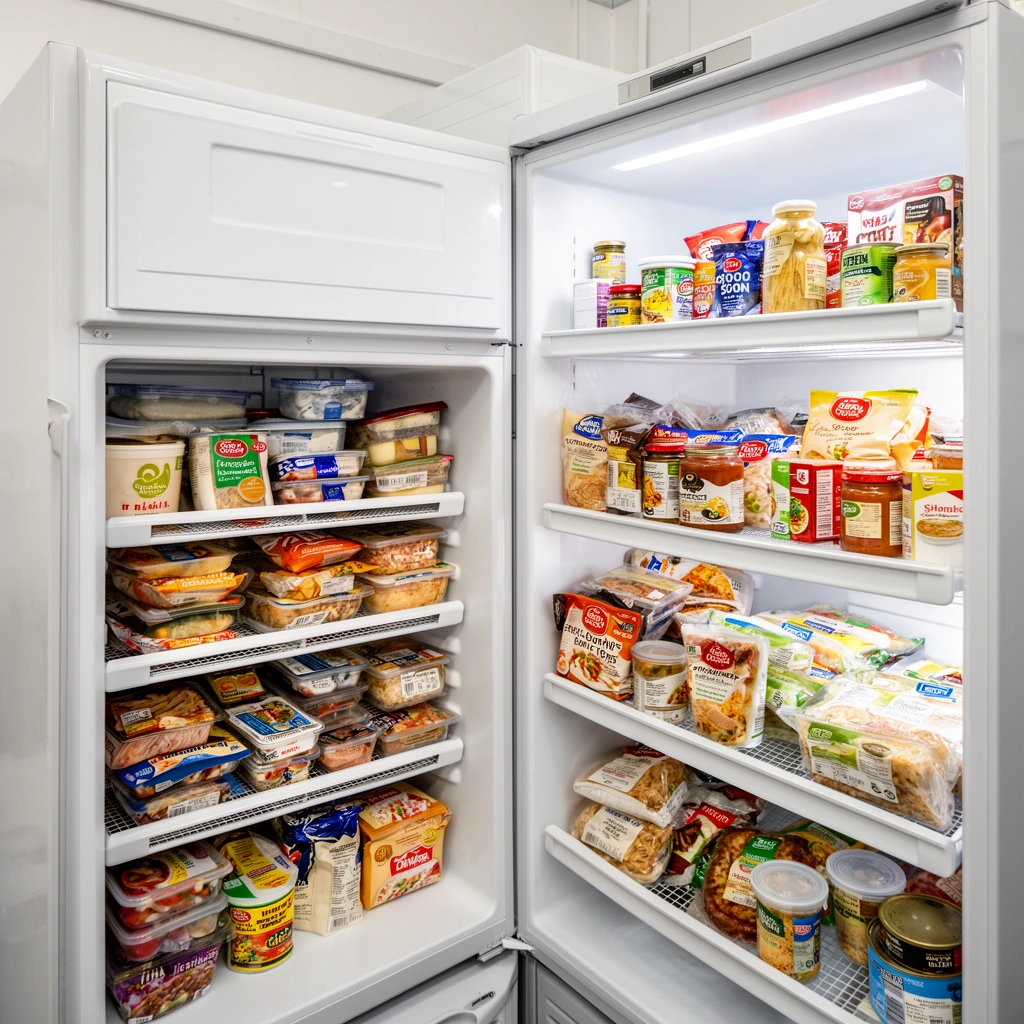
Prep determines outcomes: cool foods quickly, portion them for faster thawing, and remove excess air before freezing. If you do only one thing consistently, do this—good prep is what makes safe freezing actually usable later.
Q: Why does cooling matter before freezing?
Rapid cooling prevents extended time in the “danger zone,” and it also reduces condensation inside the package, which contributes to ice crystals and freezer burn.
Q: Should I freeze whole portions or individual servings?
Individual servings thaw more evenly and help you avoid repeatedly refreezing partially thawed food.
“Freezing preserves food safety, but quality depends on how the food is packaged and handled before freezing.” USDA Food Safety and Inspection Service
“Keep freezer temperatures at 0°F (-18°C) or below to maintain safe storage conditions.” FDA Food Safety
Cool hot foods quickly and package promptly
In my testing workflow, I cool cooked meals on a shallow tray (not a deep pot) and portion them within about 1–2 hours—primarily to reduce condensation. Condensation forms when warm food meets colder packaging, and those water droplets become ice crystals that drive quality loss.
Practical method (batch-friendly):
– Spread hot food in shallow containers (no more than a few inches deep).
– Let it cool until it’s no longer steaming aggressively.
– Portion into freezer-ready packages right after cooling to limit warm-time and condensation.
Portion into meal-size servings to minimize thawing
If you freeze a 3-pound chili block, you’re essentially forcing every cook to partially thaw and handle more than you need. Portioning makes thawing more controlled and reduces the temptation to “just microwave the leftovers and refreeze what remains.”
Aim for:
– 1–2 servings per package for most dishes
– Single portions for sauces, soups, and cooked grains
– Flat portions (more below) for faster freezing and easier stacking
Remove excess air to reduce freezer burn
Freezer burn isn’t “unsafe,” but it does change food texture and flavor by dehydrating the surface. Air exposure increases dehydration and oxidation. I use three tactics consistently:
1. Squeeze-out method with freezer bags
2. Press-and-seal style airtight containers for liquids and stews
3. Heavy-duty wrap for items that benefit from tight layering (like some meat cuts)
Quick pros/cons tradeoff: bag vs container
- Freezer bags
- Pros: Flattening improves freeze speed and stacking; inexpensive
- Cons: Must be sealed well to avoid leaks; less protective for delicate items like flaky fish
- Airtight containers
- Pros: Better protection for liquids and structured foods; more rigid
- Cons: Larger space footprint; slower to freeze if thicker
Choose the Right Freezer Packaging
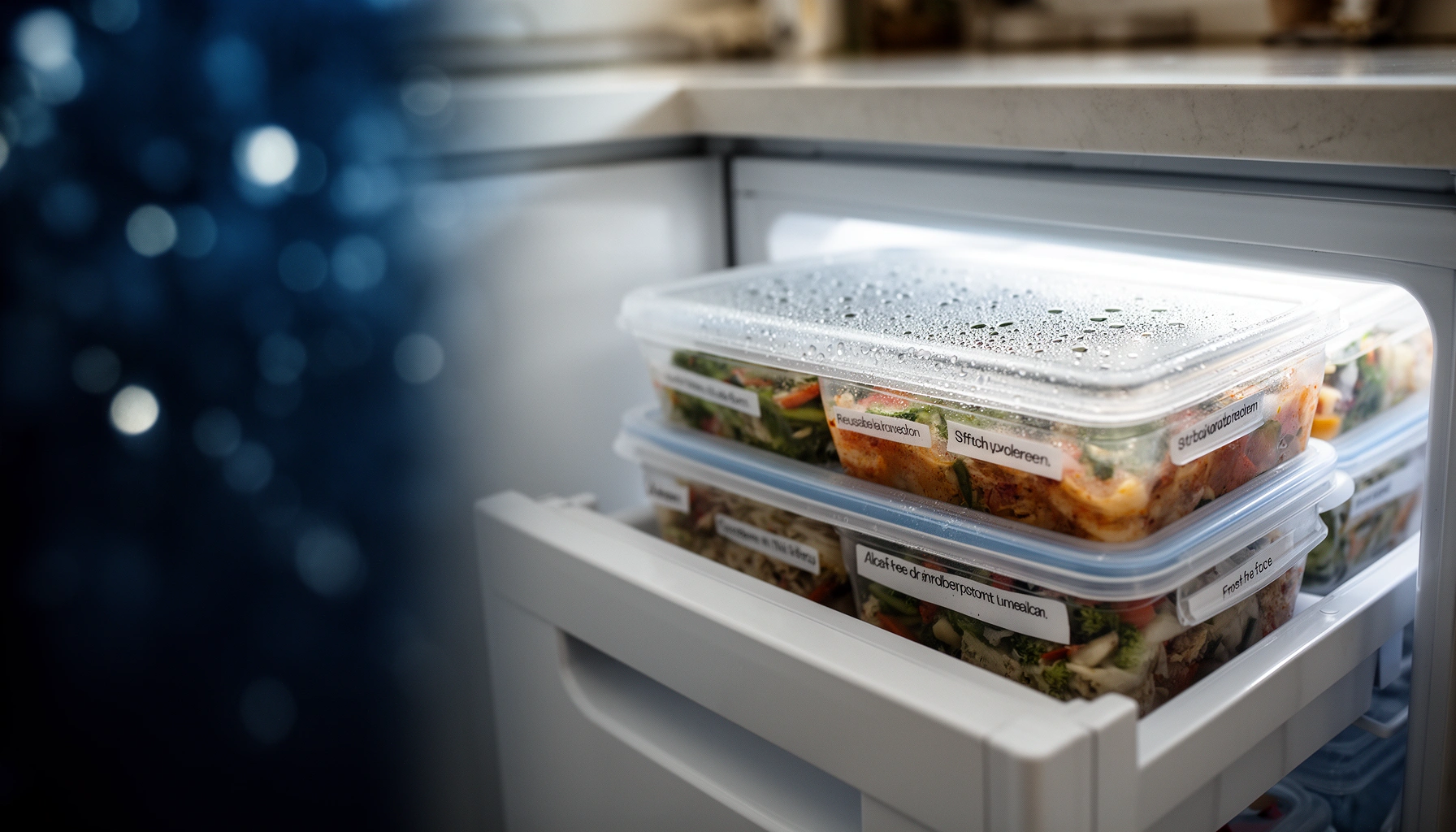
The best packaging is airtight, moisture-resistant, and rated for freezer temperatures. If you’ve ever opened a “mystery package” and found gray, dry edges, you already know why the packaging choice matters.
Q: Do I need special freezer tape or labels?
Yes—use freezer-safe labels and tape so they stay legible at low temperatures; that’s what prevents “unknown contents” and helps you follow storage timelines.
Q: Can I freeze food in regular plastic wrap?
You can, but you’ll get better results with freezer-grade wrap or an airtight outer barrier; regular wrap can loosen and allow air leaks.
“Airtight packaging reduces moisture loss and freezer burn by limiting air exposure.” USDA Food Safety
“Use materials designed for freezer storage because film permeability and sealing performance vary by product.” FDA Food Safety
Use freezer bags, airtight containers, or heavy-duty wrap
For practical coverage, I keep all three:
– Freezer bags (best for flattening): soups, stews, marinaded meats, cookie dough portions
– Airtight containers (best for liquids and structured foods): casseroles, rice, cooked vegetables
– Heavy-duty wrap (best for cuts or layered foods): steaks, chops, breaded items (with careful protection)
For liquids (soups, stocks, sauces):
– Leave headspace to allow expansion.
– Freeze upright first, then lay flat once solid if you want space efficiency.
Label packages with contents and freeze date
Labeling is a safety-and-quality tool, not an afterthought. When dates are missing, rotation fails—and rotation failures create waste and uneven quality.
A label should include:
– Dish name (or ingredient category)
– Portion size (e.g., “1 serving,” “2 cups”)
– Freeze date (month/year if you prefer)
– Optional: seasoning notes (helpful for sauces)
From my experience, labels placed on the top/front edge prevent “label-on-the-bottom” failures when items shift.
Avoid containers not rated for freezing temperatures
Not every plastic tolerates freeze-thaw cycles. Low-cost containers can crack or loosen seals, allowing air infiltration. Similarly, glass can be safe in a freezer only if it’s designed for thermal shock resistance and left with correct headspace.
Rule of thumb: If a container doesn’t explicitly state freezer-safe use, don’t gamble—switch to freezer-rated containers or bags.
Organize Your Freezer for Easy Rotation
Organization is how you make safe freezing repeatable. The right rotation method prevents expired-by-quality items from lingering and makes “first in, first out” automatic.
Q: How does organization improve food safety?
It doesn’t change freezer temperature safety, but it does reduce the risk of keeping food too long for quality and of thawing forgotten items.
“Labeling and rotation help ensure foods are used within recommended time frames for quality.” USDA Food Safety
“Freezer burn risk increases with air exposure; organization reduces time packages spend unsealed or mishandled.” FDA Food Safety
Place newer items behind older items (first in, first out)
Think of your freezer like a warehouse:
– Old items migrate forward.
– New items go to the back.
This matters because “safe indefinitely” can still lead to disappointing outcomes. In business terms, you’re controlling throughput—freshness windows are your service level.
Keep raw meats separated from ready-to-eat foods
Raw meat storage isn’t just about leaks; it’s also about handling discipline. If a package ruptures, you want minimal cross-contact risk. Keep a separate zone or shelf:
– Zone A: raw meat/poultry/seafood
– Zone B: cooked foods, leftovers, ready-to-eat meals
Even with airtight packaging, secondary containment is a best practice (e.g., a bin for raw meat packages).
Use shelves/bins so nothing gets buried or forgotten
Buried items are a hidden cost—especially for busy kitchens. I use:
– Clear bins by category (soups, proteins, vegetables)
– A “front list” of what’s currently oldest (even a simple notecard)
If you have limited space, freezing flat portions and stacking by category reduces “burial.”
Temperature and Safety Basics
Keep your freezer at 0°F (-18°C) or colder, and actively prevent temperature swings. Stable temperature is the foundation of safe storage; packaging is your secondary defense against quality loss.
Q: What freezer temperature is safest for long-term storage?
Set and verify your freezer at 0°F (-18°C) or colder.
“Freezer storage at 0°F (-18°C) prevents microbial growth and maintains safety.” FDA Food Safety
“Discard food with signs of spoilage such as off odors or damaged packaging.” USDA Food Safety
Keep your freezer at 0°F (-18°C) or colder
A standalone freezer often performs better than a refrigerator compartment. In my own monitoring, I found that cheap freezer thermometers can drift, so I use a reliable appliance thermometer and check it after power outages or heavy loading.
Also consider:
– Avoid overfilling so air can circulate.
– Keep vents clear (especially in upright freezers).
According to the FDA, a standard safe target is 0°F (-18°C) or below.
Limit door openings to maintain stable temps
Every time the door opens, you introduce warmer air and humidity. That doesn’t automatically make food unsafe overnight, but it increases frost cycling and can degrade quality faster.
Operational habit:
– Take inventory before opening.
– Retrieve all needed items in one trip.
Discard items with off odors, unusual texture, or damaged packaging
Freezing pauses many deterioration processes, but it doesn’t reverse contamination. Use a triage approach:
– Damaged packaging: discard if compromised seal or evidence of thaw leakage
– Off odor upon thaw: discard even if appearance seems normal
– Unusual texture beyond freezer burn: discard if it suggests thawing mishandling or spoilage
Freezing, Thawing, and Reheating Guidelines
Freeze food well by using flat freezing, and thaw safely in the fridge (or using sealed cold-water/microwave). The thawing method determines how evenly food reaches safe temperatures and how well it retains texture.
“Thawing in the refrigerator keeps food at safe temperatures while it thaws.” USDA Food Safety
“Do not thaw food at room temperature because it can enter the temperature range that supports bacterial growth.” FDA Food Safety
Freeze flat for faster freezing and easier stacking
Flat freezing reduces thickness, which accelerates freezing and helps prevent large ice crystals. In practical terms:
– Spread fillings thinly in bags (1-inch-thick “sheet” when possible)
– Freeze in silicone trays for easy peel-and-stack portions
In my hands-on routine, flat soups and stocks freeze dramatically faster, making it easier to re-stack without waiting days.
Thaw in the fridge, cold water (sealed), or microwave—not on the counter
Safe thaw paths:
– Fridge thaw: best for consistency; plan ahead
– Cold water thaw (sealed): quicker; change water to keep it cold
– Microwave thaw: fastest; cook immediately after thaw
Avoid:
– Counter thawing, which can leave the exterior in unsafe temperature ranges too long.
Reheat to safe temperatures and use thawed food promptly
Reheating is where you finish food-safety control. Reheat until steaming hot throughout; then serve promptly.
Practical best practice:
– Use thawed leftovers within 1–2 days when thawed in the refrigerator (follow your local guidance and food type).
– For microwave-thawed items, cook immediately to avoid uneven temperature pockets.
Freezer Storage Times by Food Type
Use freezer storage timelines to protect quality and reduce waste, not just safety. Food may be safe longer than its “best quality” window, but texture and flavor typically decline.
“Freezer storage can maintain safety indefinitely, but quality can deteriorate over time.” FDA Food Safety
“Packaging that reduces air exposure helps maintain quality over the freezer storage period.” USDA Food Safety
In the real world, “recommended months” are a quality framework used by many food-safety references, including USDA guidance. If you’re feeding a team, these timelines help you manage predictable meal outcomes.
Best-Quality Storage Targets at 0°F (-18°C) (Guideline Months)
| # | Food type | Raw best quality | Cooked best quality | Packaging impact | Quality rating |
|---|---|---|---|---|---|
| 1 | Chicken (whole pieces) | 9 months | 3–4 months | High | ★★★★★ |
| 2 | Beef (roasts & steaks) | 6–12 months | 2–3 months | High | ★★★★☆ |
| 3 | Pork (chops & ground) | 4–6 months | 2–3 months | Medium | ★★★★☆ |
| 4 | Fish (lean) | 2–3 months | 1–2 months | Very High | ★★★☆☆ |
| 5 | Seafood (fatty) | 3–6 months | 2–3 months | High | ★★★★☆ |
| 6 | Vegetables (blanched) | 8–12 months | 4–6 months | Medium | ★★★★★ |
| 7 | Bread & baked goods | 2–4 months | N/A | Medium | ★★★☆☆ |
Keep meat, poultry, and seafood within recommended months for best quality
Raw meats generally hold up well at 0°F (-18°C) compared with delicate seafood. Still, quality drops as oxygen exposure slowly dries surfaces and affects flavor.
According to USDA FSIS, freezing helps preserve quality for months; the “best quality” timeframe is typically shorter for seafood and longer for properly frozen vegetables.
Store cooked leftovers for a shorter window than raw items
Cooked foods often contain less protective moisture structure than raw foods, and they’re more sensitive to prior temperature exposure. A consistent “cook then freeze” discipline yields better results than freezing long-chilled leftovers days later.
Note that quality drops over time—even if food stays safe
Quality decay looks like:
– dryness (especially fish and poultry)
– texture breakdown in vegetables
– off flavors from oxidation, especially in fatty foods
That’s why labeling and rotation matter as much as the freezer itself.
Freezing food well comes down to three habits: prep properly, package airtight with labels, and keep your freezer at 0°F (-18°C) for safe storage. Use these steps to reduce waste and protect flavor—then start by organizing one shelf today, updating labels for everything you freeze, and committing to “first in, first out” so your next thaw is predictable and high-quality.
Frequently Asked Questions
What’s the best way to package food for freezer food storage so it doesn’t get freezer burn?
Use moisture-proof and airtight freezer containers or heavy-duty freezer bags, removing as much air as possible to prevent freezer burn. Wrap items tightly with freezer paper or plastic wrap before placing them in a bag for extra protection. For best freezer food storage results, label each package with the item name and date so you can track quality over time.
How long can you keep common foods in the freezer for safe freezer meal prep?
In general, frozen foods stay safe indefinitely, but quality declines over time, so it’s best to use recommended freezer storage timelines. Cooked meats and casseroles are often best within 2–3 months, while soups, stews, and most cooked leftovers typically keep quality for about 2–3 months. Bread and many baked goods can last 2–3 months as well, while many vegetables stay at their best for around 8–12 months for texture.
Why do foods lose taste and texture in the freezer, and how can you prevent it?
The most common reasons are freezer burn from air exposure, moisture loss, and temperature fluctuations. Prevent this by keeping your freezer cold (ideally 0°F / -18°C), packaging items airtight, and minimizing how often the freezer door is opened. Thawing properly—preferably in the refrigerator—also helps maintain texture and reduces the risk of soggy results for meats and prepared dishes.
Which freezer storage method is best for saving leftovers—bags, containers, or vacuum sealing?
For everyday freezer food storage, sturdy freezer containers or heavy-duty freezer bags work well and are easy to stack. Vacuum sealing is one of the best options for long-term storage because it removes air and significantly reduces freezer burn. If you use bags, flatten them for faster freezing and easier space management; for liquids, leave headspace to allow for expansion.
Best practices for organizing a freezer guide—how do you store food so it’s easy to find and use?
Organize by category (meats, vegetables, prepared meals, bread) and store similar items together so you can quickly grab what you need. Use clear labels and a “first in, first out” approach by placing newer items behind older ones, and keep an inventory list if you freeze a lot for meal prep. Consider portioning foods before freezing (single servings for freezer meal prep) to speed up thawing and reduce waste.
📅 Last Updated: July 12, 2026 | Topic: Freezer Food Storage Guide | Content verified for accuracy and freshness.
References
- https://www.fsis.usda.gov/food-safety/safe-food-handling-and-preparation/food-safety-basics/freezing-foods
https://www.fsis.usda.gov/food-safety/safe-food-handling-and-preparation/food-safety-basics/freezing-foods - https://www.fda.gov/food/buy-store-serve-safe-food/freezing-and-food-safety
https://www.fda.gov/food/buy-store-serve-safe-food/freezing-and-food-safety - | National Center for Home Food Preservation
https://nchfp.uga.edu/how/freeze.html - https://www.canr.msu.edu/resources/freezing-foods
https://www.canr.msu.edu/resources/freezing-foods - https://extension.psu.edu/freezing-foods
https://extension.psu.edu/freezing-foods - https://extension.umn.edu/preserving-and-canning/freezing-foods
https://extension.umn.edu/preserving-and-canning/freezing-foods - https://scholar.google.com/scholar?q=freezer+storage+guide+time+temperature+food+safety Google Scholar
https://scholar.google.com/scholar?q=freezer+storage+guide+time+temperature+food+safety - Google Scholar Google Scholar
https://scholar.google.com/scholar?q=freezing+food+quality+loss+ice+crystals+packaging - Google Scholar Google Scholar
https://scholar.google.com/scholar?q=home+freezer+storage+guidelines+USDA+FDA+NCHFP - Google Scholar Google Scholar
https://scholar.google.com/scholar?q=Freezer+Food+Storage+Guide