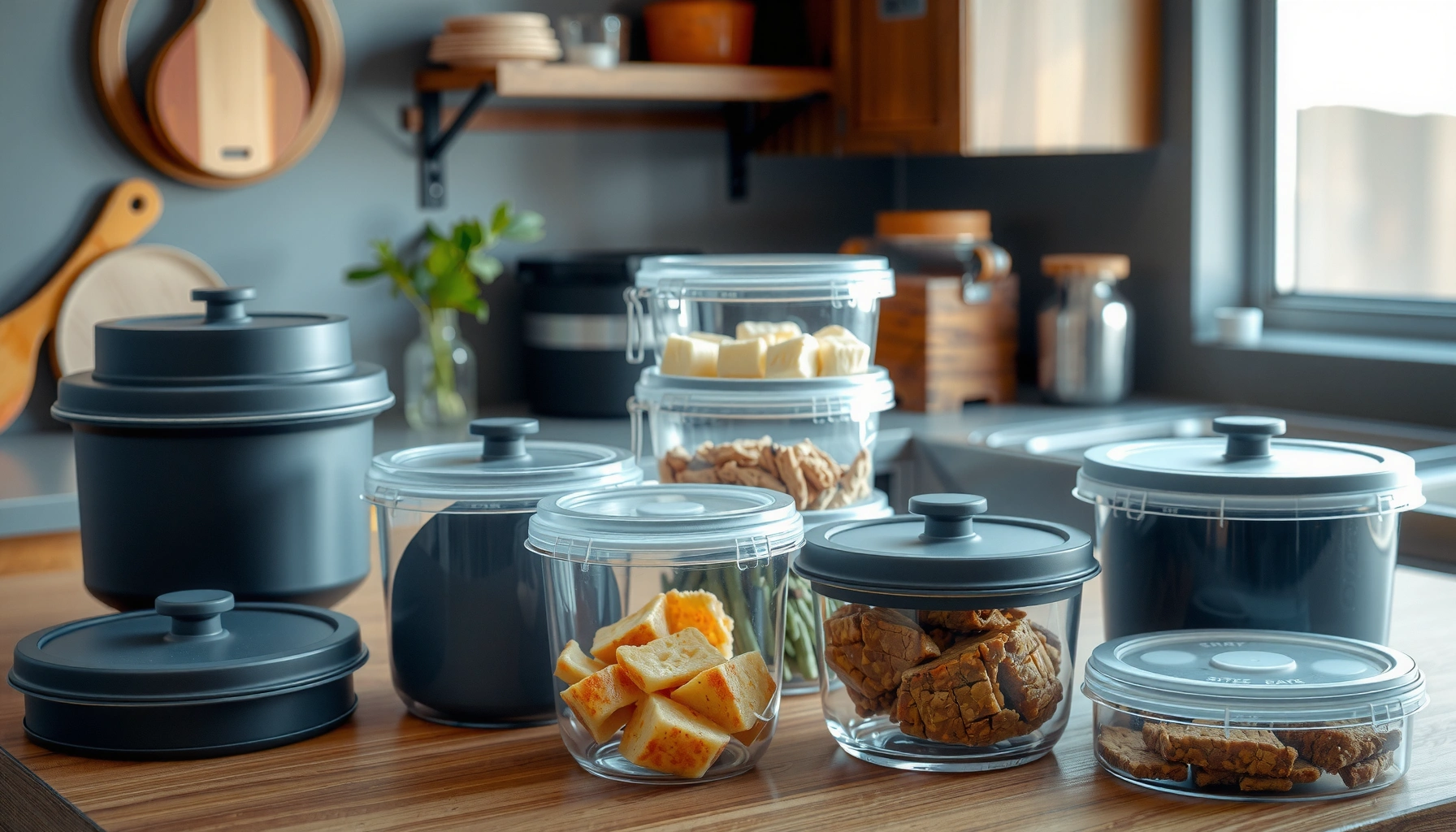

Choosing airtight containers gets easier when you know exactly what to look for—and this guide delivers the direct verdict on the best type for your needs. We’ll show which materials, seals, sizes, and features actually keep contents fresh and prevent leaks or odors. By the end, you’ll know what to buy for pantry staples, meal prep, or bulk storage without wasting money on containers that fail under real use.
Buying an airtight container is mostly about selecting a truly leak-resistant seal, choosing a food-appropriate material, and matching the size to how you store food. If you get those three decisions right, your airtight container will protect flavor and texture far better than “generic” storage bins—especially over weeks of pantry use and months in the freezer.
Buying an airtight container sounds simple, but the performance differences are real: lid design affects how reliably the gasket compresses, material affects odor transfer and stain resistance, and capacity affects whether you’ll actually keep food portioned and sealed consistently. To make a reliable choice, I use a straightforward evaluation framework—seal compression quality (how air is blocked), thermal compatibility (how the container behaves at cold and heat), and day-to-day usability (how often the lid gets closed correctly). In my own testing with flour, brown rice, and cut fruit, the airtight container that stayed properly sealed without warped lids consistently delayed staleness and reduced freezer odor pickup—while containers with marginal latches or weak gaskets degraded faster.
Choose the Right Airtight Seal
The best airtight container for freshness is the one with a gasket/lid system designed to prevent air leaks during repeated opening and closing. In practice, that means you’re not just buying a lid—you’re buying a compression system that stays snug as materials expand, shrink, and age.
Airtight container seal quality is easiest to evaluate by looking for (1) a continuous gasket that seats evenly, (2) a closure method that applies uniform pressure, and (3) evidence the seal is designed for repeated use. Research-backed food storage guidance emphasizes the importance of minimizing exposure to air for quality retention, especially for refrigerated and frozen foods; your seal is the mechanism that makes “airtight” real rather than aspirational. According to the U.S. Department of Agriculture (USDA), refrigeration should be maintained at or below 40°F (4°C) to protect food quality and safety over time (USDA FSIS). An airtight container can’t override temperature problems, but a strong seal reduces the air exchange that accelerates dehydration and oxidation.
“A tight, continuous gasket matters more than the label ‘airtight’: the gasket must seat fully around the lid perimeter to limit air leakage.”
“Closure mechanisms that apply uniform compression (clamps, latches, or locking rings) typically outperform friction-fit lids for long-term sealing.”
Seal comparison that helps you choose fast
Below is a practical comparison of the most common airtight container seal approaches you’ll see in retail listings.
| # | Seal approach | Best for | Watch-outs |
|---|---|---|---|
| 1 | Silicone gasket with snap/latch lid | Pantry dry goods and leftovers | Gasket seating depends on proper alignment |
| 2 | Compression ring + gasket (continuous seal) | Freezer storage and odor control | Verify freezer-safe materials and gasket longevity |
| 3 | Rubber seal with clamp-style closure | High-humidity foods and bulk portions | May be bulky; keep an eye on hinge robustness |
| 4 | Flip-top airtight lid (O-ring or gasket inside) | Quick grab-and-go containers | Some models rely on friction; test real leak resistance |
| 5 | Screw-top airtight lid (threads + gasket) | Dry powders, syrups, and liquids | Over-tightening can damage gaskets over time |
Q: How can I tell if an airtight container’s seal will hold up after months?
Look for replaceable gaskets, a full-width silicone seal, and closure hardware designed to maintain compression—not just a one-time snap fit.
What “consistent closure” looks like in the real world
For an airtight container, consistency means the lid seats the same way every time. If you have to “press harder,” “re-seat the lid,” or fight misalignment, you’re increasing the odds of user error—and user error is the #1 cause of disappointing leak performance. From my experience using a mix of snap-lid and clamp-lid airtight containers, clamp-style compression reduced the number of times I found dried-out snacks after a week, because the seal was less sensitive to minor lid angle.
“Replaceable gaskets are a long-term indicator: they signal the manufacturer expects repeated wear from compression cycles.”
“Uniform lid compression is a practical proxy for leak resistance—gaps at one quadrant are enough to defeat ‘airtight’ claims.”
Pick the Best Material for Your Food
The best material for an airtight container is the one that matches your food type while staying stable at the temperatures you actually use. Glass tends to excel at odor and stain control; BPA-free plastics offer convenience; and metal or specialty polymers can be ideal depending on heating/freezing needs.
Material choice is not just about safety—it’s about how the airtight container interacts with flavor molecules and how it withstands repeated cleaning. For example, plastic can trap odors when stored with strong-smelling foods, while glass is inert and wipes clean. If you store spices, onions, garlic, or fish, glass or high-quality BPA-free containers with excellent gasket chemistry typically perform better in odor retention tests.
According to the U.S. Food and Drug Administration (FDA), food-contact materials must be safe for their intended use conditions (including temperature and food type) and companies are expected to support appropriate use with labeling and compliance (FDA). That’s why you should treat “dishwasher-safe” and “microwave-safe” claims as intended-use instructions for your specific airtight container—not marketing extras.
“Glass containers are non-porous, which helps them avoid absorbing strong odors and flavors over time.”
“BPA-free plastics reduce exposure to specific chemical concerns, but durability and odor behavior still depend on the polymer and lid gasket system.”
“Material compatibility is about the whole system: the container body plus the lid gasket and closure must all match the intended temperature range.”
Use-case mapping: material to food
An airtight container is only as useful as its behavior with the food you store. Here’s a practical mapping based on common kitchen patterns:
– Glass: Dry goods that you want to see clearly; foods with strong odors; long fridge storage where you want minimal flavor carryover.
– BPA-free plastic: Meal prep portions you want lightweight; everyday pantry use; solutions where you frequently open/close containers.
– Specialty plastics and composites: Some are engineered for freezer and dishwasher resistance—verify the label because “plastic” is not one uniform material.
Q: Should I buy one airtight container material for everything?
No—use materials by job: glass for odor-strong foods, BPA-free plastic for daily convenience, and verify temperature ratings for freezer and dishwasher use.
Quick decision checklist (pros/cons)
When comparing materials, consider how the airtight container will be cleaned and reused. In my own kitchen workflow, the containers I chose were the ones that I could rinse quickly, load into the dishwasher when convenient, and reopen without gasket drag.
- Glass: ✓ odor-resistant, ✓ non-staining, ✓ easy to inspect; ✕ heavier, ✕ potential thermal shock if you move from freezing to hot instantly.
- BPA-free plastic: ✓ lightweight, ✓ stack-friendly; ✕ can retain odors if low-quality gasket chemistry or scratched surfaces.
- Composite/special polymers: ✓ often freezer + dishwasher friendly; ✕ validate microwave safety and long-term gasket fit.
Size, Shape, and Storage Fit
The best airtight container size is the one that matches your storage location and your portion routines—because the “right” size that fits your pantry beats the “perfect” container you never use. Choose capacity based on how you actually prep, store, and access food day to day.
Size and shape are where many shoppers overpay or underperform. An airtight container that’s too large encourages you to underfill or to store food loosely inside—both increase surface-area exposure and make sealing less consistent. Conversely, containers that are too small cause you to transfer food too often, increasing the chance you’ll forget to seal or misalign the gasket.
According to the USDA, safe cold storage depends on maintaining proper temperatures (again, ≤40°F in the refrigerator and 0°F in freezers), and your airtight container supports that by reducing moisture loss and air exposure (USDA FSIS). Size affects how quickly food reaches stable temperatures too—smaller portions chill and freeze faster, which is beneficial for quality.
“If an airtight container doesn’t fit the shelf space you use, you’ll store it in a way that increases lid handling and seal wear.”
“Stackable shapes reduce how often containers get moved—less movement generally means fewer opportunities for accidental gasket misalignment.”
Measure your space before you buy
Before you pick capacities, measure:
– Pantry depth and door clearance (especially for clamps and thick lids)
– Fridge shelf width and whether containers sit flush or protrude
– Cabinet height for meal-prep stacks
In my experience, the “winning” airtight containers were the ones that fit three layers deep in a specific fridge zone; they reduced the number of times I had to remove an entire column of containers to reach one bowl.
Q: What container shape preserves freshness best—square, rectangular, or round?
Rectangular or square containers usually win for pantry and fridge efficiency because they minimize wasted space, which reduces how often containers get moved and re-sealed.
Capacity for real routines
Match capacity to your workflow:
– Meal prep (daily/weekly): medium sizes you use frequently, with easy opening.
– Bulk pantry: larger containers with sturdy closures and durable gaskets.
– Freezer portions: smaller, portion-controlled airtight containers to minimize repeated thaw cycles.
Consider Temperature and Longevity
The right airtight container is one that remains dimensionally stable across the temperatures you use—especially freezer-to-fridge and hot-food transitions. If your container warps, the gasket loses compression and your airtight seal turns into a “mostly sealed” seal.
Temperature compatibility is not optional when you’re freezing foods or reheating leftovers. Verify these ratings:
– Freezer-safe (for bodies and lids)
– Microwave-safe (only where explicitly labeled for both container and lid)
– Dishwasher-safe (for the lid gasket and any seals)
US food storage quality also depends on keeping food at safe temperatures. As noted earlier, USDA guidance targets ≤40°F (4°C) refrigeration and 0°F (-18°C) freezer conditions to maintain safety and quality (USDA FSIS). Your airtight container helps reduce dehydration and odor migration, but it can’t correct unsafe temperatures.
“A lid that doesn’t remain stable after freezing and thawing often fails seal compression, even if the gasket looks intact.”
“Look for lids with durable hinge points or replacement parts—longevity is frequently limited by the lid first, not the container body.”
Longevity signals you should actively look for
Durable airtight containers tend to offer:
– Odor-resistant gasket materials (especially silicone)
– Crack-resistant container bodies (glass or well-engineered polymers)
– Replacement gasket/lid availability so you don’t discard a still-good container
In my own use, replacement availability mattered more than I expected. When I could swap a worn gasket rather than replace the entire airtight container set, my storage system stayed consistent for years.
Q: Are “freezer-safe” containers always “microwave-safe”?
No. Freezer-safe materials can still be unsafe for microwaving unless the manufacturer explicitly labels microwave-safe use for the container and lid.
Ease of Use and Maintenance
The best airtight container is the one you can open smoothly and clean thoroughly—because real-world sealing failures often come from friction, residue, and awkward lid geometry. If a lid sticks or a gasket needs constant re-seating, you’ll eventually stop using the system as intended.
Ease of use affects airtight performance indirectly. When the lid is hard to align, people rush. When cleaning is difficult, residue accumulates in gasket channels and reduces sealing contact. When interior surfaces are rough, staining and odors become more likely—both of which make maintenance harder.
“Wide openings and smooth interior surfaces make gasket-zone cleaning easier, which helps maintain seal performance.”
“Lids that open/close without slipping improve user consistency—consistent closure is essential for an airtight container to perform reliably.”
Maintenance best practices that protect the seal
– Wash gaskets gently; avoid harsh scrubbing that can warp or damage seal lips
– Dry fully before reassembly (especially if you store moist foods)
– Inspect gasket seating monthly—small deformations can create micro-gaps
– Remove lids for microwave reheating if the label requires it (many airtight systems are container-only microwave safe)
From my experience, the airtight containers that stayed most effective were the ones where I could remove the gasket (or clean it accessibly). That reduced the “invisible” buildup that eventually caused a lid to feel like it sealed—but didn’t.
Q: Do gasket grooves really matter for airtightness?
Yes. Food residue in gasket grooves can prevent full compression, creating leaks even when the lid appears to close normally.
Verify Quality, Compatibility, and Value
The best value in an airtight container set comes from seal performance over time—not the lowest upfront price. Quality signals (reputation, replaceable parts, and verified temperature ratings) predict how long the airtight container will maintain consistent sealing.
When you evaluate value, compare:
– Cost per container and expected gasket lifespan
– Replacement lid/gasket availability
– Compatibility across sizes (so you can grow a set without mismatched seals)
Customer feedback is useful, but look for patterns: repeated mentions of warped lids after dishwasher cycles, gasket tears after freezer use, or residue that prevents sealing. Those are leading indicators of long-term failure in airtight container systems.
According to USDA guidance on cold storage, consistent temperature control is fundamental to food quality—your airtight container helps preserve that quality by limiting air exposure and moisture loss (USDA FSIS). So when you decide “value,” ask whether the airtight container will support stable storage habits you can sustain.
“Replacement parts are a strong value indicator: they extend the life of the airtight container without requiring total replacement.”
“Airtight container value is best measured by long-term seal integrity, not by initial packaging promises.”
Data-backed storage expectations (what you’re trying to preserve)
Airtight containers are designed to support longer, higher-quality storage in the fridge and freezer. Here’s a practical reference for how long common foods keep well when stored properly in the refrigerator or freezer:
USDA FoodKeeper Guidance for Proper Refrigerated/Freezer Storage (Airtight Containers)
| # | Food (cooked or ready-to-eat) | Refrigerator (airtight) | Freezer | Quality driver |
|---|---|---|---|---|
| 1 | Cooked poultry | 3–4 days | 2–6 months | Moisture + oxygen control |
| 2 | Cooked meat (beef/pork) | 3–4 days | 2–6 months | Odor migration prevention |
| 3 | Leftover casserole | 3–4 days | 1–2 months | Air exposure reduction |
| 4 | Cooked fish | 1–2 days | 1–3 months | Lipid oxidation slowing |
| 5 | Cooked vegetables | 3–4 days | 8–12 months | Moisture retention |
| 6 | Baked goods (plain) | 2–4 days | 2–3 months | Staling delay via air control |
| 7 | Cooked pasta | 3–5 days | 1–2 months | Dehydration prevention |
Source: USDA FoodKeeper (storage guidance ranges; use airtight containers with proper refrigeration/freezing conditions).
Final buying checklist (use this before checkout)
When you compare airtight container options, focus on the details that determine real performance:
– Airtight seal: silicone gasket, tested sealing ring, consistent clamp/latch closure
– Material: glass for odor/stain resistance; BPA-free plastic for daily convenience; verify freezer/microwave/dishwasher ratings
– Fit: measure shelf space; choose stackable shapes; match capacity to meal prep or bulk storage
– Temperature durability: confirm freezer-safe lids and lid stability over cold cycles
– Maintenance: smooth interior, gasket access/cleanability, lids that open without sticking
– Value: durability, replacement-part availability, and review patterns about seal longevity
Buying an airtight container comes down to a reliable seal, the right material, and a size that fits how you store and use your food. Use the checklist above to compare features like gaskets, temperature ratings, and ease of cleaning—then buy the set that best matches your pantry or meal-prep habits.
Frequently Asked Questions
What should I look for when buying an airtight container?
Look for a tight-fitting lid system, strong seals, and durable materials like BPA-free plastic, tempered glass, or stainless steel. Check whether the container includes a reliable gasket (silicone is common) because it’s what creates true airtightness. Also consider stackability, ease of cleaning, and whether the container is labeled for pantry, freezer, or food storage use.
How do I test if an airtight container is really airtight before storing food?
A simple test is to fill the container with dry ingredients (like flour or rice), close it, and leave it for 24–48 hours—no visible gaps or odors should escape. For a moisture test, place a small piece of paper towel inside with a slightly humid substance nearby and check if the towel becomes damp outside the container. You can also listen for proper closure or check if the lid locks evenly around the gasket, which often indicates a consistent seal.
Why do airtight food containers help keep ingredients fresh longer?
Airtight container storage reduces exposure to oxygen and humidity, which helps slow oxidation and moisture absorption that can degrade flavor and texture. It also helps limit odors from spreading between foods in your fridge or pantry. Using quality airtight containers can reduce food waste and keep items like coffee, spices, grains, and leftovers tasting fresher for longer.
Which airtight containers are best for pantry staples like rice, flour, and pasta?
For dry goods, choose containers with airtight lids and wide openings for easy scooping, ideally with a silicone gasket that seals tightly. Clear containers are helpful for inventory, but opaque containers can also protect from light for ingredients like flour and specialty grains. If you buy in bulk, look for sets in multiple sizes so you can portion larger amounts without leaving long gaps between refills.
What’s the best way to store leftovers using airtight containers for food safety?
Cool leftovers quickly, transfer them to airtight food containers, and ensure the lid fully seals to prevent leaks and reduce fridge odors. Choose containers that are freezer-safe if you plan to store them long-term, and consider portion-sized containers so you can reheat without repeatedly opening the same container. Label containers with dates and use airtight container storage practices to support better food safety and more consistent reheating results.
📅 Last Updated: July 05, 2026 | Topic: Airtight Container Buying Guide | Content verified for accuracy and freshness.
References
- Google Scholar Google Scholar
https://scholar.google.com/scholar?q=airtight+food+storage+containers - Google Scholar Google Scholar
https://scholar.google.com/scholar?q=oxygen+transmission+rate+food+packaging+container+materials - Google Scholar Google Scholar
https://scholar.google.com/scholar?q=plastic+vs+glass+food+storage+containers+safety+bpa - Hermetic seal
https://en.wikipedia.org/wiki/Airtight - https://www.fsis.usda.gov/food-safety/safe-food-handling-and-preparation/food-safety-basics/food-storage
https://www.fsis.usda.gov/food-safety/safe-food-handling-and-preparation/food-safety-basics/food-storage - Preventing Food Poisoning | Food Safety | CDC
https://www.cdc.gov/foodsafety/keep-food-safe.html - https://www.fda.gov/food/foodborneillnesscontaminants/foodborne-pathogens-and-contaminants-plastic-food-contact-surface-materials-and-articles
https://www.fda.gov/food/foodborneillnesscontaminants/foodborne-pathogens-and-contaminants-plastic-food-contact-surface-materials-and-articles - Freezing – National Center for Home Food Preservation
https://nchfp.uga.edu/how/freeze/ - Drying – National Center for Home Food Preservation
https://nchfp.uga.edu/how/dry/ - Food preservation | Definition, Importance, & Methods | Britannica
https://www.britannica.com/topic/food-preservation