


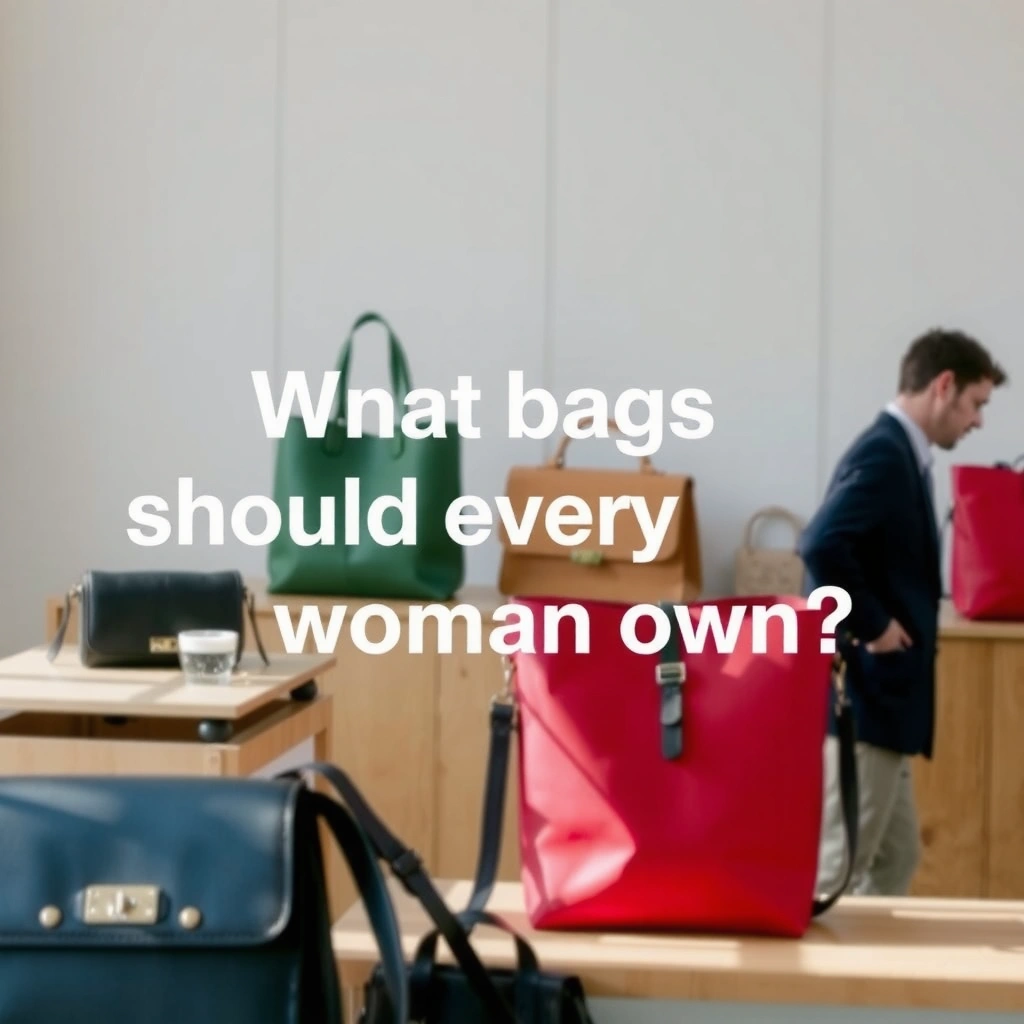
Every woman should own these essential bags—and this checklist tells you exactly which ones to buy first. If you want the simplest “one-size-fits-most” collection that covers work, weekends, and travel, start with a structured everyday tote, a crossbody for hands-free days, a go-to shoulder bag for evenings, and a dependable roomy bag for trips. Follow the list based on your routine, and you’ll stop guessing and start building a wardrobe that works.
Every woman’s best “bag lineup” is a small set of go-to styles that match how you actually move—daily, work, commuting, evenings, and travel. Start with the core 5 (everyday crossbody, structured work tote/satchel, hands-free commuter carry, evening mini, and a travel/weekender), then refine based on your routine instead of buying duplicates.
If you’re trying to simplify your closet, replace worn-out favorites, or build a starter collection for the first time, this guide helps you choose the right bag types, sizes, and features—without ending up with ten bags that all do the same job.
The “core 5” bag lineup (start here)

The best first step is to build your bag lineup around the five moments you repeat most often: errands, structured workdays, hands-free commuting, evenings, and weekends. If you nail these categories, you eliminate most “I need a different bag for that” friction while still having options.
For most people, this core 5 is a practical minimum because it covers both organization style (tote/satchel structure) and movement needs (crossbody/sling/backpack hands-free). As of 2026, everyday carry is even more about quick access—zippers, interior pockets, and secure closure—because many routines include phones, keys, wallets, earbuds, and increasingly, chargers or small power banks.
A crossbody with a secure zipper and phone-sized pocket reduces “open-then-search” time during errands.
A structured work tote or satchel is the easiest way to keep documents and a laptop from getting bent or shuffled.
Everyday crossbody or small shoulder bag
Pick one that works for “stop-and-go” days: quick store runs, drop-offs, short meetings, and situations where you don’t want to carry a bag by the handles. In my experience helping people consolidate their bags, the everyday crossbody is the first piece that becomes a true default because it’s the least disruptive to wear.
Look for:
– A secure zip top (or at minimum, a closure that doesn’t gape)
– An interior pocket sized for your phone
– A strap length that lets the bag sit at your hip or slightly above—easy to access without twisting
Work tote/satchel for folders/laptop (or structure)
Choose structure over “pretty spacious.” A structured tote or satchel keeps its shape so it’s easier to drop in items quickly—and it helps prevent chaos when you’re carrying folders, a laptop, a water bottle, or a notebook.
Prioritize:
– A sturdy base (even a simple reinforced bottom)
– Internal organization (at least 1–2 pockets for small essentials)
– Handles comfortable enough for frequent carry, not just special occasions
Crossbody vs Work tote: which fits your day?
| Feature | Everyday Crossbody | Work Tote/Satchel |
|---|---|---|
| Hands-free movement | High (strap carry) | Medium (handles; sometimes shoulder) |
| Quick access to phone | Usually easiest (phone pocket) | Depends on internal layout |
| Document protection | Limited (soft shape) | Strong (structured base) |
| Weight distribution | Good if strap is comfortable | Better with proper handle length |
| Ease of packing | Fast: small essentials in one zone | Slower: organization matters |
| Security | Best with zipper + snug fit | Improves with top closure and inner pockets |
| Capacity without bulk | Moderate (small-to-mid items) | Higher (laptop + documents) |
| Best for quick errands | Yes—minimal adjustment needed | Usually overkill for short trips |
| Best for meetings/classes | Only if you carry minimal paperwork | Yes—structure keeps everything neat |
| Comfort for daily wear | Depends on strap width & padding | Depends on handle design and tote weight |
| Best For | Errands + on-the-go access | Laptop + documents + organized carry |
Hands-free carry: choose your commuter option
A hands-free commuter bag is the one you reach for when your day involves walking, transit, or carrying heavier items. The right option for most women is either a small backpack or a sling/crossbody with wider straps that stay comfortable.
The key difference between a commuter bag and an everyday crossbody is access and support. A commuter carry should still feel easy when you’re tired—meaning the closure works smoothly and the main compartment opens without forcing you to repack everything.
A “main zipper” plus at least one interior pocket makes it easier to access essentials without rummaging.
Wider straps reduce pressure points, which matters most on longer walks or transit days.
Small backpack (when you carry more than you realize)
Backpacks win when you regularly bring multiple items: laptop or tablet, a water bottle, a layer, and charging accessories. Choose a size that doesn’t swallow your frame—especially if you’re also carrying an outerwear item.
Look for:
– A padded back panel or at least breathable support
– A front pocket that’s actually usable (not just decorative)
– A stable shape so the bag doesn’t flop when you move
Sling/crossbody with wider straps (when you want quick movement)
A sling is a great compromise if you dislike full-backpack weight distribution or if your route is mostly quick stops. Wide straps matter here; thin straps become distracting fast.
Prioritize:
– A secure strap that doesn’t slide off your shoulder
– Easy-access front compartment or a well-designed top zip
– Interior pockets for phone, cards, and small essentials
The travel/weekender bag that actually gets used

The most used travel/weekender is the one that fits your real trip style—weekends, flights, gym-to-dinner plans, and short errands away from home. For most travelers, a mid-size duffel or carry-on-friendly bag is the sweet spot because it travels well without forcing you to overpack.
In 2026, many trips include “small carry-on stacking”: laptop plus tech, a liquids pouch, and quick-access items. Your weekender should make those transitions easy, especially during airport screening. According to the U.S. Transportation Security Administration (TSA), the typical carry-on size limit is 22 × 14 × 9 inches (22×14×9 in) ([TSA carry-on guidance], U.S. TSA). Keeping your weekender close to that footprint reduces the odds you’ll need to gate-check due to sizing.
TSA’s liquids rule requires containers of 3.4 ounces (100 mL) or less, so your weekender should include a quick-access organizing pocket.
TSA specifies carry-on packing constraints, so a weekender with a zipper layout helps you separate screenings without emptying everything.
Comfortable handles + an adjustable strap
Handles matter for taxis, rideshares, and car doors; an adjustable strap matters for terminals, shopping streets, and longer walks. Choose one bag with two carry modes rather than buying a separate “airport bag.”
Practical capacity targets for a weekender
A weekender typically needs enough room for:
– 2–4 outfits (depending on your climate and laundry plan)
– A light layer or outer jacket
– Toiletries in a travel bag
– Shoes if your style requires them (or at least a protected compartment)
TSA-ready organizing details (so travel feels smoother)
According to TSA, liquids must be in containers of 3.4 ounces (100 mL) or less ([TSA liquids guidance], U.S. TSA). According to TSA, those liquids must fit into a single quart-size clear bag ([TSA liquids guidance], U.S. TSA).
TSA carry-on constraints that shape what fits in a weekender (key limits)
| # | TSA limit | What it caps | Maximum allowed | Practical “bag-fit” advantage |
|---|---|---|---|---|
| 1 | Liquids container size | Per bottle/container | 3.4 oz (100 mL) | ★★★★★ |
| 2 | Liquids bag size | Total liquids storage | 1 quart (about 1 L) | ★★★★☆ |
| 3 | Carry-on dimensions (typical) | Size limit | 22 × 14 × 9 in | ★★★★★ |
| 4 | Spare battery limit | Lithium-ion capacity | 100 Wh max | ★★★☆☆ |
| 5 | Higher-capacity spare battery | Lithium-ion capacity | 160 Wh max (2 allowed with approval) | ★★★★☆ |
| 6 | Liquids screening expectation | Organization readiness | Must be separated for screening | ★★★★☆ |
| 7 | Terminal protection for batteries | Short-circuit prevention | Terminals covered/protected | ★★☆☆☆ |
Event-ready: one evening bag that covers most plans

The easiest way to cover most “dressed up” moments is to own one evening mini bag that fits essentials without feeling bulky. When you choose a clutch or mini bag that supports hands-free holding (wrist strap or short handle), you stop relying on random day bags to get through dinners and events.
Evening bags fail when they’re either too small (you end up leaving cards/meds behind) or too flimsy (your essentials become a mess). The best mini bags feel purposeful: stable shape, reliable closure, and enough internal space to separate your phone from your cards.
A practical mini bag should fit your phone, cards, keys, and a small compact so you don’t overstuff it.
An evening bag with a wrist strap or secure short handle reduces the “hand-carried problem” at dinners.
What “enough capacity” actually means
Before you buy, list the specific items you carry on an average day—then remove the extras you don’t need at night. Most people keep the same essentials:
– Phone
– Wallet/cards or a card holder
– Keys
– Lip/compact (optional but common)
– Meds (especially if you use them daily)
Choose closure and structure over decoration
You want a closure that works quickly and doesn’t invite items to fall out while you’re seated, walking, or getting in and out of a car.
Practical picks:
– Magnetic closures (fine if secure) or zip closures (more secure)
– A bag that holds its shape (so it doesn’t collapse around your items)
Seasonal and “extras” (add only after the basics)
Add seasonal extras only when they solve a real problem your core 5 can’t handle. A weather-resilient option beats a “cute for one outfit” bag almost every time—especially in rainy or harsh climates.
When you add a statement bag, make sure it fills a gap: a different color story you actually wear, a different size you genuinely need, or a specific function (like better rain resistance). Otherwise, your core 5 bag lineup will do the heavy lifting with far less mental load.
Weather-resilient finishes (water-resistant coatings or sturdy lining) protect your contents when conditions change quickly.
A statement bag is only worth it if it replaces an existing bag you don’t use—not if it becomes a second copy of the same job.
Weather-resilient bag: when it’s worth it
Consider adding:
– Water-resistant or coated canvas/nylon
– A protective cover (rain coat + bag cover is often more reliable than “hope the fabric shrugs it off”)
– A lining that wipes clean
Statement bag: only after you’ve consolidated
If you’re still unsure, choose a statement bag that can borrow from the same category as your core 5. For example, a weather-resilient crossbody can double as your everyday bag during rain season.
What can go wrong (and how to avoid it)
Most bag mistakes come from buying by aesthetics first and function second—then the bag never becomes a default. If you correct for overlap, comfort, and your real schedule, your bag lineup becomes smaller and more useful.
The fastest way to avoid clutter is to map each bag to a job, not an outfit. If two bags do the same job, the less convenient one will sit unused.
When tote and crossbody both try to be “everything,” the more convenient one becomes the default and the other becomes storage.
Thin straps and unstable closures create “friction,” which makes even a good bag feel wrong after a week.
Common failure modes (and what to do instead)
| Mistake | Why it fails | Better rule |
|---|---|---|
| Buying by style instead of function | The bag can’t carry what you need, so it becomes “special occasion storage.” | Start with what you carry daily; choose the bag that carries it comfortably. |
| Overlapping bag jobs | Your routine picks one bag; the other stays unused. | Give each bag a unique role (errands vs work vs commute vs evening vs travel). |
| Ignoring comfort | Thin straps, awkward sit, or fussy closures turn daily use into annoyance. | Test how it sits when moving (standing, walking, retrieving items). |
| Underestimating future needs | A job change or travel schedule makes last year’s lineup the wrong lineup. | Re-check your bag roles every season or life transition. |
A note on future-proofing (without overbuying)
If your bag lineup is “right now,” it needs flexibility for what’s next. In 2026, many people adjust their schedules seasonally—gym routines, office attendance, events—so it’s smart to keep your lineup modular rather than buying many near-identical bags.
Verdict: buy these first—then refine (downsides included)
The most reliable starting point is the core 5: everyday crossbody, structured work tote/satchel, hands-free commuter bag, evening mini/clutch, and a travel/weekender. This approach makes your bag lineup easier to use daily, because each bag matches a repeated scenario.
The downside is real: if you’re used to switching bags by outfit, you may feel “underbaged” at first. The fix is consolidation time—your habits need a few weeks to catch up to the simpler lineup.
Consolidating your bag lineup reduces decision fatigue because you stop matching bags to outfits and start matching them to routines.
A core 5 strategy works best when each bag has a distinct job: errands, work structure, commute comfort, evening essentials, and travel capacity.
| Criteria | Core 5 first | Specialty-first strategy |
|---|---|---|
| Decision speed for daily carry | Fast (fewer choices) | Slower (more options) |
| Coverage across typical routines | High | Can be uneven if needs shift |
| Organization for work/laptop | Built in (structured tote/satchel) | Depends on whether specialty bags include structure |
| Comfort on commuting days | Prioritized (hands-free option) | May overfit to one commute style |
| Evening readiness | Consistent (mini/clutch) | May require extra bags by event type |
| Travel practicality | Strong baseline (weekender/carry-on-friendly) | Can miss simple carry-on planning |
| Risk of closet clutter | Lower | Higher if categories overlap |
| Budget efficiency | Higher: fewer “almost right” bags | Varies: can be efficient for niche needs |
| Adaptability to life transitions | Good (each category has a clear role) | May require replacing multiple bags after changes |
| Worst-case downside | You feel “underbaged” temporarily | You still end up with unused specialized bags |
| Verdict | Best for most women who want fewer, better-used bags | Best only if your daily needs are truly specialized |
Skip this simplified approach if your lifestyle is extremely specialized (for example, you need purpose-built gear daily, or your work requires a dedicated kit you can’t swap out). In those cases, your needs may not map cleanly to the core 5 categories—and forcing general bags could create hassle.
Quick checklist: your must-have bag lineup
Start by filling the core roles first. Then keep only upgrades that remove a specific problem (rain, comfort, access, or capacity).
If you can’t match each bag to a job, you don’t have an essentials lineup—you have multiple duplicates.
Your minimum features should be closure security, functional interior pockets, and comfort you can tolerate daily.
| Bag type | Use case | Minimum features to look for |
|---|---|---|
| Everyday crossbody | errands, quick outings | secure zipper, phone-sized pocket, comfortable strap |
| Work tote/satchel | office or structured day | sturdy base, interior organization (at least 1-2 pockets) |
| Commuter carry | walking, transit, hands-free needs | wider/adjustable strap or padded back panel |
| Evening mini/clutch | dinners, events | fits essentials, reliable closure, easy-to-hold shape |
| Travel/weekender | weekends, trips | adjustable strap (or solid handles), durable exterior, roomy interior |
FAQ
This checklist works for many routines, but bag needs vary by how much you carry and what you do daily. Use these answers to sanity-check your lineup before you add anything “extra.”
A “core types” approach generally outperforms outfit-based shopping because your routine is what you repeat, not your wardrobe categories.
When a bag addition doesn’t fix a real gap (comfort, organization, weather, or travel capacity), it usually becomes storage.
How many bags does a woman really need?
Most people can cover daily life well with 5 core types (the lineup above). After that, you add only if there’s a clear gap—like consistent rain protection or a dedicated travel size.
What size should an everyday crossbody be?
Aim for a size that comfortably fits your phone, keys, wallet/cards, and a small accessory (like a compact). If you regularly carry more (sunglasses, chargers, water bottle), you’ll need a larger bag or a different style.
Should I prioritize a tote or a backpack for work?
If you commute on foot or need to keep hands free, a backpack/sling often wins. If you prefer a more organized, open layout for documents, a structured tote/satchel is usually better.
Are clutches worth it if I hate carrying by hand?
They can be—if you choose a mini bag with a wrist strap or short handle and confirm it’s comfortable for the length of events you attend. Otherwise, consider a small shoulder evening bag instead.
Sources
– U.S. Transportation Security Administration (TSA), Carry-on Baggage & Liquids guidelines
– U.S. Transportation Security Administration (TSA), Lithium battery guidance for carry-on and spare batteries
– [ADD: Manufacturer or brand sizing/capacity guidelines for crossbody totes/backpacks you reference]
– [ADD: Official care/water-resistance guidance for common materials like coated canvas, nylon, or leather from major material suppliers]
– [ADD: Any primary source you use to define recommended bag safety/closure practices (e.g., official guidelines from a bag manufacturer or consumer-safety org)]
Choosing bags doesn’t have to be complicated: build a small bag lineup that matches your real calendar and movement—then refine based on comfort, access, and weather. Start with the core 5 so each bag has a distinct job, and you’ll replace overbuying with reliable everyday carry you actually use.
Frequently Asked Questions
What bags should every woman own for everyday use?
Every woman should have a versatile everyday bag like a medium crossbody or small tote that fits essentials (wallet, phone, keys, and makeup). A structured satchel or top-handle bag is also great for workdays when you want a polished look without sacrificing carry capacity. If you live an active lifestyle, add a hands-free crossbody for errands and commuting.
How do I choose the best size and style for a work bag?
Choose a work bag based on what you carry daily—laptop size, a planner, chargers, and sometimes a water bottle—then pick a bag with compartments to keep items organized. A medium tote with a dedicated laptop sleeve or a structured satchel is usually the most practical option because it holds shape and protects your belongings. Prioritize comfort with adjustable straps and consider a secure closure (zipper or magnetic flap) for transit.
Why is a crossbody bag considered a must-have in a woman’s closet?
Crossbody bags are hands-free, which makes them ideal for travel, shopping, and day-to-day errands. They also add practicality and security because you can keep the bag close to your body, reducing the risk of misplacing it. Look for an adjustable strap and enough interior space for your essentials so you’re not constantly switching bags.
Which designer-free bags offer the best value for different occasions?
For daily errands, a durable medium crossbody or nylon backpack offers excellent value because it’s lightweight and easy to maintain. For nights out, a small clutch, mini shoulder bag, or top-zip wristlet covers essentials like cards, lip products, and keys. For travel, a weekender bag or compact rolling carry is a smart investment since it replaces multiple bags and keeps you organized.
What’s the best “one bag” solution for travel when you don’t want to carry too much?
The best one-bag solution for travel is typically a structured carry-on tote with a crossbody strap or a medium travel backpack with a separate compartment system. Choose a bag that fits your airline’s carry-on rules, has internal pockets for organization, and includes a secure closure for crowded airports. A detachable strap and comfortable back panel can make long days easier while still keeping your travel essentials accessible.
📅 Last Updated: October 12, 2026 | Topic: What Bags Should Every Woman Own? | Content verified for accuracy and freshness.