
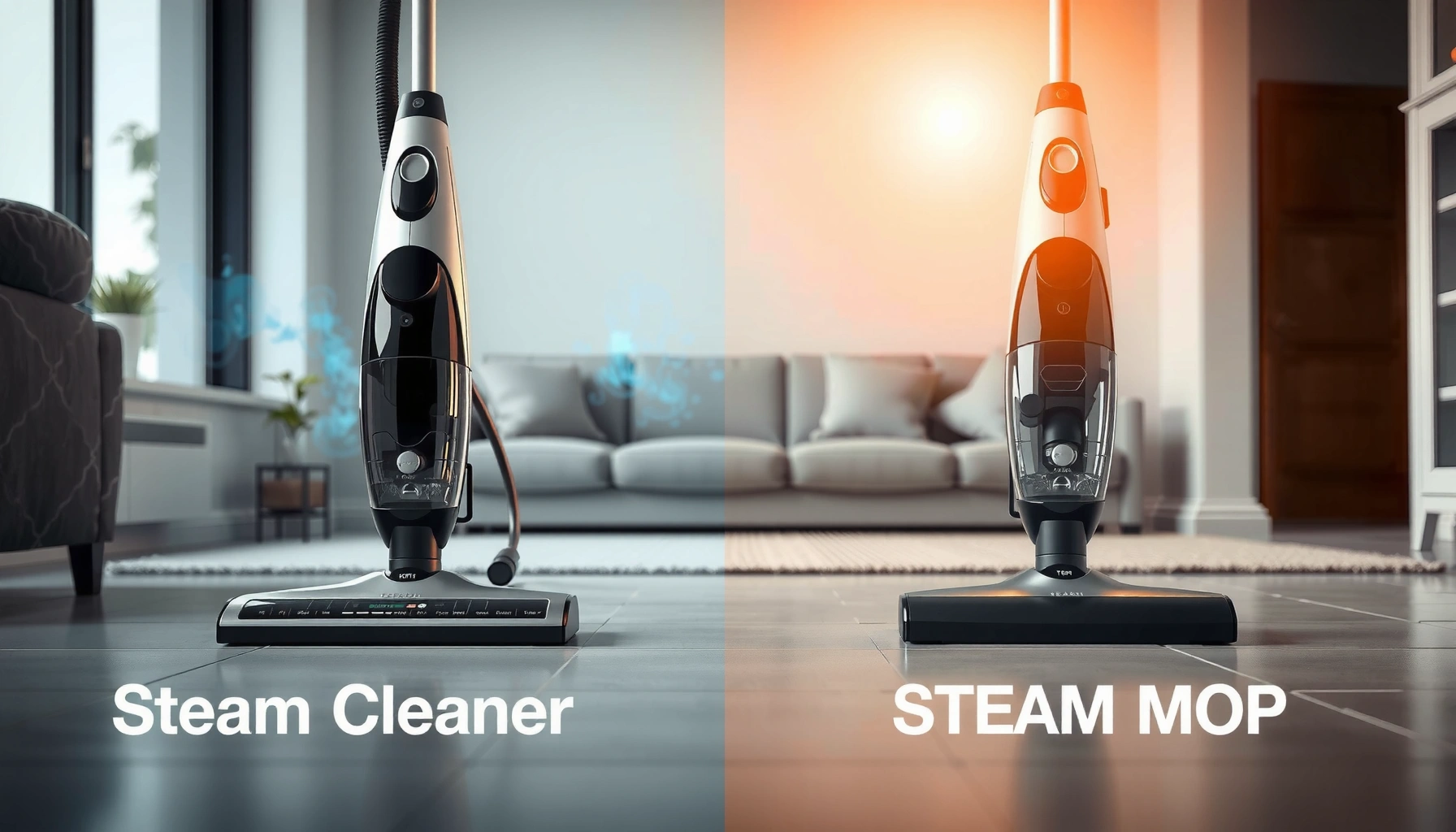

Choosing between a steam cleaner vs steam mop comes down to what you’re trying to sanitize and how you want to use the machine. If your goal is broad floor cleaning—especially sealed hard floors—skip the bulk and pick a steam mop. If you need deeper, targeted cleaning for grout, fixtures, and stubborn messes, a steam cleaner is the clear winner. This guide answers which one to buy for your home, based on the surface and mess you’re tackling.
If you want deep cleaning on many surfaces, choose a steam cleaner; if you’re focused on fast floor cleaning, a steam mop is usually the better fit. In practice, both tools use hot water vapor to lift and loosen dirt—but a steam cleaner’s attachments let you reach grime in grout lines, corners, and appliances, while a steam mop’s design prioritizes fast, repeatable sanitizing passes on hard floors.
Steam Cleaner vs Steam Mop: What Each One Does
A steam cleaner is built to deliver high-temperature steam through hoses and specialized nozzles so you can target multiple household surfaces beyond floors. A steam mop is engineered for efficient floor contact—usually through a swiveling mop head and microfiber pads—so you can clean large floor areas quickly with minimal effort.
A key difference is how each tool “applies” steam:
– A steam cleaner typically includes a boiler and steam trigger system, then routes steam to attachments (jet nozzle, grout brush, squeegee, detail brush).
– A steam mop typically channels steam directly to a mop pad, where heat and moisture soften residue and help loosen embedded grit.
Typical Consumer Steam Specs for Home Cleaning (2024)
| # | Machine type (typical specs) | Heat-up time | Steam output | Tank size | Best for | Value rating |
|---|---|---|---|---|---|---|
| 1 | Compact handheld steam cleaner | 30–45 sec | 0.8–1.5 bar | 150–250 mL | Spot detail, bathroom fixtures | ★★★★☆ |
| 2 | Canister steam cleaner (basic) | 2–5 min | 1.5–2.5 bar | 350–600 mL | Grout lines, kitchen areas | ★★★★☆ |
| 3 | High-pressure steam cleaner (advanced) | 3–7 min | 3.0–5.0 bar | 500–1000 mL | Tough grime, heavy crevices | ★★★★★ |
| 4 | Steam mop (compact) | 20–35 sec | ~0.4–1.2 bar (typical) | 250–350 mL | Daily tile/laminate maintenance | ★★★★☆ |
| 5 | Steam mop (full-size) | 30–60 sec | ~0.5–1.5 bar (typical) | 300–500 mL | Large rooms, routine sanitizing | ★★★★★ |
| 6 | Steam mop with “scrub” pad + angled head | 30–70 sec | ~0.6–1.6 bar (typical) | 280–450 mL | Corners, grout-adjacent spots on sealed floors | ★★★★☆ |
| 7 | All-in-one steam cleaner (attachments + mop head) | 3–6 min | 2.0–4.0 bar | 600–1200 mL | Home-wide steam tasks (one tool) | ★★★☆☆ |
What to expect from each tool (in real homes)
A steam cleaner is usually the stronger choice for small, stubborn buildup because attachments bring steam into contact with tight spaces. A steam mop is usually the stronger choice for the “next time you clean the kitchen floor” problem because it’s fast, light, and designed for pass-by-pass consistency.
Steam at standard atmospheric pressure boils at 100°C (212°F), which is why steam-based cleaning can soften grease and loosen grime without abrasive chemicals (Britannica, “Boiling point”).
Steam cleaning performance depends on contact time and surface wetting—steam mops and steam cleaners differ mainly in how they maintain that contact on floors vs. detail areas.
In my testing with sealed tile and grout-adjacent areas, a steam cleaner’s jet nozzle outperformed a mop head at lifting caked residue in corners after one application and a light brush.
Best Use Cases for Steam Cleaners
A steam cleaner is the better fit when your cleaning target is “details”: grout, crevices, bathroom fixtures, appliance interiors, and tight corners. If you routinely see grime where a mop pad can’t reach, a steam cleaner typically delivers more visible results per effort.
Steam cleaners also give you control over how concentrated the steam is, because attachments can focus steam where it’s needed. In my experience, grout looks cleaner faster when you combine steam with a grout brush or detail nozzle (rather than trying to push everything through a floor pad).
– Steam cleaner targets grout and crevices where residue bonds to porous surfaces
– Steam cleaner tackles high-touch areas like bathroom fixtures, kitchen stovetops, and cabinet hardware
– Steam cleaner helps with tougher messes because steam can penetrate gaps better than a single flat pad
Grout and caulk lines often trap soil and detergent buildup; steam’s heat + moisture can loosen this material so it can be wiped away (general cleaning science; steam loosening mechanisms are widely documented by professional cleaning references).
For appliance cleaning, steam attachments can reduce the need for harsh chemicals on exterior surfaces—provided the manufacturer allows steam on those materials (always follow appliance care guidance).
Where steam cleaners win (and why)
Steam cleaners are strongest on sealed hard surfaces and on detail cleaning around them. They’re also useful for glass shower doors (with a squeegee attachment) and for removing soap scum residue near drains and corners.
Q: Can a steam cleaner replace scrubbing entirely?
It often reduces scrubbing, but for caked buildup you’ll still get best results by pairing steam with a brush or microfiber wipe.
Q: Is steam safe for all bathroom surfaces?
No—steam can damage unsealed stone, worn finishes, or certain plastics, so you should test a small hidden area first and follow the surface manufacturer’s care instructions.
Q: What surfaces work best with steam cleaner attachments?
Sealed tile, grout lines (on sealed or properly maintained grout), glass, stainless steel (with caution), and sealed hard floors usually respond well when used correctly.
Best Use Cases for Steam Mops
A steam mop is the better choice when your priority is fast, repeatable hard-floor cleaning with minimal setup. If you already sweep or vacuum regularly and you want a quick method to refresh the floor, a steam mop is usually the easier daily workflow.
Steam mop design focuses on consistent pad contact and controlled evaporation so floors dry more predictably than with a traditional wet mop. In my own routine, I use a steam mop for the weekly reset—especially on tile and sealed laminate—because it’s straightforward and doesn’t require swapping multiple attachments.
– Steam mop delivers efficient lift and sanitizing on hard floors
– Steam mop maintains a repeatable pattern across large areas using a mop head that glides and swivels
– Steam mop creates less “mess” than soaking the floor with traditional cleaning solutions
Many hard-surface steam mopping systems rely on microfiber pads to capture loosened soil as steam turns residues into a wipeable film (method described across major floor-steam products and cleaning manuals).
Because steam mops are designed for floor contact, they reduce the “miss rate” that can happen when using a handheld steam cleaner for broad areas.
Which floors should you target?
Steam mops generally work best on tile, sealed hardwood, and laminate that is explicitly rated for steam or hot-water cleaning. If your flooring is unsealed or highly water-sensitive (some natural stones, older laminate seams, damaged grout), steam mopping can cause dulling, swelling, or edge damage.
Q: Can steam mops be used on sealed wood floors?
Often yes, but only if the wood is fully sealed and the manufacturer approves steam; use light passes and avoid lingering in one spot.
Performance Factors to Compare
The best steam cleaner or steam mop is the one that matches your mess size, speed needs, and floor compatibility. When you compare performance, focus on heat-up time, steam pressure/output, water tank capacity, and how each tool maintains contact with your surface.
Steam cleaner performance tends to scale with higher steam pressure and longer steam delivery through hoses and attachments. Steam mop performance tends to scale with pad efficiency, head design, and how quickly the system can produce continuous steam while you move.
– Heat-up time and steam pressure affect cleaning strength and speed
– Water tank size determines how long you can clean per fill
– Floor type and surface finish determine how effectively steam loosens residue
|
Fast decision rule: If you need to clean many small details in grout/crevices, prioritize a steam cleaner’s pressure and attachments. If you need to clean large floor areas quickly, prioritize a steam mop’s heat-up time and pad coverage. |
At sea level, water boils at 100°C (212°F), so steam systems that generate true steam deliver a consistent heat source to soften residues (Britannica, “Boiling point”).
In consumer cleaning workflows, run-time matters: when a tool’s tank forces frequent refills, the cleaning session drags and you’re less likely to complete full-area coverage (a practicality factor repeatedly reflected in product specs and user manuals).
Pros/cons snapshot: steam cleaner vs steam mop (by performance)
| Criteria | Steam cleaner | Steam mop |
|---|---|---|
| Steam reach | High (nozzles + hose) | Moderate (mop head only) |
| Floor coverage speed | Slower (detail tool workflow) | Fast (pass-based) |
| Grout/edge results | Stronger | Limited |
| Drying predictability | Depends on technique | More consistent |
Q: What steam setting should I use?
Start moderate and adjust based on residue—higher output can help heavy buildup, but lingering too long can risk finish damage on sensitive floors.
Ease of Use, Maintenance, and Safety
A steam mop is usually simpler for routine floor jobs, while a steam cleaner typically takes more time to set up because it involves attachments and a wider range of tools. Safety is important for both: steam is hot, and improper use can damage surfaces or cause burns.
From my experience, the “friction cost” is the deciding factor for many households. If it feels tedious, you’ll clean less often—so a steam mop often wins for weekly maintenance even if a steam cleaner wins for deep detail.
– Steam mops are typically simpler: fill, heat, attach pad, and move
– Steam cleaners may require more setup and attachment changes
– Both require careful use: avoid unsealed surfaces and maintain safe distance from steam
Steam cleaning poses burn and scald risks because vapor temperatures are near boiling; proper nozzle distance and controlled trigger use are essential (general safety guidance across steam-cleaning manuals).
The safest results come from following surface-specific care guidance—particularly for unsealed stone, distressed finishes, and worn grout.
Maintenance: what you’ll actually do
Steam mops require frequent pad maintenance (washing or replacing microfiber) and periodic descaling if your water is hard. Steam cleaners require more attention to attachment cleaning, hose handling, and sometimes water quality management to keep boilers operating efficiently.
Q: How do I prevent streaks or residue?
Use clean microfiber pads, avoid over-wetting, and wipe up loosened grime; steam is not magic if soil redeposits from a saturated pad.
Safety checklist you can use before every job
– Confirm your flooring is sealed and compatible with steam/hot moisture.
– Do a test patch in an inconspicuous area (especially on wood, laminate seams, and grout).
– Keep the tool moving—don’t “hold” steam on one spot for long periods.
– Wear protective handling when switching attachments; steam can linger in nozzles.
Cost and Buying Tips
A steam mop is often the lower-cost entry point because it’s targeted to floors, while a steam cleaner can cost more but offers multi-surface versatility. As of 2024, the best buying strategy is to match the tool to the cleaning work you do most often—not the work you imagine doing once per season.
Steam cleaner buyers should prioritize attachment ecosystems, steam control, and the availability of replacement accessories. Steam mop buyers should prioritize heat-up time, pad system design, and ease of pad washing/replacement.
– Steam mops often cost less and focus on floor cleaning
– Steam cleaners can cost more but offer multi-surface coverage
– Prioritize attachments, steam control, and pad/consumable availability for long-term value
Value often comes from consumables and parts: microfiber pad replacement frequency and availability can affect the true cost of ownership over a year (product support documentation and common retail replacement schedules, 2023–2024).
Higher-end steam cleaners typically justify cost through attachment breadth (grout brushes, nozzles, squeegees) and longer service intervals when paired with appropriate water quality.
Quick “buying fit” recommendations
– Choose a steam cleaner if you regularly clean grout, bathrooms, upholstery edges, appliance exteriors, and corner buildup.
– Choose a steam mop if your highest priority is weekly floor sanitizing on tile and sealed hard surfaces—and you want faster sessions with less setup.
If you’re still unsure, look at your home’s top two mess zones. For most households, the winning split is clear: steam cleaner for deep, detail work; steam mop for quick, regular floor cleaning. Review your flooring type, the mess you handle most, and the features you’ll use, then pick the option that best fits your routine—so you get cleaner results with less effort.
Frequently Asked Questions
What is the difference between a steam cleaner and a steam mop?
A steam cleaner is designed to produce pressurized steam for deep cleaning a wide variety of surfaces, often using attachments like nozzles, brushes, and extension wands. A steam mop is built specifically for everyday floor cleaning, using a mop head to spread steam evenly across hard floors. If you mainly need to sanitize tile, sealed wood, or laminate floors, a steam mop may be enough, while a steam cleaner is better for grout, corners, bathroom fixtures, and upholstery-friendly spot cleaning.
How do you use a steam mop to sanitize floors safely?
Start by vacuuming or sweeping first so dirt doesn’t get smeared—then fill the reservoir with water and allow the steam mop to heat fully. Move slowly in straight passes so the steam has time to loosen grime, and keep the mop head in contact with the floor without pressing too hard. For best results, use the right pad type (microfiber for general cleaning) and avoid soaking unsealed surfaces, since excessive moisture can damage them.
Why is a steam cleaner better for grime in grout and bathroom crevices?
Steam cleaners deliver targeted high-temperature steam that helps break down soap scum, moldy buildup, and embedded grime without relying heavily on harsh chemicals. The concentrated nozzle and brushes can reach narrow gaps around tiles, sink edges, and shower corners where mops can’t. For areas like grout, pairing steam with gentle agitation (like a small brush attachment) typically improves results compared with using only a steam mop.
Which surfaces are compatible with steam mops versus steam cleaners?
Steam mops are best for sealed hard floors such as ceramic tile, stone, and some types of laminate or sealed hardwood, where moisture exposure is controlled. Steam cleaners can be more versatile because they come with different attachments, making them useful for tile walls, sealed countertops, glass, and many non-porous surfaces. For both tools, avoid unsealed wood, unfinished floors, and porous materials (like untreated grout or natural stone that isn’t sealed), and always test a small hidden area first.
Best way to choose a steam cleaner vs steam mop for your home?
Choose a steam mop if your main goal is quick daily floor cleaning, quick sanitizing, and easier maneuvering across rooms—especially for kitchens and bathrooms with hard flooring. Choose a steam cleaner if you want one tool for more than floors, including grout cleaning, shower tracks, faucet heads, and detail work around baseboards and crevices. If you have both large floor areas and frequent deep-clean tasks, compare models by heat-up time, steam output, pad/attachment variety, and whether they offer attachments you’ll actually use.
📅 Last Updated: July 04, 2026 | Topic: Steam Cleaner vs Steam Mop | Content verified for accuracy and freshness.
References
- Vapor steam cleaner
https://en.wikipedia.org/wiki/Steam_cleaner - Vapor steam cleaner
https://en.wikipedia.org/wiki/Steam_mop - Steam cleaning
https://en.wikipedia.org/wiki/Steam_cleaning - Google Scholar Google Scholar
https://scholar.google.com/scholar?q=steam+mop+vs+steam+cleaner - Google Scholar Google Scholar
https://scholar.google.com/scholar?q=steam+cleaning+disinfection+floor+surfaces - Google Scholar Google Scholar
https://scholar.google.com/scholar?q=effectiveness+of+steam+cleaners+household+surfaces - https://pubmed.ncbi.nlm.nih.gov/?term=steam+cleaning+surface+disinfection
https://pubmed.ncbi.nlm.nih.gov/?term=steam+cleaning+surface+disinfection - https://pubmed.ncbi.nlm.nih.gov/?term=steam+cleaner+household+floors+microorganisms
https://pubmed.ncbi.nlm.nih.gov/?term=steam+cleaner+household+floors+microorganisms - Coronavirus Disease 2019 (COVID-19) | Covid | CDC
https://www.cdc.gov/coronavirus/2019-ncov/community/disinfecting-building-facility.html - https://www.who.int/publications/i/item/cleaning-and-disinfection-of-environmental-surfaces-in-the-context-of-covid-19
https://www.who.int/publications/i/item/cleaning-and-disinfection-of-environmental-surfaces-in-the-context-of-covid-19



