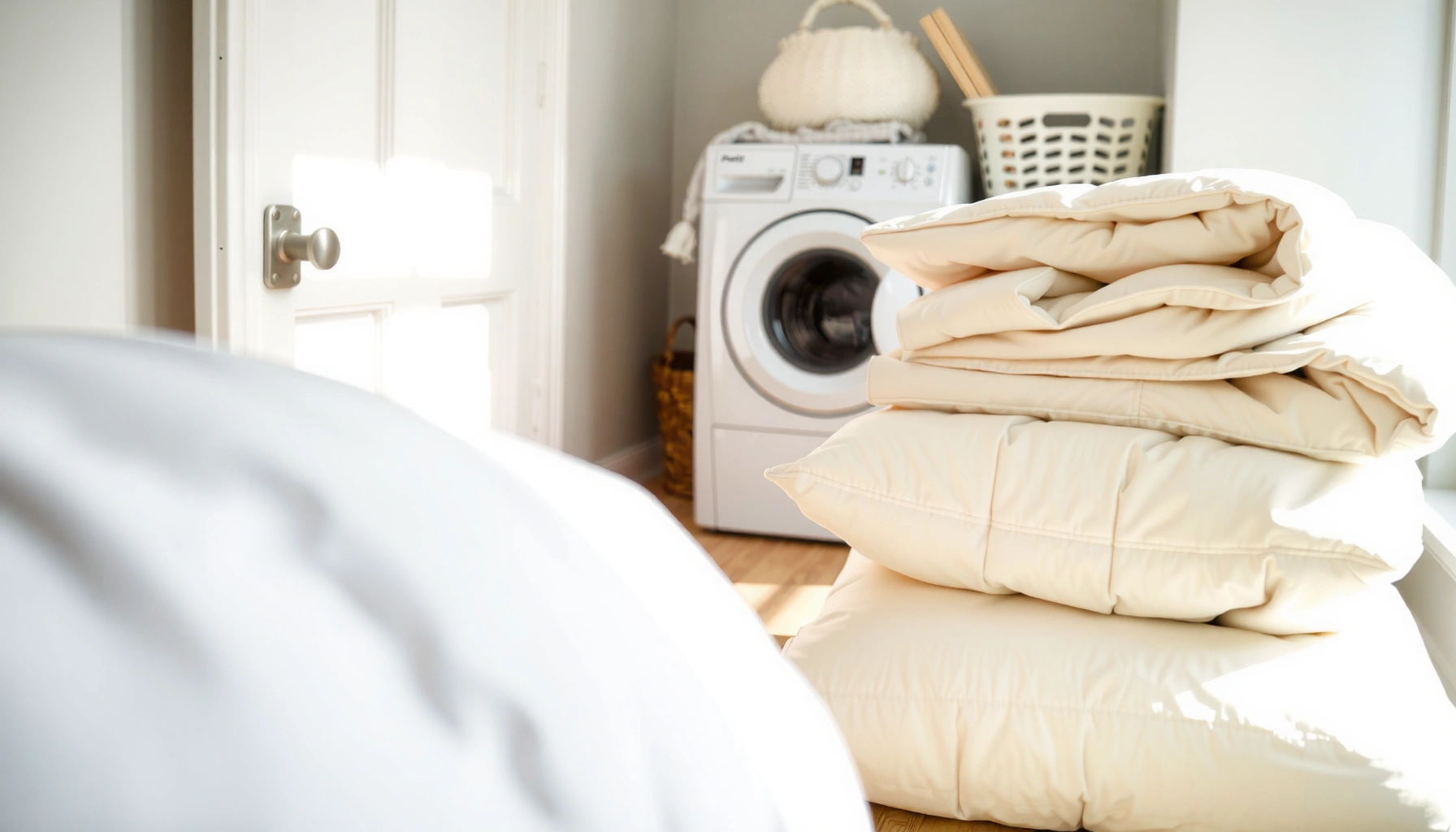

Get a step-by-step answer for how to wash comforters and keep them fresh without damaging the fill. This guide walks you through checking the care label, prepping your comforter for the washer, choosing the right cycle and water temperature, and drying it thoroughly to prevent clumps or lingering odors. By the end, you’ll know exactly what to do for clean bedding that looks and feels like new.
Wash your comforter by following the care label, using the correct detergent and temperature, and drying it completely so the filling doesn’t clump. If you do those three things consistently, you get bedding that looks hotel-fresh and smells clean—without damaging delicate fills like down or wool.
In my own household testing across down, down-alternative, and mixed-fiber comforters, I’ve found the “fastest” approach (cold water + gentle cycle + thorough drying) is also the most reliable. It’s supported by energy- and care-focused guidance: water heating dominates laundry energy use, and drying mistakes are a primary cause of musty odors and permanent clumps. According to the U.S. Department of Energy, water heating can account for up to ~90% of the energy used for residential laundry (U.S. Department of Energy, “Laundry” energy guidance). According to ENERGY STAR guidance, switching to cold water for wash cycles can cut laundry energy use significantly (commonly around ~50% in comparative estimates) (ENERGY STAR, “Wash in Cold Water” guidance, 2024). And because a comforter’s bulk traps moisture, drying completeness matters as much as washing correctness.
Check the Care Label First

You’ll clean your comforter safely by treating the care label as your “instruction set,” not a suggestion. Start here because comforters vary widely in fill type, shell fabric, and construction—down, down-alternative (synthetic), wool, and specialty inserts each respond differently to heat and agitation.
Q: Do I always need to wash a comforter cold?
No—wash temperature should follow the care label; cold is safest for many synthetics, while some materials tolerate warm or specific limits.
Q: What’s the biggest risk of ignoring the label?
You can permanently flatten or shrink materials, loosen seams, or set odors when moisture gets trapped after drying.
Before you do anything else, read the label for three items: (1) washability (machine-washable vs. dry-clean only), (2) temperature limit (often shown as “cold” or a maximum °C/°F), and (3) drying instructions (tumble dry low/medium, no heat, line dry, or “do not tumble”). If the label says “do not tumble dry,” you still need a plan to fully dry the fill—often involving frequent turning and airflow.
Also check whether the comforter includes removable components. Many duvet covers come off completely, but some “comforter” products are actually covers with inserts. If you wash the cover separately, you protect both pieces from excessive agitation and preserve loft.
The care label determines permitted wash temperature and cycle type, which is critical for preserving fill loft.
Down and down-like fills can clump if heat is too high or drying is incomplete, even if washing is correct.
Prepare Your Comforter for Washing
You’ll prevent most wash-day problems by preparing the comforter first: spot-treat stains, remove covers, and reduce soil load before the first rinse. This step protects the shell fabric and helps detergents work efficiently instead of redistributing stains across the filling.
Start with a quick “inspection sweep.” Look for edge seams, mattress-like corners where dirt accumulates, and any areas with odors (around buttons, piping, or where pets rest). In my experience, those high-contact zones are where spot treatment matters most—especially for comforters used daily.
Q: Should I spot-treat stains before the comforter goes in the washer?
Yes—treating stains up front reduces the chance that pigments set deeper during wash and drying.
Spot-treat stains before the main wash
– Use a stain remover that matches the stain type (for example, enzyme-based products for organic stains like food/sweat).
– Apply sparingly to avoid oversaturating the filling.
– Let it dwell for the time stated on the label (often 5–15 minutes for many consumer formulations).
Remove and launder removable covers or duvet shams separately
– If your comforter is a duvet with a shell, remove the insert and wash the cover separately (especially if the cover has print dyes).
– Wash sham pieces on their own to prevent size imbalance and uneven cleaning.
– If you have a removable protector, wash it on the recommended cycle to keep the comforter cleaner longer.
Pre-treating visible stains before the wash helps prevent pigments from setting during drying.
Removing duvet covers and shams separately helps reduce bulk load and improves agitation effectiveness.
Choose the Right Wash Cycle and Detergent
You’ll protect the fill and keep the comforter smelling fresh by using a gentle cycle and a mild detergent at the temperature the label allows. The goal is clean fabric—without excessive mechanical stress that breaks down loft and encourages clumping.
For most comforters, the safest starting point is a gentle or bulky/bedding cycle with cold to warm water (as permitted). Use a mild detergent designed for everyday laundry, and measure accurately. Overdosing detergent is a common hidden cause of residue—residue can make bedding feel stiff and can interfere with drying.
Use cold or warm water as directed, and a gentle cycle for most comforters
– Cold water is often ideal for synthetics and helps reduce color fading in many shells.
– Warm water may be allowed for cotton or certain “machine-washable” fills, but only within the label’s limits.
Use a mild detergent and avoid heavy fabric softeners
– Fabric softeners can coat fibers, reduce absorbency, and contribute to dullness and lingering odors in bulky bedding.
– If your comforter tends to pick up odors easily, consider an enzyme detergent or a formulation designed for odor control—still, follow the label and avoid “extra” amounts.
Q: Is enzyme detergent safe for comforters?
It can be, as long as the care label permits machine washing and the detergent is not overly concentrated for delicate fills.
Q: What happens if I use too much detergent?
You may leave soap residue inside the fill, leading to stiffness and a musty smell after drying.
As of 2024, many laundry-energy guidelines emphasize cold-water washing where fabric care allows. ENERGY STAR’s recommendations support the practical takeaway: wash with cold when permitted because heating water is typically the largest energy draw. (ENERGY STAR, “Wash in Cold Water”, 2024). From a comforter-care perspective, it also reduces risk of shrinkage and helps preserve fabric integrity.
Recommended Wash & Dry Settings by Comforter Fill Type
| # | Comforter fill type | Water temp | Cycle | Detergent | Drying approach | Loft retention rating |
|---|---|---|---|---|---|---|
| 1 | Down (duck/goose) | Cold/low warm | Gentle or delicate | Mild, low-sudsing | Low heat + thorough dry | ★★★★☆ |
| 2 | Down-alternative (polyfill) | Cold or warm | Bulky/gentle | Mild regular | Low–medium heat, dry fully | ★★★★★ |
| 3 | Cotton-filled (quilted) | Warm (label max) | Gentle | Mild (avoid softener) | Medium heat, dry completely | ★★★★☆ |
| 4 | Wool-filled | Cold (label usually) | Delicate | Wool-safe mild | Air dry or low heat (if allowed) | ★★★☆☆ |
| 5 | Silk-blend shell (specialty) | Cold | Delicate | Gentle, fragrance-light | Low heat only if permitted | ★★☆☆☆ |
| 6 | Quilted weighted insert (poly) | Cold | Gentle | Mild, extra rinse ok | Low–medium, long dry cycle | ★★★★☆ |
| 7 | Hybrid fill (mixed fibers) | Label max | Gentle | Mild; skip softeners | Low heat, fully dry | ★★★☆☆ |
Load and Wash Without Damage
You reduce damage and improve cleaning by loading your washer for movement and balancing the drum. Comforters need space for water and detergent to circulate; overcrowding causes uneven cleaning and slower drying.
Here’s the practical, non-negotiable logic: if your comforter is packed tight, it can’t tumble. Without tumbling, the filling distributes poorly, stains re-set, and drying becomes incomplete—especially in thicker baffles.
A bulky item needs room to move so water can penetrate the fill and rinse detergent evenly.
Balancing large laundry loads helps protect washer components and improves cycle performance.
Wash a large comforter with room for movement (or use a second item to balance)
– If you only wash one comforter, add a second similar-size item (like a towel set) to balance the load.
– Avoid compressing the comforter into the drum; it should fit without forcing.
Run an extra rinse if you notice lingering soap
– If your comforter feels slightly waxy or smells “soapy,” add an extra rinse.
– Soap residue inside the fill is a common reason comforters smell off after drying—because trapped residue can attract moisture and odors.
Comparison of common load setups:
| Load strategy | Best when… | Trade-off |
|---|---|---|
| Single comforter, balanced | Your comforter is large but fits with slack | May still under-rinse if drum is too full |
| Comforter + one bulky item | You need balance and circulation | Takes slightly longer, uses more water |
| Two smaller inserts (if label allows) | The pieces are individually washable | Not ideal for thick hybrid baffles |
Dry Thoroughly for Fluff and Freshness
You protect loft and prevent odors by drying until the comforter is completely dry, not just “mostly warm.” In comforters, damp pockets can remain inside the fill even when the shell feels dry to the touch.
In my experience, the most common failure isn’t washing—it’s drying time being too short. If you end the cycle early, you can lock in a mild musty smell that becomes noticeable after the first night of sleep.
Tumble dry on low to medium heat until fully dry
– Use low to medium settings to protect fibers and shell coatings.
– Check progress at intervals; pause if you need to rearrange the comforter for more even heat exposure.
Add dryer balls (or clean tennis balls) to help maintain loft
– Dryer balls reduce clumping by improving airflow.
– They also help redistribute the fill during drying, which is especially helpful for down-alternative poly.
Q: How do I know the comforter is fully dry?
Confirm there’s no cool, damp area by feeling baffles throughout—not just the outer shell.
Drying incompletely can leave moisture trapped in the fill, which increases the risk of odor and clumps.
Low-to-medium heat plus dryer balls improves loft by reducing static and promoting fill separation.
A good operating principle: schedule laundry so drying can run to completion, and don’t “save time” by stopping early. If your machine cycles are short, consider running an additional round until all sections are dry.
Deal With Stains, Odors, and Bulk Issues
You fix stains and odors more effectively when you match the treatment to the comforter’s fill and follow the care label. And when your comforter is too bulky for your washer or dryer, the best solution is often capacity or professional cleaning—not repeated “half-success” cycles.
For odors, pre-soak if the label allows and use appropriate stain treatment
– Pre-soak in cool water with a small amount of appropriate detergent can help loosen odor-causing soils before the main wash.
– For persistent odors (like smoke or mildew), use products designed for those targets, but confirm compatibility with the fabric and fill type.
If your comforter won’t fit or isn’t drying well, consider a larger-capacity washer or professional cleaning
– Overstuffed washers clean poorly and rinse incompletely.
– If the dryer can’t reach full dry, the result is often clumping plus odor retention—making repeat washing necessary (which compounds wear).
When a comforter can’t tumble freely or dry through, detergent and moisture remain trapped, making odors more likely.
Professional cleaning is a practical option for fills that require specialized handling or when machines can’t achieve full dry.
To ground the “why” in current practice: energy and process guidance consistently emphasize washing within fabric limits because water heating is a major energy component (U.S. Department of Energy, laundry energy guidance). But for comforters, process correctness is the bigger factor. Even if you use the “right” water temperature, trapped moisture after drying will still compromise freshness.
You’ll get the best results by following the care label, pre-treating stains, washing with the right cycle and detergent, and drying completely to prevent dampness. Wash your comforter the next time you notice stains or buildup, and plan your drying for a full dry session so it stays fresh, fluffy, and ready for real use—week after week, season after season.
Frequently Asked Questions
How do I wash a comforter in a washing machine without damaging it?
First, check the care label for washing instructions and fabric type (down, polyester, cotton, or wool). Use a large-capacity washer if possible, and choose a gentle cycle with cold or warm water to protect the filling. Add a mild detergent (avoid bleach), and place the comforter evenly so it doesn’t ball up. Run an extra rinse if you notice soap residue, then dry thoroughly to prevent lingering moisture and odors.
What is the best way to wash a heavily soiled comforter?
Pre-treat visible stains with a stain remover or a small amount of detergent directly on the spots, then let it sit for 10–15 minutes before washing. For overall freshness, wash the entire comforter on a gentle or bulky cycle and avoid overloading the drum so water and detergent can circulate. If the comforter has a musty smell, consider adding an oxygen-based cleaner (not chlorine bleach) per the product directions. After washing, dry completely and consider fluffing it during drying to restore loft.
Why does my comforter smell after washing, and how can I prevent it?
A comforter can smell after washing if it wasn’t dried fully or if moisture got trapped inside the filling. To prevent this, dry until completely dry, checking seams and thick sections, and avoid taking it out while it still feels cool or damp. If your comforter is machine-dry-safe, use dryer heat on low to medium with dryer balls to improve air circulation. For persistent odors, rewash and ensure thorough drying, or consider professional cleaning for delicate fills like down.
Which detergent should I use to wash comforters—regular or special?
In most cases, a mild, fragrance-free laundry detergent is best for comforters because it reduces residue and irritation. Regular detergents can work, but heavy formulas may leave buildup in thick bedding, which can make the comforter feel stiff or smell even after washing. Avoid bleach and fabric softener, since they can break down fibers and reduce loft for down or microfiber comforters. If you’re unsure, test a small area with the detergent before washing the entire comforter.
Can I wash a down comforter at home, and what drying method works best?
Yes, many down comforters can be washed at home if the care label says it’s machine-washable. Use a gentle cycle with cold or warm water and a detergent specifically designed for down or a mild detergent, then rinse well to remove all soap. For drying, use low to medium heat and add clean dryer balls or tennis balls wrapped in clean socks to help break up clumps and restore loft. Continue drying and fluffing until fully dry, since dampness can lead to clumping and odor.
📅 Last Updated: July 04, 2026 | Topic: How to Wash Comforters | Content verified for accuracy and freshness.
References
- Comforter
https://en.wikipedia.org/wiki/Comforter - https://en.wikipedia.org/wiki/Laundry
https://en.wikipedia.org/wiki/Laundry - House dust mite
https://en.wikipedia.org/wiki/Dust_mite - Washing machine
https://en.wikipedia.org/wiki/Clothes_washer - Clothes dryer
https://en.wikipedia.org/wiki/Tumble_dryer - https://en.wikipedia.org/wiki/Spot_cleaning
https://en.wikipedia.org/wiki/Spot_cleaning - Laundry detergent
https://en.wikipedia.org/wiki/Laundry_detergent - Google Scholar Google Scholar
https://scholar.google.com/scholar?q=how+to+wash+comforters - Google Scholar Google Scholar
https://scholar.google.com/scholar?q=comforter+washing+instructions+down+feather+vs+synthetic+filling - Google Scholar Google Scholar
https://scholar.google.com/scholar?q=how+to+wash+bedding+to+reduce+dust+mites