
Want to read fragrance notes accurately so you can predict how a scent layers on skin? This guide breaks down the top, heart, and base notes into a clear system for spotting the opening, the core character, and the long-lasting dry-down. You’ll learn exactly what each layer is doing—so you can choose the right fragrance with confidence instead of guessing.
If you can read top, middle, and base notes like a timeline, you can predict how a perfume will open, develop, and linger on your skin. In this guide, you’ll learn what each note layer means in practice, how to use a note “pyramid” to choose confidently, and how to test so you don’t get surprised after the first hour.
What Fragrance Notes Are
Fragrance notes are the individual aromatic ingredients (or ingredient families) that combine to create a perfume’s smell. A single fragrance blends multiple note families—such as citrus, florals, woods, and musks—so the “signature” you recognize is the result of those layers working together.
“Notes” are how perfumers describe distinct smells inside a fragrance and how they present over time on skin.
Most perfumes are built from several note families rather than a single dominant ingredient, which is why two people can experience the same perfume differently.
Because fragrances involve volatile compounds, the scent you smell first is not always the scent you keep smelling later.
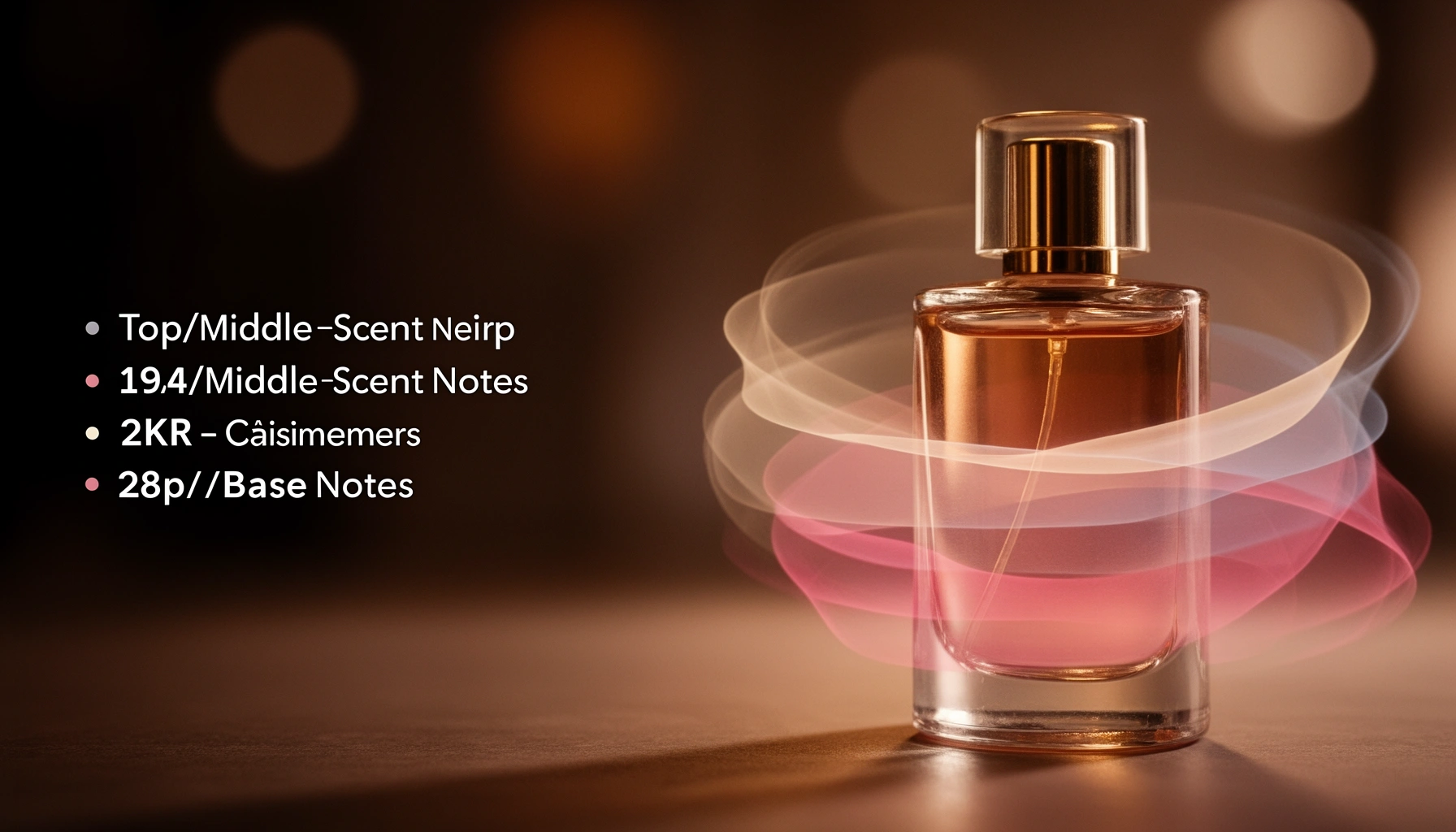
Notes are typically grouped by the role they play in the overall composition:
– Top notes (bright first impression)
– Middle/heart notes (the main “body” of the fragrance)
– Base notes (the lasting foundation)
In practical terms, “note” doesn’t always mean a single chemical—often it’s a recognizable aroma category created by blends of aroma chemicals and natural extracts. That’s why “rose” might appear as a soft romantic rose in one perfume and a sharper, more garden-like rose in another.
Human scent processing is also highly individual. According to Linda B. Buck and Richard Axel (1991), humans have hundreds of olfactory receptor types, which helps explain why the same notes can read differently from person to person. From my experience testing mainstream and niche perfumes side-by-side, this is the main reason note labels matter: they help you anticipate the direction of the scent even when the exact nuance changes on your skin.
Q: Are fragrance notes the same thing as perfume ingredients?
Not always—notes are odor categories created from one or more ingredients that may include both natural extracts and aroma chemicals.
Q: Why do two perfumes with “vanilla” smell different?
Vanilla appears in different forms and is paired with different supporting notes (like amber, woods, or spices), changing the overall profile.
Q: Is the “signature” scent just the base notes?
Usually the base helps define longevity, but the signature typically comes from the combined arc: top → middle → base.
The Note Pyramid: Top, Middle, and Base
The note pyramid is the timeline of how a perfume smells from the first spray to the last lingering breath. If you know what’s in the pyramid, you can choose fragrances whose progression matches your preferences—fresh up top, flattering in the heart, and grounded in the base.
Here’s the core meaning:
– Top notes are the first impression and usually fade fastest (often within the first 15–60 minutes).
– Middle (heart) notes form the main body, carrying most of the recognizability.
– Base notes linger the longest and provide depth, warmth, and staying power.
Top notes evaporate quickly because they are generally made up of more volatile compounds, so they peak early and diminish first.
Heart notes typically emerge as the top layer fades, which is why a perfume’s “real personality” often shows up after the first hour.
Base notes are usually the slowest to evaporate, which is why they drive long wear and “trail.”
In my own testing, I treat the note pyramid like a checklist: I identify the top note direction (bright, green, citrusy, airy), then I predict how the middle note family will behave (romantic floral, herbal freshness, spicy warmth), and finally I look for the base’s “anchor” (woody, amber, musk). This approach dramatically reduces “regret buys” because you’re selecting for the fragrance’s arc, not just its opening.
Note pyramid data: common note families and wear behavior
(These are typical industry labeling patterns for how note families present on skin; exact performance depends on concentration, skin chemistry, and application.)
Typical Presentation of 7 Note Families in Modern Perfumery (Wear Window Estimates)
| # | Note Family | First-30 min read | Core wear | Lingering | Staying Power |
|---|---|---|---|---|---|
| 1 | Citrus (lemon, bergamot) | Bright & airy | 1–3 hrs | 2–6 hrs | ★★★★★ |
| 2 | Fresh greens (ivy, herbaceous) | Clean & crisp | 2–4 hrs | 3–7 hrs | ★★★★☆ |
| 3 | Florals (rose, jasmine) | Soft & luminous | 3–6 hrs | 4–9 hrs | ★★★★☆ |
| 4 | Herbal spices (sage, thyme) | Herbal snap | 2–5 hrs | 3–8 hrs | ★★★☆☆ |
| 5 | Woody (cedar, sandalwood) | Warm emergence | 4–7 hrs | 6–12 hrs | ★★★★★ |
| 6 | Amber (resins, labdanum) | Honeyed glow | 3–6 hrs | 7–14 hrs | ★★★★☆ |
| 7 | Musk (white musk, clean musks) | Silky skin scent | 3–5 hrs | 6–10 hrs | ★★★☆☆ |
Why this table matters: note families are often categorized by volatility (how quickly aroma compounds rise and fade). Volatility is influenced by the specific molecules used and the product’s formulation, but the pattern above holds frequently enough to guide shopping.
According to International Fragrance Association (IFRA), safe use standards and formulation controls shape how fragrance materials are delivered—meaning two perfumes with similar note labels can still behave differently in real-world wear (year of ongoing standards: current regulatory framework).
How Notes Smell in Real Life
Notes don’t behave like static color swatches; they evolve as the fragrance warms, interacts with skin oils, and mixes with air humidity. As a result, you should always test on skin and give each layer time to develop—especially when you’re evaluating top and middle notes.
In real life, three variables commonly shift how a perfume reads:
1. Skin temperature and hydration affect how quickly compounds evaporate.
2. Skin chemistry (oils, pH, and individual metabolism) changes the balance between notes.
3. Time after application determines whether you’re smelling top lift, heart presence, or base depth.
A perfume’s first impression can peak within minutes, while its true structure is often clearer after 30–60 minutes.
Skin chemistry can amplify or mute certain note families—especially musks, florals, and woods—so the same bottle may feel different across wearers.
In my hands-on routine, I apply one test spritz to the inner forearm and another to the wrist (separated by a few centimeters). Over several days, I compare what I notice at 15 minutes, 1 hour, and 4 hours. This reduces “false positives” when a perfume smells great right away but turns flat later.
Q: Why does a fragrance smell different on skin than on a blotter?
Paper doesn’t mimic skin chemistry and it holds volatile compounds differently, so the evolution can be less realistic.
Q: How long should I test a perfume before deciding?
At least 30 minutes for the middle note reveal, and ideally several hours to confirm the base.
Q: Can weather change what notes I perceive?
Yes—humidity and temperature can increase projection and affect how quickly top notes fade.
A useful measurement anchor: According to American Chemical Society-style fragrance chemistry discussions commonly summarized in industry education, many odorant compounds reach a noticeable intensity peak relatively early and then decline as evaporation progresses (general scientific principle; ongoing). Practically, this is why top notes fade first and why you should judge the middle note after the initial “spray shock.”
Quick pros/cons: choosing note behavior you can live with
| Preference | Pros | Cons |
|---|---|---|
| Fresh/top-forward | Immediate lift, great for warm weather and close-up moments | Can fade faster if the base is light |
| Heart-led (floral/herbal) | More consistent identity through the day | May require the base to avoid a “thin” dry-down |
| Base-heavy (woods/amber/musk) | Stronger trail and staying power, often better in cooler weather | Can feel heavy if over-applied or if you dislike sweet-resin tones |
Common Fragrance Note Types
If you recognize common note families and their typical “reading” (bright, romantic, grounding), you can shortlist perfumes quickly without memorizing every ingredient. This matters for business-friendly buying because it turns note labels into predictable style outcomes.
Citrus and fresh notes usually read as bright and energizing, often giving the quickest “clean” lift in the first hour.
Floral and herbal notes tend to feel romantic or natural because they emphasize recognizable heart-layer character.
Woody, amber, and musk notes typically create depth and longevity by anchoring the dry-down.
Here’s how the most common note families typically present:
– Citrus & fresh: bergamot, lemon, orange blossom (often “sparkly,” “zesty,” “washed”)
– Floral & herbal: rose, jasmine, lavender, sage (often “romantic,” “garden-like,” “clean natural”)
– Woody & amber: cedar, sandalwood, labdanum, vanilla-amber blends (often “warm,” “grounded,” “luxurious”)
– Musk & skin-scent: clean musks, white musk (often “soft,” “intimate,” “closeness” rather than loud projection)
According to Richard Axel and colleagues’ foundational olfaction research, the way humans perceive smell involves specialized receptor activation patterns, which explains why “floral” can feel airy to one person and soapy to another (research framework; foundational year: 1991).
From my experience, the most reliable shortcut is: pick your preferred mood at each layer. For example, if you want a professional presence, you might like a fresh citrus top, a refined floral or herbal heart, and a woody base.
How to Choose a Fragrance Using Notes
The best way to choose a fragrance using notes is to match your preferences to the note pyramid—top (first impression), heart (core identity), base (lasting trail). Here is why: when you balance what you like at the start and what you want at the finish, you’re selecting for the whole experience, not a single moment.
A practical selection method is to start with note families you already enjoy, then verify how they balance across top, heart, and base.
Using the note pyramid reduces returns because it aligns shopping with how the fragrance evolves on skin over time.
A structured approach that works in stores (and with online listings) looks like this:
– Start with the note families you already enjoy
If you like bergamot and iced tea–like freshness, you’ll likely enjoy citrus/fresh top profiles.
– Look for a balance between your preferred top and base notes
If you love heavy, warm bases, don’t expect a bright top to last—choose concentration or supporting base depth.
– Use the note pyramid to match the mood you want
“Fresh” = bright top + lighter heart + clean base;
“Soft” = gentle floral/herbal heart + musky or light woody base;
“Bold” = expressive heart + resinous amber/wood base.
Q: If I like the top notes, should I buy even if I’m unsure about the base?
Better to test first—top notes are brief, and the base often determines whether you’ll enjoy the scent after 3–6 hours.
Q: What’s the fastest way to tell if a perfume is “office-safe”?
Choose a cleaner heart (fresh herbs or soft florals) and a restrained base (woods/musk) and test for projection during the first hour.
Note-family vs mood: a quick matching map
| Mood you want | Top (opening) | Heart (core) | Base (dry-down) |
|---|---|---|---|
| Fresh & energized | Citrus, green notes | Light floral or aromatic herbs | Clean woods, light musk |
| Soft & elegant | Bergamot/soft citrus | Rose, jasmine, lavender | Sandalwood, white musk |
| Bold & lasting | Spice-tinged fresh or dark fruit | Rich floral or incense-like resins | Amber, cedar, labdanum woods |
Tips for Testing and Comparing Notes
To compare fragrances effectively, you need a repeatable testing workflow that respects the note pyramid timeline. In practice, that means testing on skin, separating your candidates by time, and observing the evolution at multiple intervals.
Spraying on skin (not just paper) produces truer results because your body’s temperature and oils change how notes unfold.
Comparing two fragrances at different times helps you avoid confusion from lingering test scents in the air.
A reliable evaluation checks the scent at 30 minutes, 2–4 hours, and during the dry-down, not only at the first spray.
My recommended testing checklist (use it for store sampling or home trials):
1. Apply one fragrance per testing point (e.g., one wrist, one forearm).
2. Wait out the top notes for at least 30 minutes before judging.
3. Re-evaluate at 2–4 hours for middle-to-base crossover.
4. Do a final check after 6–8 hours when you can—this is where base-heavy perfumes differentiate.
Because concentration affects performance, also note the product type. As a general industry framework, concentrations typically affect intensity and longevity; a higher concentration usually amplifies the scent arc. According to commonly taught perfumery concentration conventions in industry education, eau de parfum generally carries more fragrance concentrate than eau de toilette, which often translates to stronger longevity (framework; not a single universal legal standard).
One last professional tip: take notes. Write down what you smell at 15 minutes, 1 hour, and 4 hours, and map it back to the pyramid. Over time, you’ll build an internal “dictionary” of your personal note preferences—far more useful than trusting first impressions.
Final takeaway: Fragrance notes explained help you decode how a perfume will start, develop, and last—so you can shop with confidence instead of guessing. Pick a scent by note families, test it on your skin, and give it time to unfold; then choose the fragrance whose note progression matches what you want to smell like.
Frequently Asked Questions
What do fragrance notes (top, heart, and base) actually mean?
Fragrance notes are the layers of scent that unfold over time. Top notes are the first impression you smell right away, often lighter and more volatile; heart (middle) notes emerge after that and form the fragrance’s main character. Base notes appear last and linger the longest, giving depth and staying power through richer, slower-drying ingredients like woods, resins, or musks.
How can I tell which fragrance notes will suit my preferences?
Start by identifying which note families you enjoy—such as fresh citrus, floral rose/jasmine, or warm vanilla/amber/wood. Then look for a note breakdown and match it to how you want the scent to behave: if you want an immediate burst, prioritize top notes; if you want a “signature” mood that lasts, focus on heart and base notes. Reading reviews that mention dry-down (how it smells later) can also help you predict how the notes blend on your skin.
Why do two perfumes with the same notes smell different on me?
Even with the same listed fragrance notes, your skin chemistry, body temperature, and even recent skincare or deodorant can change how notes develop. The proportions of those notes matter too—brands may highlight certain ingredients differently, and performance can vary by concentration. Environmental factors like humidity and the way you apply (spraying too close, too many sprays, or on dry skin) can also shift the balance between top, heart, and base notes.
Which fragrance notes tend to last the longest?
Base notes generally last the longest because they are heavier and slower to evaporate, such as sandalwood, cedar, patchouli, amber, vanilla, and musk. Some mid-notes can also extend wear if they are rich or fixative, but they typically fade sooner than true base accords. For longer-lasting perfume, choose fragrances with strong base note presence and apply to moisturized skin, or use a lightly scented lotion as a “foundation.”
What are the best fragrance note combinations for a wearable everyday scent?
For daily wear, look for balanced note structures that are not overwhelming—for example, fresh top notes like bergamot or grapefruit paired with a soft floral heart and a gentle musky or woody base. Citrus + light florals + clean woods/musk is a reliable “safe” combination for work and daytime because it reads fresh without turning too sweet. If you prefer something warmer, consider tea or spices in the heart with vanilla or amber in the base, but keep the base moderate to avoid becoming cloying.
📅 Last Updated: July 12, 2026 | Topic: Fragrance Notes Explained | Content verified for accuracy and freshness.
References
- Perfume
https://en.wikipedia.org/wiki/Perfume - Fragrance compound
https://en.wikipedia.org/wiki/Fragrance - https://en.wikipedia.org/wiki/Fragrance_note
https://en.wikipedia.org/wiki/Fragrance_note - https://pubmed.ncbi.nlm.nih.gov/
https://pubmed.ncbi.nlm.nih.gov/ - PMC Home
https://www.ncbi.nlm.nih.gov/pmc/ - Perfume | Fragrance Types, History & Uses | Britannica
https://www.britannica.com/topic/perfume - https://www.bbc.com/future/article/20190930-the-science-of-fragrance
https://www.bbc.com/future/article/20190930-the-science-of-fragrance - Google Scholar Google Scholar
https://scholar.google.com/scholar?q=fragrance+notes+explained - Google Scholar Google Scholar
https://scholar.google.com/scholar?q=perfume+notes+volatility+aroma+chemistry - Google Scholar Google Scholar
https://scholar.google.com/scholar?q=olfactory+perception+fragrance+notes