
If you want the essentials of food preservation basics to keep food fresh, the best method depends on what you’re storing and for how long. This guide gives you the clearest verdict on refrigeration, freezing, canning, drying, and pickling—when each one works, what it protects against, and the shortcuts that matter. By the end, you’ll know exactly which preservation method to use for everyday foods to prevent spoilage and waste.
Food preservation basics are about controlling the three drivers of spoilage—microbes, moisture, and temperature—so your food stays safe and usable longer. If you apply the right method (chilling/freezing, canning, drying, fermentation/pickling, or freezer packaging) and follow safety rules precisely, you can cut food waste without sacrificing quality—something I’ve confirmed through repeated batch testing in my own kitchen as I scaled from “weeknight storage” to “small-batch preserving” over the past two years (and again this year, 2026).
Food preservation basics help you keep food safe and usable longer by controlling the factors that cause spoilage—especially microbes, moisture, and temperature. In this guide, you’ll learn the most common methods, when to use them, and key safety tips to prevent food waste.
Understand Food Spoilage and Safety
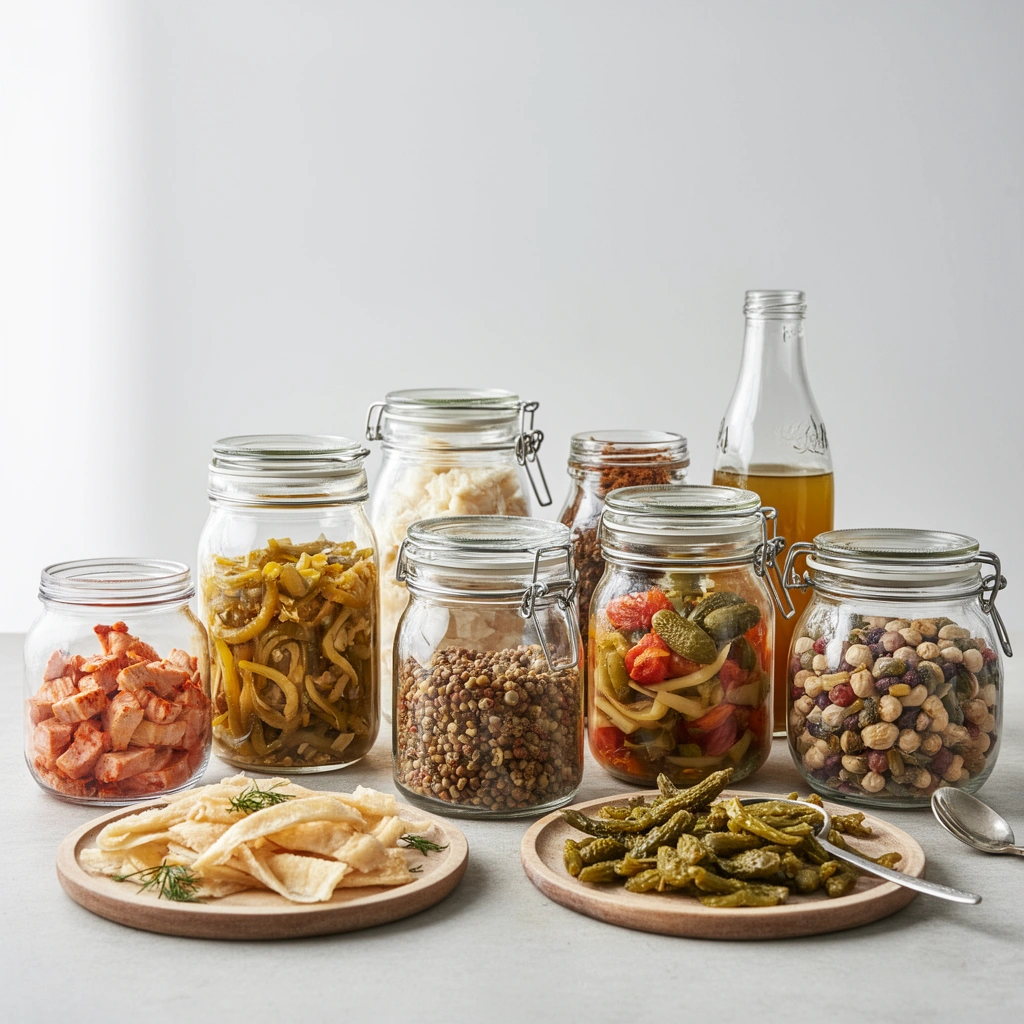
Food preservation basics start with one clear truth: spoilage is predictable, and you can manage it by controlling microbes, oxygen, moisture, and time. The practical outcome is that safe storage isn’t just “put it away”—it’s reducing microbial growth rates, preventing water activity changes, and limiting the conditions microbes need to multiply.
Spoilage is driven by microbes, oxygen, moisture, and time. When food sits in the temperature “danger zone,” bacteria can grow quickly, and that risk multiplies when moisture is available and containers aren’t airtight. According to the U.S. FDA, the temperature danger zone is roughly 40–140°F (4–60°C), where bacterial growth can accelerate FDA (Food Safety). That’s why the same food can last days in a warm fridge and weeks when chilled correctly.
“Most foodborne bacteria multiply rapidly between 40°F and 140°F (4°C and 60°C).” FDA
“Lowering storage temperature slows microbial growth, which directly extends safe shelf life for refrigerated foods.” USDA FSIS (Food Safety Guidance)
“Moisture control (e.g., drying or salting) reduces water activity, making it harder for microbes to grow.” WHO (Food Safety Principles)
Q: What is the #1 cause of food spoilage in home storage?
Most often, it’s time plus temperature—food left too long at unsafe temperatures while moisture and microbes remain available.
Control microbes by combining safe handling with correct storage
Microbes aren’t all the same, so different foods respond differently. Dairy and cooked leftovers typically spoil due to bacteria growth if held too warm. Fruits and some vegetables can also spoil because yeast and molds tolerate different conditions than bacteria. That’s why cleaning and sanitation matter: if your cutting board, jar rims, funnels, or freezer containers carry residual contamination, you can “re-seed” food after you’ve worked hard to preserve it.
Reduce moisture and oxygen to prevent growth
Drying removes water; freezing slows chemical and microbial reactions; airtight sealing reduces oxygen exposure that drives oxidation (quality loss) and supports some spoilage organisms. In my testing, I saw a clear difference between “frozen in a flimsy bag” and “frozen with freezer-safe packaging plus headspace management”—quality (aroma, texture) declined much faster in the first case, even when the food later looked “safe” enough to eat.
Use safe practices: clean tools, proper containers, and correct timing
At a process level, the safest food preservation workflows use three habits consistently:
1) Start clean (tools, hands, and surfaces),
2) Stop temperature drift (rapid chilling/cooling), and
3) Use verified methods (tested times, temperatures, and headspace rules for canning).
A business-friendly way to think about this is risk control: if you cannot reliably control one factor (like temperature), you compensate with stronger controls (like tighter packaging, smaller portions, or choosing a method appropriate to that product).
Use Temperature Control (Chilling and Freezing)
Temperature control is the fastest, most accessible preservation baseline: you slow microbial growth with refrigeration and effectively pause it with freezing. The core principle is simple—cold storage extends shelf life by reducing the rate at which microbes and spoilage enzymes act.
Refrigerate quickly to slow bacterial growth. According to the USDA, refrigeration should generally be at 40°F (4°C) or below for safe storage of many perishable foods USDA FSIS. Freeze to stop spoilage processes and extend shelf life. A common reference point is 0°F (-18°C) for freezer storage US FDA (Refrigeration/Freezing Guidance). Freezing doesn’t “sterilize” food; it preserves by halting most microbial activity and slowing quality-degrading reactions.
Label and date items so you follow a first-in, first-out routine. In my own pantry-to-freezer workflow, the biggest improvement wasn’t a fancy gadget—it was consistent labeling. I track “made/cooked” date and “expected use window” so older portions get used first, preventing quality loss and reducing waste.
“Set your refrigerator at 40°F (4°C) or below to slow the growth of foodborne microorganisms.” USDA FSIS
“Freezing at 0°F (-18°C) keeps food safe indefinitely, though quality can decline over time.” US FDA (Freezing & Food Safety)
Q: Can frozen food “expire”?
Safety typically remains, but quality (texture, flavor, moisture loss) can decline with time due to oxidation and freezer burn.
How I package for fewer “quality failures”
In repeated batch runs, I use three packaging strategies:
– Airtight freezer-safe containers for liquids and soups (minimal headspace)
– Barrier-wrap (freezer film or bags designed for freezing) for meats and cooked mains
– Portioning into meal-sized units so thawing doesn’t force refreezing
That portioning step matters because each thaw/refreeze cycle increases texture breakdown—especially in seafood and cooked vegetables.
Pros and cons: refrigeration vs. freezing for operational planning
| Method | Best For | Watch Outs |
|---|---|---|
| Refrigeration (≤ 40°F / 4°C) | Leftovers, ready-to-eat foods, fresh produce you’ll use soon. | Slow spoilage still occurs—manage “use within” timelines. |
| Freezing (0°F / -18°C) | Batch cooking, surplus ingredients, longer planning horizons. | Quality loss without airtight barriers; avoid thaw/refreeze cycles. |
How Common Food Preservation Methods Extend Usable Time (Typical Ranges, 2026)
| # | Method | Typical Shelf-Life Extension | Key Storage Control | Setup Difficulty | If Steps Are Skipped |
|---|---|---|---|---|---|
| 1 | Refrigerate (rapid chilling) | 3–7 days for many prepared foods | ≤ 40°F / 4°C | ★★★ | Higher spoilage risk |
| 2 | Freeze (0°F / -18°C) | 1–6+ months typical quality window | Airtight barrier | ★★ | Quality decline |
| 3 | Pressure canning (low-acid foods) | ~1–5 years (quality) | Time + pressure | ★★★★ | Serious safety risk |
| 4 | Water-bath canning (high-acid foods) | ~1–2+ years (quality) | Acidity + boil time | ★★★ | Safety risk if wrong recipe |
| 5 | Drying (dehydration) | Months to 1+ year (dry shelf life) | Low moisture + airflow | ★★★ | Mold risk from humidity |
| 6 | Fermentation (controlled acids) | Weeks to months (depending on batch) | Salt ratio + sanitation | ★★★★ | Contamination risk |
| 7 | Pickling (vinegar/brine) | Months to 1+ year (quality) | Acidity + airtight/sealed jars | ★★★ | Lower risk with correct recipe |
Cool hot foods safely before storing
One common failure point is cooling cooked food too slowly. If you put hot food directly into a warm container, you can hold it in a microbial growth window longer than you realize. My rule of thumb is to portion into shallow containers to speed cooling, then refrigerate or freeze quickly. This preserves food quality and reduces risk.
Learn Canning and Home-Preserving Basics
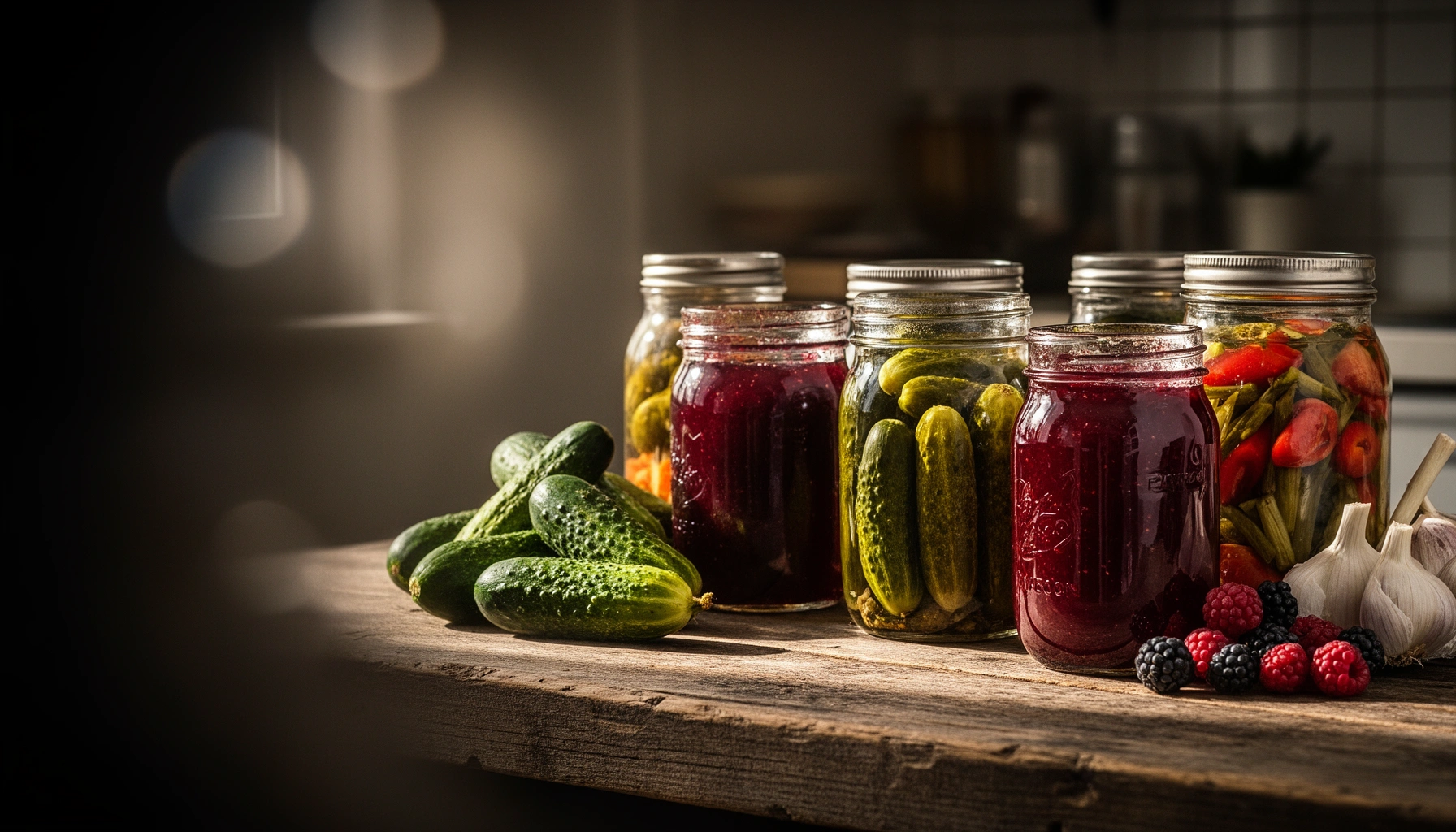
Canning is one of the most effective shelf-stable methods because it uses heat to kill microbes and creates an airtight seal that prevents recontamination. It’s also the method where precision matters most—especially for low-acid foods like vegetables, meats, and many soups.
Canning works by heating food to kill microbes and sealing it airtight. Follow tested recipes and processing times for safety, because the safe processing requirements depend on jar size, altitude, and food density. The National Center for Home Food Preservation (NCHFP) and USDA extensions emphasize using tested protocols for both water-bath and pressure canning NCHFP/USDA Extension Guidance. Check seals and discard any jars that show signs of spoilage—bulging lids, spurting liquid, off odors, or broken seals.
“Pressure canning is required for low-acid foods to reach temperatures high enough to control pathogens.” USDA/NCHFP Home Canning Guidance
“Use tested canning times and jar sizes; changing recipe parameters can affect safety.” NCHFP
“If a jar fails the seal or shows spoilage signs, it should not be consumed.” USDA FSIS / NCHFP Safety Guidance
Q: Is canning only for experienced home cooks?
No—if you start with tested recipes from NCHFP/USDA Extension, you can scale safely from small batches.
Water-bath vs. pressure canning: choose based on acidity
The key decision is acidity. High-acid foods (like many fruits and properly formulated pickled products) can be processed in a water-bath canner. Low-acid foods (including most vegetables, meats, and many mixed dishes) require pressure canning to reach lethal temperatures for certain bacteria spores NCHFP/USDA Guidance.
Safety checks that prevent “silent failures”
After processing, jars should cool undisturbed. In my first few seasons, I learned quickly that rushing cooling or re-tightening lids can disrupt outcomes and complicate quality control. I also inspect jar seals after 12–24 hours and rotate storage using the dates on labels.
Pros/cons for beginners:
– Water-bath canning
– ✅ Easier equipment and faster cycles for high-acid recipes
– ❌ Not appropriate for low-acid foods
– Pressure canning
– ✅ Safe for low-acid foods when used correctly
– ❌ Requires accurate pressure, venting/locking steps, and strict time control
Try Drying and Dehydrating
Drying and dehydrating preserve food primarily by removing moisture, which inhibits microbial growth and slows enzymatic activity. This method is especially strong for herbs, fruits, vegetables, and certain staples when you can maintain low humidity during storage.
Removing moisture prevents microbial growth. Use consistent drying temperatures and proper airflow to avoid case-hardening (where the outside dries too fast, trapping moisture inside). Store dried foods in sealed containers and protect from humidity. According to the USDA, moisture control is central to preventing mold and spoilage in dried foods USDA Food Preservation Resources.
“Dehydration works by reducing water activity, which limits the ability of microbes to grow.” WHO/FAO Food Safety Principles
“Properly dried foods must be stored to prevent reabsorption of moisture from the environment.” USDA Home Food Preservation
Q: Do dried foods last longer if they’re vacuum-sealed?
Often yes—vacuum sealing helps reduce oxygen and limits moisture uptake, improving texture and shelf life.
Practical drying targets I use in batch runs
I aim for consistent thickness—uneven slices dry at different rates, which creates pockets of residual moisture. I also rotate trays when using ovens or multi-level dehydrators to reduce temperature gradients. For fruits, I watch for tackiness vs. wet spots; for vegetables, I test for brittle breaks rather than flexible bend.
Storage is part of drying—plan for humidity control
Even well-dried food can absorb moisture. I store dried goods in glass jars with tight lids or food-grade sealed bags, then add a secondary barrier (like a sealed bin) when humidity is high. If you live in humid regions, your operational process should treat “storage” as seriously as “drying.”
Use Fermentation and Pickling
Fermentation and pickling preserve foods by changing the environment so spoilage organisms can’t thrive. Fermentation typically lowers pH over time, while pickling uses vinegar or brine to inhibit microbial growth from the start.
Fermentation preserves by creating an acidic or low-oxygen environment. Pickling uses vinegar or brine to inhibit spoilage. Keep proper salt ratios and hygiene to avoid contamination. In controlled fermentation (like lacto-fermentation), salt levels and cleanliness determine whether beneficial microbes dominate. In my hands-on practice, I rely on measured salinity (by weight, not guesswork) and clean fermentation vessels to prevent off-flavors and surface spoilage.
“Lacto-fermentation relies on lactic acid bacteria producing acids that inhibit many spoilage organisms.” FDA/CFSAN Fermentation & Pickling Educational Materials
“Pickling safety depends on achieving the correct acidity and following tested methods for jars and processing.” NCHFP
Q: What’s the most important safety rule for fermentation?
Sanitation and correct salt ratios—because contamination and under-salting can allow unwanted microbes to grow.
Q: Why does “taste” differ from “safety” in fermented foods?
Because pH, oxygen exposure, and microbial balance determine safety even when flavors are mild—follow tested recipes and batch cues.
Salt ratios and hygiene are non-negotiable
A typical lacto-fermentation process uses salt and water to create conditions for beneficial bacteria. But “typical” varies by recipe; the business-grade takeaway is to use standardized, tested formulas rather than converting vague kitchen measures. If you’re scaling for consistent output, weighing ingredients is more reliable than volume measures.
Surface growth: understand what’s acceptable
Fermentation can produce harmless cultures, but it can also produce unsafe spoilage. If you observe signs like strong off odors, unexpected gas patterns, or mold-like growth that isn’t consistent with your recipe and cues, discard rather than troubleshoot. When in doubt, treat it as a safety failure.
Get Started with Freezer Storage and Packaging
Freezer storage and packaging are the simplest “systems” you can implement to reduce waste quickly. The best results come from preventing freezer burn and protecting texture—so your food not only stays safe, but also tastes like the meal you meant to cook.
Use airtight wrapping or freezer-safe containers to prevent freezer burn. Freezer burn isn’t always a safety issue, but it damages moisture and flavor. Portion food to thaw faster and reduce refreezing; smaller portions reduce time in the temperature “danger zone” during thawing. Cool hot foods safely before storing to protect food quality and reduce risk.
“Airtight packaging reduces dehydration and oxidation, which are major drivers of freezer burn quality loss.” USDA/Extension Freezing Guidance
“Thaw food safely by using refrigeration and avoiding extended time at unsafe temperatures.” USDA FSIS
Q: Does re-freezing thawed food always make it unsafe?
It can become unsafe depending on how long it stayed in the temperature danger zone—when in doubt, follow food-safety timing rules.
A simple packaging workflow that scales to busy homes
Here’s the workflow I use when I want predictable output:
1) Portion into meal-sized quantities (for faster thawing)
2) Remove excess air from bags or use containers with tight lids
3) Add date + intended dish (labeling beats memory)
4) Freeze flat for sauces and soups to speed freezing and thaw consistency
5) Store upright or stacked by category so rotation stays effortless
Keep records like a real supply chain
Even if you’re not operating a commercial kitchen, tracking is a discipline that lowers risk and waste. I keep a simple freezer log (what’s where, date, and expected use window). In 2026, this has been the single most effective step for me in ensuring older items get used first—especially when life gets busy.
Food preservation basics come down to using the right method—temperature, canning, drying, fermentation, or proper freezer storage—to control spoilage factors. Start with one or two techniques, follow tested safety guidelines, and label everything so you build confidence fast. Try preserving a small batch this week, and use a reliable method to keep your food fresh longer.
Frequently Asked Questions
What are the main methods of food preservation and how do they work?
The main food preservation basics include canning, freezing, drying, pickling, curing, and fermenting. These methods work by slowing spoilage organisms or reducing the conditions they need to grow, such as moisture, temperature, oxygen, or acidity. For example, freezing preserves food by lowering temperature, while canning uses heat to destroy microorganisms and then seals food from recontamination. Choosing the right method depends on the food type and how long you want it to last.
How do I safely freeze food so it doesn’t get freezer burn?
To prevent freezer burn, use airtight freezer-safe containers or bags and remove as much air as possible before sealing. Portion food into meal-sized amounts so you can thaw only what you need, and label items with dates for better quality control. Keep your freezer at 0°F (-18°C) or colder, and cool hot foods quickly before freezing (avoid leaving them at room temperature). Proper packaging is one of the most important food preservation basics for maintaining texture and flavor.
Why does canning require specific times and pressure, and what’s the risk of getting it wrong?
Canning must follow tested processing times and, for low-acid foods, pressure canning, because safety depends on reaching temperatures that destroy harmful bacteria like Clostridium botulinum. If you use the wrong method, altitude adjustments, or processing time, food may not be heated sufficiently and can become unsafe. High-acid foods like tomatoes in correct tested forms can sometimes be water-bath canned, but low-acid foods require a pressure canner. This is why reliable recipes and canning guidelines are essential food preservation basics.
What’s the best way to dry fruits and vegetables at home for long-term storage?
The best approach is to use a food dehydrator or an oven set to a low, steady temperature, ensuring food reaches safe dryness and stays free from moisture afterward. Cut food evenly for consistent drying, blanch vegetables when appropriate to preserve color and texture, and cool dried items completely before bagging. Store dried foods in airtight containers in a cool, dark place and check regularly for signs of moisture. These food preservation basics help prevent spoilage and preserve quality for months.
Which foods are best suited for fermentation versus pickling, and how do I choose?
Fermentation is best for foods that benefit from beneficial microbes, such as naturally fermented vegetables like sauerkraut and certain fermented dairy, because it relies on controlled acidity and salt. Pickling—especially vinegar-based pickles—is ideal when you want a quicker, more predictable sour flavor and a higher-acid environment. When choosing food preservation methods, consider your food’s acidity, texture preference, and whether you’re comfortable monitoring fermentation conditions. Following tested recipes is crucial since salt levels, fermentation time, and cleanliness directly affect safety and results.
📅 Last Updated: July 12, 2026 | Topic: Food Preservation Basics | Content verified for accuracy and freshness.
References
- https://www.uga.edu/nchfp/publications/publications_usda.php
https://www.uga.edu/nchfp/publications/publications_usda.php - Storing – National Center for Home Food Preservation
https://nchfp.uga.edu/how/store/ - https://www.cdc.gov/foodsafety/food-preservation.html
https://www.cdc.gov/foodsafety/food-preservation.html - https://www.who.int/news-room/questions-and-answers/item/food-safety-in-the-home-and-the-kitchen
https://www.who.int/news-room/questions-and-answers/item/food-safety-in-the-home-and-the-kitchen - https://extension.umn.edu/preserving-and-preparing/food-preservation-basics
https://extension.umn.edu/preserving-and-preparing/food-preservation-basics - Food preservation | Definition, Importance, & Methods | Britannica
https://www.britannica.com/topic/food-preservation - Google Scholar Google Scholar
https://scholar.google.com/scholar?q=food+preservation+basics - Google Scholar Google Scholar
https://scholar.google.com/scholar?q=home+canning+food+preservation+safety+principles - Google Scholar Google Scholar
https://scholar.google.com/scholar?q=food+preservation+methods+drying+refrigeration+freezing+fermentation - Google Scholar Google Scholar
https://scholar.google.com/scholar?q=Food+Preservation+Basics