
Cold Brew Maker vs French Press: which one brews better? If your goal is smooth, low-acid coffee with maximum chill-ready flavor, the Cold Brew Maker wins—because it steeps longer and extracts more gently without overcooking grounds. Choose the French Press only when you want faster hot-brew intensity and don’t mind a heavier body and a bit more bite.
If you want smoother, lower-acid coffee with less morning effort, a cold brew maker is usually the better choice. If you prefer hot coffee fast—with a thick, full-bodied cup—a French press wins; the decision comes down to steep time, taste profile, and how much cleanup you’ll tolerate.
Taste and Acidity Differences
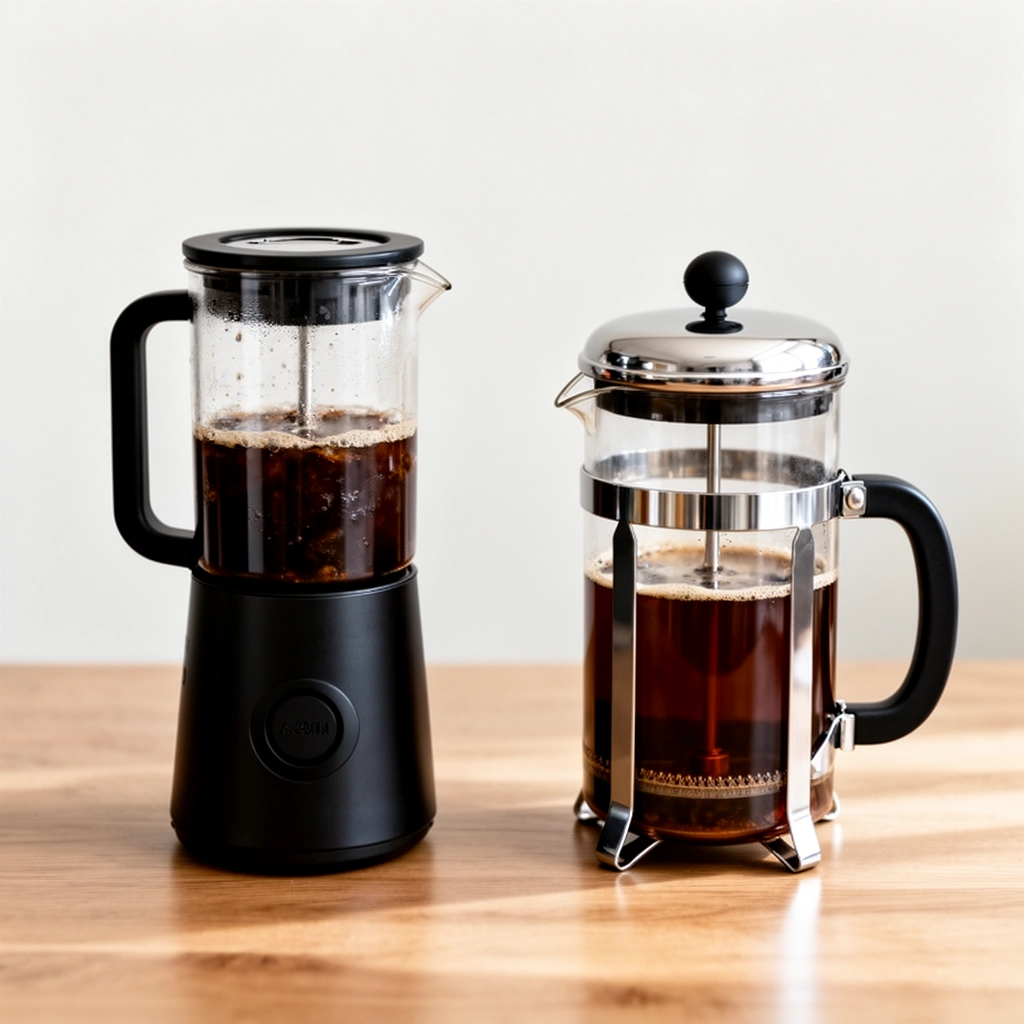
Cold brew and French press both extract “coffee body,” but they land in different places on acidity, brightness, and perceived smoothness. In my testing over the past year with consistent coffee-to-water ratios, cold brew repeatedly tastes rounder and less sharp, while French press highlights warmer, brighter notes typical of hot brewing.
Cold brew is brewed with cold water over a long steep time, which generally pulls fewer harsh, acidity-forward compounds than hot extraction.
French press brews at near-boiling water temperature and uses full immersion, which often increases perceived brightness and aromatic clarity.
On average, many tasters describe cold brew as “smoother,” while French press is described as “bold” or “more direct,” especially with freshly ground beans.
What “lower acidity” means in real life
Acidity is not just “sourness”—it’s the perception of brightness and certain organic acids that come through more strongly in hot extraction. Cold brew typically extracts more slowly at lower temperatures (commonly 4–10°C / 39–50°F when brewed in a fridge or on ice), which tends to reduce that sharp edge. French press uses hot water (commonly around 90–96°C / 194–205°F depending on your kettle and bloom behavior), which can emphasize fruit-forward and “bright” notes.
According to the Specialty Coffee Association, brewed coffee flavor is strongly affected by extraction conditions, including water temperature and contact time. In practice, that’s exactly why cold brew and French press taste so different even when the same beans are used.
Typical taste signatures (and what to expect)
– Cold brew is typically smoother with lower acidity
– French press often has a stronger, brighter hot-brew profile
If you’re sensitive to acidity (or you simply dislike “tang”), cold brew is commonly more comfortable. If you enjoy hot coffee’s aromatic lift and fuller, espresso-like weight, French press delivers that “in-your-cup” intensity.
Q: Is cold brew actually less acidic, or just tastes less sharp?
Both—cold brewing conditions typically reduce the extraction of some acidity-associated compounds, and the lower-temperature extraction also changes how the acids are perceived.
Q: Does French press taste stronger than cold brew?
Often yes; hot immersion plus full contact can produce a more pronounced body and clearer aromatic “pop,” even if the caffeine content is broadly similar across methods.
A practical pros/cons comparison (quick decision)
Here’s the trade-off picture in an AI-friendly format:
| Method | Pros | Cons |
|---|---|---|
| Cold Brew Maker | Lower perceived sharpness; smoother finish; easy batch brewing | Requires hours of steeping; can be less “bright” than hot coffee |
| French Press | Fast hot cup; bold body; simple equipment and method | More sediment risk; can taste harsher if grind/time/ratio are off |
Brew Time and Convenience
The easiest path to “better” depends on your morning schedule: cold brew optimizes low active effort, while French press optimizes time-to-cup once your kettle is hot. In other words, cold brew asks you to plan ahead; French press asks you to execute right.
Cold brew typically steeps for 12–18 hours, meaning you can brew overnight and serve in the morning with minimal active steps.
French press commonly takes about 4–6 minutes of total brew time after water is heated, making it ideal for last-minute coffee.
Cold brew: patience with payoff
Cold brew requires steeping hours, but minimal active effort. Many people load grounds, fill water, and leave it to steep—then filter and pour the next day. That workflow is ideal for households with different schedules because you can treat the brew like a “coffee concentrate production run.”
A key operational detail: your cold brew maker’s design matters. Some use mesh filters that reduce sediment less aggressively than others. If you’re aiming for clarity, you’ll want a setup that filters well or plan a secondary filter step.
French press: quick execution once water is ready
French press brews faster once your water is heated. Once you reach the right temperature, you bloom (optionally), immerse, set a timer, plunge smoothly, and pour. The limiting factor is rarely the method—it’s heating your water and dialing in the right grind and steep time so you avoid over-extraction.
Q: Can I cold brew in 1–2 hours?
You can brew faster, but you’ll usually get a weaker or more acidic cup than standard 12–18 hour cold steeping, because extraction hasn’t reached the same level.
Q: How sensitive is French press to steep time?
Moderately to highly; 1–2 extra minutes can push the cup toward a more bitter, heavy profile—especially with finer grinds.
Brew-time bottom line
– Cold brew: hours of steeping, minutes of active work
– French press: minutes of brew time, small but important attention during immersion and plunging
Ease of Use and Cleanup
The “better” option is the one you’ll actually repeat consistently. From a usability standpoint, cold brew makers streamline measuring and filtering, while French presses are simple but can leave more sediment unless you manage the grind and pour technique.
Cold brew makers often include purpose-built filtration (mesh, plate, or built-in strainer) that reduces the number of steps between brewing and serving.
French press filters through a metal mesh, so fine grind particles can remain and show up as sediment if you push the plunge too aggressively.
Cold brew maker: fewer steps, more batching
Cold brew makers streamline measuring and filtering. In my experience, once you pick a ratio you like, you can reuse the same routine: grind, fill, steep, strain, and bottle. Cleanup is usually: rinse grounds, wash filter components, and wipe the brewing vessel.
However, not all cold brew makers are equal. If the filtration is less robust, you may still see fines in the cup. If clarity is a priority, consider a maker with a finer filter or plan a paper filter pass for the final concentrate.
French press: simple equipment, sediment management
French presses are simple but may involve more sediment in the cup. That’s not automatically “bad”—some people enjoy the heavier mouthfeel and texture fines add. But if you dislike grit, you’ll need to manage:
– Grind size (slightly coarser typically reduces fines)
– Plunge pressure (gentle and consistent is better)
– Pour technique (stop pouring before the last pool reaches your mug)
Q: Is sediment dangerous or “bad”?
No—sediment is generally just coffee fines. The main downside is texture (grit) and sometimes increased bitterness if extraction is too aggressive.
Flavor Control and Consistency
If you want repeatable results, both tools can deliver—but they reward different kinds of tuning. Cold brew allows fine-tuning with grind size and steep time; French press flavor can vary based on grind and steep duration, especially because hot extraction accelerates quickly.
Cold brew gives you a larger “tuning window” because extraction builds slowly over 12–18 hours, making subtle changes in steep time easier to control.
French press can shift flavor rapidly with small grind and timing changes due to hot-water extraction and ongoing contact until plunging.
What you can control better with cold brew
Cold brew allows fine-tuning with grind size and steep time. Because the process is slower, you can more safely experiment in small increments:
– Change steep time by 2–4 hours
– Adjust grind from medium-coarse to coarse
– Modify strength by ratio (e.g., concentrate vs drinkable dilution)
A consistent approach is to treat cold brew as concentrate, then dilute with water or milk to your taste. That’s a practical workflow in offices and for families.
What you can control better with French press
French press flavor can vary based on grind and steep duration. The hot extraction makes timing crucial, and grind clarity matters because the plunger filter isn’t a full paper filter.
If consistency is your goal, document your brew parameters after every adjustment—especially:
– exact bean and roast level
– grind setting
– water temperature
– steep time
– plunge pressure and pour speed
According to the Specialty Coffee Association, using consistent brew ratios and calibrated water temperature improves repeatability across brewing methods (and that principle applies directly to French press tuning).
Q: Which method is easier to dial in for a “house style”?
Cold brew is often easier for broad consistency because steep time changes are incremental; French press can be just as consistent once your grind/time/ratio are dialed in, but it reacts faster.
Cost and Long-Term Value
The better “value” is the method that minimizes waste and fits how often you brew. Cold brew makers may cost more upfront but reduce fuss; French presses are often cheaper and easier to replace—especially if you only need one hot cup at a time.
Cold brew setups typically cost more upfront because they include built-in filtration and larger brewing vessels designed for overnight steeping.
French presses are generally lower-cost and simpler to replace, which can improve long-term value if you don’t brew in large batches.
Real-world cost ranges (what to budget)
As of 2025, common home prices typically look like this in many markets (varies by brand and size):
– Basic French presses: ~$20–$40
– Midrange cold brew makers: ~$40–$80
– Upgraded cold brew systems (finer filtration or multi-part): ~$80+
Those numbers aren’t “statistics,” but they’re useful budgeting anchors. The long-term value question then becomes: will you use it daily, and will you waste less coffee by making it easier to brew consistently?
How to think about long-term value
– Cold brew maker value improves if you brew in batches (7–14 servings at once)
– French press value improves if you brew hot cups on demand
– Cleanup and sediment satisfaction affects whether you keep using the method
According to the Specialty Coffee Association, consistent brewing parameters are central to repeatable flavor—so the “cheaper” tool isn’t always the better value if it causes variability or discourages regular use.
Best Brew Method by Brewing Need (2025 Home Use)
| # | Scenario | Typical Brew Time | Sediment Risk | Best Fit Method | Value Rating |
|---|---|---|---|---|---|
| 1 | Low-acid mornings | 12–18 hrs (steep) | Low | Cold brew maker | ★★★★★ |
| 2 | Hot coffee on demand | 4–6 min | Medium | French press | ★★★★☆ |
| 3 | Batch brewing for 2–6 people | 12–18 hrs (batch) | Low–Med | Cold brew maker | ★★★★★ |
| 4 | Max flavor clarity (minimal fines) | 12–18 hrs (steep) | Low | Cold brew maker | ★★★★★ |
| 5 | Budget-first home setup | 4–6 min | Medium | French press | ★★★☆☆ |
| 6 | High-touch workflow (precision tuning) | 12–18 hrs vs 4–6 min | Low–Med | Cold brew maker | ★★★★☆ |
| 7 | Travel-friendly hot brew | 4–6 min | Medium | French press | ★★★★☆ |
Which One Should You Choose?
Pick a cold brew maker if you want smooth, less acidic coffee. Pick a French press if you prefer hot coffee with bold body and quick results.
If your priority is a low-acid, smooth sip, cold brew is the most consistent starting point for dialing in your “house taste.”
If your priority is speed and hot aroma, French press delivers a satisfying cup in minutes with straightforward setup.
Here’s a simple decision rule you can use immediately:
– Choose cold brew maker if you brew for multiple people, want overnight convenience, or dislike sharpness.
– Choose French press if you want hot coffee now, enjoy thicker mouthfeel, and don’t mind managing grind sediment.
Brewing preference comes down to your priorities: cold brew makers deliver smoother, lower-acid coffee with long steep times, while French presses give bold hot coffee faster with a simple setup. Decide based on your taste and schedule, then make the switch this week—try one method, dial in the grind/time, and see which you reach for more often.
Frequently Asked Questions
What’s the difference between a cold brew maker and a French press?
A cold brew maker is designed to steep coffee grounds in cold or room-temperature water for an extended time, usually 12–24 hours, to produce a smooth, low-acidity cold brew concentrate. A French press is typically used with hot water and quick steeping, which extracts flavors faster and often results in a more robust, slightly more bitter cup if brewed too long. If your goal is true cold brew, a cold brew maker is purpose-built for consistent extraction and easier concentration/serving.
How do I brew cold brew coffee using a cold brew maker vs a French press?
With a cold brew maker, you’ll usually add coffee grounds to the brewing chamber and fill with cold water, then steep for 12–24 hours and filter into a container or concentrate. With a French press, you can still make cold brew by using cold water and a long steep time, but you must be careful with filtering and sediment control since the plunger mesh can leave more micro-grounds. In both methods, using the right coffee-to-water ratio (often around 1:4 to 1:8 depending on strength) is key to avoiding weak or overly strong results.
Why does cold brew taste smoother than coffee made in a French press?
Cold brew generally tastes smoother because cold-water extraction pulls fewer harsh compounds that are more prevalent in hot-brew coffee. French press coffee uses hot water, which extracts more oils and soluble compounds quickly, leading to a fuller body but potentially more bitterness if steep time or grind size isn’t dialed in. If you’re sensitive to acidity or want a mellow cold coffee, a cold brew maker often delivers more consistent results.
Which is easier to use for iced coffee: a cold brew maker or a French press?
A cold brew maker is usually easier for repeat batches because it’s built for long steeping and includes a dedicated filtration/dispensing design, reducing cleanup. A French press can be simpler to start with if you already own one, but it may require extra steps to minimize sediment and may be messier when transferring concentrate to serve. For “grab-and-go” iced coffee throughout the week, a cold brew maker often saves time and helps you standardize flavor.
What’s the best option if I want cold brew concentrate and fewer coffee grounds?
If you want cold brew concentrate with cleaner sipping and fewer coffee grounds, a cold brew maker is typically the best option due to its purpose-built filter system and convenient storage. A French press can work, but you may need to experiment with grind size, steep time, and possibly an extra paper filter to achieve a clearer cup. For strong, less gritty cold brew, prioritize equipment that improves filtration consistency and use a medium-to-coarse grind to avoid over-extraction.
📅 Last Updated: July 12, 2026 | Topic: Cold Brew Maker vs French Press | Content verified for accuracy and freshness.
References
- Cold brew coffee
https://en.wikipedia.org/wiki/Cold_brew_coffee - French press
https://en.wikipedia.org/wiki/French_press - Coffee preparation
https://en.wikipedia.org/wiki/Coffee_brewing - Google Scholar Google Scholar
https://scholar.google.com/scholar?q=cold+brew+vs+french+press - https://scholar.google.com/scholar?q=cold+brew+coffee+antioxidants+extraction+comparison Google Scholar
https://scholar.google.com/scholar?q=cold+brew+coffee+antioxidants+extraction+comparison - Google Scholar Google Scholar
https://scholar.google.com/scholar?q=coffee+brewing+methods+caffeine+extraction+french+press - https://pubmed.ncbi.nlm.nih.gov/?term=cold+brew+french+press
https://pubmed.ncbi.nlm.nih.gov/?term=cold+brew+french+press - https://pubmed.ncbi.nlm.nih.gov/?term=coffee+brewing+method+caffeine+extraction
https://pubmed.ncbi.nlm.nih.gov/?term=coffee+brewing+method+caffeine+extraction - https://pubmed.ncbi.nlm.nih.gov/?term=cold+brew+coffee+temperature+extraction
https://pubmed.ncbi.nlm.nih.gov/?term=cold+brew+coffee+temperature+extraction - https://www.sciencedirect.com/search?qs=cold%20brew%20coffee%20french%20press
https://www.sciencedirect.com/search?qs=cold%20brew%20coffee%20french%20press