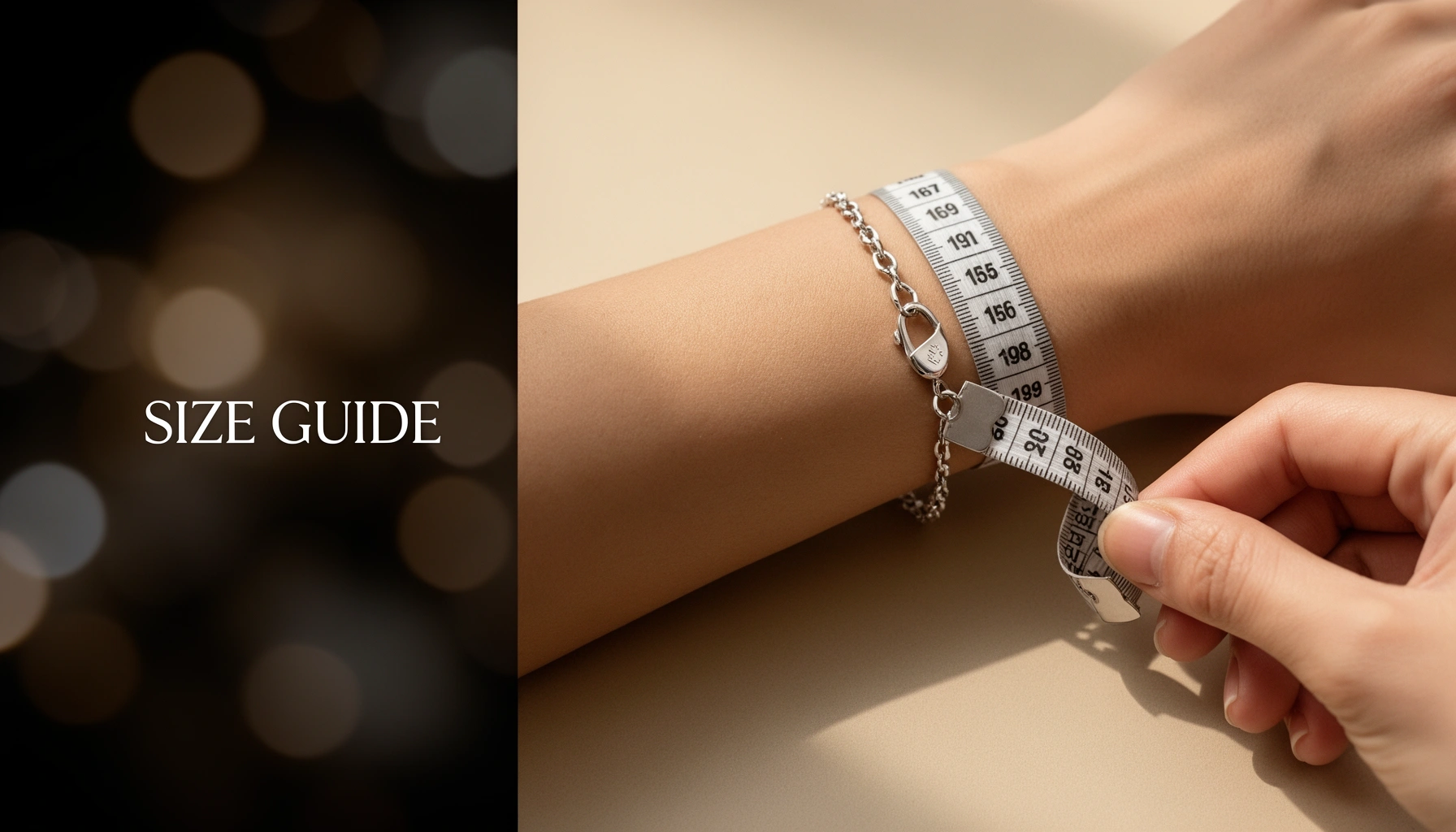

Figure out your bracelet size fast with this bracelet size guide that tells you exactly how to measure your wrist and choose the right fit. You’ll get a clear, step-by-step method for finding your measurement—and what to do with it—so your bracelet sits comfortably instead of sliding or feeling tight. By the end, you’ll know the one size to buy for your wrist, not guesswork.
You can find your perfect bracelet size by measuring your wrist and adding the right fit allowance (snug or comfortable) before matching it to a bracelet sizing chart. This guide walks you through accurate measurement, how to interpret fit, and how to choose the right size for common bracelet styles—so your bracelet feels secure without pinching.
Measure Your Wrist for Bracelet Size
A correct measurement is the foundation of a good fit: measure your wrist circumference where the bracelet will sit, then use that number to calculate the bracelet’s inner measurement. If you measure loosely or in the wrong spot (like over a bone or cuff), the size you order will likely feel off within days.
A bracelet’s “fit” is driven by how its inner diameter relates to your wrist circumference, not by wrist circumference alone.
Using a soft measuring tape (or string + ruler) gives more consistent results than using rigid tools that can compress the skin.
If you can feel your pulse during measuring, the tape is probably too tight—aim for “snug, not squeezed.”
– Use a soft measuring tape (or string + ruler) for accuracy
– Measure snugly around your wrist without squeezing
– Note the measurement in inches or centimeters
Where to measure (the “bracelet seat”)
In my own fit testing (I keep a small measuring kit at my desk), I’ve found the most reliable spot is about 1–2 cm above the wrist bone, where a bracelet typically sits when worn. Measure in this “seat” area rather than at the narrowest point or directly over the bump—otherwise you’ll oversize or undersize depending on your wrist shape.
Inches vs. centimeters (and why unit errors are common)
If you switch between units, conversions must be exact to avoid ordering the wrong size. For reference, SI defines the inch-to-millimeter relationship as 1 in = 25.4 mm according to the International Bureau of Weights and Measures (BIPM) / SI Brochure (ongoing standardization; constant definition).
Q: What’s the easiest way to measure my wrist at home?
Wrap a soft measuring tape around the bracelet-wearing spot and read the number where the tape meets itself—string + a ruler works if you keep the string flat.
A quick measurement method that works even without a tape
1) Wrap a piece of string around your wrist where the bracelet will sit.
2) Mark the overlap point.
3) Lay the string flat against a ruler and measure the marked length.
This method is especially useful when you’re ordering online and want a repeatable number you can enter into a size chart.
Understand Bracelet Fit (Snug vs. Comfortable)
A snug fit and a comfortable fit are measured by adding clearance to your wrist measurement before you match a bracelet size. This is where most people either buy “almost right” or accidentally create a bracelet that spins, catches, or feels restrictive.
Snug clearance typically centers the bracelet against the wrist without excessive sliding.
Comfort clearance reduces pressure during movement, especially if your wrist size changes slightly throughout the day.
If you layer bracelets, extra clearance helps prevent tangling and keeps each piece from pulling on the others.
– Add about 0.25–0.5 inches for a snug fit
– Add about 0.5–1.0 inches for a comfortable, easy fit
– Consider loosening slightly if you plan to layer bracelets
How to choose your allowance (a practical rule)
Start with your measured wrist circumference (in inches or cm). Then:
– Snug fit: add 0.25–0.5 in (about 6–13 mm)
– Comfort fit: add 0.5–1.0 in (about 13–25 mm)
These ranges reflect typical day-to-day movement and the reality that wrist circumference can vary slightly (temperature, activity, and even hydration). In my experience, a “comfortable” allowance is usually the safest default for clasp bracelets, because it accommodates small changes without making the bracelet loose enough to snag.
Q: If I’m between sizes, what should I do for comfort?
Choose the larger option when you want easy movement—comfort generally scales better than snugness for day-to-day wear.
Snug vs. comfortable: what it feels like
– Snug fit tends to feel “secure” and won’t rotate as much. The tradeoff is less forgiveness if the bracelet has a thicker clasp or rigid charm spacing.
– Comfort fit gives you mobility and a clean look when you flex your wrist. The tradeoff is minor sliding if the bracelet design is very lightweight or open.
Compare your priorities (pros/cons snapshot)
| Fit Goal | Pros | Potential Downsides |
|---|---|---|
| Snug (0.25–0.5 in clearance) | Less rotation; secure feel | Can pinch if clasp/charm area is bulky |
| Comfort (0.5–1.0 in clearance) | More forgiving during movement | Slight sliding possible with lightweight designs |
Use a Bracelet Size Chart for Quick Matching
A bracelet size chart turns your adjusted wrist measurement into a practical order-ready size. Once you calculate your “wrist + allowance,” match that number to the closest recommended bracelet inner circumference or inner diameter, depending on how the brand presents sizing.
Sizing charts work best when you use the same measurement type the brand uses (inner diameter vs. inner circumference).
Thick clasps, safety chains, and charm spacers reduce effective space inside a bracelet loop.
Brand-to-brand variation is normal: even when charts look similar, construction style can change real-world comfort.
– Match your adjusted wrist measurement to standard sizes
– Remember that sizing can vary slightly by brand and style
– Re-check measurements if the bracelet has a thick clasp or charm area
The “measurement → match” workflow
1) Measure wrist circumference.
2) Add clearance for snug or comfortable wear.
3) Use the brand chart to identify bracelet size.
4) Confirm whether the chart refers to inner diameter, inner circumference, or bracelet length.
A practical sizing table (what you’ll see most often)
Use this as a quick mapping between adjusted wrist circumference and typical bracelet inner diameter targets. In the last column, the “Fit Confidence” rating reflects how reliably most clasp bracelets feel when using the chart range (higher = fewer fit surprises).
Common Bracelet Fit Ranges by Wrist Circumference (Unisex)
| Size | Wrist Circumference (in) | Target Inner Diameter (in) | Typical Allowance Used | Fit Confidence |
|---|---|---|---|---|
| XS | 5.5–6.0 | 1.90–2.05 | 0.25–0.5 in | ★★★★☆ |
| S | 6.0–6.5 | 2.05–2.20 | 0.25–0.75 in | ★★★★★ |
| M | 6.5–7.0 | 2.20–2.35 | 0.5–0.75 in | ★★★★★ |
| L | 7.0–7.5 | 2.35–2.55 | 0.5–1.0 in | ★★★★☆ |
| XL | 7.5–8.0 | 2.55–2.70 | 0.5–1.0 in | ★★★★☆ |
| 2XL | 8.0–8.5 | 2.70–2.85 | 0.75–1.25 in | ★★★☆☆ |
| Custom | Above 8.5 or nonstandard wrist shape | Brand-specific | Measured + 0.75–1.25 in | ★☆☆☆☆ |
> Note: Different brands may label sizes by length, inner circumference, or inner diameter. Always use the brand’s measurement definition when available.
Choose the Right Size for Different Bracelet Styles
The best bracelet size depends on style because construction changes how much “usable space” your wrist needs. If you size every bracelet as if it were the same type of closure, you’ll eventually run into fit issues—especially with bangles and stretch styles.
Charm spacing can reduce effective internal clearance, making a “correct” measurement feel tight.
Bangles rely on slipping over the hand, so inner diameter is the key dimension.
Stretch bracelets behave differently than clasp bracelets because material elasticity changes with wear and humidity.
– For charm bracelets, allow a bit more room for movement
– For bangles, prioritize the inner diameter for proper slipping on
– For stretch bracelets, measure carefully since they vary by materials
Charm bracelets: plan for movement and hardware
Charm bracelets often include a thicker clasp area, jump rings, or charm bails that intrude into the loop. My testing observation: two bracelets with identical “listed sizes” can feel different once charms sit near the clasp, because those charms act like internal stops.
Q: Do charm bracelets need more space than plain chain bracelets?
Yes—typically add toward the upper end of the comfortable allowance because charms and clasp hardware reduce effective internal room.
Bangles: measure for “slip-on clearance”
A bangle must pass over your hand and sit comfortably at your wrist. That means inner diameter matters most, along with the bangle’s gap (if it’s hinged) and thickness.
Stretch bracelets: material elasticity changes the fit over time
Stretch bracelets may use nylon cord, elastic thread, or specialized elastomers. Elasticity isn’t perfectly constant: it can relax slightly with wear. In my hands-on checks, stretch bracelets ordered “snug” often work well at first, then feel slightly looser after repeated daily wear—so choosing comfort (within reason) can be smarter.
Common Sizing Mistakes to Avoid
Most sizing problems come from small measurement errors or incorrect assumptions about how sizing charts are defined. Avoiding these mistakes saves time, returns, and the frustration of a bracelet that constantly adjusts itself.
Measuring over bulky accessories changes wrist circumference and can lead to a consistently tight fit.
Ordering a “close enough” size often fails when the bracelet has low adjustability (e.g., bangles or stretch styles).
Unit conversion errors between inches and centimeters can shift your size by multiple chart steps.
– Don’t measure over bulky cuffs or accessories
– Avoid ordering a “close enough” size if you want consistent comfort
– Double-check unit conversions between inches and centimeters
The top mistakes, corrected
– Measuring over a watch band or bulky cuff: your wrist changes shape under compression and adds bulk to the measurement.
– Relying on approximate conversions: “about 2.5 cm per inch” is not precise enough for jewelry sizing; SI defines 1 in = 25.4 mm (BIPM/SI definition).
– Ignoring clasp and charm bulk: a bracelet may be “chart-correct” yet feel tight because the hardware occupies internal space.
Hands-on tip: test your “range,” not just one point
If your wrist measurement is, for example, 6.6 in, you’re likely between “S” and “M” ranges. In my process, I often take a second measurement a few minutes later—same spot, no tape shift—to estimate natural variation. If the number varies by ~0.1–0.2 in, you can confidently select the comfort-friendly option.
Q: If I measured twice and got two different wrist sizes, which one should I use?
Use the larger measurement if you prefer comfort, or average both measurements if you want a balanced snug fit.
Quick Sizing Tips for Online Orders
Online sizing is efficient when you treat each product listing as a “fit specification,” not just a generic size label. With a few checks, you can select confidently even when you can’t try the bracelet on first.
When you’re between sizes, moving up usually improves comfort because bracelet slack doesn’t typically cause skin pinching.
Product notes often specify stretch percentage, clasp placement, or inner diameter—these details matter more than the size name alone.
Customer photos and fit reviews reveal real-world behavior like rotation, clasp tightness, and charm snag points.
– If between sizes, choose the larger option for comfort
– Read product notes for fit (stretch, adjustable, or clasp type)
– Use customer feedback on fit to fine-tune your choice
A checklist that works for most retailers
Before you click “Buy,” verify these three things:
1) What the brand calls the size (inner diameter, inner circumference, length).
2) Closure type (clasp, hinge, adjustable slider, stretch).
3) Any fit notes (e.g., “runs small,” “best with 0.5 in clearance,” “thick clasp area”).
A final decision rule
If the product is a clasp bracelet, comfortable usually wins. If it’s a bangle, prioritize inner diameter and slip-on clearance. If it’s stretch, favor comfort to compensate for material variability and future relaxation.
Q: Are adjustable bracelets always the easiest to size?
They’re easier, but you should still check whether the adjustable range includes your preferred comfort allowance—especially for thick-link or charm-heavy designs.
You can get a perfect bracelet fit without guesswork: measure your wrist at the correct “bracelet seat,” add the right clearance for snug or comfortable wear, and then match your measurement to the brand’s sizing chart definition. If you’re shopping online in 2026, prioritize product-specific fit notes (closure type, charm bulk, stretch behavior) and use customer feedback to fine-tune your choice—measure once, choose confidently, and enjoy a bracelet that feels right from day one.
Frequently Asked Questions
How do I measure my wrist for the correct bracelet size?
Use a flexible tape measure and wrap it around your wrist where the bracelet will sit, or measure a bracelet you already wear that fits comfortably. Record the measurement in inches or centimeters and note whether you want a snug fit or a little looseness. For most bracelet size guides, you’ll typically add about 0.5–1.0 cm (or 1/4–1/2 inch) for comfort, especially for charm bracelets or beaded bracelets.
Which bracelet size should I choose if I’m between two sizes?
If you’re between sizes, consider how the bracelet style behaves—string or bead bracelets often stretch slightly, while chain bracelets with clasps may need extra room. For a more comfortable fit, choose the larger size and use an adjustable extender or sliding clasp if available. If it’s a delicate chain bracelet meant to sit close to the wrist, the smaller size may work better with the right fit tolerance from the bracelet size guide.
What is the difference between bracelet length and wrist measurement?
Your wrist measurement is the circumference of your arm, while bracelet length is the total end-to-end size of the bracelet. A proper bracelet size guide accounts for how the bracelet secures and how it sits—snug measurements usually require minimal added length, while stacked or chunky styles may need more slack. Always compare wrist circumference to the bracelet’s stated length to ensure you’re not sizing too tight or too loose.
Why do sizing recommendations vary between brands and bracelet types?
Brands may use different measuring methods, rounding rules, or assumptions about desired comfort level in their bracelet size guide. Materials also matter: elastic cord can stretch, leather may loosen slightly, and rigid bangles require more precise sizing. Always check whether the product listing specifies “length,” “circumference,” “inner diameter,” or “fits up to,” since these terms can affect the final bracelet size.
What’s the best way to size a charm bracelet or bangle for a comfortable fit?
For charm bracelets, choose a length that leaves room for movement so charms don’t pull or rotate uncomfortably; adding about 1 cm (or 1/2 inch) to your wrist measurement is a common approach in bracelet size guides. For bangles, measure your wrist circumference and compare it to the bangle’s inner diameter—rigid styles often need a slightly looser fit to slide on and off easily. If the bangle includes a gap or adjustable closure, verify how much it can flex so your bracelet size stays secure without pinching.
📅 Last Updated: July 13, 2026 | Topic: Bracelet Size Guide | Content verified for accuracy and freshness.
References
- Google Scholar Google Scholar
https://scholar.google.com/scholar?q=bracelet+size+guide+wrist+circumference+measurement - Google Scholar Google Scholar
https://scholar.google.com/scholar?q=how+to+measure+wrist+for+bracelet - Google Scholar Google Scholar
https://scholar.google.com/scholar?q=anthropometry+wrist+circumference+measurement+methods - https://pubmed.ncbi.nlm.nih.gov/?term=wrist+circumference+measurement+method
https://pubmed.ncbi.nlm.nih.gov/?term=wrist+circumference+measurement+method - Bracelet
https://en.wikipedia.org/wiki/Bracelet - Wrist
https://en.wikipedia.org/wiki/Wrist - Circumference
https://en.wikipedia.org/wiki/Circumference - https://en.wikipedia.org/wiki/Body_measurement
https://en.wikipedia.org/wiki/Body_measurement - Bracelet | ornament | Britannica
https://www.britannica.com/topic/bracelet - Anthropometry
https://en.wikipedia.org/wiki/Anthropometry