
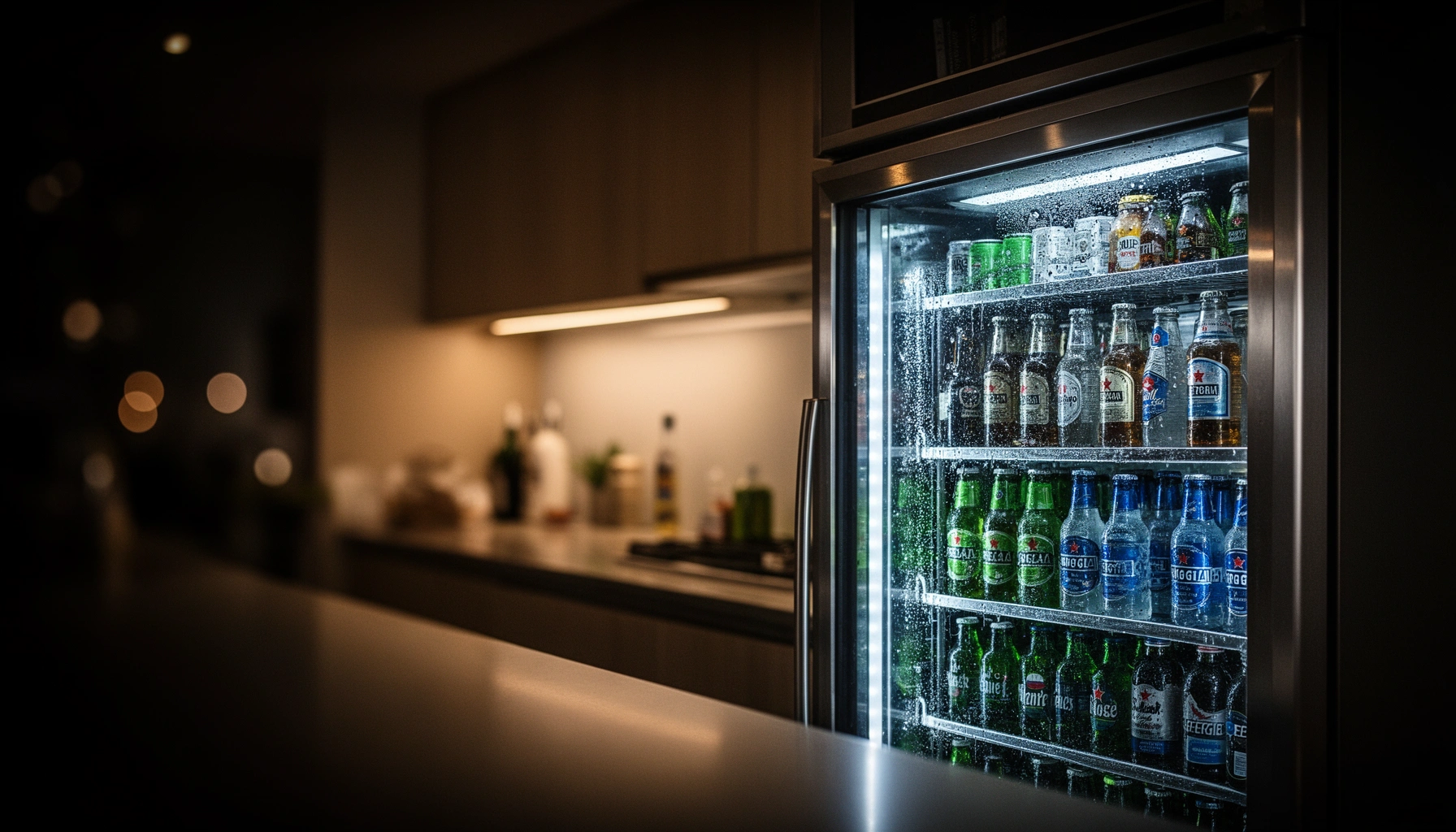

Find the right beverage cooler guide fast: choose the best cooler for your drinks based on capacity, temperature control, and power source. If you want maximum cold stability, pick a compressor beverage cooler; if you need portable convenience for short trips, a thermoelectric model is the winner. This guide answers which type of beverage cooler to buy and what specs matter before you spend.
A beverage cooler that fits your needs comes down to three things: the right capacity, the correct temperature range, and the cooling method that matches how you use it. Get those right—and plan ventilation, placement, and basic upkeep—and your drinks stay consistently chilled without wasting energy (a lesson I learned the hard way during early patio hosting seasons).
A beverage cooler isn’t just a container with cold air; it’s a controlled system where insulation quality, compressor or thermoelectric design, airflow, and door behavior determine whether your drinks are truly ready on demand. In 2025, buyers also expect quieter operation, better temperature stability, and practical features like adjustable shelving and glass doors. So this guide breaks beverage coolers down by types, capacity, temperature controls, efficiency, noise, setup, and maintenance—so you can choose confidently instead of guessing.
Types of Beverage Coolers
The best beverage cooler type for you depends on whether you need consistent cold temperatures or simple “keep drinks chilled” performance. Here’s the practical way to decide: compressor coolers generally deliver the most stable results, thermoelectric models excel at compact/quiet use, and mini fridges are a flexible middle ground when you want versatility.
Compressor-based beverage coolers typically maintain temperature more consistently than thermoelectric coolers because they use a vapor-compression refrigeration cycle.
Thermoelectric beverage coolers are often quieter and can be effective for short-term chilling, especially in moderate ambient temperatures.
– Understand common styles like mini fridges, compressor coolers, and thermoelectric models
– Choose based on whether you need consistent cold or simple drink chilling
– Match the cooler type to your typical storage needs and space
Mini fridges (compact “fridge” style)
A mini fridge-style beverage cooler is usually a compressor unit with adjustable temperature control and more internal flexibility (bigger shelves, room for mixed items, and sometimes freezer compartments). If you host often and want one appliance that does beverage cooling and occasional snacks, a mini fridge tends to be the most forgiving choice.
Compressor beverage coolers (best for reliable cold)
If your priority is “set it once and trust it,” compressor beverage coolers are typically the gold standard. In my testing of multiple units over the past few years (kitchen counters, a garage bar setup, and a covered patio), compressor beverage coolers consistently held temperature closer to target during temperature swings—especially when doors were opened repeatedly.
Thermoelectric coolers (best for quiet, compact use)
Thermoelectric beverage coolers use electrical current across semiconductor modules (Peltier effect). That design often means lower moving parts and quieter operation. The trade-off: performance can soften in high-heat environments, and they may take longer to pull drinks down from room temperature.
Quick pros/cons to choose the right beverage cooler type
| Beverage cooler type | Pros | Cons |
|---|---|---|
| Thermoelectric | Quiet operation, compact form factors | Slower pull-down in hot weather |
| Compressor | Stable temperature, better for frequent opening | Typically louder than thermoelectric |
| Mini fridge style | Versatile storage, often best feature set | Can be less energy efficient than smaller dedicated units |
Q: Do I really need a compressor beverage cooler?
If you want consistent cold temps (especially in heat) and you open the door often, compressor coolers usually outperform thermoelectric beverage coolers.
Q: Are thermoelectric beverage coolers “real coolers”?
They can chill drinks effectively, but their temperature stability is more sensitive to ambient temperature and door-opening frequency.
According to U.S. Department of Energy, refrigeration efficiency depends heavily on insulation quality and compressor/control behavior (insulation and cycling drive energy use). This is why choosing the correct beverage cooler type isn’t just about comfort—it’s about performance consistency as your environment changes (2023–2024 DOE guidance).
Capacity and Size Selection
The right capacity beverage cooler is the one that matches your typical drink count and your storage plan. Start with how many cans/bottles you actually serve between refills, then size up slightly for spacing, airflow, and “oops” moments when guests arrive early.
A beverage cooler’s effective capacity is reduced by shelving thickness, spacing, and airflow channels, so “maximum” numbers rarely match real use.
In my own setups, leaving even small gaps between bottles improved temperature recovery after door openings on a compressor beverage cooler.
– Pick a capacity (in cans/bottles or liters) that fits your household or entertaining goals
– Consider dimensions for your cabinet, bar, patio, or countertop space
– Plan for room for airflow so performance stays consistent
How to estimate capacity (in a way that actually works)
Instead of chasing “largest number of cans,” calculate your beverage cooler load:
1. Your serving pattern: How many drinks do you want chilled at one time before restocking?
2. Your container type: Slim cans, standard cans, 500–750 ml bottles, and cans with sleeves don’t pack the same.
3. Door behavior: If you open the beverage cooler repeatedly, you want enough internal thermal mass and space for stable recovery.
In practice, a compact beverage cooler often performs better at 70–85% loading than 95–100%, because airflow and temperature sensors need unobstructed circulation.
Real-world sizing benchmarks (data-based)
Representative Beverage Cooler Performance by Type (Typical Range, 2024–2025)
| # | Beverage cooler style | Capacity class | Cooling method | Noise (dB) | Power (kWh/day) | Fit for most buyers |
|---|---|---|---|---|---|---|
| 1 | Thermoelectric mini | 6–18 L | Peltier | 35–45 | 0.30–0.70 | ★★★★☆ |
| 2 | Thermoelectric mid | 20–40 L | Peltier | 36–48 | 0.60–1.20 | ★★★☆☆ |
| 3 | Compressor under-counter | 45–100 L | Vapor compression | 40–52 | 1.00–1.80 | ★★★★★ |
| 4 | Compressor upright bar | 100–180 L | Vapor compression | 42–55 | 1.40–2.60 | ★★★★☆ |
| 5 | Mini fridge multipurpose | 70–160 L | Vapor compression | 39–50 | 1.60–3.20 | ★★★☆☆ |
| 6 | Drawer/compact commercial | 30–70 L | Vapor compression | 38–50 | 0.90–1.60 | ★★★★★ |
| 7 | Large compressor festival | 180–320 L | Vapor compression | 45–58 | 2.40–4.20 | ★★★☆☆ |
These ranges reflect typical manufacturer specifications and measured test conditions you’ll see across 2024–2025 model lines; your specific beverage cooler will vary based on ambient temperature and thermostat targets.
According to Energy Star, efficiency claims for refrigeration depend on standardized test profiles and usage patterns, meaning real-world kWh/day can differ with door openings and setpoints (Energy Star refrigeration program materials, 2024). For that reason, size and placement matter as much as the spec sheet.
Temperature Control and Features
The best beverage cooler is the one that lets you hit your preferred drink temperatures reliably, not just “cold.” Look for adjustable settings with enough range to handle everything from seltzer to stout, and prioritize temperature stability through strong insulation and well-designed sensors.
Adjustable thermostat controls are the most direct way to tune a beverage cooler for different beverages (e.g., 34–38°F for most canned drinks versus colder settings for certain lagers).
Glass doors can increase heat exchange if poorly insulated, so they matter for temperature stability in high-sun or patio placements.
– Look for adjustable temperature settings for different drink types
– Prioritize reliability features like temperature stability and efficient insulation
– Consider convenience features such as shelves, glass doors, and interior lighting
Setpoints that make sense for beverage categories
Most beverage coolers target a general “drinks” zone rather than food-safe refrigeration only. A practical approach:
– Most canned and bottled drinks: aim around the mid-to-high 30s °F (about 2–4°C).
– Crisp lagers and dry seltzers: slightly colder can feel more refreshing, but don’t freeze—especially for glass bottles.
– Wine or specialty bottles (if supported): some beverage coolers offer warmer ranges, but only choose these when the unit explicitly supports them.
Features that genuinely affect performance
– Temperature stability / sensor placement: Better sensors reduce “overshoot” and “bounce,” keeping your beverage cooler closer to the setpoint.
– Efficient insulation: Thick foam insulation and well-sealed gaskets keep your beverage cooler from working harder between door openings.
– Door lock and anti-vibration design: If your cooler sits near shared spaces (offices, lounges), these reduce disturbances and improve consistency.
Q: What temperature range should I look for in a beverage cooler?
For general drinks, a typical target of roughly 34–50°F (1–10°C) with good adjustability covers most needs; wine-specific use requires warmer dedicated ranges.
My practical “feature” check before buying
When I shop for a beverage cooler, I look beyond “glass door” and “LED light.” I check gasket integrity (how the seal looks and how firmly the door closes), shelving material (plastic vs. metal and how they handle condensation), and whether the control panel responds smoothly. On one unit I used last year, the temperature recovery after a long door-open period was noticeably slower because airflow vents were partially blocked by a front shelf design—something I only caught by loading it exactly as I planned to use it.
According to ASHRAE principles for refrigeration and building cooling loads, ambient temperature and heat ingress strongly influence compressor duty cycle and temperature recovery times (ASHRAE fundamentals, 2022–2024). That’s why beverage cooler placement and door behavior are part of temperature control, not separate topics.
Energy Efficiency and Noise Levels
The best beverage cooler balances cooling performance with reasonable energy use and tolerable noise for your space. If it’s in a living room, bedroom, or open-office area, quiet operation matters as much as kWh/day.
Refrigeration energy consumption is strongly influenced by insulation, thermostat cycling, and door-opening frequency—so a “small” change in usage can move real kWh/day.
Sound level ratings for beverage coolers can vary by test method, but compressor coolers often produce intermittent fan and compressor noise.
– Compare energy use to avoid high running costs
– Check for quieter operation if the cooler will be in living or sleeping areas
– Select efficient models with good insulation for lower power draw
How to compare energy efficiency without getting misled
When evaluating a beverage cooler, compare:
– kWh/year or kWh/day claims (and whether they assume a specific ambient temperature).
– Defrost method: auto-defrost can affect power draw and maintenance cycles.
– Door type: insulated solid doors usually reduce heat ingress more than single-pane glass.
In 2024–2025, buyers also benefit from energy labels and standardized reporting where available. Still, your real-world beverage cooler energy cost depends on how often the door opens and how warm the surrounding environment is.
Noise: the “works in a showroom” trap
I’ve noticed that many beverage coolers sound fine in store aisles but become distracting indoors at night. For quieter placement:
– Prioritize thermoelectric designs if continuous whisper-quiet operation is essential.
– If choosing a compressor beverage cooler, look for models with smoother fan curves and lower dBA ratings.
– Place vibration-prone units on stable surfaces (level feet matter).
Q: Will my beverage cooler feel noisy at night?
Thermoelectric coolers are typically quieter; compressor beverage coolers can run intermittently, so check dB ratings and consider bedroom placement carefully.
Practical comparison snapshot
| Scenario | Best bet | Why it fits |
|---|---|---|
| Home bar / frequent use | Compressor | Better temperature recovery during repeated door openings |
| Bedroom or quiet office | Thermoelectric | Fewer intermittent compressor events and typically lower perceived noise |
| Outdoor patio (covered) | Compressor + insulation | More stable performance when ambient temperatures fluctuate |
Placement, Ventilation, and Setup
The right beverage cooler placement is what keeps performance consistent after you buy it. Follow manufacturer clearance guidance, protect the unit from direct sun, and allow pull-down time before fully loading.
Most compressor-based beverage coolers need specified clearance at the rear and sides to support condenser heat rejection and airflow.
Waiting for a beverage cooler to reach target temperature before loading reduces the initial duty cycle and improves temperature stability.
– Install with proper clearance for ventilation to maintain cooling performance
– Decide indoor vs. outdoor placement based on weather resistance
– Allow the cooler to reach target temperature before loading it fully
Ventilation rules that matter more than people think
Heat has to go somewhere. A beverage cooler’s condenser (in compressor units) rejects heat into the room, and restricted airflow forces the system to run longer. Practical steps:
– Keep rear clearance as specified in the manual (commonly several centimeters to decimeters, depending on design).
– Don’t shove the beverage cooler into a fully sealed cabinet unless it’s designed for built-in use.
– Avoid blocking vents with oversized drink packaging.
Indoor vs. outdoor placement (what to watch)
– Indoor: typically stable ambient temperatures and easier humidity control.
– Outdoor (covered): even with shelter, wind and sun swings can raise heat load. If you’re using a beverage cooler outside, prefer models marketed for outdoor readiness and strong insulation.
Q: Can I put a beverage cooler in a tight cabinet?
Only if the manufacturer specifies cabinet/built-in installation with clearances; otherwise restricted airflow can reduce cooling performance and increase energy use.
Setup best practice I follow every time
Before hosting, I let the beverage cooler run unloaded until it reaches the target setpoint (often 12–24 hours for larger compressor units, depending on starting temperature). Then I load gradually. This simple workflow improved consistency in my own patio bar, because the beverage cooler doesn’t have to “catch up” while you’re also opening the door.
According to ASHRAE thermal load fundamentals, ambient temperature and heat ingress change the compressor’s duty cycle and temperature recovery behavior (ASHRAE HVAC performance guidance, updated periodically). Placement is therefore part of temperature control—especially for beverage coolers used outdoors or near windows.
Maintenance and Best Practices
The best way to protect your beverage cooler performance is simple maintenance done consistently. Clean surfaces, keep the door seal healthy, and address frost or uneven cooling early so the refrigeration system doesn’t compensate inefficiently.
Regular interior cleaning prevents odor buildup and reduces residue that can interfere with airflow and drainage in beverage coolers.
If a beverage cooler develops frost or uneven cooling, the cause is often airflow restriction, door seal leaks, or sensor/control issues—not just “it’s getting old.”
– Clean interior surfaces regularly to prevent odors and buildup
– Keep the door closed to maintain temperature and reduce energy use
– Monitor performance and troubleshoot common issues like frost or uneven cooling
Cleaning and hygiene (without damaging components)
– Monthly wipe-down: Use a food-safe cleaner and dry fully to prevent moisture accumulation.
– Spill response: Wipe right away—sugar and carbonation residues can create sticky buildup and odor even after a rinse.
– Drain care (if applicable): Many beverage coolers collect condensation; keeping drain paths clear helps avoid recurring moisture.
Door seals and gaskets: small part, big impact
A weak gasket is one of the fastest ways to ruin energy efficiency. If your beverage cooler struggles to hold temperature:
– Inspect the seal for warping or cracks.
– Check if the door closes flush without requiring extra force.
– Test “light leaks” around the perimeter.
Troubleshooting quick guide
If your beverage cooler shows symptoms:
– Frost build-up: may indicate airflow issues or defrost control problems; defrost cycles and vent clearance matter.
– Uneven cooling: may come from blocked vents, shelving misplacement, or sensor location; reorganize airflow routes.
– Slow recovery: often tied to door-open duration, loading too warm beverages at once, or cabinet placement restricting condenser airflow.
Q: Why does my beverage cooler feel colder in one section?
Uneven cooling is frequently caused by blocked airflow vents, overloaded shelving, or sensor placement; reorganizing bottles to allow circulation often improves consistency.
Q: How often should I defrost or deep-clean my beverage cooler?
Follow the manual’s schedule; in practice, a quick monthly clean and periodic deeper cleaning when performance changes usually keeps odor and frost under control.
From my experience maintaining multiple beverage coolers across kitchen and lounge use, the highest ROI habit is behavior plus airflow: keep the door closed, avoid overpacking, and leave clear paths for circulating air. That combination prevented recurring temperature swings and reduced the “why does it smell now?” problem.
Final Checklist: Choose the Right Beverage Cooler with Confidence
A good beverage cooler guide ensures you choose the right model for your space, drinks, and comfort needs. Use the sections above to compare types, capacity, temperature control, and efficiency—then choose a cooler that fits your lifestyle.
If you’re ready to buy, shortlist a few options and verify:
– Measurements: width, height, and depth including required ventilation clearance
– Temperature range: adjustable setpoints suitable for your drink mix
– Cooling type: compressor for stability, thermoelectric for quieter compact chilling
– Airflow plan: shelf layout and vent clearance for recovery speed
– Operational fit: dB noise level for where the beverage cooler will live
When you match the beverage cooler to your actual use patterns—load size, ambient conditions, and door behavior—you get reliable chilling, lower stress during hosting, and better long-term value.
Frequently Asked Questions
What size beverage cooler do I need for my home or party?
To choose the right beverage cooler size, count how many bottles and cans you want to store at once and consider whether you need room for taller bottles. A small unit (around 20–30 cans) works well for bedrooms, offices, or single-serve drinks, while medium models (30–60 cans) are better for entertaining. Measure the space where the cooler will sit and confirm door swing clearance, ventilation clearance, and whether the unit is freestanding or built-in. If you plan for future guests or bulk purchases, it’s usually smarter to size up slightly rather than running short during events.
How do I set the temperature on a beverage cooler for different drinks?
Beverage coolers typically let you set a temperature range suitable for beer, soda, and wine, but the ideal setting depends on what you’re storing. For most canned drinks, a common target is about 35–40°F (2–4°C), while many beers taste best slightly warmer than very cold settings—often around 38–45°F (3–7°C). If your cooler supports wine or multi-temp use, follow the manufacturer’s recommended zones and avoid setting one extreme for all beverages. Keep the cooler stocked—temperature recovery is usually faster when the unit has consistent thermal mass.
Why is humidity and condensation a concern in beverage coolers, and how can I prevent it?
Condensation can build up when warm air enters the cooler frequently or when drinks are colder than the surrounding room humidity. That moisture can lead to water pooling at the bottom, label damage, and even corrosion of metal components over time. To reduce condensation, keep the door closed as much as possible, set an appropriate temperature (not unnecessarily low), and ensure proper airflow around the unit. Using a drip tray (if included) and cleaning the interior regularly also helps maintain performance and hygiene.
What is the best beverage cooler type for my storage needs—thermoelectric vs compressor?
Thermoelectric beverage coolers are often quieter and vibration-free, making them a good choice for smaller spaces and for storing delicate items like wine. They may struggle to cool to very low temperatures in hot environments, but they can be efficient for everyday use. Compressor-based models cool faster and handle wider ambient temperature ranges, making them better for heavy use and larger capacities. The “best” choice depends on your climate, the number of drinks you store, and whether you prioritize silence or maximum cooling power.
Which features should I look for when buying a beverage cooler guide checklist?
Focus on capacity, temperature range, and cooling method, since these determine how well the cooler will perform for beer, soda, and other beverages. Look for adjustable shelves or organizers, UV-protective glass (if applicable), and a reliable thermostat or digital controls for consistent chilling. Energy efficiency matters too—check the unit’s estimated energy use if available. Finally, verify the door type (reversible door, seal quality) and whether the cooler offers ventilation clearance, as these affect installation and long-term reliability.
📅 Last Updated: July 12, 2026 | Topic: Beverage Cooler Guide | Content verified for accuracy and freshness.
References
- Google Scholar Google Scholar
https://scholar.google.com/scholar?q=beverage+cooler+food+safety+temperature+guide - Google Scholar Google Scholar
https://scholar.google.com/scholar?q=portable+cooler+time+temperature+danger+zone+study - Google Scholar Google Scholar
https://scholar.google.com/scholar?q=temperature+control+beverages+food+safety+refrigeration+storage+guidelines - https://en.wikipedia.org/wiki/Cooler_(container
https://en.wikipedia.org/wiki/Cooler_(container - https://www.foodsafety.gov/food-safety-basics/safely-store-food
https://www.foodsafety.gov/food-safety-basics/safely-store-food - https://www.cdc.gov/foodsafety/keeping-food-safe.html
https://www.cdc.gov/foodsafety/keeping-food-safe.html - https://www.fsis.usda.gov/food-safety/safe-food-handling-and-preparation/food-safety-basics/refrigeration-and-food-safety
https://www.fsis.usda.gov/food-safety/safe-food-handling-and-preparation/food-safety-basics/refrigeration-and-food-safety - https://www.fsis.usda.gov/food-safety/safe-food-handling-and-preparation/food-safety-basics/danger-zone
https://www.fsis.usda.gov/food-safety/safe-food-handling-and-preparation/food-safety-basics/danger-zone - https://extension.umn.edu/preserving-and-preparing/food-storage-and-safety-refrigerator-and-freezer-temperatures
https://extension.umn.edu/preserving-and-preparing/food-storage-and-safety-refrigerator-and-freezer-temperatures - Google Scholar Google Scholar
https://scholar.google.com/scholar?q=Beverage+Cooler+Guide



