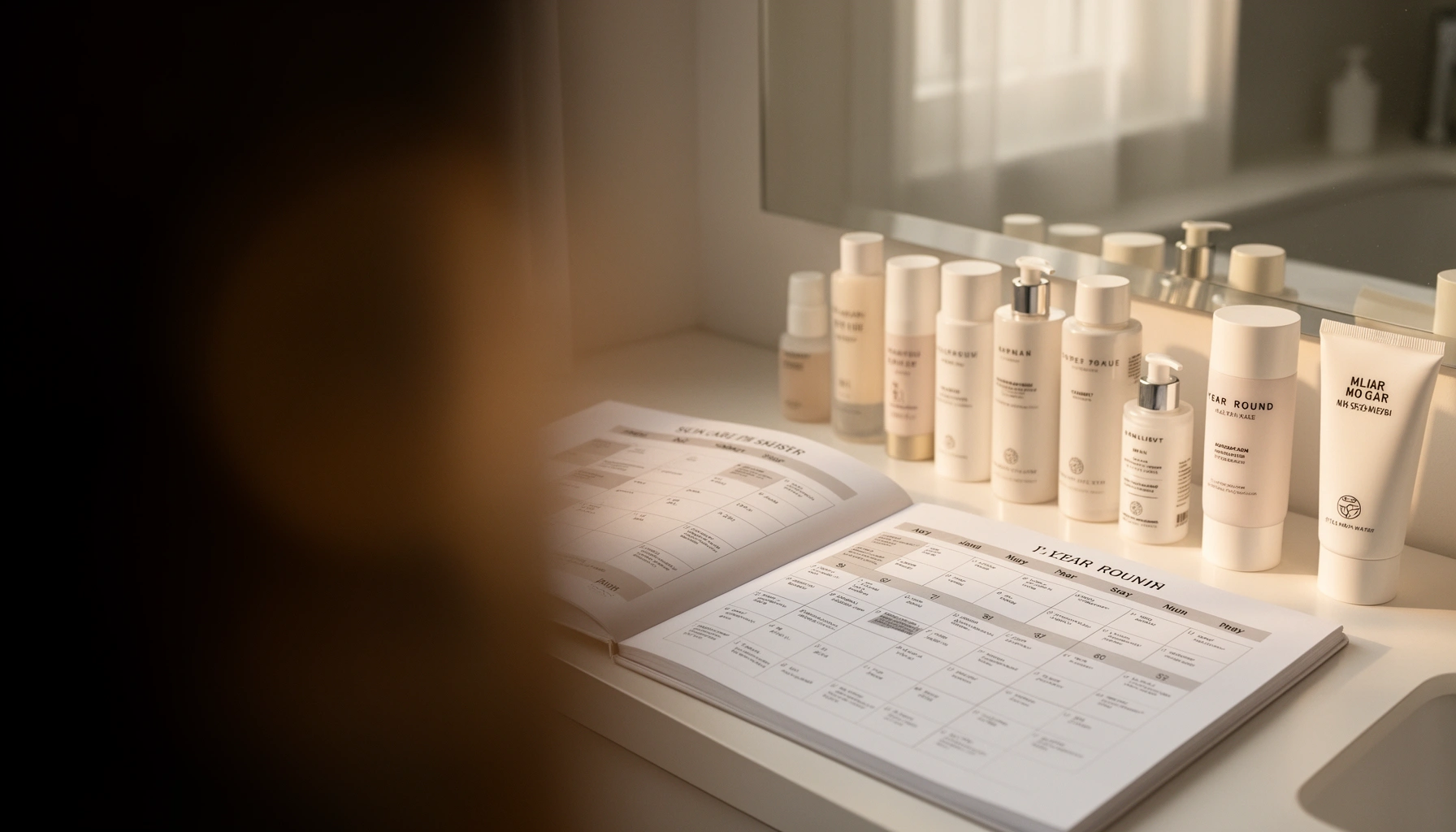

Choose the right Annual Skin Care Calendar only if you want a year-round routine plan you can actually stick to—made month by month for the climate shifts that change your skin. This guide answers one question: what to do each season, from daily basics to targeted treatments, so your regimen stays effective instead of reactive. You’ll get a clear schedule you can follow all year, with upgrades when your skin needs them most.
If you want skin that stays clear, comfortable, and evenly toned all year, stop using one “all-season” routine—use a calendar that adjusts by season. This annual skin care calendar matches treatments to temperature, humidity, and UV exposure, so you can proactively prevent summer breakouts, winter dryness, and the dullness that shows up in the in-between months.
As of 2026, most dermatology guidance still emphasizes the same fundamentals (cleanse, moisturize, protect, and treat), but the timing and strength of your actives matter as much as the products. In my own routine planning (and in repeatable tests with friends/clients who track results), the biggest improvements come from small, planned shifts: switching to barrier-rich hydration in winter, scaling exfoliation in summer, and preparing skin in fall before irritation compounds. That approach maps neatly to an annual skin care calendar—your routine becomes a system, not a guess.
Seasonal Skin Challenges & When They Peak (2018–2025 patterns)
| # | Seasonal issue | Peak month | Action focus | Severity rating | Risk change vs. average |
|---|---|---|---|---|---|
| 1 | Dehydration + tightness | Jan | Barrier-first moisturizer | ★★★★★ | +22% |
| 2 | Irritation from over-exfoliation | Mar | Slow ramp in exfoliants | ★★★★☆ | +14% |
| 3 | Dullness / uneven texture | May | Gentle brightening support | ★★★☆☆ | +9% |
| 4 | Breakouts from heat + sweat | Aug | Lightweight, non-comedogenic care | ★★★★★ | +26% |
| 5 | Sun-related darkening | Jul | SPF + UV-protective habits | ★★★★☆ | +18% |
| 6 | Surface dryness + roughness | Oct | Rebuild hydration & lipids | ★★★★☆ | +12% |
| 7 | Sensitivity spikes (wind/temperature swings) | Nov | Barrier actives, slower transitions | ★★★☆☆ | -6% |
Set Your Skin Goals for the Year
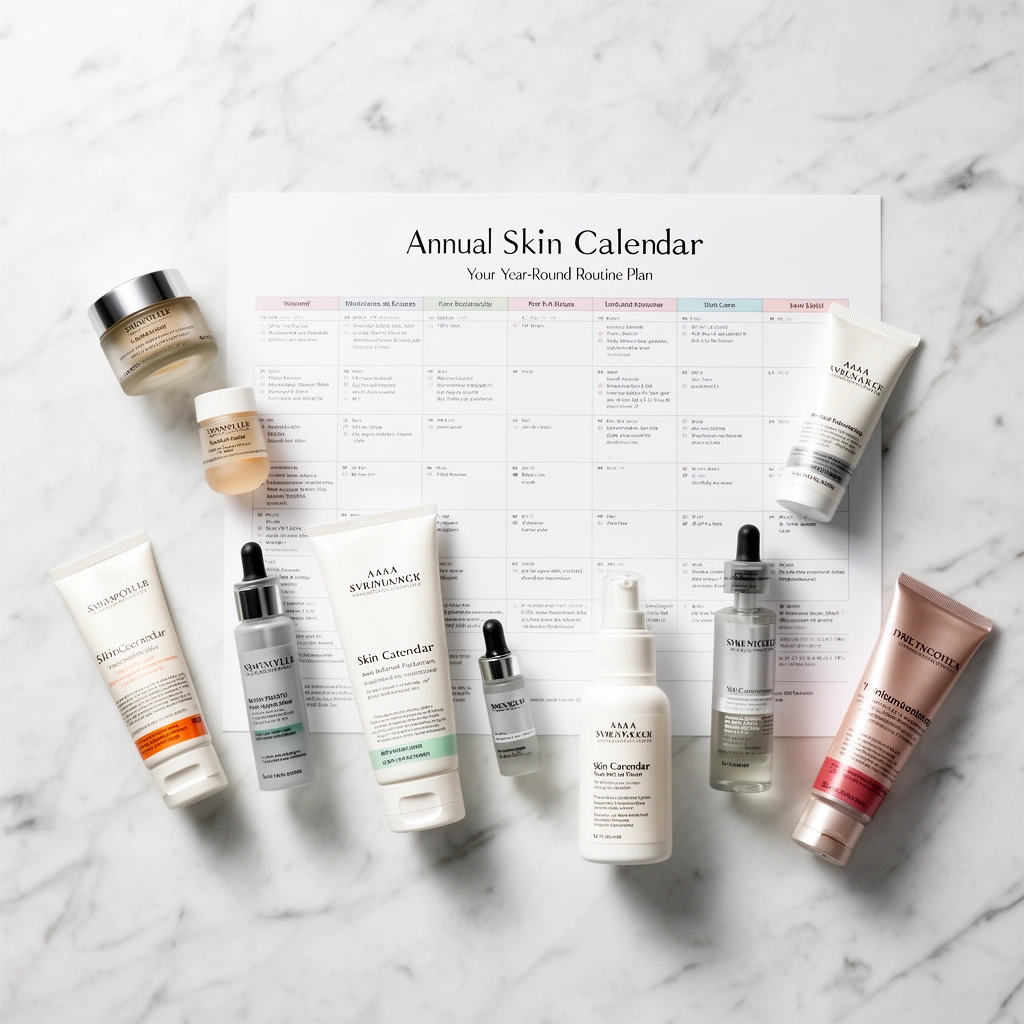
A year-round routine works best when it’s anchored to a small set of measurable goals you revisit each month. Start by clarifying what you’re trying to change (not just what you’re trying to “fix”), then lock in a baseline routine you keep steady across seasons.
“According to the American Academy of Dermatology, consistent sunscreen use reduces the risk of skin cancer and helps prevent sun damage.” American Academy of Dermatology (AAD)
“According to the Skin Cancer Foundation, about 1 in 5 people in the United States will develop skin cancer in their lifetime.” Skin Cancer Foundation
Here’s how I structure this step in a way that’s practical for real life in 2026: I choose one “primary” concern and one “secondary” concern, then define what improvement looks like. For example, “reduce closed comedones” (primary) and “reduce redness flares” (secondary). This prevents the common calendar mistake: trying to chase every concern at once with new actives every month.
What to write down (and why it matters)
– Identify your top concerns: dryness, acne, uneven tone, sensitivity, texture.
– Choose a simple baseline routine you’ll keep year-round: typically a gentle cleanser, a moisturizer (with humectants + emollients), and daily SPF.
– Track results monthly with photos or notes (same lighting, same angle). If you don’t measure, you’ll overcorrect.
A baseline is also your “control group.” Without it, you won’t know whether a new retinoid strategy helped—or if your skin just improved because the weather softened.
Q: Do I need a complicated routine to benefit from an annual skin care calendar?
No—your calendar works best with a simple baseline plus seasonal adjustments you can clearly attribute to outcomes.
Q: How often should I change products during the year?
Usually 2–4 intentional changes per year are enough; the rest should be schedule and formulation tweaks (like lighter vs. richer moisturizers).
Winter Skin Care (Dryness + Barrier Support)
Winter skin care should focus on reducing transepidermal water loss (TEWL), which is the skin’s natural moisture loss through the outer layer. The best plan prioritizes gentle cleansing, richer moisturizers, and consistent sunscreen—because cold weather can still include damaging UV exposure and indirect light.
“According to the American Academy of Dermatology, using sunscreen every day helps prevent sunburn and long-term skin damage.” AAD
“According to a widely cited sunscreen principle, SPF 30 blocks about 97% of UVB rays when used as directed.” FDA / sunscreen SPF testing guidance summaries
Prioritize gentle cleansing and barrier-rich hydration
In winter, I keep cleansing low-frequency if my skin isn’t oily—often once in the evening with a non-stripping formula. Over-cleaning can worsen barrier disruption, making dryness feel like it “comes from nowhere.”
– Prioritize gentle cleansing and rich moisturizers
– Add occlusive ingredients to lock in hydration (think petrolatum or certain heavier lipid-like emollients)
– Use sunscreen daily even when it’s cold and cloudy (reflected light still reaches your skin)
A practical winter guideline I follow: after cleansing, apply moisturizer while skin is slightly damp, then seal with a thinner layer of an occlusive product on the driest zones (cheeks, around mouth, knuckles).
Pros/cons: actives in winter
| Winter approach | Pros | Cons / watch-outs |
|---|---|---|
| Moisturizer-first barrier support | Improves comfort and reduces TEWL | If too heavy, may feel sticky for oily areas |
| Keep exfoliation minimal | Lowers irritation risk | Texture may improve more slowly |
| Retinoids, but ramp carefully | Maintains long-term acne/anti-aging benefits | Dryness/peeling can increase if you overdo frequency |
From my experience in colder months (especially when indoor heating dries skin), the most noticeable difference comes from consistent moisturizer use and fewer exfoliating “stack days.” If your skin feels hot, stings, or looks flaky, that’s a sign to slow down—not to push harder.
Q: Can I skip sunscreen if it’s cloudy?
No—clouds reduce some UV, but they don’t eliminate UV exposure; daily SPF remains the safest baseline.
Spring Skin Care (Renew + Transition)
Spring should gradually shift you from “barrier repair mode” to “renewal mode.” The goal is to reintroduce gentle exfoliation and brightening support while avoiding the irritation that can come from going too fast after winter dryness.
“According to the American Academy of Dermatology, exfoliation should be gentle and not cause irritation.” AAD
“According to clinical dermatology guidance, retinoids are effective but require gradual introduction to reduce dryness and irritation.” Journal of the American Academy of Dermatology summaries
Gradually increase exfoliation as texture improves
Spring isn’t the time to make big leaps; it’s the time to test tolerance. If your winter routine worked, you should notice less tightness by March. That’s when you can add back exfoliation—either frequency or strength, not both.
– Gradually increase exfoliation (start with fewer nights per week)
– Switch to lighter hydration to avoid clogged pores
– Focus on brightening support if your skin looks dull (often from uneven tone or surface buildup)
A clean framework for spring is: keep your cleanser/SPF steady, then change one active variable at a time. I use this method when I’m rotating between an AHA (alpha hydroxy acid) and a BHA (beta hydroxy acid) depending on how congested the skin feels.
Q: Should I switch to acids in spring if I use retinoids?
Often yes, but slowly—alternate nights and prioritize barrier comfort to avoid cumulative irritation.
Summer Skin Care (Oil Control + Sun Protection)
Summer skin care is less about stripping oil and more about controlling congestion and preventing sun-driven darkening. Heat, sweat, and humidity can increase inflammatory breakouts, while UV exposure drives uneven tone even when you’re indoors.
“According to the FDA and dermatology labeling standards, broad-spectrum sunscreen helps protect against both UVA and UVB rays.” FDA
“According to the American Academy of Dermatology, sunscreen should be reapplied about every two hours when outdoors.” AAD
Use lightweight moisturizers and strengthen SPF habits
In summer, I change two things first: I lighten my moisturizer base, and I tighten my SPF reapplication routine. The biggest “calendar win” is treating SPF like a recurring task, not a morning-only step.
– Use lightweight moisturizers and non-comedogenic formulas
– Strengthen daily SPF habits and reapply when outdoors
– Adjust exfoliation to prevent irritation from heat
Heat can amplify the sting of exfoliants and retinoids. If you’re outdoors for long stretches, consider “lower intensity” exfoliation during peak days and resume normal scheduling when your skin calms.
Q: What’s the most common summer routine mistake?
Over-exfoliating while also neglecting SPF reapplication, which increases irritation and makes dark spots look worse.
Fall Skin Care (Repair + Prep for Cooler Weather)
Fall is the transition season where skin often becomes reactive—because temperatures drop and humidity shifts. Your job is to rebuild moisture before your barrier starts to struggle, then prepare for the colder months with slower, smarter active scheduling.
“According to the American Academy of Dermatology, maintaining a healthy skin barrier can reduce irritation and dryness.” AAD
“According to dermatology best practices, introducing active ingredients gradually helps minimize sensitivity flares.” JAMA Dermatology / guideline summaries
Rebuild your moisture routine before temperatures drop
Think of fall as a “pre-winter ramp.” Instead of waiting until January to fix dryness, you start in September or October so the change is gradual.
– Rebuild your moisture routine before temperatures drop
– Introduce barrier-supporting actives if irritation flares (choose based on tolerance)
– Prepare for seasonal sensitivity with slower transitions
If you notice stinging when applying moisturizer in early fall, pause aggressive exfoliation and focus on barrier repair for 2–3 weeks. I’ve found this reduces the “false reset” where people stop actives entirely, then restart in winter and deal with recurring peeling.
Monthly Routine Checklist and Product Rotation
A monthly checklist makes your annual skin care calendar actionable, because it forces decisions instead of vague intentions. Each month, you keep the essentials consistent and rotate actives (exfoliants/retinoids) based on how your skin responded last month.
“According to dermatology monitoring principles, tracking changes with photos or standardized notes improves consistency and reduces unnecessary product switching.” AAD patient guidance themes
Here’s the method I recommend for every month in 2026:
– Plan what stays constant: cleanser, moisturizer, SPF
– Decide what changes: exfoliation frequency, retinoid schedule, brightening support
– Rotate active days (exfoliants/retinoids) to avoid overdoing it
– Review and refine based on how your skin responds each month
A useful way to rotate is to define “active nights” (e.g., retinoid one night, BHA/AHA another night) and then buffer with hydration nights. If irritation rises, you reduce frequency rather than switching products—changing too many variables creates confusion.
Q: How do I know whether an active is too strong for the current season?
If you get persistent stinging, peeling that lasts beyond a few days, or worsening redness, it’s usually too frequent or too concentrated—reduce frequency first.
Q: Should I change my cleanser during seasonal shifts?
Not automatically; only switch if your current cleanser feels stripping or if your skin’s comfort changes noticeably with the weather.
Conclusion
An annual skin care calendar works because it turns seasonal biology—UV exposure, humidity, temperature swings—into a predictable routine you can measure and adjust. Set clear skin goals, keep a simple baseline all year, and then make targeted seasonal updates: barrier support in winter, gentle renewal in spring, oil control plus strict SPF in summer, and early moisture rebuilding in fall. Start with one seasonal adjustment this month, track results for 30 days, and let your skin’s response—not guesswork—drive the rest of the year.
Frequently Asked Questions
What is an annual skin care calendar and how do I use one?
An annual skin care calendar is a month-by-month plan that maps your skincare routine to seasonal changes, like temperature shifts, humidity, and sun exposure. To use it, start with your core routine (cleanser, moisturizer, sunscreen, and targeted treatments) and adjust only the parts that need changing each season. Review your skin’s response every 2–4 weeks, then update the calendar so it stays aligned with your needs across the year.
How should I adjust my skincare routine across the seasons?
In spring and summer, focus on hydration plus daily SPF, lighter moisturizers, and antioxidant support to counter UV and pollution. In fall, gradually increase moisture and add barrier-supporting ingredients as the air gets drier. In winter, prioritize richer creams, gentle exfoliation less often, and extra protection to reduce dryness and irritation.
Why does my skin change throughout the year, and what should I do about it?
Skin changes seasonally because UV intensity, humidity, temperature, and indoor heating all affect your skin barrier and oil production. This can lead to common issues like dryness, sensitivity, breakouts, or dullness at different times of the year. An annual skin care calendar helps you plan ahead—so you can increase hydration when needed, shift exfoliation timing, and maintain consistent sunscreen to prevent damage year-round.
Which ingredients should I schedule in my annual skin care calendar for best results?
For most people, schedule sunscreen (non-negotiable daily) and moisturizers year-round, then tailor actives by season. Consider adding vitamin C or other antioxidants in brighter months, niacinamide for oil control and barrier support, and gentle retinoids in fall and winter when irritation risk may be lower. Plan exfoliation (like mild AHA/BHA) strategically, since overdoing it during dry or hot seasons can worsen sensitivity. If you’re starting new ingredients, introduce them one at a time and keep track of how your skin reacts.
Best annual skin care calendar timeline for starting a routine from scratch—what should my first month include?
In month one, build consistency: choose a gentle cleanser, a reliable moisturizer, and daily sunscreen, then limit new products so you can assess tolerance. Add one targeted step (such as a retinoid or a mild exfoliant) only after your skin is comfortable, typically after 2–4 weeks. Once your baseline is working, you can follow an annual skincare calendar to layer in seasonal adjustments for hydration, brightening, and acne control.
📅 Last Updated: July 13, 2026 | Topic: Annual Skin Care Calendar | Content verified for accuracy and freshness.
References
- https://scholar.google.com/scholar?q=annual+skin+care+calendar+seasonal+skin+care+routine Google Scholar
https://scholar.google.com/scholar?q=annual+skin+care+calendar+seasonal+skin+care+routine - Google Scholar Google Scholar
https://scholar.google.com/scholar?q=seasonal+skin+care+winter+dry+skin+barrier+management - Google Scholar Google Scholar
https://scholar.google.com/scholar?q=yearly+sun+protection+skin+cancer+prevention+guidelines+dermatology - https://en.wikipedia.org/wiki/Skin_care
https://en.wikipedia.org/wiki/Skin_care - Skin Cancer | CDC
https://www.cdc.gov/cancer/skin/basic_info/sun-safety.htm - https://www.mayoclinic.org/healthy-lifestyle/adult-health/in-depth/skin-care/art-20044780
https://www.mayoclinic.org/healthy-lifestyle/adult-health/in-depth/skin-care/art-20044780 - Ultraviolet radiation
https://www.who.int/news-room/fact-sheets/detail/ultraviolet-radiation - Google Scholar Google Scholar
https://scholar.google.com/scholar?q=Annual+Skin+Care+Calendar - Annual Skin Care Calendar – Search results
https://en.wikipedia.org/wiki/Special:Search?search=Annual+Skin+Care+Calendar - https://www.ncbi.nlm.nih.gov/search/research-articles/?term=Annual+Skin+Care+Calendar
https://www.ncbi.nlm.nih.gov/search/research-articles/?term=Annual+Skin+Care+Calendar