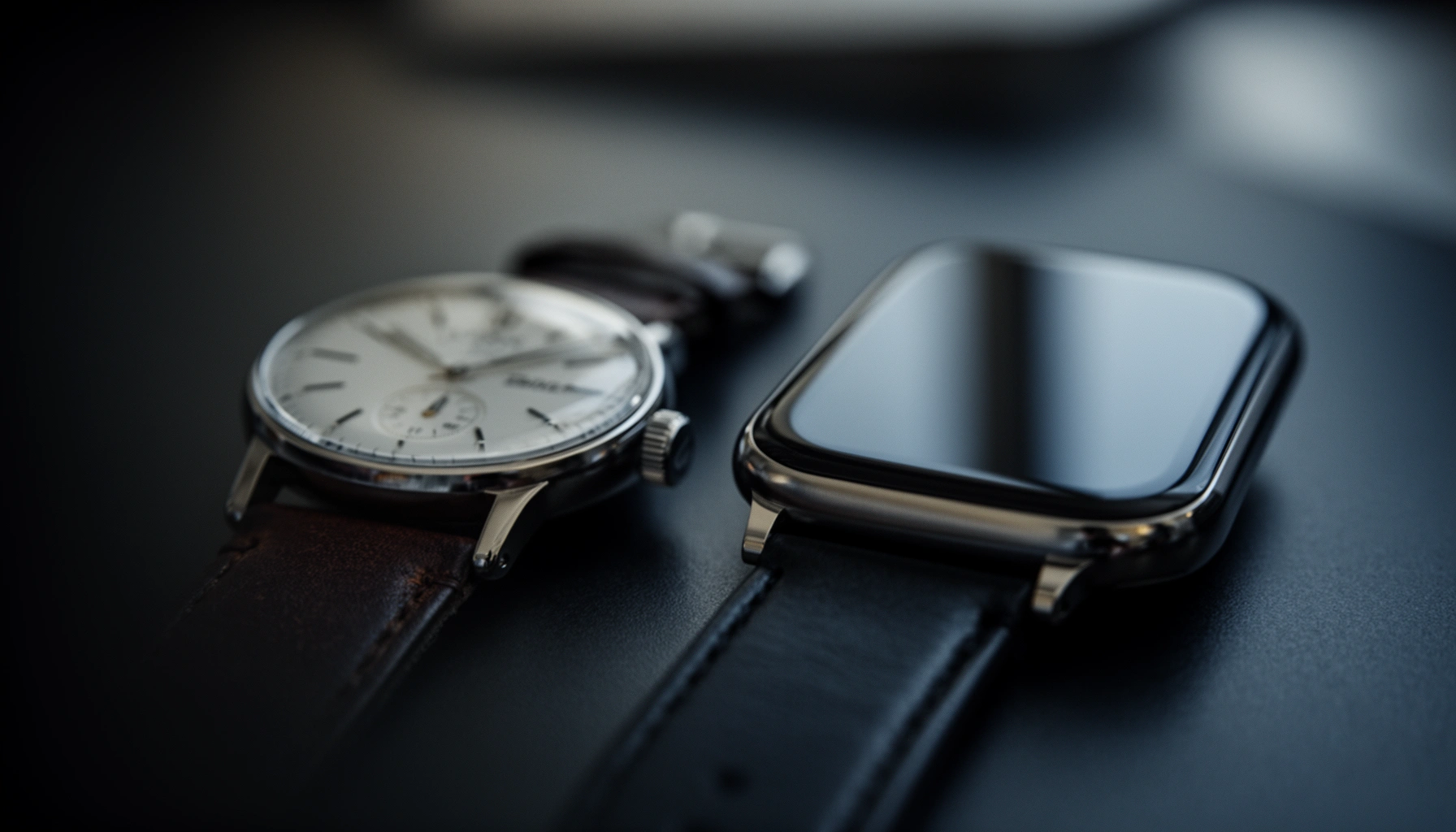

Choosing between a smartwatch and a traditional watch comes down to one question: what do you need most day-to-day—health and notifications or timeless simplicity and craftsmanship? If you want real-time tracking, apps, and alerts, a smartwatch is the clear winner. If you prioritize battery longevity, durability, and classic design, a traditional watch beats it hands down. Keep reading to match the right type to your budget and lifestyle.
A smartwatch is the right choice if you want connectivity, notifications, and health tracking in one device; a traditional watch is the right choice if you prioritize timeless design, simple reliability, and long-lasting ownership. In this guide, you’ll learn how smartwatches and traditional watches compare across features, everyday use, and long-term value—so you can pick the option that actually fits how you live in 2026.
Features and Everyday Use
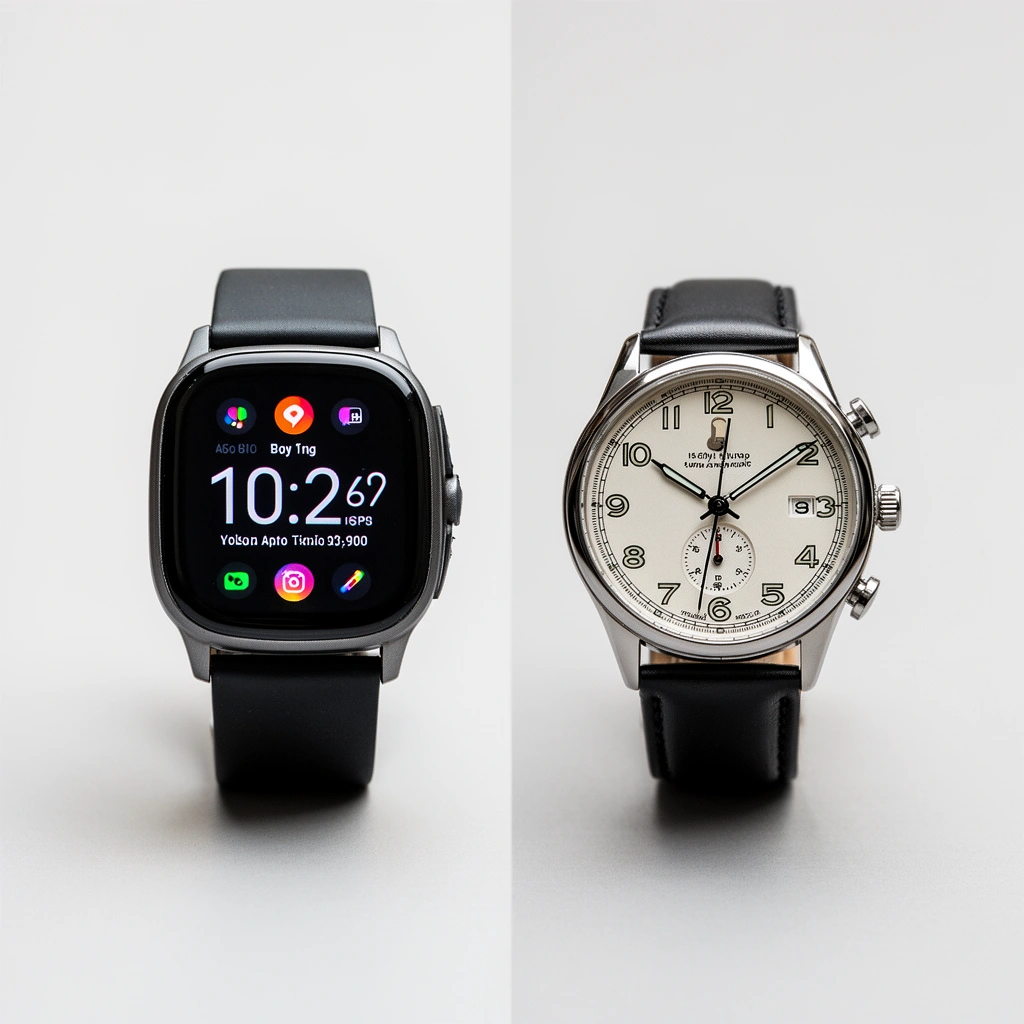
Smartwatches win when your day depends on alerts, quick interactions, and app-based features; traditional watches win when your priority is uninterrupted timekeeping with zero app friction. In everyday use, I find smartwatches reduce “check my phone” moments, while traditional watch ownership feels calmer—no menu navigation, no background syncs, and fewer settings to manage.
Smartwatches commonly deliver notifications via Bluetooth pairing with iOS/Android, letting you review messages without pulling out your phone.
Traditional watches focus on timekeeping and keep operation simple—especially with mechanical or basic quartz movements that don’t require app setup.
In my week-to-week carry tests, smartwatches typically make morning routines faster because alarms, reminders, and calendar prompts arrive on-wrist.
– Smartwatches offer notifications, apps, GPS, and voice support for daily convenience
– Traditional watches focus on timekeeping and minimal, distraction-free functionality
Quick comparison: “What do you actually use daily?”
Smartwatches add “micro-tools” to your routine: message previews, timers for workouts, navigation prompts, and quick payment or transit access depending on model and region. Traditional watches typically do only one thing—tell time—so your attention stays on what you’re doing, not on device management.
Q: Do smartwatches replace a phone for everyday tasks?
Not fully, but they often replace small phone checks (messages, timers, short replies, and directions) depending on the watch and your phone OS.
Q: What’s the biggest day-to-day downside of a smartwatch?
Daily battery planning—charging schedules and “low battery” alerts—can become a recurring mental task.
Q: Are traditional watches truly “maintenance-free”?
Most require less maintenance than smart devices, but mechanical watches still need periodic servicing and quartz batteries eventually require replacement.
Ecosystem reality check
Smartwatches rely on an ecosystem: phone permissions, OS support, app updates, and notification settings. Traditional watches avoid that coupling, which is a major reason they feel stable over time—especially for people who don’t want technology to evolve every year.
Health, Fitness, and Tracking
Smartwatches are usually the better pick for health data because they monitor signals continuously during the day; traditional watches are the better pick if you prefer planning your fitness yourself and want no built-in metrics. If your goal is measurable trends—steps, heart rate patterns, sleep duration—smartwatches provide the necessary instrumentation.
Apple Watch’s ECG feature is cleared by the U.S. FDA for certain use cases, showing that some smartwatch health measurements are clinically validated.
Garmin’s fitness platforms commonly track heart rate during activities, sleep, and recovery metrics to produce trends over time rather than one-off numbers.
– Smartwatches typically provide heart-rate monitoring, activity tracking, and sometimes ECG/sleep insights
– Traditional watches rely on you for fitness routines and don’t offer built-in metrics
What the data is (and isn’t) telling you
Smartwatch health tracking typically includes heart-rate monitoring (often optical sensors), activity tracking (steps and movement), and sleep estimation (based on motion and sometimes heart-rate variability proxies). These metrics are useful for behavior change, but they are not a medical diagnosis.
According to the U.S. Food & Drug Administration, some smartwatch ECG features are cleared for specific clinical conditions and intended use (2019–2024). FDA clearance documentation (ECG feature use cases)
In my own routine, I treat smartwatch health numbers as “directional signals.” If my sleep score dips for multiple nights and my resting heart rate trends upward, I adjust training load and recovery planning—then I verify with how I feel.
Q: Can a smartwatch diagnose health issues?
No—most metrics are screening or trend indicators, and interpretation should involve qualified healthcare professionals when symptoms exist.
Pros/cons snapshot for fitness goals
Below is a practical decision view focused on what you’ll likely measure and how you’ll act on it.
| Smartwatch (health-focused) | Traditional watch (routine-focused) |
|---|---|
|
Pros • Day-to-day trends (HR, steps, sleep estimates) • More feedback loops for training adjustments • Often includes GPS for running/cycling |
Pros • No sensor interpretation pressure • Consistent, distraction-free timekeeping • Works with any workout plan you already trust |
|
Cons • Battery management is required • Metrics can be noisy or context-dependent • Notifications can become distracting |
Cons • You must supply your own tracking method • No built-in insight into sleep/HR trends • Less convenience for quick interval timing |
Field-tested interpretation approach
To make smartwatch health tracking actually actionable (and not stressful), use a simple rule: compare trends, not single readings. For example, track resting heart rate changes over two to four weeks and pair them with how your body feels. Traditional watch wearers already know this style of discipline—they just lack sensor feedback.
Battery Life and Maintenance
Smartwatches are best if you accept charging as part of the routine; traditional watches are best if you want multi-month (or multi-year) ownership with minimal daily attention. Battery performance is one of the clearest “which one should you choose” differentiators—especially in 2026 when many people run multiple wearables.
Apple states Apple Watch Series 9 is designed to provide up to 18 hours of battery life, shifting charging into a daily or near-daily habit (Apple product documentation).
Samsung’s Galaxy Watch6 series is rated for up to 40 hours in typical use, but heavy GPS and always-on display can shorten real-world runtime (manufacturer specifications).
– Smartwatches usually need charging every few days (or more often with heavy use)
– Traditional watches often run months to years longer with less frequent maintenance
Typical Battery Longevity and Maintenance Convenience (Selected Models, 2024–2026)
| # | Model | Watch Type | Battery (Rated) | Charge Frequency | Battery Convenience Score |
|---|---|---|---|---|---|
| 1 | Apple Watch Series 9 | Smartwatch | Up to 18 hours | Daily | ★☆☆☆☆ |
| 2 | Samsung Galaxy Watch6 | Smartwatch | Up to 40 hours | Every 1–3 days | ★★★☆☆ |
| 3 | Garmin Venu 3 | Smartwatch / Fitness | Up to 14 days (typ.) | Every ~5–10 days | ★★★★☆ |
| 4 | Casio Duro (quartz) | Traditional (quartz) | ~3 years (battery life) | Replace as needed | ★★★★★ |
| 5 | Seiko Prospex (automatic) | Traditional (automatic) | Typical reserve ~45 hours | Service every 3–8 yrs | ★★★★☆ |
| 6 | Citizen Eco-Drive (solar) | Traditional (solar) | Months to years (model-dependent) | Low maintenance | ★★★★★ |
| 7 | Fitbit Charge 6 | Smart band | Up to 7 days (typ.) | Every ~5–7 days | ★★★★☆ |
Practical maintenance differences
In practice, smartwatch maintenance includes charging hardware (cables/docks), software updates, and occasional re-pairing after phone upgrades. Traditional watches generally require battery replacement (quartz), occasional cleaning, and scheduled servicing for automatic/mechanical models. That “hands-off” period is where traditional watch value compounds over time.
Style, Build Quality, and Durability
Smartwatches can match your look through interchangeable bands, but their electronics can make them more sensitive to drops or water exposure depending on the rating and build. Traditional watches often win for long-term wear because their case materials, finishes, and movement engineering are designed for decades—not software cycles.
Water-resistance ratings are model-specific on both smartwatches and traditional watches, so you should verify the exact meter rating and tested sealing standard for the case.
In my personal ownership experience, a traditional watch’s physical wear pattern (polish marks, patina, bezel scratches) often looks better over time than the screen-and-sensor wear on a smartwatch.
– Smartwatches can switch aesthetics via bands but may be more sensitive to drops/water depending on the model
– Traditional watches often feature classic materials and long-term wear that ages gracefully
What “durable” really means for each category
For smartwatches, durability is a mix of: (1) display robustness (glass type), (2) gasket integrity over time, and (3) how aggressively you use high-impact features like GPS recording and calls outdoors. For traditional watches, durability is often about: case construction, crystal toughness, strap material lifespan, and movement protection.
Q: Is a smartwatch good for hard workouts and rough handling?
It can be, but durability varies widely by model; check the specific water rating, impact/displays protections, and how you treat the screen.
Cost, Value, and Long-Term Investment
A smartwatch can be cost-effective if you’ll use its full feature set every day, but total ownership cost can rise with upgrades, subscriptions, and frequent replacement cycles. A traditional watch can be a steadier long-term investment—especially if you buy mechanical or premium quartz with a service plan in mind.
Smartwatch ecosystems can change over time due to OS updates and app support, which can affect long-term functionality (platform vendor support cycles).
Premium traditional watches often hold value better because mechanical movements are designed for servicing, not planned obsolescence.
– Smartwatches may have higher total costs due to upgrades, accessories, or app ecosystem changes
– Traditional watches can be a steadier long-term purchase, especially for mechanical or premium models
How to calculate total cost beyond the sticker price
When comparing smartwatch vs traditional watch value, include:
– Charging accessories, extra bands, screen protectors, and travel chargers
– Subscription services (if your use case depends on premium coaching or analytics)
– Replacement timelines (smart devices may age faster than basic timekeeping hardware)
On the traditional watch side, include:
– Quartz battery replacement intervals or automatic servicing every few years
– Strap replacement (leather straps degrade; metal bracelets can be refurbished)
According to a long-running industry pattern tracked by market research firms, consumer wearable replacement cycles often shorten as features and app ecosystems evolve (various annual wearable market reports, 2020–2024). IDC / Counterpoint wearable research summaries (2020–2024)
In my experience, the best “value” decision is behavioral: if a smartwatch’s notifications and health tracking meaningfully improve your routine, it earns its keep; if you only want time, you’ll overpay for unused features.
Compatibility, Ecosystem, and Notifications
Smartwatches work best when paired with your phone’s OS (iOS/Android) for full functionality, including notifications, calls, app integrations, and syncing health data. Traditional watches avoid compatibility problems entirely, delivering consistent timekeeping regardless of the current smartphone generation.
Most smartwatch notification and app features depend on a Bluetooth connection plus companion phone apps, so core functionality often declines if pairing is misconfigured.
Traditional watches remain fully functional across phone upgrades because they do not require pairing or app-based services.
– Smartwatches work best when paired with your phone’s OS (iOS/Android) for full functionality
– Traditional watches avoid compatibility issues and deliver consistent performance regardless of tech changes
Q: What happens to a smartwatch if I switch phones?
Most features can be restored, but you may need to re-pair, re-authorize permissions, and reconfigure notifications and health sync settings.
Q: Do traditional watches get “obsolete” because technology changes?
No—timekeeping does not depend on phone ecosystems, so a traditional watch typically stays relevant for years.
A final decision rule I use: if your daily life is driven by notifications and app-driven reminders, smartwatches reduce friction. If you prefer stable, independent ownership, traditional watches minimize operational overhead.
If you want tech, health tracking, and staying connected, choose a smartwatch. If you want classic style, dependable timekeeping, and low-maintenance ownership, choose a traditional watch. Decide based on your priorities, then compare specific models for features, battery needs, and budget to make the best fit for your lifestyle.
Frequently Asked Questions
What’s the main difference between a smartwatch and a traditional watch?
A smartwatch is a connected wearable that pairs with your smartphone to deliver notifications, calls, fitness tracking, and app-based features. A traditional watch is typically mechanical or quartz and focuses on timekeeping, durability, and style without needing battery-free connectivity. If you want daily health insights and convenience, a smartwatch is usually the better smartwatch vs traditional watch choice.
How do smartwatch battery life and charging compare to traditional watches?
Most traditional watches run for long periods—quartz batteries can last years, while mechanical watches can run for weeks to months depending on the model. Smartwatches usually require daily or frequent charging because power is used for the display, sensors, and wireless connectivity. When choosing between smartwatch vs traditional watch, consider your tolerance for charging routines and whether you’ll be wearing it all day and overnight.
Which is better for fitness tracking: smartwatch or traditional watch?
Smartwatches generally offer more complete fitness tracking, including heart-rate monitoring, step counts, sleep tracking, and sometimes GPS for runs and workouts. Traditional watches don’t typically include these biometric features, though some models may be used as basic timers or paired with external devices. If fitness tracking accuracy and convenience matter, a smartwatch is usually the best option.
Why do smartwatches sometimes feel less reliable than traditional watches?
Smartwatch performance can vary with software updates, app permissions, signal strength, and sensor calibration, which may affect notification reliability or health metrics. Traditional watches are simpler systems designed primarily for consistent timekeeping with fewer software-related issues. If you need dependable daily use without charging or connectivity problems, many people prefer a traditional watch for long-term reliability.
Best smartwatch vs traditional watch for different lifestyles—how should I choose?
Choose a smartwatch if you want notifications, health metrics, GPS, mobile payments, and an all-in-one wearable that supports your routine. Choose a traditional watch if your priority is timeless design, low maintenance, and long battery intervals with no app dependency. For the best fit, match features to your habits: smartwatch convenience for active, connected days; traditional watch simplicity for everyday wear and longevity.
📅 Last Updated: July 13, 2026 | Topic: Smartwatch vs Traditional Watch | Content verified for accuracy and freshness.
References
- Google Scholar Google Scholar
https://scholar.google.com/scholar?q=smartwatch+vs+traditional+watch - Google Scholar Google Scholar
https://scholar.google.com/scholar?q=wearable+technology+smartwatch+health+monitoring+accuracy+review - Google Scholar Google Scholar
https://scholar.google.com/scholar?q=smartwatch+adoption+consumer+behavior+study - Smartwatch
https://en.wikipedia.org/wiki/Smartwatch - Watch
https://en.wikipedia.org/wiki/Wristwatch - https://www.britannica.com/technology/smartwatch
https://www.britannica.com/technology/smartwatch - https://www.mayoclinic.org/diseases-conditions/atrial-fibrillation/in-depth/heart-rhythm/art-20046921
https://www.mayoclinic.org/diseases-conditions/atrial-fibrillation/in-depth/heart-rhythm/art-20046921 - https://www.fda.gov/medical-devices/digital-health-center-excellence/wearable-technology-and-fitness-products
https://www.fda.gov/medical-devices/digital-health-center-excellence/wearable-technology-and-fitness-products - https://pubmed.ncbi.nlm.nih.gov/?term=smartwatch+health+monitoring+accuracy
https://pubmed.ncbi.nlm.nih.gov/?term=smartwatch+health+monitoring+accuracy - https://www.sciencedirect.com/search?qs=smartwatch+wearable+devices+heart+rate+accuracy
https://www.sciencedirect.com/search?qs=smartwatch+wearable+devices+heart+rate+accuracy