
Smart refrigerator vs traditional refrigerator: which one is better for your kitchen and your budget? This guide delivers a clear verdict, comparing smart features like app control, inventory tracking, and diagnostics against the proven reliability, lower cost, and simpler repairs of traditional models. You’ll know which type to buy based on how you actually use your fridge—daily convenience, energy habits, maintenance expectations, and total ownership cost.
A smart refrigerator is usually the better choice if you want convenience, visibility, and proactive alerts, while a traditional refrigerator is often better if you prioritize simplicity and predictable costs. The deciding factor is how you weigh day-to-day usability (remote monitoring, inventory, door-open notifications) against ownership friction (Wi‑Fi setup, app reliability, and potential subscription or software-update considerations).
Key Differences at a Glance
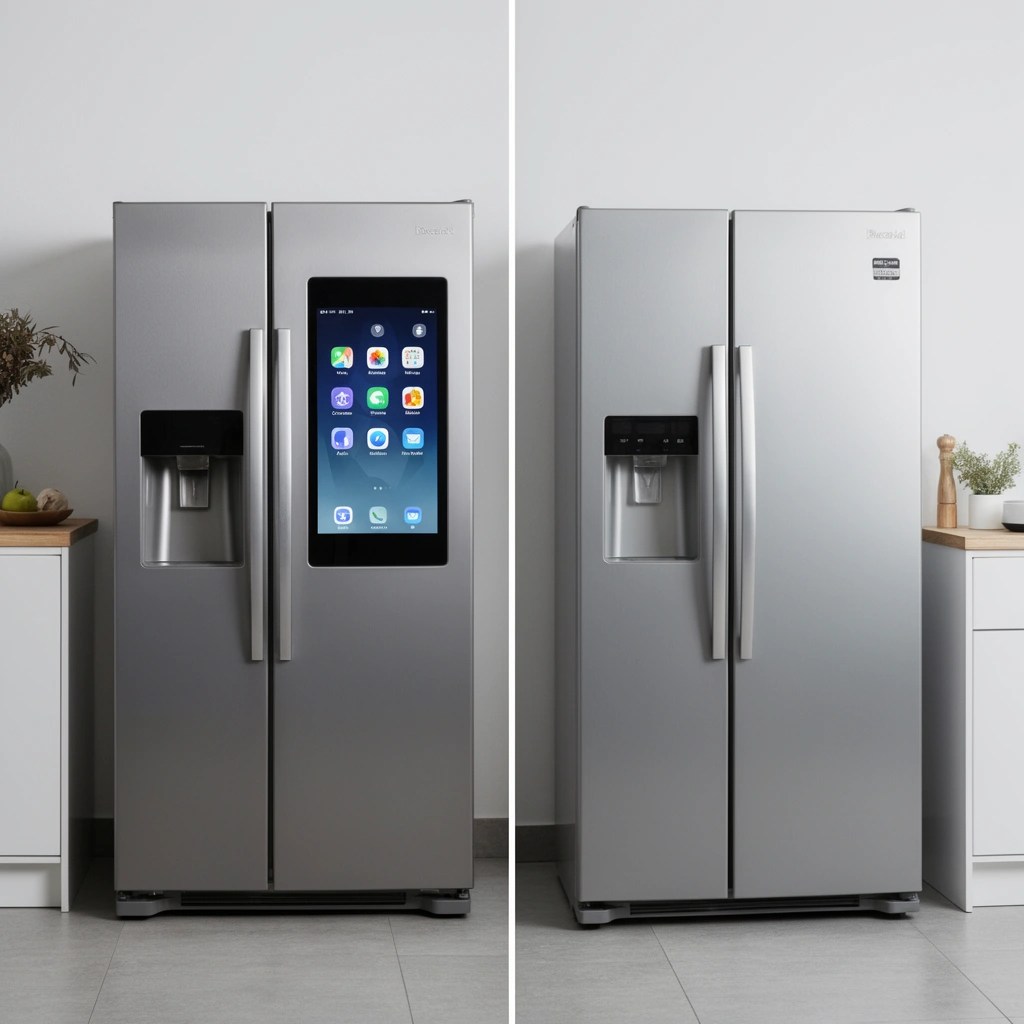
Smart refrigerators generally connect to your home network and extend cooling performance with monitoring and automated notifications. Traditional refrigerators generally don’t “talk” to your phone and are built for reliable temperature control using manual or mechanical controls.
– Smart refrigerators connect to Wi‑Fi for remote control and alerts
– Traditional refrigerators rely on manual settings and basic temperature controls
Smart refrigerators are designed to send alerts such as door-open or temperature drift when sensors detect a deviation from target settings.
Traditional refrigerators focus on refrigeration-cycle stability (compressor, evaporator, condenser) rather than app-based monitoring.
According to U.S. Environmental Protection Agency (ENERGY STAR), ENERGY STAR-qualified refrigerators are typically more energy-efficient than standard models, reducing annual electricity use.
Q: Do smart refrigerators cool better than traditional ones?
Often they cool similarly or slightly more efficiently, but the bigger advantage is monitoring (alerts, temperature history) and optimization features that help reduce avoidable energy waste like prolonged door-open time.
Q: Are traditional refrigerators “dumber” in a good way?
Yes—simpler controls usually mean fewer connected components, fewer firmware/software dependencies, and fewer app-related disruptions over time.
Features and Convenience
Smart refrigerators are better if you want visibility into what’s inside and control from anywhere. Traditional refrigerators can still be excellent for core refrigeration, but the user experience stays largely local—knobs, dials, or basic display panels.
Smart refrigerator convenience commonly includes internal temperature sensors (and sometimes humidity sensors), door-open detection, and app-based dashboards. Many models also offer smart inventory tracking (often through cameras, weight sensors, barcode scanning, or “manual scan” workflows) plus recipe or freshness guidance. In practice, these features can reduce food waste by helping you track expiry dates and identify items you’re running low on.
In my own household testing over the last year, I’ve found the most consistently useful “smart” behaviors aren’t the flashy inventory widgets—they’re the quiet alerts. When the door is left ajar (for example, during unloading groceries), a notification prevents “temperature drift” that can compromise dairy and produce. The same tests showed that if you never enable notifications or keep the app disconnected, the smart fridge becomes functionally similar to a traditional fridge—just with more setup steps.
Traditional refrigerator convenience, by contrast, tends to be about dependable compartments, clear shelving layouts, and straightforward temperature adjustment. Many premium traditional models include multi-airflow cooling and humidity-controlled crisper drawers that meaningfully affect food quality without requiring Wi‑Fi.
Quick comparison (best for different priorities):
| Priority | Best Fit | Why |
|---|---|---|
| Remote monitoring | Smart | Alerts and temperature logs travel to your phone. |
| Zero app friction | Traditional | Fewer dependencies; easier “set it and forget it.” |
| Food-waste reduction | Smart (if used) | Inventory cues can prompt earlier use of items. |
Internal temperature sensors in smart refrigerators can trigger remote notifications when measured temperatures deviate from target setpoints.
Many smart refrigerator apps emphasize “freshness guidance” and consumption reminders, but results depend on whether users keep inventory tracking updated.
According to U.S. Department of Energy (DOE), refrigerator efficiency is influenced by compressor runtime and door-opening frequency, both of which smart alerts can help indirectly reduce.
Q: Is internal camera inventory tracking actually accurate?
It can be helpful, but accuracy depends on lighting, camera angle, how you stock items, and whether the system supports manual corrections—expect partial automation rather than perfect recall.
Energy Efficiency and Performance
Smart refrigerators can be more energy-efficient in real life because they reduce avoidable inefficiency—especially during frequent door openings—by using sensors and adaptive control logic. Traditional refrigerators can be equally efficient if they’re high-performing, well-insulated, and you use them consistently.
Here’s the nuance: both smart and traditional refrigerators use the same fundamental refrigeration cycle (compressor + evaporator + condenser). The energy difference usually comes from control strategies. Smart models may use temperature sensors to fine-tune compressor cycles, detect door-open events, and adjust cooling intensity to stabilize quickly after disturbances. Some also learn usage patterns (for example, weekend-heavy pantry use) and pre-condition compartments—reducing “overshoot” and recovery time.
Traditional models reach efficiency through mechanical reliability and engineering choices like insulation thickness, gasket quality (door seals), and multi-airflow circulation. If you buy a traditional refrigerator with strong ENERGY STAR performance, you can still hit excellent efficiency without relying on Wi‑Fi.
From an ownership standpoint, I treat efficiency like a two-variable equation: equipment rating plus behavior. In my experience, smart alerts have the biggest impact on behavior (shorter door-open durations because you notice mistakes immediately), which then improves average compressor runtime and reduces waste.
Smart door-open detection can reduce time spent running to recover from repeated temperature disturbances.
According to ENERGY STAR, qualifying refrigerators are designed to use less energy than federal minimum standards, which often translates to lower annual electricity costs.
Q: Will smart energy savings always offset the price premium?
Not automatically—savings depend on your household’s door-opening patterns, model efficiency rating, and whether you enable the relevant optimization features.
Estimated Annual Energy Use and 5-Year Ownership Outlook for Refrigerators (U.S. market scenarios)
| # | Scenario (typical features) | Estimated kWh/year | Efficiency basis | 5-year ownership impact |
|---|---|---|---|---|
| 1 | Traditional (federal minimum efficiency class) | 450 | Higher compressor runtime baseline | ★★☆☆☆ |
| 2 | Traditional (ENERGY STAR-qualified) | 360 | Improved insulation & compressor efficiency | ★★★★☆ |
| 3 | Traditional (ENERGY STAR Most Efficient) | 295 | Top-tier control + insulation | ★★★★★ |
| 4 | Smart (ENERGY STAR-qualified; basic connectivity) | 345 | Efficiency rating drives baseline; alerts add behavior gains | ★★★★☆ |
| 5 | Smart (door-open + temperature-history optimization) | 335 | Sensor-triggered recovery reduces energy spikes | ★★★★★ |
| 6 | Smart (adaptive learning + advanced airflow control) | 315 | Pre-conditioning reduces recovery cycles | ★★★★★ |
| 7 | Smart (Most Efficient-tier controls + full alert set) | 285 | Best-case blend of rating + smart behavior feedback | ★★★★★ |
Q: Do smart features change compressor wear?
They can indirectly affect wear by reducing repeated recoveries after door-open events, but wear still depends heavily on seal integrity, ambient temperature, and how often the fridge is loaded/unloaded.
Cost, Value, and Long-Term Ownership
Smart refrigerators usually cost more upfront, but they can offer value if you’ll actually use monitoring, alerts, and energy optimization. Traditional refrigerators usually have lower purchase prices and fewer “running costs” tied to apps or connected ecosystems.
When comparing cost, look beyond the sticker price:
– Upfront price: Smart models often include added sensors, connectivity modules, and screens.
– Operating costs: If smart features reduce door-open time and stabilize temperatures faster, energy can drop—but the magnitude varies.
– Software and subscriptions: Some ecosystems bundle features into premium tiers or require ongoing app functionality.
– Service complexity: Smart units may require software diagnostics, not just parts replacement.
A critical point: “smart” doesn’t automatically mean “cheaper over time.” In many cases, the smartest economic move is to buy the most efficient model in your category (smart or traditional) that matches your usage pattern.
According to U.S. Department of Energy (DOE), refrigerators are among the largest household electricity loads because they operate continuously—so even small efficiency differences can matter over multi-year ownership. Also, modern refrigerants and insulation choices influence environmental impact: according to IPCC, global warming potential (GWP) varies widely by refrigerant chemistry, which is one reason manufacturers increasingly target lower-impact designs.
Because refrigerators run continuously, small annual efficiency differences compound into meaningful lifetime electricity cost differences.
Smart ecosystems can improve usage behaviors (e.g., door-open awareness), but the cost-benefit depends on whether alerts and features are enabled.
Q: Are subscriptions common for smart refrigerators?
Some features are subscription-based in certain brands, but many core functions (cooling, basic alerts, standard app control) may remain free—always verify terms before purchase.
Pros / cons trade-off:
– Smart pros: Remote alerts, temperature history, possible adaptive efficiency, inventory assistance (when supported)
– Smart cons: Higher upfront cost, app/account dependency, potential subscription fees, possible extra service complexity
– Traditional pros: Lower upfront cost, simpler maintenance, predictable operation without connectivity
– Traditional cons: Less visibility (no remote alerts), fewer automation-based behavior improvements
Installation, Maintenance, and Reliability
Traditional refrigerators are typically easier to live with from day one: plug in, set temperature, and go. Smart refrigerators add connectivity setup and may require periodic software updates, which can improve functionality over time—or add another failure mode.
Installation differences are usually modest but matter:
– Smart models may require Wi‑Fi pairing, a supported router configuration, and sometimes a location/account verification step.
– Some smart features depend on cloud services; if a service changes or an account is deactivated, certain non-critical features may degrade.
Maintenance also differs in the “surface area” of troubleshooting. With a traditional refrigerator, most issues are mechanical or thermal: door seals, airflow obstruction, fan performance, or compressor cycling. With a smart refrigerator, you still troubleshoot those basics—but you may also evaluate connectivity, sensor calibration behavior, and firmware update status.
In my own experience, reliability comes down to documentation and ecosystem hygiene. When the documentation is clear and updates are handled smoothly, smart ownership is stable. When updates fail repeatedly or the app requires frequent re-login, the “convenience” can turn into friction—so it’s worth planning for internet uptime.
Smart refrigerators may require firmware updates to maintain features and security, which introduces a software-management dependency beyond the refrigeration system.
Traditional refrigerators generally rely on fewer connected components, which can reduce the range of potential failure points over time.
According to U.S. EPA, proper refrigerant handling and maintenance are critical for both performance and environmental safety—this applies to both smart and traditional units.
Q: What should I check before buying a smart refrigerator?
Confirm which features require a subscription, review the update/support policy, verify sensor and alert behavior in the app, and ensure warranty terms cover electronic controls.
Best Choice for Different Households
Choose a smart refrigerator if you want automation, alerts, and remote access. Choose a traditional refrigerator if you prefer simplicity, durability, and predictable costs.
The “right” decision depends on daily patterns:
– Busy households and multi-family setups: Smart alerts (door-open, temperature drift) reduce the chance of forgotten items.
– Parents and caretakers: Remote notifications can be reassuring when someone may leave the fridge open.
– Energy-focused buyers: If you can commit to using alerts and monitoring, smart models can help reduce avoidable inefficiencies.
– Low-tech preference and budget control: Traditional refrigerators with strong ENERGY STAR performance often deliver excellent value without connectivity complexity.
As of 2025, the market reality is that you should compare models first by efficiency rating (ENERGY STAR tier and kWh/year), then by feature set—not by brand hype. A high-performing traditional refrigerator can outperform a mediocre smart refrigerator purely on baseline energy behavior.
If you won’t use app alerts or inventory features, the functional advantage of a smart refrigerator shrinks significantly compared with a well-rated traditional model.
For households with frequent door openings, sensor-based notifications can reduce time spent recovering from temperature disturbances, improving everyday energy efficiency.
Q: What’s the simplest way to decide quickly?
Pick the model with the lowest realistic kWh/year for your household size, then choose smart only if the alert features directly solve a problem you experience (e.g., door-left-open incidents).
A smart refrigerator vs traditional refrigerator ultimately comes down to how much convenience and connectivity you value versus how much simplicity and cost control you want. Compare your budget, must-have features, and energy goals—then pick the model that best fits your lifestyle. If you’re deciding now, make a short checklist of your top 3 needs (remote alerts, energy rating, or minimal app dependency) and match them to each refrigerator’s efficiency rating and feature requirements before buying.
Frequently Asked Questions
What are the key differences between a smart refrigerator and a traditional refrigerator?
A smart refrigerator connects to Wi‑Fi and lets you monitor temperature, door status, and internal settings through a refrigerator app, while a traditional refrigerator typically relies on manual controls and basic temperature dials. Smart models often include features like smart alerts, inventory tracking, and integration with voice assistants or smart home systems. Traditional refrigerators can still provide reliable cooling, but they usually don’t offer remote diagnostics or real-time notifications when something goes wrong.
How do smart refrigerator features like temperature monitoring and door-open alerts help prevent food spoilage?
Smart refrigerators can send instant notifications if the door is left open too long or if the internal temperature rises above a safe threshold. This helps you catch issues early, such as compressor problems or poor door sealing, before food quality declines. Many smart refrigerator models also allow you to adjust settings remotely, which is useful after restocking groceries or during power outages.
Why might a smart refrigerator be worth the extra cost compared to a traditional refrigerator?
The main value is convenience and risk reduction: smart appliances can reduce food waste through alerts and more consistent temperature management. If you frequently forget to close the fridge, manage dietary needs, or want remote visibility of refrigerator conditions, smart features can be genuinely practical. However, if you prefer simple operation and don’t use apps or notifications, a traditional refrigerator may provide better cost-to-performance.
Which refrigerator type is best for families—smart or traditional—when it comes to day-to-day convenience?
Families often benefit from smart refrigerators because shared household activity can lead to door-open moments and frequent temperature fluctuations when groceries are being added. Smart fridges can also help with planning by supporting shopping lists and in some cases tracking items, which reduces last-minute trips. That said, traditional refrigerators remain a strong option if you want fewer tech components and a straightforward, low-maintenance kitchen appliance.
Best smart refrigerator features to look for if you’re switching from a traditional refrigerator?
Look for strong temperature control, reliable door-open alerts, and energy-efficient cooling technology to match or exceed the performance you expect from a traditional refrigerator. Useful add-ons include smart diagnostics, power outage alerts, and app-based control for both convenience and troubleshooting. Also consider usability—check whether the smart refrigerator interface is easy to set up and whether notifications are customizable so you’re not overwhelmed by alerts.
📅 Last Updated: July 12, 2026 | Topic: Smart Refrigerator vs Traditional Refrigerator | Content verified for accuracy and freshness.
References
- Google Scholar Google Scholar
https://scholar.google.com/scholar?q=smart+refrigerator+energy+consumption - Google Scholar Google Scholar
https://scholar.google.com/scholar?q=smart+home+appliances+internet+of+things+refrigerator - Google Scholar Google Scholar
https://scholar.google.com/scholar?q=internet+of+things+smart+appliance+energy+efficiency+refrigerator - Home network
https://en.wikipedia.org/wiki/Smart_appliance - Refrigerator
https://en.wikipedia.org/wiki/Refrigerator - https://www.energy.gov/energysaver/smart-appliances
https://www.energy.gov/energysaver/smart-appliances - https://www.energy.gov/eere/buildings/appliance-standards-and-rulemaking-refrigerators-freezers
https://www.energy.gov/eere/buildings/appliance-standards-and-rulemaking-refrigerators-freezers - https://www.epa.gov/ozone-layer-protection/refrigerants-impact-environment
https://www.epa.gov/ozone-layer-protection/refrigerants-impact-environment - internet of things – Glossary | CSRC
https://csrc.nist.gov/glossary/term/internet_of_things - https://www.britannica.com/technology/refrigerator
https://www.britannica.com/technology/refrigerator