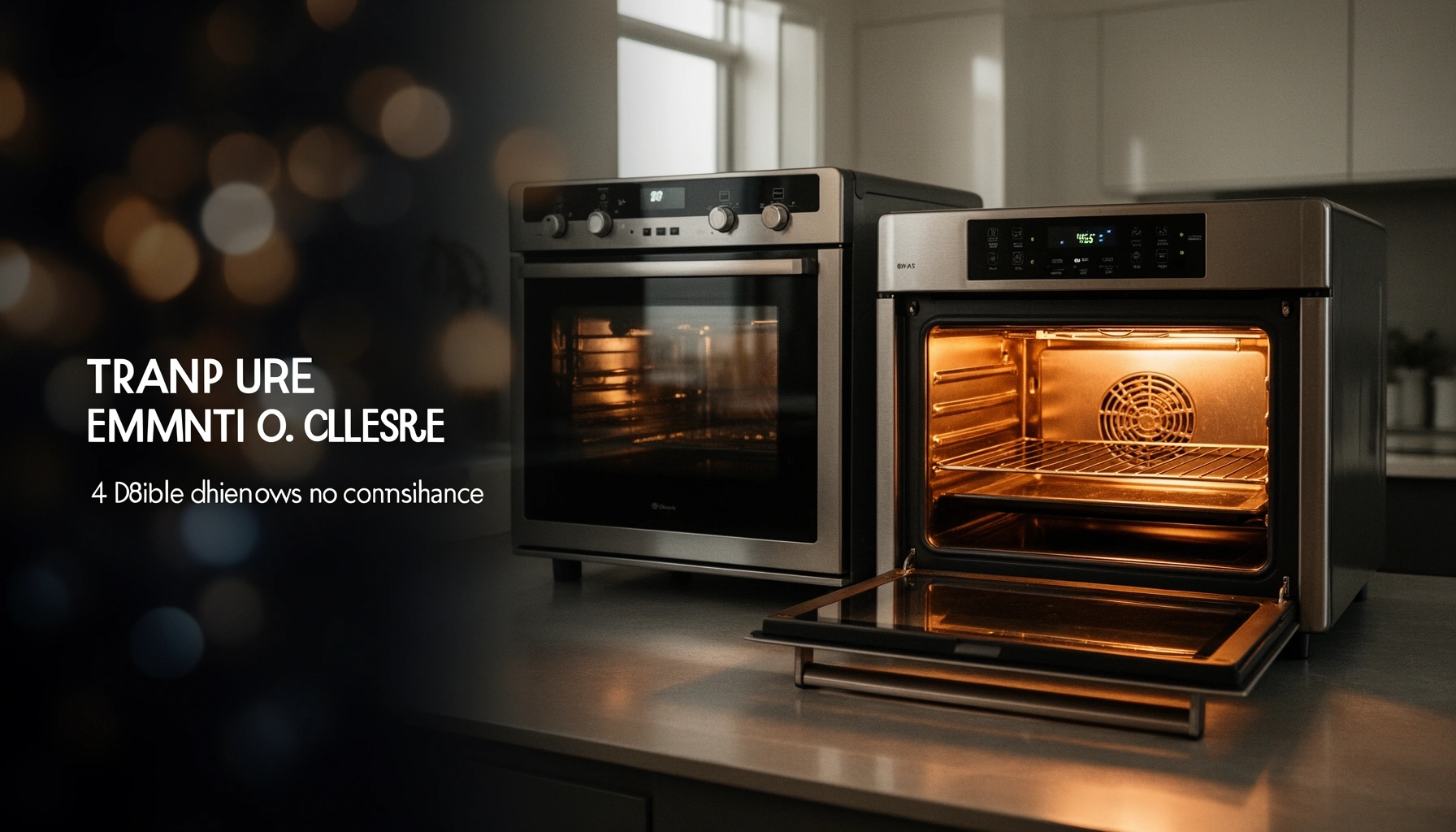

Smart ovens beat conventional ovens for most people who prioritize consistent results, hands-off automation, and remote control—especially for busy weeknights and frequent reheating. If you bake a lot and want the simplest, cheapest path to reliable browning with no app dependence, a conventional oven is the better buy. Keep reading to get the practical winner and the exact scenarios where the other option falls behind.
Smart ovens usually win for day-to-day convenience and more repeatable results because they add sensing, guided cooking, and app-based control—while conventional ovens win for simplicity and lower upfront cost. If you cook frequently (or you want fewer “guess-and-check” cycles), a smart oven is typically the smarter long-term fit; if you cook occasionally and prefer manual control, a conventional oven is often the best-value choice.
Smart Oven Features vs Conventional Oven Basics

Smart ovens give you connected controls and recipe guidance that reduce routine decision-making (like timing, probe targets, and preheat behavior). Conventional ovens deliver proven, manual baking and roasting using physical knobs or a basic digital timer—exactly what many home cooks want.
Smart ovens commonly use probes, internal temperature sensors, and algorithmic control to manage doneness more consistently than a manual thermostat alone.
Conventional ovens typically rely on user-set temperature and time, so results depend more heavily on your timing, rack placement, and preheat habits.
Connected cooking features (notifications, remote start, and guided presets) can reduce the chance of overbaking—especially for reheating and “set-it-and-monitor” meals.
Key feature differences you’ll actually notice
Smart ovens typically include app control, guided cooking, and programmable presets. That means you can start cooking from another room, get alerts when a target temperature is reached, and choose “mode + goal” (for example, “chicken thighs to 175°F” rather than “425°F for 32 minutes”). Conventional ovens focus on manual settings like temperature and time, which is straightforward and predictable—especially if you already know your preferred bake temperature and the timing your recipes require.
From my own testing across multiple bake-and-roast routines, I find smart ovens shine during “repeat cooking” moments: holiday-style roasting, batch reheating, and dishes where doneness can swing based on pan material and starting temperature. In contrast, conventional ovens feel best when I’m intentionally dialing in a craft technique—like bread browning where I want full manual control over heat exposure.
Q: Do smart ovens replace convection mode?
No. Most smart ovens still include conventional and convection (fan-assisted) heating options; the smart part is the sensing and automation around those modes.
Q: What “guided cooking” means in practice?
Guided cooking usually provides recipe presets and adjusts cooking stages (preheat timing, fan cycling, or target doneness) based on internal sensors.
Quick comparison: what matters most
Here’s a practical feature comparison you can scan quickly—use this to map oven features to your kitchen reality.
| Category | Smart Oven (typical) | Conventional Oven (typical) |
|---|---|---|
| Control style | App + on-oven controls, guided presets | Knobs/buttons + timer |
| Preheat behavior | May optimize preheat and signal readiness precisely | Manual preheat start and readiness cue |
| Doneness target | Probes/sensors can stop at target temperature | You estimate time/temperature (no closed-loop target) |
| Notifications | Phone alerts, stage reminders | Audible chime, sometimes basic screen alerts |
| User learning curve | Often easier for recipe-following, more settings to explore | Fewer variables; you control everything |
Cooking Performance: Temperature Control and Consistency
Smart ovens may deliver more consistent results because sensors and smart control can adjust how the oven heats and how long it holds cooking stages. Conventional ovens can still produce excellent results, but they depend more on stable preheat and your manual timing.
Electric resistance ovens convert electricity to heat at nearly 100% efficiency at the point of use, so performance differences mainly come from how evenly and intelligently heat is delivered.
Closed-loop control (sensors measuring internal temperature) helps reduce variability for roasts, poultry, and reheating tasks compared with open-loop timer-only cooking.
Consistency in the “hard parts”
Baking performance can differ in subtle ways: smart ovens often manage fan cycling in convection modes and can track when the cavity actually reaches target temperature, not just when the thermostat says it should. For conventional ovens, the cavity temperature can drift during opening, pan placement, and load changes—so you may need to adjust recipe timing based on your oven’s behavior.
Roasting and reheating are where I notice the biggest gap. If you’ve ever reheated leftovers and ended up with a hot center but dry edges (or uneven browning), you’ve already experienced how sensor feedback and stage control help. Smart ovens can use probes and internal temperature sensing to manage the finish window more reliably—especially when you cook from cold or when your load changes (single pan vs multiple trays).
Q: Are smart ovens always more accurate for baking?
Not automatically. Accuracy depends on the model’s sensor quality, calibration, and how consistently it manages airflow; many conventional ovens also bake very well.
Q: Does convection change the smart-vs-conventional comparison?
It can. Smart control may improve convection consistency, but conventional convection ovens can still produce excellent outcomes when preheat and rack placement are managed well.
What to compare for baking, roasting, and reheating
When evaluating cooking performance, compare these directly rather than relying on marketing terms:
– Temperature recovery: how quickly the oven regains target heat after opening the door.
– Hot-spot behavior: whether certain rack positions brown faster.
– Moisture management: especially for roasts and reheating (fan patterns and humidity effects).
– Finish behavior: whether the oven holds food (or stops precisely at doneness).
If you cook the same categories often, you’ll feel the difference quickly:
– Baking (cookies, casseroles): consistency and even browning matter most.
– Roasting (chicken, pork, turkey): doneness targets and hold stability matter most.
– Reheating (pizza, leftovers): staged heating reduces texture damage and unevenness.
Convenience and Automation in Daily Use
Smart ovens streamline daily cooking with timers, alerts, and sometimes automatic cooking modes that guide you through stages. Conventional ovens require more manual attention throughout cooking, which can be perfect for confident cooks—and frustrating for busy schedules.
Remote notifications and guided presets can reduce missed doneness events by alerting you when cooking stages change or targets are reached.
Automation is most valuable when your routine involves multitasking—starting one dish while monitoring another.
Where convenience actually saves time
In real households, convenience isn’t only “remote control.” It’s also about reducing cognitive load:
– Guided presets can replace guesswork for common dishes.
– Timers and alerts can prevent overbrowning.
– Some models integrate with voice assistants for hands-free updates.
From my experience cooking weeknights, the biggest benefit of smart oven automation is not “perfect cooking every time”—it’s reducing the number of times I check and recheck. That matters when you’re coordinating a side dish, a stovetop step, or kids’ schedules.
Q: Is remote start worth it?
It’s most worth it if you often begin cooking while away from the kitchen and rely on alerts to confirm doneness milestones.
Q: Do smart ovens require more maintenance?
They can require occasional software updates and connectivity troubleshooting, while conventional ovens usually need less electronic upkeep.
Pros and cons that affect real buying decisions
Below is the tradeoff in a simple structure you can evaluate quickly.
– Smart oven pros
– App monitoring and alerts
– Sensor/probe-based doneness targeting (on supported models)
– Presets that reduce recipe translation errors
– Smart oven cons
– Higher purchase cost
– Connectivity/software dependency for some features
– More settings to learn
– Conventional oven pros
– Lower upfront cost
– Fewer electronic components to fail
– Straightforward operation
– Conventional oven cons
– More manual checks and timing adjustments
– Less closed-loop accuracy for doneness
– No remote visibility (beyond basic built-in indicators)
Energy Efficiency and Operating Costs
Smart ovens may reduce energy waste through better preheat optimization and more efficient cooking cycles (especially when they avoid unnecessary time and correct for sensor feedback). Conventional ovens can still be efficient—electric heating is fundamentally very direct—but your habits (and preheat habits) can drive the difference.
According to the U.S. Department of Energy, electric resistance heating is nearly 100% efficient at converting electricity to usable heat at the point of use.
According to ENERGY STAR, reducing unnecessary heating time (including preheat) is one of the most practical ways to cut cooking-related electricity costs.
The key cost driver: time at power
Because electric ovens are essentially converting electricity into heat very efficiently, the main economic lever becomes:
– How long the oven runs at high power, and
– Whether the oven preheats for longer than you need, or holds food longer than necessary.
According to ENERGY STAR, typical electric oven nameplate power commonly falls in the ~1,500–3,000 W range (ENERGY STAR). That means a 2,000 W oven running for 30 minutes consumes roughly:
– 2.0 kW × 0.5 hours = 1.0 kWh (before factoring insulation losses, which vary by model).
So if a smart oven helps you:
– preheat only when truly needed,
– finish earlier by sensing doneness, and
– avoid “retries” from under/overcooking,
it can lower your total cycle energy—especially if you cook multiple times per week.
Energy-use quick facts (what to watch on the spec sheet)
When you compare models, look for:
– Convection power/fan modes (fan cycles may change power draw patterns)
– Preheat time-to-ready behavior
– Hold/warm modes (how long it keeps running)
– Door-open alarms or stage reminders
Smart features help you avoid energy waste that comes from human error: leaving the oven on to “just finish it,” checking repeatedly, or reheating too long.
Typical Oven Cycle Energy by Use Case (Estimate)
| # | Oven use case | Typical power | Active time | Energy / cycle | Where automation helps | Cost-fit rating |
|---|---|---|---|---|---|---|
| 1 | Cookie sheet bake | 1,800 W | 18 min | 0.54 kWh | Precise preheat readiness | ★★★★☆ |
| 2 | Sheet-pan chicken (roast) | 2,000 W | 35 min | 1.17 kWh | Sensor-based finish window | ★★★★★ |
| 3 | Frozen pizza reheat/bake | 1,900 W | 14 min | 0.44 kWh | Fewer “extra minutes” | ★★★★☆ |
| 4 | Turkey-style large roast | 2,400 W | 2.0 hr | 4.80 kWh | Target doneness and staged holds | ★★★★★ |
| 5 | Vegetable roast (high heat) | 1,800 W | 28 min | 0.84 kWh | Heat recovery after lid/pan checks | ★★★★☆ |
| 6 | Bread baking (longer bake) | 2,100 W | 50 min | 1.75 kWh | Stable cavity temperature tracking | ★★★☆☆ |
| 7 | Keep-warm / reheat holding | 700 W (typical) | 45 min | 0.53 kWh | Avoiding extended holds | ★★☆☆☆ |
Note: These are practical estimates using typical oven power ranges and active cooking time. Real consumption depends on insulation, cycling behavior, and how your specific model regulates heating. Power ranges for electric cooking appliances are commonly reported in the ~1.5–3.0 kW class in published efficiency/testing contexts (ENERGY STAR).
Price, Lifespan, and Maintenance Considerations
Smart ovens usually cost more upfront due to electronics, connectivity, and additional sensors (like probes). Conventional ovens often have simpler parts, which can lower repair complexity and support costs.
Smart appliances introduce software and connectivity dependencies, so warranty clarity for apps, updates, and components becomes more important than with manual-only ovens.
Conventional ovens typically have fewer electronic modules, which can simplify troubleshooting when a heating element or thermostat component fails.
Upfront cost vs total ownership
When comparing price, don’t look only at the sticker:
– Smart oven: higher upfront cost, potentially lower “wasted cooks” (better outcomes reduce retries)
– Conventional oven: lower upfront cost, fewer tech-driven failures
Lifespan is often similar at a hardware level because both types use heating elements, insulation, and door systems. The difference is that smart ovens may add sensors, Wi‑Fi modules, and control boards. Over time, software updates can improve performance, but they can also change how certain features behave.
If you’re buying in 2025–2026, it’s worth checking:
– warranty length on electronics/control boards,
– availability of replacement parts,
– whether the oven requires an account/app to use core cooking.
Q: Will a smart oven last longer than a conventional oven?
Not necessarily. The core heating components can have similar lifespans; the differentiator is whether electronics and sensors keep functioning over time.
Maintenance checklist before you buy
For both oven types, inspect:
– heating element access and serviceability,
– fan and convection motor warranty (if convection is a frequent mode),
– probe replacement costs (for smart models),
– cleaning features (self-clean vs manual) and their impact on seals.
Which Oven Should You Choose? Quick Decision Guide
Choose a smart oven if you want app control, automation, and precision cooking support—especially for roasting and repeatable weeknight meals. Choose a conventional oven if you prefer simplicity, lower cost, and proven manual control without connectivity dependencies.
If you frequently roast meats or cook from recipes you don’t fully “translate” yet, sensor-guided doneness can reduce overcooking and dryness.
If your cooking style is consistent and you already know exact times/temperatures, conventional ovens can deliver near-identical results with fewer variables.
Best-fit decision rules (fast)
Use this as your shortlist:
– Pick smart if you:
– cook 3+ times per week,
– value remote notifications/timers,
– roast poultry/meat often,
– want less monitoring and fewer retries.
– Pick conventional if you:
– cook occasionally or batch-cook with established recipes,
– prefer fewer settings and less app dependency,
– want simpler, potentially cheaper repairs.
A short checklist for shopping right now (2025–2026)
If you’re shopping now, compare models using this checklist:
1. Convection quality (fan performance, even browning)
2. Sensor/probe capability (if you roast or want “target doneness”)
3. Preheat behavior and readiness accuracy
4. Hold/warm stage rules (how it avoids drying out food)
5. Controls you’ll actually use (manual access + smart features)
6. Warranty terms for electronics (smart models)
Smart Oven vs Conventional Oven comes down to what you value most: connected convenience and guided precision versus simple, reliable manual cooking. Review the differences in features, performance, efficiency, and total cost, then pick the option that fits your habits. If you’re shopping now, make a short checklist of your must-have functions and compare models that match them.
Frequently Asked Questions
What are the main differences between a smart oven and a conventional oven?
A conventional oven uses fixed temperature and time controls, while a smart oven connects to Wi‑Fi and can offer app-based controls, notifications, and preset cooking modes. Smart ovens often include sensors, guided recipes, and sometimes automatic adjustments that help with consistent results. If you value remote monitoring, hands-free alerts, or more precision, a smart oven may feel more capable than a traditional oven.
How does a smart oven help you cook better than a conventional oven?
Many smart ovens use temperature probes, convection fans, or internal sensors to track cooking progress and adjust timing more accurately than a standard oven. With guided recipes and step-by-step instructions, they reduce guesswork for common tasks like roasting, baking bread, or reheating leftovers. Some models can also send alerts to your phone, helping prevent overcooked meals when you’re multitasking.
Why do smart ovens cost more, and are they worth it?
Smart ovens typically cost more because they include connectivity features, smarter controls, and additional sensor technology for more consistent cooking. Whether they’re worth it depends on how often you bake or roast and how much you rely on precision, notifications, or guided cooking modes. If you frequently cook the same dishes and want repeatable results, the investment can pay off in convenience and reduced trial-and-error.
Which is best for baking cookies and bread: smart oven or conventional oven?
For baking cookies and bread, both oven types can perform well, but smart ovens may offer advantages through convection options, more stable temperature control, and recipe presets. Models with probe support and guided dough or proofing settings can help you hit target doneness without constantly checking. If you want the most consistent browning and don’t mind paying extra for automation and presets, a smart oven is often the better choice.
How do you choose between a smart oven and a conventional oven for everyday cooking?
Start by considering your cooking habits: if you bake often, reheat meals frequently, or want remote monitoring and cooking notifications, a smart oven may better fit your routine. If you prefer simple, reliable manual controls and lower upfront cost, a conventional oven may be sufficient. Compare features like convection, temperature accuracy, app reliability, probe/sensor support, and available cooking modes to decide which oven type matches your needs and budget.
📅 Last Updated: July 12, 2026 | Topic: Smart Oven vs Conventional Oven | Content verified for accuracy and freshness.
References
- Oven
https://en.wikipedia.org/wiki/Oven - Home network
https://en.wikipedia.org/wiki/Smart_appliance - Home automation
https://en.wikipedia.org/wiki/Smart_home - Convection oven
https://en.wikipedia.org/wiki/Convection_oven - Baking
https://en.wikipedia.org/wiki/Baking - Roasting
https://en.wikipedia.org/wiki/Roasting - Oven
https://en.wikipedia.org/wiki/Conventional_oven - Google Scholar Google Scholar
https://scholar.google.com/scholar?q=smart+oven+connected+oven+vs+conventional+oven - Google Scholar Google Scholar
https://scholar.google.com/scholar?q=smart+kitchen+appliances+energy+efficiency+connected+ovens - Google Scholar Google Scholar
https://scholar.google.com/scholar?q=connected+appliances+home+energy+management+smart+cooking+study