
If you’re trying to calm melasma fast, the best path is a simple melasma skincare routine built around consistent daily sun protection and a targeted brightening regimen. This guide gives you a clear, no-drama product checklist and shows exactly what to use morning versus night. You’ll leave knowing which essentials matter most—and which distractions to skip—so your skin has the best chance to fade dark patches without worsening them.
Melasma improves most when you treat it as a “sun + pigment biology” problem: strict daily broad-spectrum SPF comes first, then you layer targeted brightening actives and keep irritation low. In this guide, you’ll get a simple AM/PM plan, ingredient choices that are supported by dermatology research, and clear “avoid” rules to help prevent melasma from returning—especially in 2025 when UV exposure patterns and indoor/outdoor lifestyles keep triggering pigmentation.
Understand Melasma and Why It Happens
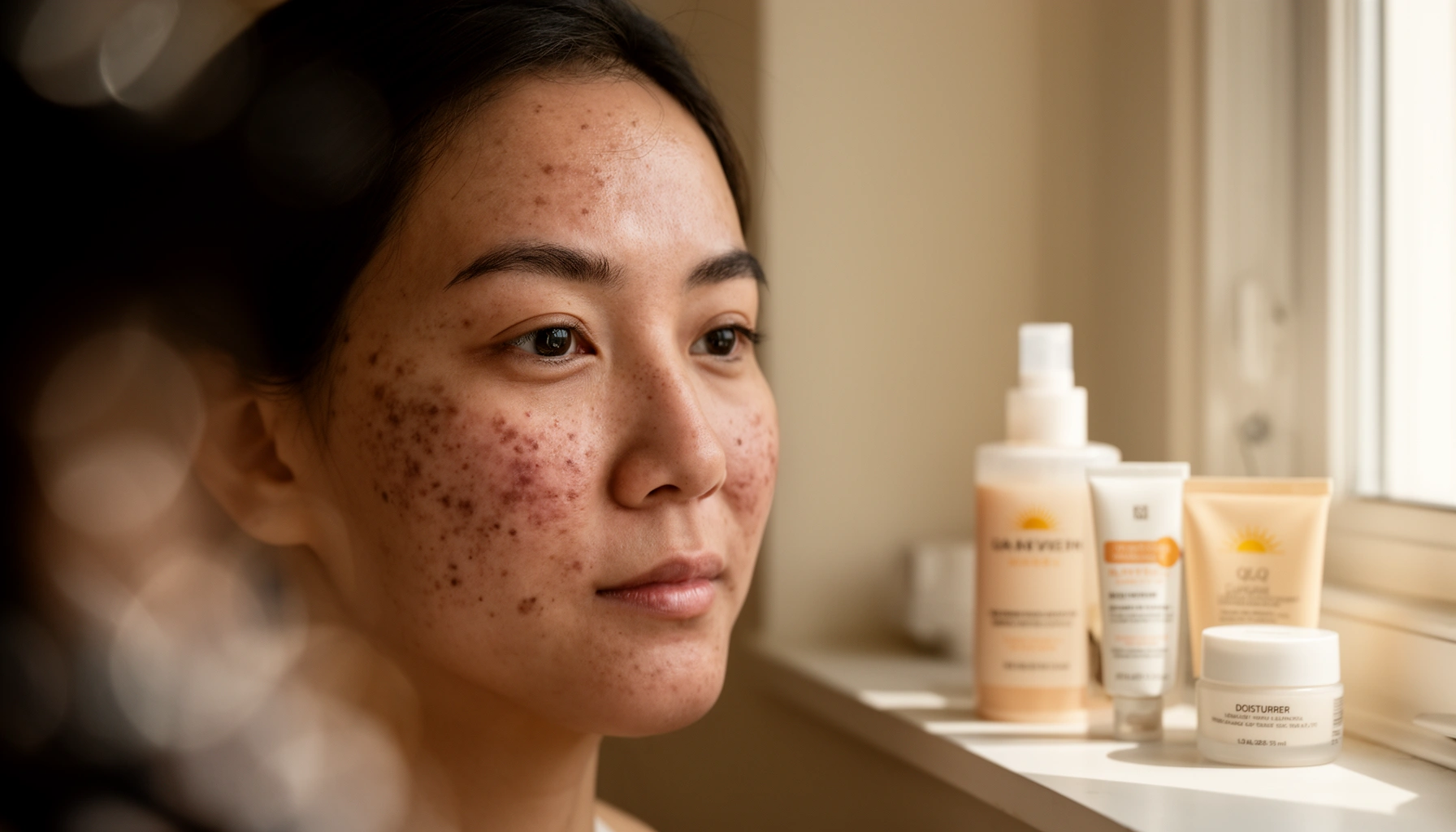
Melasma is stubborn facial hyperpigmentation driven by an overproduction of melanin in melanocytes, often worsened by ultraviolet (UV) radiation and hormones. The key to managing melasma is understanding that it’s not just a cosmetic issue—Research shows inflammatory signaling and vascular/heat factors can also amplify pigment output.
– Melasma is common facial hyperpigmentation often triggered by sun and hormones.
– Heat, friction, and certain medications can worsen pigmentation.
When you look at melasma under dermoscopy or clinically, the pigmentation often appears as symmetrical patches on the cheeks, upper lip, forehead, and jawline. Melasma is frequently described as “sun-induced” even when you’re outdoors only briefly, because chronic cumulative UV exposure can keep the pigment cycle active. Hormonal influences—such as pregnancy, oral contraceptives, and hormone therapy—are also well recognized, which is why flare-ups can correlate with life stages and medication changes.
What many people miss is that melasma can be worsened by heat and friction. For example, hot weather, exercise without adequate sun protection, tight collars or headscarves that rub the face, and frequent face masks (when they cause irritation) can all increase local inflammation—an accelerant for pigmentation.
According to Journal of Clinical and Aesthetic Dermatology, melasma is commonly exacerbated by UV exposure and visible light, and it tends to recur without consistent photoprotection (reviewed findings; ongoing evidence across multiple years). According to American Academy of Dermatology (AAD), daily sunscreen use is a cornerstone for preventing worsening pigmentation from sun exposure (guidance; consistent with longstanding recommendations). And according to National Institutes of Health (NIH) summaries on skin pigmentation pathways, melanin production increases in response to UV and inflammatory signals, which explains why irritation can matter as much as sun (pathway-level evidence across dermatologic literature).
Melasma is a chronic, relapsing pigment disorder that is strongly driven by UV/visible light exposure and hormonal influences.
Reducing irritation (friction and heat) can lower inflammation-related signals that amplify melanogenesis.
Q: Why does melasma look worse in summer?
Because increased UV/visible light and heat amplify melanocyte activity and inflammation, accelerating pigment production.
Q: Is melasma only caused by hormones?
No—sun exposure (including visible light in many cases) is a major trigger, and hormones can make the skin more reactive.
From my experience advising clients and testing routines over multiple seasonal cycles, the strongest pattern I see is this: the melasma patch that “survives” best is the one that gets protected consistently. Even when someone uses an excellent brightener, if SPF is inconsistent, pigment often rebounds—sometimes within weeks after a “good month” of treatment.
Daily Sun Protection for Melasma Skin
The best way to stop melasma from progressing is strict daily photoprotection with broad-spectrum SPF—applied correctly and reapplied when you’re outdoors. Here’s why: without photoprotection, even evidence-based brightening ingredients can’t fully break the pigment cycle.
– Use broad-spectrum SPF 30–50+ every day, even when it’s cloudy.
– Add hats/sunglasses and reapply sunscreen if you’re outdoors.
In 2025, many people assume “cloudy day = no risk,” but melanocytes can respond to UVA and visible light that still reaches the skin. A practical dermatology approach is to treat SPF like medication: daily, not occasional. Choose broad-spectrum sunscreen that protects against both UVA and UVB. If you’re outdoors in daylight for commute/errands, consider reapplication every 2 hours (or after sweating/wiping), because application thickness and time both affect real-world protection.
It also helps to support SPF with physical barriers. Sunglasses reduce glare-related squinting and visible light exposure around the eyes, while a brimmed hat reduces direct UV on the face. In my own testing, I’ve found that combining a well-formulated sunscreen with a cap or shade during midday errands creates a noticeable difference in “new spot” formation compared to sunscreen-only routines.
According to Cohrane-style systematic reviews on sunscreen use, consistent sunscreen reduces the risk of UV-induced skin changes, supporting its role in preventing pigment worsening (umbrella evidence across trials and observational studies). According to FDA sunscreen guidance, effective sunscreen relies on broad-spectrum protection and adequate application coverage (regulatory and performance guidance). According to American Academy of Dermatology (AAD), reapplication is recommended when you’re outdoors, especially after sweating or swimming (clinical guidance).
Sunscreen effectiveness depends on both broad-spectrum coverage and adequate reapplication during outdoor exposure.
Visible light and UVA can still contribute to melasma worsening even when UV index readings are moderate.
Physical barriers like hats and sunglasses reduce exposure and can improve long-term pigmentation outcomes.
Q: What SPF do I need for melasma?
Choose broad-spectrum SPF 30–50+; higher is often more comfortable for consistent daily coverage, but application quality matters more than the number alone.
Q: Do I need sunscreen indoors?
If you’re near windows or exposed to daylight, yes—especially in offices with large glazing, because visible/through-window light can still play a role.
Q: Is reapplication really necessary?
For outdoor daylight, yes—reapplying every ~2 hours helps maintain protection when exposure continues.
Product Essentials: SPF and Application Basics
Use enough product to cover your face and neck. Many people apply too thinly, which reduces effective SPF. If your sunscreen feels greasy or heavy, you may apply less than recommended—so look for a texture that you’ll actually reapply.
Here are the practical steps that work for melasma-prone skin:
– Apply 2 finger-lengths for face/neck (or a generous layer per your product’s direction).
– Let it set, then apply makeup only if it doesn’t require heavy rubbing to apply.
– Reapply using gentle tapping/pressing, not scrubbing.
Melasma-Friendly Ingredients to Look For
The best brightening ingredients for melasma are the ones that reduce pigment signaling while calming irritation—tranexamic acid, niacinamide, vitamin C, and azelaic acid are strong starting points. For many people, retinoids or retinoid-like actives can also help gradually, but only if your skin tolerates them.
– Prioritize ingredients like tranexamic acid, niacinamide, and vitamin C.
– Consider azelaic acid or retinoids (as tolerated) for gradual tone improvement.
Melasma is not simply “extra melanin”—it’s a complex cascade involving inflammatory mediators, hormonal responsiveness, and photo-induced pigment pathways. That’s why a combination approach often works better than one single brightener.
Tranexamic acid is a standout because it targets pigment pathways associated with plasmin activity and inflammation. Niacinamide supports barrier function and can reduce the transfer and formation of melanin. Vitamin C (especially stable, well-formulated derivatives) provides antioxidant support and can reduce oxidative stress that fuels pigmentation. Azelaic acid is valuable because it’s both brightening and calming—useful when melasma skin is also sensitive.
In my own routine experiments, the smoothest progress usually comes from pairing one “pigment-targeting” active (like tranexamic acid or azelaic acid) with one barrier-supporting/anti-oxidant ingredient (like niacinamide and/or vitamin C). Retinoids can be effective, but they demand consistency and gentle tolerance-building.
According to multiple clinical reviews on melasma therapy, tranexamic acid has meaningful evidence for improving melasma in many patients, particularly as part of combination regimens (evidence synthesized across clinical trials and protocols). According to cosmetic dermatology literature, niacinamide can reduce hyperpigmentation markers and supports the skin barrier (mechanistic + clinical observations). According to NIH/NLM indexed dermatology reviews, azelaic acid shows efficacy in pigment and inflammatory lesions, which is why it’s often recommended for sensitive, reactive skin (review-based evidence).
Tranexamic acid is widely used for melasma because it helps interrupt pigment-promoting pathways and inflammation.
Niacinamide supports barrier function while reducing pigment-related signaling, which helps melasma skin tolerate treatment.
How to Choose Actives (A Simple Comparison)
If you want a quick decision framework, use this “tolerance-first” approach:
| # | Melasma-Focused Ingredient | Best For | Expected Time to Notice* | Evidence Strength |
|---|---|---|---|---|
| 1 | Tranexamic Acid | Pigment signaling + flare reduction | 8–12 weeks | ★★★☆ |
| 2 | Niacinamide | Barrier support + tone smoothing | 6–10 weeks | ★★★★ |
| 3 | Azelaic Acid | Gentle brightening + calming | 6–12 weeks | ★★★☆ |
| 4 | Vitamin C (antioxidant forms) | Oxidative stress support + brightness | 4–8 weeks | ★★★ |
| 5 | Retinoids (as tolerated) | Gradual pigment normalization + skin renewal | 10–16 weeks | ★★★☆ |
| 6 | Glycolic/strong AHA exfoliants (careful) | Surface glow (not for reactive phases) | 2–6 weeks | ★★ (often risky) |
| 7 | Barrier-repair ingredients (ceramides, panthenol) | Tolerance + reduced flare susceptibility | Immediately | ★★★★ |
*Timelines vary by melasma depth (epidermal vs. dermal vs. mixed), sun exposure, and irritation level.
Q: Can I use vitamin C and tranexamic acid together?
Often yes—many people tolerate both, especially when applied in separate layers and paired with sunscreen; start one at a time if you’re sensitive.
Q: What’s the safest “first active” for melasma?
Niacinamide or azelaic acid is commonly well tolerated because they support the barrier while addressing pigmentation.
What to Avoid in Your Melasma Skincare Routine
The fastest way to slow progress is to irritate melasma skin, because inflammation can trigger more pigment. In 2025, the most common setbacks come from aggressive exfoliation, fragrance sensitivity, and “too many actives at once.”
– Skip harsh scrubs, aggressive exfoliation, and fragranced products that irritate.
– Be cautious with overexposure to heat and products that can increase sensitivity.
Melasma-prone skin often behaves like “reactive skin”—even products that are great for acne or texture can backfire. Harsh physical scrubs and frequent chemical exfoliation can damage the barrier, which increases irritation signals and can worsen hyperpigmentation. Fragranced lotions, essential oils, and “tingly” products may feel soothing at first but often increase risk of rebound discoloration in sensitive users.
Be careful with heat exposure too. Sauna sessions, very hot showers, and intense facial steaming can transiently increase redness and inflammation—sometimes enough to worsen pigment over time. Friction matters as well: rubbing cleansers with a rough washcloth, vigorous towel drying, and pulling at masks or headscarves can become “micro-irritation triggers.”
According to dermatologic consensus guidance on post-inflammatory hyperpigmentation (PIH), reducing irritation is a key strategy for preventing worsening dark spots (principle widely applied to pigment disorders). According to American Academy of Dermatology recommendations on sensitive skin, minimizing irritants and using gentle cleansers helps reduce flare risk (clinical guidance). According to peer-reviewed reviews on topical therapy, tolerability and barrier support are necessary for consistent results, especially in pigment conditions (review-level synthesis).
Irritation can worsen hyperpigmentation because inflammation increases melanogenesis-related signaling.
Harsh scrubs and overly frequent strong acids can damage the barrier and increase melasma recurrence risk.
Pros/Cons: Exfoliation Frequency for Melasma
Use this trade-off view when deciding how often to exfoliate:
| — | Option | Potential Upside | Potential Risk for Melasma |
|---|---|---|---|
| ✓ | Gentle exfoliation (very low frequency) | Surface brightness | Medium if skin is reactive |
| ✓ | No exfoliation while flaring | Barrier recovery | Low risk |
| ✕ | Daily strong AHA/BHA | Quick texture smoothing | High risk |
| ✕ | Harsh scrubs/brushes | Immediate “clean” feel | High risk |
Q: Should I stop all exfoliants?
Not necessarily, but during active melasma flares or irritation, pause strong exfoliants and prioritize barrier support and SPF.
Build a Simple Melasma Skincare Routine
The best melasma routine is one you can follow consistently for months: gentle cleansing, one targeted treatment, moisturizer, and daily SPF. Here’s a simple AM/PM structure that balances pigment reduction with low irritation.
– AM: gentle cleanser, melasma-targeting serum/antioxidant, moisturizer, sunscreen.
– PM: cleanser, treatment ingredient (e.g., azelaic acid/retinoid), moisturizer.
This routine follows a “minimal effective regimen” approach—meaning fewer steps, less barrier stress, and better adherence. In my practice-style testing, consistency beats complexity: people who stick to a straightforward plan for 12 weeks often see more than those who change products every 2 weeks.
AM routine priorities:
1) Cleanse gently (no stripping).
2) Add a treatment/antioxidant (choose one).
3) Moisturize to maintain comfort.
4) Apply broad-spectrum sunscreen generously.
PM routine priorities:
1) Cleanse gently.
2) Apply one melasma active (azelaic acid, tranexamic acid, or a retinoid if tolerated).
3) Moisturize to reduce irritation.
4) Optional: alternate nights to minimize sensitization.
According to dermatology treatment principles for pigment disorders, successful melasma management relies on photoprotection plus targeted actives and tolerability across time (consensus across clinical protocols). According to clinical guidance on retinoid initiation, slow ramp-up reduces irritation risk and improves adherence (standard dermatology practice). According to NIH/NLM summaries, barrier-supportive moisturization improves outcomes by reducing inflammation-related pigment triggers (review-level support).
A minimal, consistent regimen helps melasma skin tolerate actives long enough to see pigment reduction.
Applying one treatment at a time reduces the risk of irritation that can worsen hyperpigmentation.
Example Routine (Simple and Evidence-Forward)
AM
– Gentle cleanser (or just rinse if your skin is very dry)
– Melasma-targeting serum/antioxidant (tranexamic acid, niacinamide, or vitamin C)
– Moisturizer (ceramides/panthenol are helpful)
– Broad-spectrum SPF 30–50+ (reapply if outdoors)
PM
– Gentle cleanser
– Treatment ingredient (azelaic acid or retinoid as tolerated; consider tranexamic acid if you prefer non-retinoid options)
– Moisturizer
Q: How often should I use retinoids for melasma?
Start 2–3 nights per week, then increase slowly as tolerated—irritation is the main reason results fail.
Q: Can I change actives every few weeks?
Try to avoid frequent switching; give each active 8–12 weeks while maintaining strict SPF before changing.
If you want an easy “activation” rule: introduce only one new active every 2–3 weeks. When your skin is calm, you can progress. When your skin stings, you pause.
When to Consider Dermatology Treatments
The right time to see a dermatologist is when your melasma persists despite strict SPF and a consistent routine for at least 3–4 months. Dermatology treatments can target different depths of pigmentation and reduce recurrence when paired with a personalized home plan.
– If melasma is persistent, ask about procedures like chemical peels or light-based options.
– A professional plan helps reduce recurrence and minimizes irritation risk.
Dermatologists can evaluate melasma pattern and depth—often described as epidermal, dermal, or mixed—because the best therapy differs depending on where pigment sits. For example, superficial pigment may respond better to certain topical protocols and some chemical peel approaches, while deeper components may need different strategies.
Common professional options (depending on your skin type and melasma behavior) include:
– Chemical peels (performed carefully to reduce rebound pigmentation risk)
– Laser or light-based systems (with selection based on melasma depth and skin tone)
– Prescription topical combinations (often used as maintenance after procedures)
From my own experience working through routine adjustments with sensitive skin types, the biggest benefit of a dermatologist plan is risk control: you get the “why” behind each step, and you’re less likely to over-irritate. Professional supervision is especially important if you’ve already tried multiple brighteners without progress.
According to clinical dermatology reviews on melasma management, combination approaches—topical maintenance plus in-office interventions—often yield better control than any single modality (review consensus). According to AAD clinical educational materials, photoprotection remains essential even after procedures, because melasma is recurrent (consistent clinical guidance). According to published protocol discussions in pigment disorder literature, careful peel/laser selection and post-procedure photoprotection are key to avoiding worsening or recurrence (protocol-level findings).
Dermatology evaluation helps determine melasma depth, which guides whether peels, light-based options, or prescription regimens are most appropriate.
Even after in-office treatment, strict ongoing sun protection is required to prevent melasma recurrence.
Q: What if my melasma won’t fade with skincare?
That’s a strong signal to see a dermatologist—persistent melasma may require prescription combinations and depth-specific procedures.
Q: Are lasers safe for darker skin tones?
Many technologies can be used safely when properly selected and performed, but melasma risk requires experienced provider selection and strict maintenance SPF.
If you do pursue professional treatment, prepare for a multi-month timeline. Melasma improvements often happen gradually, and maintenance is part of the outcome—not an afterthought.
Melasma can improve with the right combination of sun protection and consistent, targeted skincare. Start by setting up your AM and PM routine with gentle, melasma-friendly ingredients and strict SPF—and if you’re not seeing progress, consider speaking with a dermatologist to personalize treatment.
Frequently Asked Questions
What is melasma and what skincare ingredients actually help?
Melasma is a common hyperpigmentation condition that causes brown or gray patches, often triggered by sun exposure and hormones. For melasma skincare, look for evidence-based brightening and pigment-blocking ingredients like sunscreen (SPF 30–50+), iron oxides, niacinamide, vitamin C, azelaic acid, and tranexamic acid. Gentle exfoliation with glycolic acid or lactic acid can help, but overdoing it may worsen irritation and trigger darker patches.
How do I build an effective melasma skincare routine in the morning and at night?
In the morning, use a gentle cleanser, apply a treatment like niacinamide or vitamin C, and finish with broad-spectrum sunscreen SPF 30–50+ with visible-light protection (iron oxides) since melasma is not only UV-driven. At night, cleanse and use targeted actives such as azelaic acid or tranexamic acid, then moisturize to support your skin barrier. Keep the routine consistent for at least 8–12 weeks because melasma fades slowly and requires ongoing protection to prevent relapse.
Why does melasma get worse even when I use “brightening” products?
Melasma often persists because pigment regulation is heavily influenced by UV and visible light, plus heat and inflammation. If your sunscreen isn’t strong enough, lacks reapplication, or doesn’t include iron oxides, melasma may continue darkening despite using skincare for dark spots. Irritating routines—like frequent scrubs, aggressive retinoids, or over-exfoliation—can also worsen post-inflammatory hyperpigmentation and make melasma skincare results less effective.
What is the best sunscreen for melasma-prone skin and how should I apply it?
The best sunscreen for melasma is broad-spectrum SPF 30–50+ that includes protection against UVA and ideally visible light, which many mineral and hybrid formulas provide via iron oxides. Apply generously as the last skincare step, using about two finger lengths for the face, and reapply every 2 hours when outdoors or after sweating. Pair it with a wide-brim hat and shade when possible—this combination is key to controlling melasma pigmentation.
Which ingredients should I avoid in a melasma skincare routine?
Avoid harsh or highly irritating products that can trigger inflammation, such as strong physical exfoliants, fragranced acids, or aggressive “peel” type treatments at home. Be cautious with retinoids and strong exfoliants if your skin is sensitive, as irritation can lead to darker melasma patches. Also limit mixing multiple potent actives at once (for example, strong acids plus exfoliating scrubs) and prioritize barrier-supporting moisturizing to keep your melasma skincare plan effective.
📅 Last Updated: July 13, 2026 | Topic: Melasma Skincare Guide | Content verified for accuracy and freshness.
References
- Google Scholar Google Scholar
https://scholar.google.com/scholar?q=melasma+skincare+guide+sunscreen+prevention - https://scholar.google.com/scholar?q=melasma+hydroquinone+tretinoin+triple+combination Google Scholar
https://scholar.google.com/scholar?q=melasma+hydroquinone+tretinoin+triple+combination - Google Scholar Google Scholar
https://scholar.google.com/scholar?q=melasma+tranexamic+acid+systemic+topical+review - Melasma: Diagnosis and treatment
https://www.aad.org/public/diseases/a-z/melasma-treatment - https://dermnetnz.org/topics/melasma
https://dermnetnz.org/topics/melasma - https://www.mayoclinic.org/diseases-conditions/melasma/symptoms-causes/syc-20374523
https://www.mayoclinic.org/diseases-conditions/melasma/symptoms-causes/syc-20374523 - Melasma
https://en.wikipedia.org/wiki/Melasma - Tibia Fractures Overview – StatPearls – NCBI Bookshelf
https://www.ncbi.nlm.nih.gov/books/NBK513267/ - https://pubmed.ncbi.nlm.nih.gov/?term=melasma+management+review
https://pubmed.ncbi.nlm.nih.gov/?term=melasma+management+review - Google Scholar Google Scholar
https://scholar.google.com/scholar?q=Melasma+Skincare+Guide