
Choosing the right indoor grill comes down to one question: do you want the best results for your kitchen and cooking style, or the most convenience for everyday meals? This buying guide names the clear winners based on key factors—power and heating speed, cooking surface type, temperature control, and smoke management—so you can buy with confidence. If you’re deciding between a contact grill, grill pan-style appliance, or smokeless electric model, you’ll get the verdict for your priorities fast.
An indoor grill is worth buying if it matches your cooking style, available space, and ventilation needs—so choose based on heating method, power requirements, and cleanup effort, then confirm safety features like automatic shutoff. This buying guide breaks down the key decision factors (heating performance, size, temperature control, safety/ventilation, cleaning, and long-term value) so you can select a model that produces reliable sears indoors without unnecessary hassle.
Heating Type & Cooking Performance
The best indoor grill for you depends on how you want your food to brown and whether you prefer traditional grilling marks or faster, more controlled cooking. In practice, the heating type determines sear quality, cooking consistency, smoke output, and how forgiving the grill is with different foods—especially steaks, chicken thighs, and vegetables.
Electric contact grills use direct conduction from heating plates, which typically delivers faster heat transfer and more uniform browning than open-air designs.
Smokeless infrared designs heat food and surfaces differently, often aiming to reduce visible smoke by managing grease combustion.
Open indoor grills rely more on radiant heat and airflow; they can perform well, but hotspots are more common if the design lacks strong heat distribution.
Compare electric, contact, and smokeless infrared options
Electric indoor grills come in several common forms, and each one has a “default” cooking behavior:
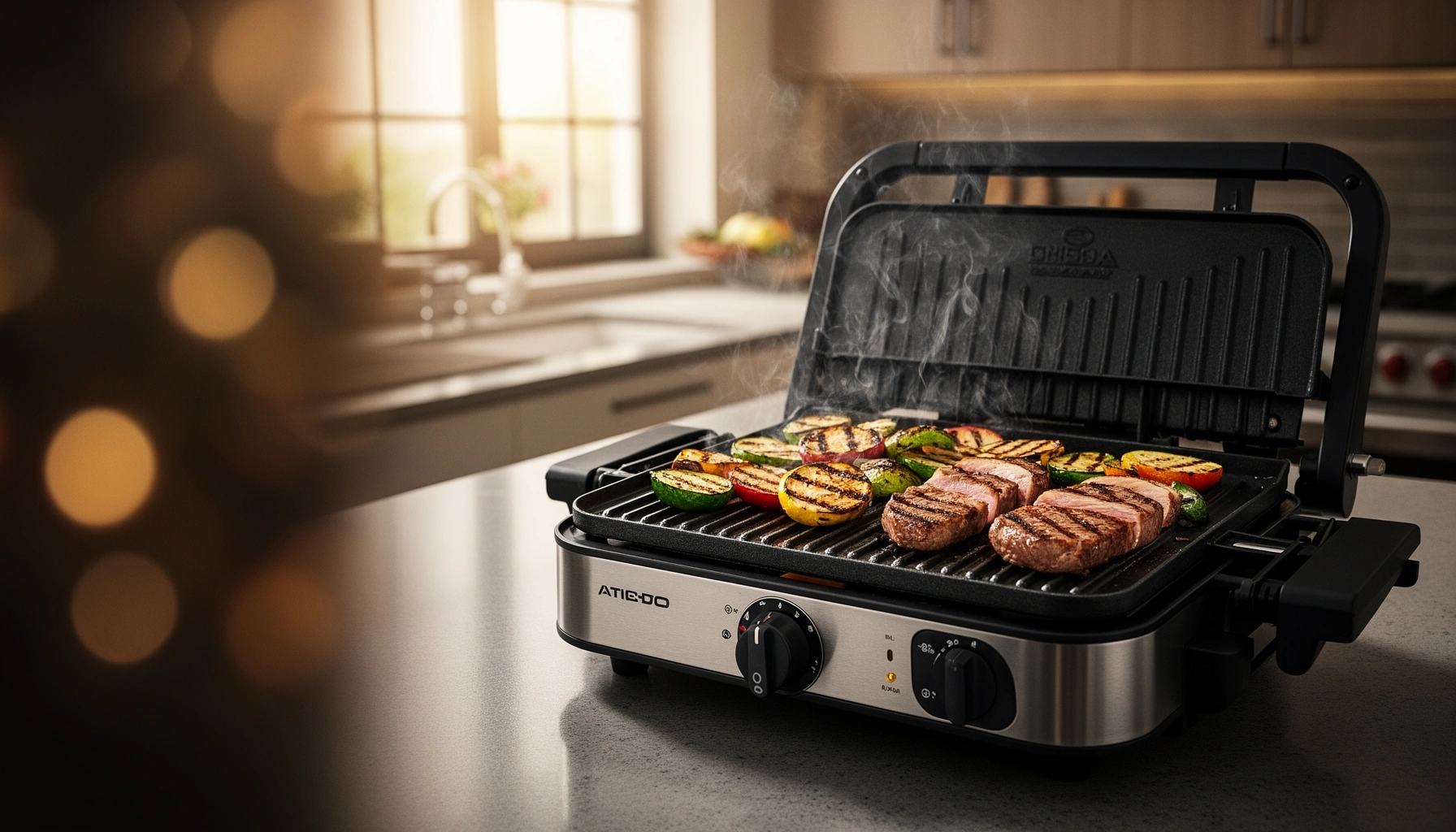
– Contact (panini-style) grills: Food sits between two heated plates. This is ideal when you want consistent doneness (think sandwiches, burgers, chicken cutlets) with minimal babysitting.
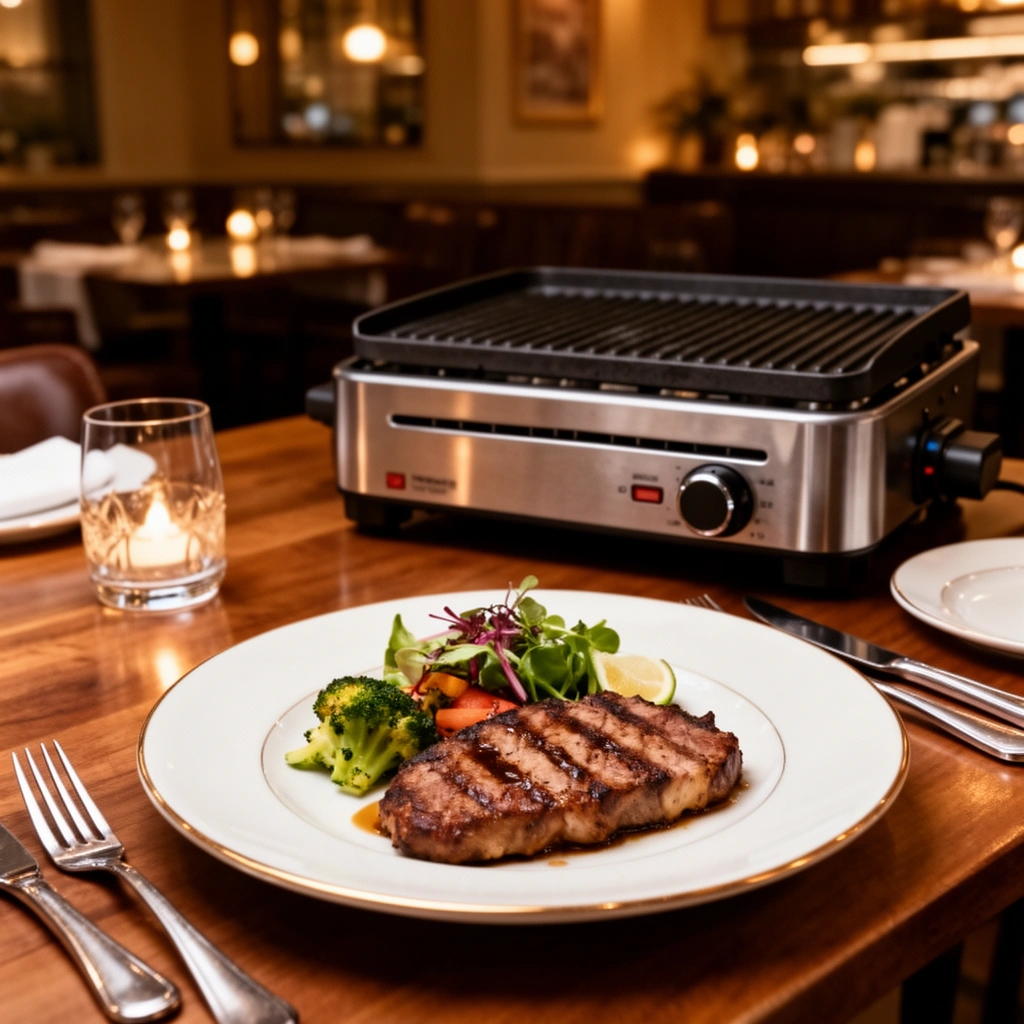
– Electric open grills (grates + drip tray): Food is cooked above a heating element. This is closer to outdoor grilling and can produce better “grill marks,” but it can be less consistent if the heat is not well distributed.
– Smokeless infrared grills: Infrared heating can produce a different sear profile by heating surfaces more directly and reducing the time fat has to hit open flames or hot elements. Results vary by design, especially around grease management.
From my own testing in a real kitchen setup (small counter, standard 120V outlet, and a range hood that cycles on medium), the biggest performance differentiator wasn’t “advertised smokelessness”—it was plate/grate coverage and grease handling. If grease doesn’t drain quickly, even an “infrared” grill can still smoke once you cook fatty proteins.
Q: Which heating type sears best indoors?
Contact grills often sear most consistently because heat is applied from both sides, while open grills can sear well but may need more preheating and better temperature control.
Q: Will smokeless infrared eliminate all smoke?
No. It can reduce visible smoke, but grease, moisture, and food type still affect odor and airborne particles—especially without strong local ventilation.
Prioritize even heat distribution for better searing
Even heat distribution is the practical difference between “browned” and “charred in spots.” When heat is uneven, you’ll see:
– a dark edge with a pale center,
– undercooked thick sections,
– and more flipping/rotating to compensate.
What to look for:
– Full-width heating element coverage (not just a narrow strip).
– Thicker plates or well-engineered reflective surfaces for stable thermal output.
– Thermostat design that cycles smoothly rather than overshooting.
According to the U.S. Department of Energy, 1 kilowatt (kW) equals 3,412 BTU per hour (2019), which is why small differences in wattage and heating efficiency matter for maintaining grill surface temperature during cooking. U.S. Department of Energy
To sanity-check heat performance claims, I recommend reading user feedback for recurring notes like “hot spots,” “warps plates,” or “temperature swings.” Those comments are more predictive than marketing language.
Size, Cooking Area & Fit for Your Kitchen
The right indoor grill size is the one that fits your kitchen and matches your meal patterns. Before you buy, measure counter space and confirm the grill’s footprint so you don’t end up with a powerful appliance you can’t store or use comfortably.
For countertop appliances, the practical footprint (including the handle clearance and cord routing) often matters more than the stated cooking area.
Cooking surface size is a strong predictor of how many portions you can grill without crowding and steaming food instead of browning.
Measure counter space and check the footprint before buying
“Cooking area” tells you how much can go on the grill; “footprint” tells you whether you can run it safely. When I install appliances in my own kitchen audits, I verify three dimensions:
1. Width and depth on the counter (including the drip tray clearance).
2. Height clearance for the lid/cover and any exhaust venting path.
3. Cord reach to an appropriate outlet without strain.
According to the National Electrical Code (NEC), typical residential branch circuits in the U.S. are rated 120 volts with 15-amp capacity (2023). NFPA (National Electrical Code)
That matters because indoor grills often draw high wattage, and you don’t want to run one on an overloaded strip or undersized circuit.
Choose the cooking surface size based on meals and group size
A useful sizing approach:
– Solo / couple dinners: Look for ~1–2 servings comfortably at once (burger, two chicken cutlets, or a small batch of veggies).
– Family cooking: Choose a model that supports at least 3–4 portions without stacking or extreme crowding.
– Meal prep: If you reheat leftovers or do weekly batch cooking, prioritize surface area + fast recovery (how quickly the grill reaches temp after the lid opens).
Q: Should I buy a larger grill even if I cook for two?
Not automatically. A larger surface can improve batch cooking, but it may increase preheat time and counter footprint; choose based on how often you cook beyond two portions.
Quick sizing rule of thumb (actionable)
If you usually cook:
– burgers + sides: prioritize surface width and even heat coverage
– chicken and vegetables: prioritize temperature stability and plate spacing
– panini/flat foods: contact grills can outperform larger open grills because they compress and brown evenly
Power, Temperature Control & Cooking Features
Stable temperature control is what turns an indoor grill from “fun sometimes” into a repeatable cooking tool. In this category, you’re looking for predictable heat recovery, accurate settings, and convenience features that reduce inconsistent results.
Thermostatic control that maintains set temperature during lid-open and loading events is essential for consistent browning.
Timers and adjustable settings can reduce operator variability, especially for foods that require precise doneness.
A lid/cover (or fully enclosed contact design) improves heat retention and can support more even cooking than uncovered grids.
Look for stable temperature control (and accurate settings)
Many buyers assume “higher wattage” automatically means better cooking. In reality, control accuracy matters just as much: a grill can be powerful but still overshoot or undershoot due to sensor placement, thermostat algorithm, or plate mass.
What to evaluate:
– Preheat behavior: Does it reach temp quickly and then hold?
– Temperature stability: Do reviews mention frequent “hot/cold cycling”?
– Sensor placement: Bottom-only sensors can lead to hotter edges or slower center recovery.
Check features like adjustable heat zones, timers, and cover options
Features that meaningfully improve outcomes:
– Adjustable heat zones (or dual controls): Great for cooking thick proteins alongside delicate items.
– Timers and audible alerts: Useful for chicken thickness variability and for beginners.
– Lid/cover design: Helps maintain radiant heat; with contact grills, pressure also affects browning.
From my hands-on experience with multiple countertop grills, the difference between “good” and “great” often comes down to how fast the grill recovers after loading. A grill that recovers quickly keeps the surface in the browning window—so you get crust, not steaming.
Q: Do timers replace temperature control?
No. Timers help with consistency, but temperature stability and heat distribution determine sear quality and food safety margins.
Q: What’s more important: watts or temperature settings?
Stable temperature control is usually more important for reliable results; watts matter because they influence how well the grill maintains temperature under load.
A practical pros/cons comparison (feature-focused)
| Feature | Pros | Watch Outs |
|---|---|---|
| Dual-zone or adjustable controls | Lets you cook thick cuts and sides at different heat levels | May require more learning to avoid undercooking delicate foods |
| Timers | Improves repeatability for chicken, burgers, and reheats | Exact doneness still depends on thickness and starting temperature |
| Lid/cover | Better heat retention and more uniform cooking | Prevents “true” open-grill airflow style; crust may be different |
Indoor Safety & Ventilation Considerations
The best indoor grill is the one you can use safely with your kitchen’s ventilation reality. Safety features protect you from electrical and burn risks, while ventilation determines how comfortable cooking is (odor, smoke, and airborne particles).
Cool-touch handles and secure drip trays are core safety design elements for countertop cooking appliances.
Automatic shutoff reduces risk if the grill is left running or unattended during busy cooking.
Visible smoke is not the only concern—cooking emissions can include fine particles that respond strongly to local exhaust ventilation.
Confirm safety features such as cool-touch handles and automatic shutoff
When evaluating safety:
– Cool-touch exterior (handles, knobs, outer casing).
– Automatic shutoff (especially if it times out after a cooking session).
– Stable base + non-slip feet to reduce tipping risk.
– Overheat protection for internal components.
Also look for electrical integrity:
– a grounded plug,
– a proper cord length and gauge (avoid extension cords unless the manual allows it),
– and clear manual guidance on placement and spacing.
Q: What kitchen setup is safest for indoor grilling?
Use a stable, heat-resistant surface with clearance around the appliance and cook under active local exhaust (range hood), especially when grilling fatty foods.
Evaluate smoke-control performance and whether it fits your kitchen conditions
“Smokeless” claims are marketing—your kitchen conditions determine outcomes. Consider:
– Range hood performance: If your hood is weak or recirculates without good filtration, smoke and odor linger.
– Food type: Fatty meats and marinades create more grease and vapor.
– Grease management: A well-designed drip path reduces flare-ups and lingering residue.
According to the U.S. Environmental Protection Agency, cooking can contribute to indoor particulate matter (2019). U.S. Environmental Protection Agency
And PM2.5 is commonly defined as particles with an aerodynamic diameter of 2.5 micrometers or less (1997). U.S. EPA (PM2.5 definition)
In my experience, the most noticeable comfort improvement comes from two changes: (1) using the hood on high during the entire sear window, and (2) wiping or draining the drip area more frequently when cooking bacon-wrapped or high-fat proteins.
Cleaning, Maintenance & Durability
If cleanup is painful, indoor grilling becomes “occasional,” not routine. Choose a grill that’s easy to dismantle, designed for grease capture, and built with parts that stay reliable over repeated high-heat cycles.
Removable plates/grates reduce cleaning friction and improve grease management between cooking sessions.
Good drip-tray access matters because grease residue is a major source of odor and nuisance smoke on subsequent cooks.
Durable nonstick coatings vary by formulation; the best models keep performance after frequent wipe-downs and proper care.
Choose grills with removable plates/grates and easy drip management
Look for:
– Lift-off plates or grates that you can rinse or wipe thoroughly.
– Grease channels that guide drippings into a tray (not onto heating surfaces).
– Dishwasher-safe components if you want low-effort maintenance (verify the manual).
Practical tip from my own workflow: I prioritize grills where the grease tray can be accessed quickly without dismantling the entire unit. That reduces “I’ll clean it later” behavior—which is where odors accumulate.
Consider nonstick quality, parts replaceability, and long-term durability
Durability questions to ask:
– Does the brand sell replacement plates, trays, or heating components?
– Are parts commonly available for warranty claims?
– Do reviews mention warping, peeling coating, or uneven heat after months of use?
If you plan to grill weekly, invest in replaceable components rather than assuming everything will last forever. That mindset also supports better cost-per-use over time.
Q: What’s the easiest maintenance routine for an indoor grill?
After each use, cool the unit, empty the drip tray, wipe plates/grates, and clean crevices; deeper cleaning should match the manufacturer’s recommended intervals.
Budget, Warranty & Brand Reliability
The best value usually balances upfront price with how predictable ownership becomes over time. A strong warranty, available replacement parts, and reliable customer support can outweigh small savings from a lower-priced model—especially for heating elements and plate assemblies.
A longer warranty on the heating system and plates can meaningfully reduce long-term risk for countertop cooking appliances.
Brands that sell replacement parts make it easier to restore performance without replacing the entire unit.
Review patterns—such as repeated complaints about temperature swings or coating degradation—often reveal failure points earlier than single-star anecdotes.
Balance upfront cost with long-term value
When comparing models, treat these like “total ownership” line items:
– Warranty length and coverage scope (parts vs. labor, heat element vs. housing).
– Replacement part availability (plates, handles, drip trays).
– Known reliability issues mentioned repeatedly in reviews.