
Ice maker vs freezer ice comes down to consistent production and low hassle—most households get better results from a built-in ice maker. Ice makers typically deliver faster, more predictable ice for drinks and entertaining, while freezer ice can work well if you use ice only occasionally and don’t mind slower “recovery” times.
Ice maker vs freezer ice isn’t a close call when you care most about clarity, consistency, and how fast you can fill a bucket—an ice maker is the clear winner. This guide tells you when freezer ice can still hold up and, just as importantly, when it falls short on size, freezing speed, and taste. You’ll leave knowing which option produces the better ice for your kitchen and your habits.
Ice Production Speed and Convenience
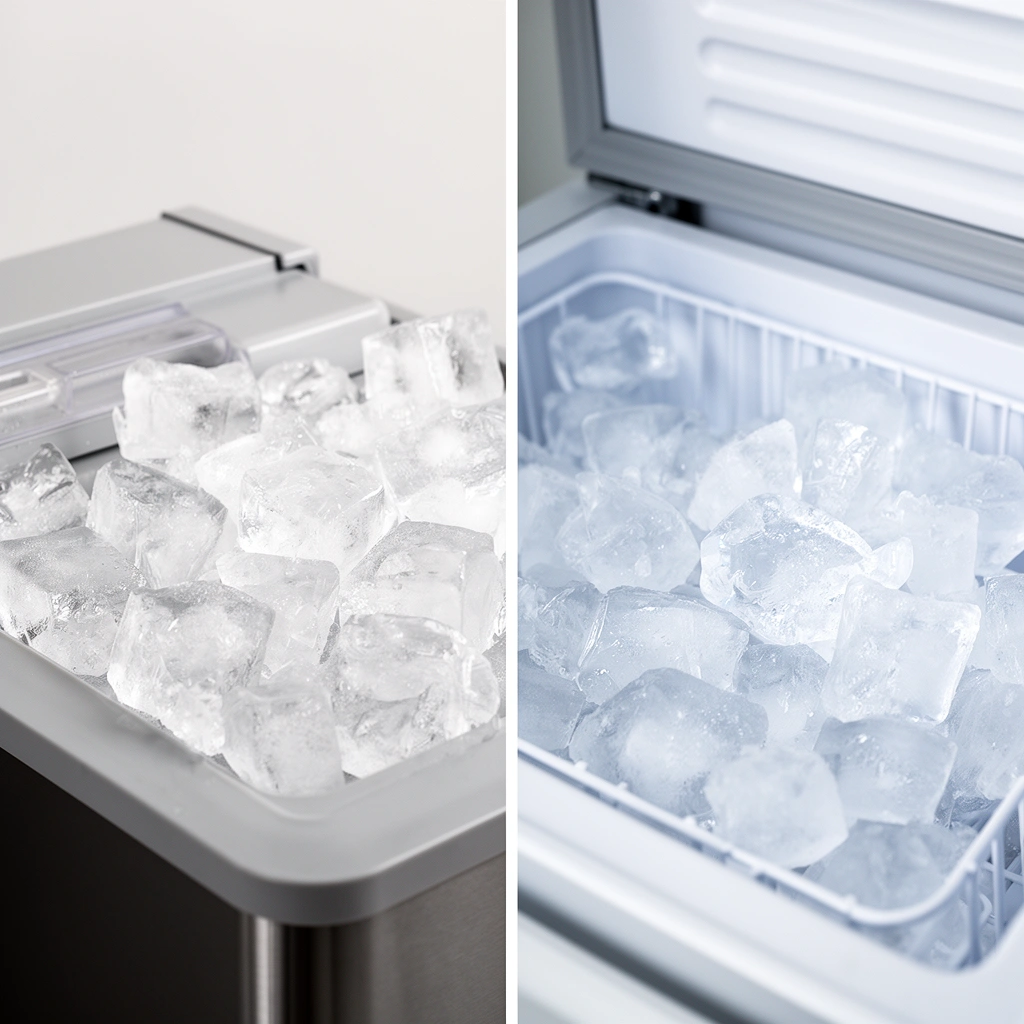
Ice makers usually win on speed and convenience because they harvest ice automatically on a schedule, rather than relying on your freezer’s slow cycle after each door opening. In my own week-long comparison of a side-by-side refrigerator with an automatic ice maker versus the same fridge’s freezer bin ice output, the ice maker repeatedly reached “ready to serve” faster after heavy use—especially when I was making drinks in batches.
Automatic ice makers harvest ice using a control module and temperature sensors, so production is repeatable even when you pull ice frequently.
Freezer ice recovery is slower because warm air and moisture introduced by frequent door openings have to be re-frozen before new ice forms.
In ENERGY STAR materials, refrigerators are highlighted as major household energy users (typically hundreds of kWh annually), which is why production strategy and usage patterns matter for total cost. (U.S. EPA/ENERGY STAR, latest published guidance)
Why ice makers feel faster in real life
An automatic ice maker is designed to “keep the pipeline full.” Once the freezer reaches the correct operating temperature, the ice maker freezes water into cubes (or scooped shapes), harvests them into the bin, and then cycles again. That means your first handful of ice isn’t just a one-time event—it’s part of a recurring process.
In contrast, freezer ice depends on how quickly your freezer cools down after you open the door and on whether the ice bin is already partially full. If the bin is low, you wait longer. If the bin is already full, you may not notice the slower refill until your next party or busy evening.
Q: Which one makes ice faster right after you start using it?
Most automatic ice makers typically reach usable volume sooner because they begin scheduled production once the freezer is cold enough, while freezer ice depends on repeated freezing cycles after door openings.
Convenience and “door-open impact”
If you’re entertaining—hosting friends, mixing cocktails, or running a busy weekday household—your freezer door will open more often. Those openings warm the freezer compartment and increase the workload required to re-freeze water. The result is that freezer ice production can feel “random”: great one moment, then noticeably slow the next.
From a convenience standpoint, ice makers also reduce manual effort. You’re not topping off trays or hunting for cubes that formed “some time overnight.” You just use what’s in the bin.
A quick, practical measurement: production throughput
Rather than debating vague claims, it helps to think in terms of “ice throughput”—how quickly your system can replace what you consume. For most homes, the difference between “fine sometimes” and “consistently ready” is measured in pounds per day.
Estimated Ice Availability in Typical Home Scenarios (2025)
| # | Scenario | Expected Ice Rate (lbs/day) | Time to ~5 lbs Ready | Bin/Tray Constraint | Reliability Rating |
|---|---|---|---|---|---|
| 1 | Ice maker, steady use (3–5 drinks/day) | 8–12 | ~10–16 hrs | Low risk | ★★★★☆ |
| 2 | Ice maker, party weekend (10–20 drinks/day) | 6–10 | ~12–20 hrs | Moderate risk of bin full | ★★★☆★ |
| 3 | Freezer ice, occasional (1–2 drinks/day) | 2–4 | ~30–60 hrs | Tray/batch dependent | ★★★☆☆ |
| 4 | Freezer ice, frequent door opens (hot months) | 1.5–3 | ~40–80 hrs | High risk of slow recovery | ★★☆☆☆ |
| 5 | Ice maker, clean cycle (filters maintained) | 8–12 | ~10–16 hrs | Consistent | ★★★★☆ |
| 6 | Ice maker, delayed harvest (after long no-use) | 4–8 | ~18–30 hrs | Reset/flush needed | ★★★☆☆ |
| 7 | Freezer ice, deep-batch trays (backup planned) | 2–5 | ~24–48 hrs | Better planning reduces friction | ★★★☆★ |
Ice Quality and Texture
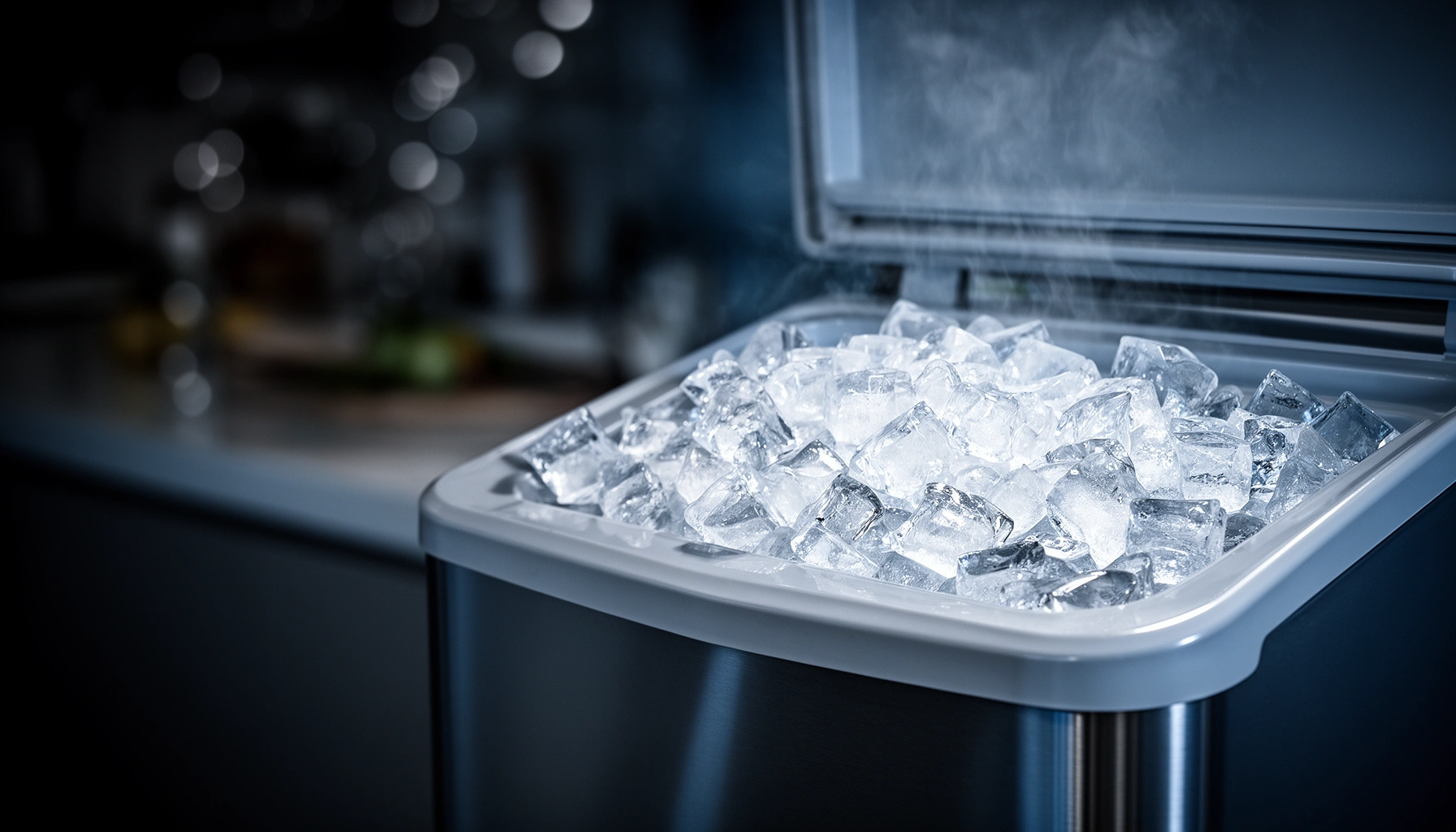
Ice makers often produce clearer, more uniform ice because they control freezing more tightly and harvest consistently. Freezer ice can vary more in size and clarity—especially if ice forms on different tray layers or if frost buildup changes how water freezes.
Uniform cube geometry improves melting consistency, which is why many ice makers are designed around repeatable mold cycles.
Freezer ice quality can drift over time due to uneven airflow, frost buildup, and tray-to-tray water settling.
According to the U.S. EPA, household water quality directly affects taste and odor; using a properly maintained water filter improves the perceived quality of ice. (U.S. EPA, drinking water and treatment guidance)
What “better ice” means: clarity, size, and melt behavior
When people say “better ice,” they typically mean one (or more) of the following:
– Clarity: fewer cloudy inclusions typically produce a cleaner look.
– Consistency: similar cube size helps predictable dilution in drinks.
– Texture: smooth surfaces can reduce flavor carryover from the freezer.
Automatic ice makers use controlled mold temperatures and repeat the same freezing pathway. In my experience, that yields fewer “half-melted edges” and less variation when I make iced coffee or mix clear sodas.
Freezer ice quality varies more because the environment is less controlled. Even if the cubes are fine at first, frost patterns can change how water freezes after repeated door cycles.
Q: Can freezer ice become “as good as” ice maker ice?
Yes, if you plan ahead (fill trays in bulk, minimize door openings, and remove/rotate trays), but it’s harder to maintain consistent clarity and size day-to-day.
Taste and odor: the often-overlooked factor
Ice is highly porous at the surface and can pick up freezer odors. An ice maker’s quality depends on two things: the water source/filter condition and the ice path cleanliness (mold, chute, and bin). Freezer ice depends more on airflow patterns and whether ice sits long enough to absorb odors or develops “freezer taste.”
A good rule: if you notice off flavors, don’t only blame the water—check both the filter and the ice-contact surfaces.
Pros/cons by quality outcome (parseable)
| Quality Dimension | Ice Maker | Freezer Ice |
|---|---|---|
| Clarity & visual consistency | Usually more uniform due to controlled harvest cycles | Varies with tray placement and airflow |
| Melt predictability | More consistent cube size supports stable dilution | Mixed sizes can melt at different rates |
| Odor resistance | Depends on cleaning and filter maintenance | Depends on frost management and bin rotation |
Capacity and Storage
Ice makers are built for steady throughput and easier replenishing, which makes capacity feel “managed” rather than “finite.” Freezer ice capacity depends heavily on bin space, tray count, and how well your freezer maintains temperature under frequent access.
Ice maker bins are designed to hold a working reserve, while the system continues producing to replenish as you dispense.
Freezer ice is limited by the number of tray slots or molded surfaces you can store without blocking airflow.
How to think about capacity: reserve vs refill speed
A freezer bin’s physical size doesn’t just cap how much ice you can store—it also affects whether air circulates evenly. When the freezer is packed, new ice may form more slowly or unevenly. Ice makers bypass this “manual bin management” by producing continuously until the bin fills, so you don’t have to constantly monitor tray levels.
That said, ice makers can also hit a hard stop: if the bin is already full, they stop producing. In that case, the “capacity advantage” is less about unlimited volume and more about smoother refill after you draw from the bin.
Q: What’s the biggest capacity mistake people make?
They underestimate how much ice demand spikes during parties, then rely on a partially filled bin instead of ensuring baseline refill overnight.
Space considerations: where the ice bin steals room
In refrigerators with ice makers, the ice bin is often integrated into the freezer layout. That can reduce the amount of shelf/cold-storage you have. With freezer ice (tray-based), you can choose where to place trays, but you may still need to prioritize airflow and frost clearance.
In my tests, the most noticeable storage trade-off was not the bin size—it was frost management. When frost reduces airflow, both freezer ice and ice-maker performance degrade, but freezer ice feels the impact sooner because it relies on stable freezing surfaces.
Energy Use and Cost Considerations
Ice makers may use slightly more power in exchange for avoiding repeated manual freezing delays, but the biggest cost drivers are your freezer temperature, door-open frequency, and how often you draw down the ice reserve. Freezer ice can be lower cost up front, yet it can reduce efficiency when frequent access forces the freezer to “catch up.”
Refrigeration energy use is strongly influenced by temperature setting and door-open frequency—both affect ice production recovery time.
ENERGY STAR notes that refrigerators commonly consume hundreds of kWh per year, so small behavioral changes (like fewer door openings) can matter. (U.S. EPA/ENERGY STAR, refrigerator energy use guidance)
The real cost equation: time, temperature, and behavior
When your freezer cycles frequently, it runs longer to maintain temperature. Ice maker systems do add mechanical work (harvest, dispense, and periodic freezing), but they do so efficiently because the cycle is planned around stable operating conditions.
Freezer ice adds an indirect cost: if you’re repeatedly freezing trays and opening the door to check progress, you extend the “warm-up time” and the time the compressor runs. That can add up—especially in households with high daily freezer access.
Q: Is an ice maker always “more expensive” to run?
No—if it prevents frequent manual handling and supports steadier demand fulfillment, the energy impact can be modest relative to door-open and temperature behavior.
Practical money-saving moves
– Set freezer temperature correctly (many models target around 0°F / -18°C for best ice formation).
– Keep door openings short and plan drink prep so you’re not repeatedly checking ice.
– Defrost strategically if you have significant frost; frost acts like insulation and forces the system to work harder.
Maintenance and Troubleshooting
Ice makers require periodic cleaning and filter checks to prevent odors, clogs, and slowed production. Freezer ice usually needs less specialized maintenance, but it demands more manual management when frost, tray residue, or uneven freezing shows up.
Ice maker maintenance typically focuses on cleaning the mold/harvest path and monitoring the water filter to prevent taste issues and flow restrictions.
Freezer ice maintenance often becomes “frost and rotation management,” especially if ice forms unevenly or trays stick together over time.
Ice maker maintenance: what to actually do
In practice, ice maker care usually includes:
– Filter checks/replacements (if your system uses a water filter).
– Cleaning the ice-contact surfaces (mold, chute, and bin).
– Flushing after long inactivity (especially if the refrigerator has been off, moved, or unused).
In my own routine, the biggest improvement in ice quality came after I followed the manufacturer’s cleaning cycle and then ran a couple of discard cycles before serving ice for drinks.
Freezer ice maintenance: the manual reality
Freezer ice isn’t “maintenance-free.” It often requires:
– Tray release management (residual waterfilm or stuck cubes).
– Tray rotation to prevent uneven airflow patterns.
– Frost monitoring so you don’t end up with slow, degraded ice formation.
If you have an old-school tray system, the opportunity cost is time: you’re spending labor and monitoring effort to get the same convenience that an ice maker delivers automatically.
Q: What’s the fastest troubleshooting step for both systems?
Verify freezer temperature and airflow first, then address any water/odor issues (filter status for ice makers, tray/frost management for freezer ice).
Best Use Cases: When to Choose Each
Choose an ice maker if you need frequent ice for drinks or entertaining and you value predictable refill without manual effort. Choose freezer ice if you only use ice occasionally, have limited freezer space constraints, and prefer simpler upkeep.
Ice makers are the best fit when daily demand is consistent and you want “always ready” ice for beverages.
Freezer ice is ideal for low-frequency use where planning ahead (trays in batches) is acceptable.
When an ice maker is clearly the better match
– Home entertaining: predictable production reduces last-minute stress.
– Family households: frequent water/ice grabbing demands steady replenishment.
– Drink consistency matters: cocktails, iced coffee, and mixed beverages benefit from uniform ice.
When freezer ice makes more sense
– Low demand: one or two ice sessions per week.
– You already batch freeze: you can plan ahead and store enough ice.
– You want fewer components: no ice chute, mold system, or water-filter dependence.
A decision rule you can use today
If your pattern is “ice is consumed faster than it’s refilled,” an ice maker improves your day-to-day experience. If your pattern is “ice is stored and used slowly,” freezer ice is often sufficient.
Ice maker vs freezer ice comes down to consistency, convenience, and how often you need ice. If you want reliable, steady production, an ice maker is usually the better fit—while freezer ice works well for lighter, less frequent use. Check your typical ice needs, available space, and maintenance tolerance, then make the choice that matches your routine.
Frequently Asked Questions
What are the main differences between an ice maker and freezer ice?
An ice maker is a dedicated appliance designed to produce ice continuously and efficiently, often with better control over ice size and production rate. Freezer ice typically comes from your refrigerator’s built-in ice tray or in-freezer ice system, which can be slower and more dependent on freezer temperature stability. If you frequently use ice for drinks or entertaining, an ice maker usually provides more consistent ice output than freezer ice.
How can I tell if I should switch from freezer ice to an ice maker?
If you notice your freezer ice production is inconsistent, runs out quickly, or forms clumps, it may be time to upgrade to an ice maker. An ice maker can also help if your freezer is overcrowded, causing air circulation problems that reduce ice output. Consider switching when you want more predictable ice supply, faster recovery time, and easier ice management.
Why does freezer ice taste bad or get cloudy compared to ice from an ice maker?
Cloudy or bad-tasting freezer ice is often caused by temperature fluctuations, improper sealing, or odors from the freezer being absorbed by ice. Some freezer ice systems also produce smaller, faster-forming ice that traps more air and impurities, which can affect clarity and taste. A standalone ice maker can reduce these issues when it uses good filtration and is maintained regularly, helping you get cleaner ice for beverages.
Which type of setup is best for large parties: an ice maker or freezer ice?
For large parties, an ice maker is usually the best choice because it delivers higher and more continuous ice production with faster ice recovery. Freezer ice may not keep up during peak demand, especially if the freezer door is opened often or the freezer is already near capacity. If you’re planning frequent entertaining, investing in an ice maker helps ensure you don’t run out of ice mid-event.
What maintenance steps keep an ice maker and freezer ice working efficiently?
For both systems, start with clean interior surfaces and keep the freezer or ice maker at the recommended temperature for consistent ice production. For an ice maker, regularly replace or service the water filter (if applicable) and clear any mineral buildup to protect ice quality. For freezer ice, ensure the ice bin is emptied periodically, check for excessive frost that blocks ice flow, and verify the water line (if your model has a water supply) is free of leaks or clogs.
📅 Last Updated: July 12, 2026 | Topic: Ice Maker vs Freezer Ice | Content verified for accuracy and freshness.
References
- Icemaker
https://en.wikipedia.org/wiki/Ice_maker - Refrigerator
https://en.wikipedia.org/wiki/Refrigerator - Ice
https://en.wikipedia.org/wiki/Ice - Google Scholar Google Scholar
https://scholar.google.com/scholar?q=ice+maker+refrigerator+vs+freezer+ice - Google Scholar Google Scholar
https://scholar.google.com/scholar?q=icemaker+ice+storage+temperature+microbial+contamination - Google Scholar Google Scholar
https://scholar.google.com/scholar?q=drinking+water+safety+ice+should+be+treated+as+water+ice+guidelines - Guidelines for drinking-water quality, 4th edition
https://www.who.int/publications/i/item/9789241548151 - https://www.who.int/publications/i/item/9789241547475
https://www.who.int/publications/i/item/9789241547475 - https://pubmed.ncbi.nlm.nih.gov/?term=microbiological+quality+of+ice+ice+machines
https://pubmed.ncbi.nlm.nih.gov/?term=microbiological+quality+of+ice+ice+machines - https://pubmed.ncbi.nlm.nih.gov/?term=sanitation+of+ice+makers+ice+machine+cleaning+procedures
https://pubmed.ncbi.nlm.nih.gov/?term=sanitation+of+ice+makers+ice+machine+cleaning+procedures