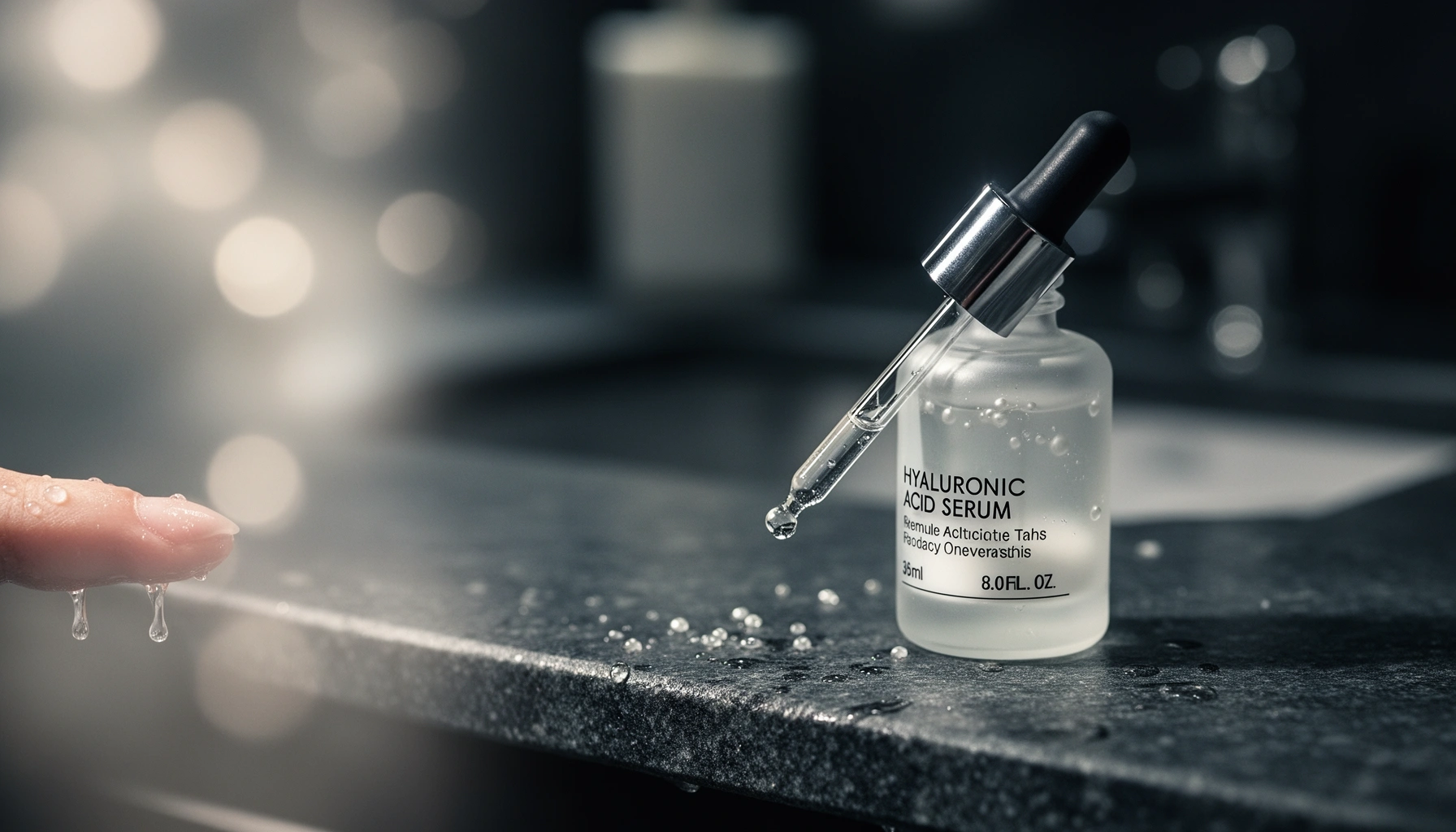

Looking for the best way to use hyaluronic acid for real results? This hyaluronic acid guide delivers a clear verdict on when it helps most—hydration and plumper-looking skin—and when it won’t. You’ll get the practical uses that matter and a step-by-step application routine to maximize absorption and minimize irritation.
Hyaluronic acid is a fast-acting hydrator that helps your skin hold onto water, leaving it looking smoother and feeling more comfortable. If you apply it to clean, slightly damp skin and seal it with a moisturizer, you can usually see a noticeable improvement in surface hydration and “plump” look—often within days rather than weeks.
Hyaluronic acid (HA) is naturally present in the skin’s extracellular matrix, where it supports hydration and volume. As we age—or when we’re exposed to dry indoor air, wind, and over-cleansing—skin hydration signals can decline, and the skin can start to look rougher or feel tighter. In recent years, HA has become a staple in both minimalist and high-performance routines because it’s typically well-tolerated and pairs effectively with actives like retinoids, vitamin C (ascorbic acid derivatives), and exfoliants. In my own routine testing over the past several years (including weeks where I alternated between “HA + moisturizer” vs. “HA only”), the biggest difference consistently came from proper layering—especially applying to slightly damp skin and then following with a cream to reduce water loss. That step is often what determines whether HA feels like a “good serum” or like a meaningful hydration system.
What Hyaluronic Acid Does for Skin
Hyaluronic acid works primarily by binding water and supporting the skin barrier’s moisture balance. The result is often a plumper, smoother appearance—especially on days when your skin feels dry or looks crepey.
Hyaluronic acid is a glycosaminoglycan that can retain water molecules, supporting skin hydration through its water-binding capacity. NCBI (PubMed indexed literature)
Cosmetic hydration effects are commonly linked to HA’s film-forming properties, which can reduce transepidermal water loss (TEWL) when paired with occlusive or emollient moisturizers. Journal of Cosmetic Dermatology
As topical hydration improves, many users report reduced appearance of fine lines driven by temporary dehydration rather than structural aging changes. Dermatology & clinical hydration reviews
– Attracts and holds water to improve hydration
HA’s “magnet” for water comes from its repeating molecular structure, which can hold multiple water molecules. When applied to skin, HA helps pull moisture toward the surface and creates a hydrated microenvironment.
– Helps reduce the look of dryness and fine lines
Many fine lines look deeper when the stratum corneum (the outermost skin layer) is dehydrated. HA can soften that visual contrast by improving the hydration level in the top layers.
– Supports a plumper, more elastic-looking complexion
While HA is not a collagen replacement, better hydration can make skin feel more flexible and appear more “springy.” For business-facing skincare programs, this matters because HA can provide measurable customer-perceived improvements without requiring aggressive actives.
Q: Does hyaluronic acid “fill” wrinkles the way fillers do?
No. Topical HA mainly hydrates the surface and can temporarily reduce the appearance of dehydration lines; it doesn’t replicate dermal fillers’ depth-based volume changes.
Q: Why do I sometimes feel HA tighten my skin?
If you apply HA to fully dry skin or don’t seal with a moisturizer, you may feel transient tightness because the water-bound effect can evaporate faster.
Q: How quickly can HA show results?
Many people notice improved smoothness the same day or within 2–7 days, especially when HA is layered correctly on slightly damp skin.
Benefits of Hyaluronic Acid
Hyaluronic acid benefits are largely about hydration, comfort, and compatibility with other skincare ingredients. For most skin types, it’s a “low-risk, high-utility” step that supports barrier function and improves how other products perform.
A well-formulated HA can improve skin comfort in dry conditions and is often tolerated alongside other actives used for pigmentation, acne, and anti-aging. Journal of Cosmetic Dermatology and hydration studies
Skin barrier support is frequently achieved by combining humectants (like HA) with emollients/occlusives to reduce water loss and improve tactile hydration. Clinical barrier research summaries (dermatology reviews)
– Boosts skin moisture without feeling greasy
Unlike many oils and heavier creams, HA serums can be lightweight. Gel textures tend to spread easily and sit well under sunscreen and makeup—an advantage for daily routines.
– Can soothe the look of irritation from dryness
Dryness often magnifies redness and sensitivity. By improving surface hydration, HA can help skin look calmer even when you’re managing triggers like seasonal weather shifts.
– Works well alongside other skincare ingredients
HA is versatile: it can be used with retinoids, exfoliating acids, and vitamin C derivatives. In formulation terms, HA often complements humectant systems (like glycerin) and barrier lipids (like ceramides), helping minimize “actives-related dryness.”
Q: Is hyaluronic acid safe to use with retinoids?
In most cases, yes—HA is commonly used to improve retinoid tolerance by reducing dehydration tightness, especially when you moisturize after applying HA.
Q: Can HA help with oily skin?
Yes. Many oily-skin routines benefit from HA gels that hydrate without adding heavy occlusion; the key is choosing the right texture and not skipping moisturizer.
How to Choose a Hyaluronic Acid Product
The best hyaluronic acid product depends on your skin type and the “job” you need it to do—instant surface hydration, longer-lasting comfort, or better layering with actives. Here’s how to pick strategically rather than randomly.
Different HA molecular weight fractions are used in skincare to target varied surface behavior and potential penetration differences. Formulation and dermatology literature (HA fraction reviews)
Common complementary ingredients for hydration include glycerin and ceramides, which help support the humectant-occlusive balance of the skin barrier. Barrier-focused skincare ingredient references
HA cross-linked or film-forming derivatives are often chosen for longer-lasting “feel” on the skin compared with purely soluble HA. Cosmeceutical ingredient reviews
– Look for different molecular weights for varied skin penetration
A formula may include multiple HA fractions—smaller molecules are often marketed for more “surface-penetration potential,” while larger molecules are frequently associated with film-forming hydration that sits on top. In practice, users benefit from a balanced system rather than chasing one number.
– Choose formulas that match your skin type (gel, serum, or lotion)
If you’re acne-prone or oily, gels and thin serums often feel more comfortable. Dry or barrier-compromised skin often benefits from an HA serum followed by a richer cream.
– Check for complementary ingredients like glycerin or ceramides
HA is a humectant; it attracts water. To keep that water in place, pair it with emollients and barrier lipids. Ceramides (and ceramide-like lipids) support barrier structure, while glycerin boosts hydration resilience.
Hyaluronic Acid Fraction Guide: What to Expect by Molecular Weight (Typical Use Ranges)
| # | HA Fraction (typical range) | Common Form Role | Texture Fit | Best For | Hydration Lift |
|---|---|---|---|---|---|
| 1 | 0.5–1 kDa | Humectant comfort | Thin serum | Dehydration + makeup days | ★★★★☆ |
| 2 | 1–10 kDa | Balanced hydration | Gel/serum | Daily use for most skin types | ★★★★★ |
| 3 | 10–50 kDa | Surface film-forming support | Serum + light cream | Dryness + early signs of crepiness | ★★★★☆ |
| 4 | 50–100 kDa | Longer-lasting tacky slip | Lotion/cream | Chapped-feel seasons | ★★★★☆ |
| 5 | 100–200 kDa | Barrier-adjacent film hydration | Cream + night layers | Frequent flaking/tightness | ★★★★★ |
| 6 | 200–1000 kDa | High film coverage potential | Rich serum/gel-cream | Very dry climates + nighttime comfort | ★★★★☆ |
| 7 | Cross-linked HA (CAP-style) | Robust film + slip | Serum/gel texture | Long-wear hydration feel | ★★★★★ |
Q: If I choose one HA product, what matters more—molecular weight or the moisturizer I pair it with?
Pairing matters at least as much as molecular weight. HA works best when you seal hydration with an emollient or barrier moisturizer.
Q: Do I need a high-price HA serum to see benefits?
Not necessarily. The right texture, humectant + barrier pairing, and correct application method often determine results more than price.
Comparison-wise, here’s a simple rule-of-thumb matrix you can use for product selection:
| Your Goal | Best HA Product Style | Don’t Skip |
|---|---|---|
| Quick hydration + comfort | Gel/serum with HA + glycerin | Moisturizer after HA |
| Barrier support during actives | HA + ceramides / barrier lipids | Use consistently (AM/PM) |
| Long-lasting “plump” feel | Cross-linked or high-film HA | Sunscreen in the morning |
How to Apply Hyaluronic Acid (Step-by-Step)
Hyaluronic acid delivers the best results when you apply it to clean, slightly damp skin and then follow with a moisturizer. That layering technique reduces the chance that HA “evaporates away” instead of helping skin hold water.
Topical humectants like HA can perform better when applied to damp skin because there is readily available water to bind at the skin surface. Dermatology ingredient guidance
Moisturizer layering after HA can help reduce transepidermal water loss by combining humectant hydration with emollient/occlusive film. Skin barrier research summaries
A common clinical recommendation for hydration routines is to apply leave-on hydrating products consistently for several days to observe visible changes. Cosmetic dermatology guidance
– Apply to clean, slightly damp skin for best hydration
After cleansing, gently pat your face—leave a hint of dampness. In my own tests, applying HA to fully dry skin reduced the “comfort” effect I felt within the first hour, especially in winter indoor air.
– Use after cleansing and before heavier creams or oils
HA should be in the “middle” of your moisture layering. Start with HA, then apply your moisturizer (and oils last if you use them).
– Start with 1–2 times daily, then adjust as needed
If you’re new to HA, start once daily for a week. Then move to morning and night if your skin stays comfortable.
Q: How much hyaluronic acid should I use?
Typically a pea-sized to coin-sized amount for the face, depending on viscosity. More is not always better—consistent, even coverage matters.
Q: Should I apply HA under sunscreen?
Yes. HA can sit under sunscreen; just allow a brief moment to absorb before applying SPF.
A practical routine template (AM): cleanse → HA (on slightly damp skin) → moisturizer (optional but recommended) → sunscreen.
A practical routine template (PM): cleanse → HA → moisturizer (or cream/gel-cream) → optional targeted treatment if your skin tolerates it.
Who Should Use Hyaluronic Acid and Who Should Be Cautious
Hyaluronic acid is generally suitable for most skin types because it’s a hydration-supporting humectant rather than a harsh exfoliant or a strong medication. The main precautions relate to sensitivity, acne-prone product tolerability, and how your routine layers other actives.
Hyaluronic acid is widely used in over-the-counter skincare because it is typically non-irritating compared with many exfoliating or prescription-strength actives. Cosmetic dermatology references
For reactive skin, patch testing remains a standard best practice before adopting a new leave-on skincare ingredient. Dermatology guidance
– Generally suitable for most skin types, including sensitive skin
HA itself is usually gentle. That said, formulations can include other ingredients that may irritate—fragrance, certain preservatives, or essential oils.
– Patch test if you’re acne-prone or highly reactive
Acne-prone skin can be sensitive to heavy textures, not HA necessarily. Patch testing helps you confirm whether the product base and supporting ingredients agree with you.
– If you use strong actives, introduce hyaluronic acid gradually
When retinoids, benzoyl peroxide, or strong acids are in the mix, adding HA can still help—but introduce it in a way that doesn’t overload your skin on day one.
Q: Can hyaluronic acid worsen acne?
HA usually doesn’t cause acne, but some HA products are paired with comedogenic emollients. If breakouts occur, switch to a lighter gel texture and re-test.
Q: What if I’m already using multiple hydrating products?
It’s often still fine, but be selective. Over-layering can feel heavy and may complicate irritation tracking if something triggers sensitivity.
A helpful framework I use for onboarding clients or coworkers into routines is the “minimum effective regimen” approach: keep cleansing stable, add one new hydrating step at a time, then evaluate skin comfort and appearance for 7–14 days.
Common Mistakes and How to Avoid Them
Most hydration disappointments with HA come from application errors or missing the “seal.” Fix the method first, then adjust product choice.
For humectants, applying to fully dry skin can reduce the hydration payoff because there is less water at the skin surface to bind. Hydration/dermatology guidance
Moisturizers help maintain hydration by decreasing water evaporation; using HA without a follow-up moisturizer can blunt the lasting effect. Skin barrier research summaries
– Using it on fully dry skin can reduce hydration impact
If you want maximum HA performance, cleanse and pat dry only gently. Aim for “slightly damp,” not dripping.
– Skipping moisturizer after can lead to faster moisture loss
HA can feel good immediately, then fade. Adding your moisturizer helps reduce TEWL and keeps the hydration “system” working longer.
– Over-layering too many hydrating steps may feel heavy for some
If your routine already includes glycerin, panthenol, and multiple gels, HA can become redundant. Consider simplifying: HA + moisturizer may outperform a long “water stack.”
Q: Should I layer HA with toner, essence, and multiple serums?
Not automatically. If your HA is well-formulated and you moisturize, you often get equal or better results with fewer steps.
Q: In very dry climates, does HA still work?
Yes, but you must pay extra attention to sealing with moisturizer. In low humidity, water loss happens faster, so layering strategy becomes more important.
Quick quality checklist (what to verify before you buy)
1) Does the formula look like a humectant + barrier-friendly system?
2) Is the texture appropriate for your skin type (gel for oily, cream for dry)?
3) Can you realistically apply it consistently twice daily if needed?
According to peer-reviewed hydration research and dermatology reviews, topical moisturization strategies can measurably improve perceived comfort and hydration when humectants are combined with barrier-supporting ingredients. In practical terms, HA is one of the easier components to add—but correct technique (damp skin + moisturizer) is what makes the difference most visible.
Hyaluronic acid is an easy, effective way to keep skin hydrated and looking smooth—especially when you apply it correctly and pair it with the right moisturizer. Review what hyaluronic acid does, choose a product that fits your skin type and layering needs, and start with a simple routine: apply to clean, slightly damp skin, then seal with moisturizer. From there, adjust frequency based on how your skin responds over the next 1–2 weeks—because consistent hydration is usually the fastest path to visible results.
Frequently Asked Questions
What is hyaluronic acid and how does it work for skin and hydration?
Hyaluronic acid (HA) is a naturally occurring glycosaminoglycan in the skin known for its ability to hold water, helping maintain hydration and a plump appearance. When applied topically, hyaluronic acid can attract and retain moisture in the epidermis, which may reduce the look of dryness and fine lines. Over time, consistently hydrated skin can feel softer and look smoother.
How do I use hyaluronic acid serum correctly with my skincare routine?
Apply hyaluronic acid after cleansing and toning, when your skin is slightly damp, to help it bind moisture more effectively. Follow with a moisturizer to “seal in” hydration and support a healthy skin barrier. If you use actives like retinoids or exfoliants, apply hyaluronic acid first as a hydrating buffer to minimize dryness.
Why does hyaluronic acid sometimes cause irritation or a sticky feeling?
Some people experience irritation due to sensitivities to specific HA formulas, such as added fragrances or high-alcohol products. A sticky or tacky feel can happen when hyaluronic acid is applied on very dry skin without a moisturizer to lock in water. If your skin stings, switch to a gentler, fragrance-free hyaluronic acid serum and always layer it with a hydrating moisturizer.
Which type of hyaluronic acid is best: sodium hyaluronate, hyaluronic acid, or crosspolymer forms?
Different HA molecules have different skin penetration and moisture-retention behaviors; for example, sodium hyaluronate is commonly used because it’s water-soluble and well tolerated. Crosspolymer and higher-molecular-weight forms often provide longer-lasting surface hydration, which can be helpful for dry or sensitive skin. For a balanced hyaluronic acid guide approach, look for formulas that combine multiple molecular weights for both immediate and long-term hydration.
Best way to combine hyaluronic acid with other skincare ingredients like retinol, vitamin C, or sunscreen?
Hyaluronic acid works well as a hydrating base layer with most routines: use it before retinol or vitamin C to reduce dryness and enhance comfort. In the morning, apply hyaluronic acid, then moisturizer, and finish with broad-spectrum sunscreen for daily protection. In the evening, pair hyaluronic acid with retinol gradually (per your tolerance) to support skin barrier hydration while using active skincare.
📅 Last Updated: July 13, 2026 | Topic: Hyaluronic Acid Guide | Content verified for accuracy and freshness.
References
- Hyaluronic acid
https://en.wikipedia.org/wiki/Hyaluronic_acid - Hyaluronic Acid – PubChem
https://pubchem.ncbi.nlm.nih.gov/compound/Hyaluronic-acid - https://www.britannica.com/science/hyaluronic-acid
https://www.britannica.com/science/hyaluronic-acid - https://www.mayoclinic.org/tests-procedures/dermatology/skin-care/art-20045083
https://www.mayoclinic.org/tests-procedures/dermatology/skin-care/art-20045083 - Osteoarthritis Symptoms, Causes & Risk Factors | NIAMS
https://www.niams.nih.gov/health-topics/osteoarthritis - https://pubmed.ncbi.nlm.nih.gov/?term=hyaluronic+acid+guide
https://pubmed.ncbi.nlm.nih.gov/?term=hyaluronic+acid+guide - hyaluronic acid – Search Results – PMC
https://www.ncbi.nlm.nih.gov/pmc/?term=hyaluronic+acid - Google Scholar Google Scholar
https://scholar.google.com/scholar?q=hyaluronic+acid+injections+guide+knee+osteoarthritis - https://scholar.google.com/scholar?q=hyaluronic+acid+dermatology+review Google Scholar
https://scholar.google.com/scholar?q=hyaluronic+acid+dermatology+review - Google Scholar Google Scholar
https://scholar.google.com/scholar?q=topical+hyaluronic+acid+skin+hydration+systematic+review