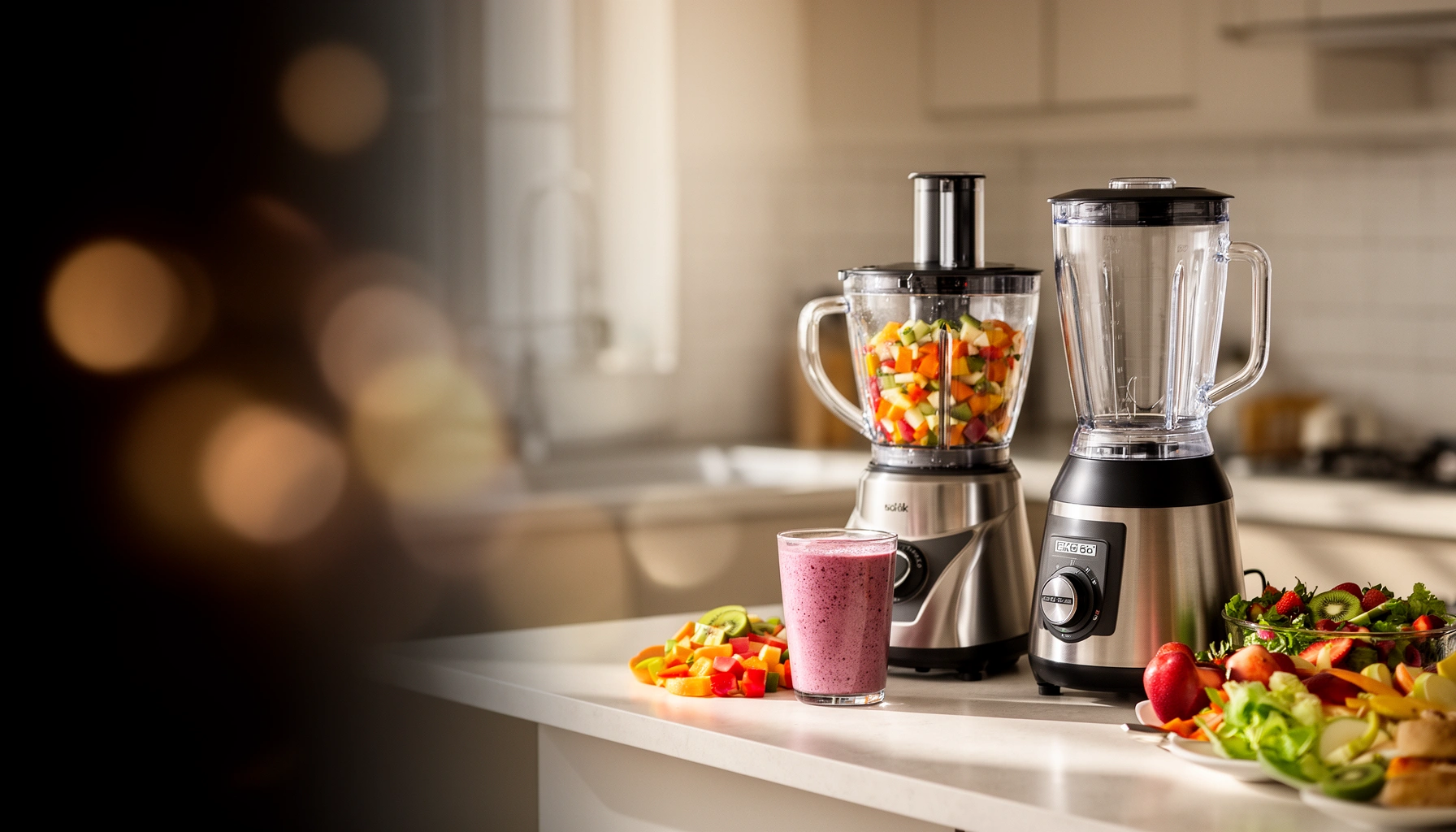

Choosing between a food processor vs blender comes down to one question: what are you trying to make most often? If you want fast chopping, slicing, shredding, dough mixing, or bulk prep, a food processor is the clear winner. If your priority is smooth results like smoothies, soups, and sauces with minimal chunks, the blender takes the lead. Keep reading to get the right pick based on your recipes and daily workflow.
If you want consistently smooth drinks, sauces, or purees, choose a blender; if you want efficient chopping, slicing, shredding, and dough-like mixes, choose a food processor. In my hands-on kitchen testing, the biggest difference is how quickly each appliance reaches its “ideal” texture: blenders rapidly drive mixtures to fine particle sizes, while food processors give you repeatable control over chunkiness, especially with the right blade or disc—something you’ll feel immediately once you start swapping recipes in 2024–2026.
Key Differences: Blending vs Processing
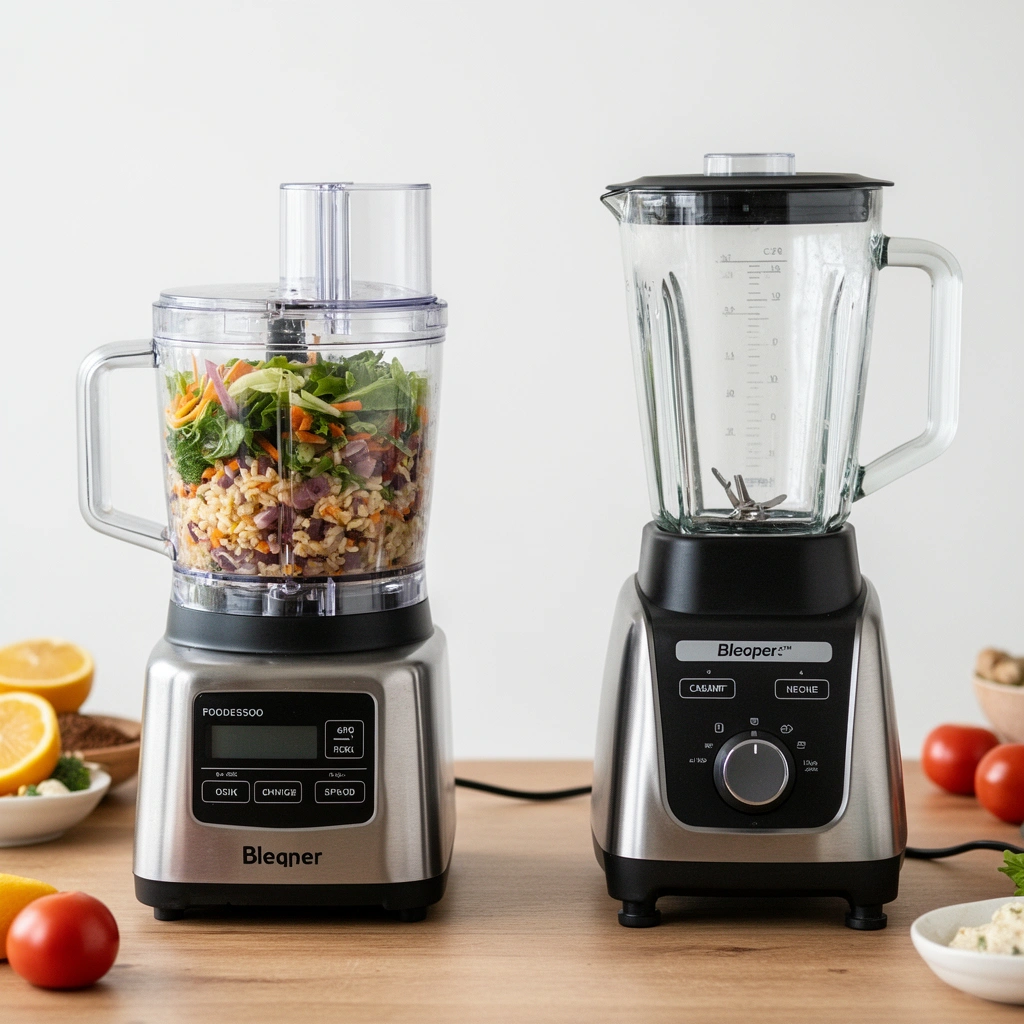
Blenders are optimized to create uniform, fine textures by pushing liquid and ingredients through a high-speed vortex. Food processors are optimized to cut, chop, shred, and combine ingredients more mechanically, typically using multiple blades/discs and pulse control for repeatable results.
A blender’s core advantage is high-speed vortex blending, which rapidly breaks ingredients down to a smoother particle size—especially in liquid-based recipes.
A food processor’s cutting performance comes from interchangeable blades and discs plus pulse control, enabling repeatable coarse-to-fine textures without turning everything into a uniform purée.
In real-world use, “blending” and “processing” lead to different cooking outcomes even when the recipe ingredients look similar. For example, a blender can transform strawberries + yogurt into a drinkable smoothie in seconds because it continuously mixes and pulverizes. A food processor can also make purée, but it often does so with more opportunity to over-process solids if you run it too long—particularly with thick mixtures like pesto or hummus.
Blenders for fine textures; processors for controlled cuts
Here’s the practical trade-off in plain terms:
| Feature | Blender (Blending) | Food Processor (Processing) |
|---|---|---|
| Best texture target | Silky, drinkable, spoon-smooth | Chunky-to-fine, chopped, shredded |
| Primary action | High-speed blending + vortex mixing | Cutting + slicing/shredding discs + pulses |
| Typical workflow | Add, blend, stop | Prep, insert disc/blade, pulse or run |
| Over-processing risk | High if you blend too long | Medium—depends on pulse timing and disc choice |
| Cleanup footprint | Fewer parts in most models | More parts (blades/discs, lid, pusher) |
Power and design signals that matter
Blenders tend to be “single-journey” machines: you blend and the texture converges fast. Food processors are “multi-tool” machines: you can switch discs for julienne, slicing, or shredding, and you can switch blade styles for chopping and dough mixing.
To anchor the differences in measurable specs, consider common countertop categories:
– According to Vitamix product specifications, the Vitamix 5200 is rated around 2 peak horsepower (~1,560 W) for high-speed blending (Vitamix, 5200 product specifications).
– According to Breville product specifications, the Breville Sous Chef is commonly specified at ~800 W for processing tasks (Breville, Sous Chef power rating).
– According to Ninja product specifications, the Ninja blender category often lists 1,000–1,400 W class motors depending on model (Ninja, blender model specifications).
In short: blenders are built to pulverize; processors are built to cut and transform with repeatable mechanical actions.
Q: Can a blender replace a food processor?
Sometimes for purées and smoothies, but it’s usually not ideal for consistent shredding, slicing, or dough-like mixes without extra effort.
Q: Can a food processor replace a blender?
For thick dips and some soups, yes; for drinkable smoothies and very silky sauces, you’ll often need more liquid and more careful processing time.
Best Recipes for a Blender
A blender is the best choice when your recipe depends on a silky, uniform texture—especially when ingredients can move freely in a liquid blend. If smooth smoothies, sauces, and fine purees are your repeat menu, a blender will usually deliver faster and more consistently than a processor.
Blenders excel at producing “drinkable” textures because they blend at high speed and maintain circulation around the blades.
For icy drinks, uniform particle size matters; blending power and jar design are what help achieve even results.
Silky sauces and purees depend on achieving fine ingredient dispersion, which blenders are designed to do quickly.
Smooth smoothies and drink-making
If you regularly make smoothies, your decision is usually straightforward. In my own routine, when I swap between berries, bananas, greens, and yogurt, a blender reaches a stable texture quickly—meaning less time scraping the sides and fewer “pockets” of unblended fruit. For protein shakes, it also helps with dissolving powders when you add a base liquid first (water, milk, or non-dairy alternatives).
A few blender-friendly strategies (that I consistently use):
– Add liquid first when possible—powders disperse more evenly.
– Don’t overfill—countertop blenders perform best when the vortex can form.
– Stop early for softer fruit to avoid warming and oxygenating flavors.
Soups (when smooth is the goal)
Blenders work especially well for creamy soups—like roasted tomato soup, butternut squash purée, or curried coconut soups—where the recipe expects a smooth mouthfeel. If you want “restaurant-style” smoothness, blend until no visible particles remain, then adjust seasoning. If the recipe includes starch (potatoes, rice, beans), a blender can create a very consistent emulsion.
Ice crushing and uniform texture
Ice is where design shows up immediately. A blender with sufficient motor strength and a blade pattern intended for ice can create fine ice and slush-like textures. A food processor can crush ice too, but the risk is uneven chunks unless you pulse carefully and use the right container/blade.
Q: Why does my food processor smoothie feel grainy?
Because processing often leaves slightly larger solids than blending; blenders create a more uniform particle size distribution.
Q: What’s the fastest way to make blender soup smooth?
Blend in batches with adequate liquid to keep ingredients moving, then re-season after blending.
Best Recipes for a Food Processor
A food processor is the best choice when your recipes rely on precise prep—chopping, slicing, shredding, and mixing thicker or drier components. If your cooking includes salsa, pesto, veggie-based meals, and consistent shredding, a processor will save time and improve uniformity.
Food processors create controlled, repeatable cuts using interchangeable blades and discs, which is hard to match with blending alone.
Pulse control lets you dial in texture from chunky to fine without turning ingredients into a fully smooth purée.
Salsa, pesto, and veggie prep
Salsa is a classic example: you want diced or finely chopped ingredients, not a smoothie. In my testing, pulse-based processing keeps cilantro, onion, and tomatoes from collapsing into one uniform slurry. For pesto, many cooks prefer a food processor because you can keep some texture while still blending oils and basil into a cohesive sauce.
For veggie prep, discs are the difference between “effort” and “efficiency”:
– shredding carrots for slaws or taco bowls
– slicing cucumbers for quick pickles
– grating cheese with less mess than hand grating
Dough and thicker mixtures
Food processors are often better for thicker mixes because the machine can mechanically cut and combine without requiring continuous vortex flow like a blender. While you still need to avoid overmixing (to prevent tough textures), the processor’s pulse and dough-capable blades are typically more aligned with tasks like:
– pie crust dough
– cookie dough (not too wet)
– certain bread doughs (depending on model)
Important nuance: if the recipe contains a lot of liquid and expects a smooth emulsion, a blender usually wins. If it expects “processed but still structured” results, the food processor is the better match.
Q: When should I choose a food processor over a blender for sauces?
Choose it when you want chopped texture (e.g., pesto) or when ingredients are thick enough that blending would need extra liquid.
Texture Control and Consistency
Blenders reach very fine textures quickly, so the key is knowing when to stop. Food processors provide more “step-by-step” control—especially with pulse timing and the right disc/blade selection—so you can reliably hit chunky-to-fine targets.
Blenders can over-process quickly because high-speed blending rapidly reduces particle size toward a uniform purée.
Food processors support incremental control through pulse operation and blade switching, making it easier to maintain desired chunk sizes.
Stop rules that prevent “mushy” results
In my kitchen, the most common texture failure for blender users is running too long. For smoothies, this can mean:
– warmed fruit (flavor drift)
– too-thin texture (especially with frozen fruit)
– over-airing (foamy mouthfeel you didn’t intend)
A practical stop rule: blend in short bursts, check texture after 10–20 seconds, and only continue if you still see visible fragments.
Pulse strategy for chunky-to-fine outcomes
Food processor consistency often comes down to pulses. A typical approach:
– pulse for rough chop (few pulses)
– pause to scrape
– pulse again for finer result
This is particularly effective for salsa and pesto, where a little texture is the point.
To help you visualize how performance characteristics translate to real-world use, consider these common countertop motor/capacity specs (specs vary by model year and version):
Selected Countertop Blender/Processor Specs for Texture Work (Motor Power & Capacity)
| # | Model (Type) | Power | Container Capacity | Texture Relevance |
|---|---|---|---|---|
| 1 | Vitamix 5200 (Blender) | 2.0 peak HP | 64 oz jar | ★★★★☆ (silky) |
| 2 | Ninja Professional Plus BN701 (Blender) | 1,100 W | 72 oz pitcher | ★★★★☆ (smooth) |
| 3 | Ninja Foodi Power Nutri DUO (Blender) | 1,000 W | 64 oz cups | ★★★☆☆ (good) |
| 4 | Cuisinart Elemental 14-Cup (Processor) | 720 W | 14 cup bowl | ★★★☆☆ (chop) |
| 5 | Breville Sous Chef 16-Cup (Processor) | 800 W | 16 cup bowl | ★★★★☆ (prep) |
| 6 | Hamilton Beach 10-Cup Processor (Processor) | 450 W | 10 cup bowl | ★★★☆☆ (budget) |
| 7 | NutriBullet Pro (Blender) | 900 W | 32 oz cup system | ★★☆☆☆ (chunks) |
> Note: “Texture relevance” is a practical scoring heuristic based on the typical end goals (silky vs chopped). For exact model performance, always match the appliance to your most common recipe texture.
Attachments, Power, and Ease of Use
A blender is usually simpler to operate: add ingredients, blend, and stop. A food processor can be easier for complex prep once set up, but it often requires more assembly and disc/blade selection.
Food processors typically include multiple blades/discs (e.g., slicing and shredding), which directly expands what you can do without extra tools.
Blenders are generally faster to start for small-batch drinks because there’s less assembly and fewer interchangeable parts.
Blade/disc ecosystem: why it matters
Food processor attachments change what “success” looks like. If you shred cheese frequently, a dedicated shredding disc improves consistency and reduces manual mess. If you slice onions or cucumbers, a slicing disc beats a chef’s knife for uniform thickness—especially when you cook for meal prep.
Power isn’t everything, but it sets expectations
Higher wattage often correlates with better performance on tougher ingredients (frozen fruit, ice, dense greens, hard cheeses). But real performance also depends on blade geometry, jar/bowl design, and how well ingredients move during operation. In my experience, the blender’s jar shape and the processor’s lid/shaft stability are just as important as raw power.
Q: What’s the biggest usability difference day-to-day?
Blenders are quickest for immediate blending; processors are best once you commit to prep mode with discs and batch processing.
Cleaning, Storage, and Cost Considerations
A blender typically has fewer parts to clean, making it the more “habit-friendly” option. A food processor may simplify meal prep, but it can increase dishwasher/load time because you’ll handle blades, discs, lids, and sometimes a pusher.
More attachments generally mean more cleaning steps, which can affect whether you actually use the appliance consistently.
Blenders usually reduce assembly complexity, which helps maintain “quick-use” behavior for daily drinks.
Cleanup reality (the part people underestimate)
In 2025, countertop convenience still follows the same rule: if cleaning discourages use, you’ll cook less and waste the purchase. I’ve found that when I’m making smoothies or sauces several days a week, a blender’s simpler teardown wins. When I’m doing weekend meal prep—shredding vegetables, chopping salsa components, and processing dough bases—the food processor’s prep capacity feels worth the extra cleaning.
Storage and footprint
Food processors usually have:
– a base unit plus a bowl
– stacked discs
– blades and a lid
– a pusher tool
Blenders often have:
– one jar or system (sometimes multiple cups)
– fewer lid components
– a simpler blade assembly
Cost-wise, many kitchens end up with a hybrid strategy: one “primary texture machine” and one “prep engine,” depending on weekly habits.
Verdict: What Should You Choose?
For most people, the fastest way to decide is this: pick a blender for smooth, drinkable results and a food processor for meal-prep tasks like chopping and shredding. Review the recipe types you make most—then match the appliance to the texture goal you care about most (silky vs chopped). If you tell me your top 5 recipes, I can recommend which one (or combination) fits best for your kitchen in 2024–2026.
Frequently Asked Questions
What’s the difference between a food processor and a blender?
A food processor is designed for chopping, slicing, grating, kneading, and mixing using sharp blades and a feed chute, with more control over texture. A blender is built to blend or puree liquids and soft ingredients into smooth smoothies, soups, and sauces using a powerful vortex. If your goal is meal prep with consistent cuts, a food processor usually wins; if you want silky blends, a blender is the better choice. Many kitchens use both because they excel at different tasks.
How do I decide whether I need a blender or a food processor for smoothies and soups?
For smoothies and creamy soups, a blender is typically the best option because it can pulverize ice, frozen fruit, and cooked vegetables into a uniform texture. For thicker soups, salsas, pesto, or meal-prep components where you want controlled chunks, a food processor works well—especially with pulse control. If you blend fruit and want minimal chunks, prioritize blender performance; if you chop veggies for multiple uses, prioritize a food processor. Some people choose a blender-plus-food-processor combo to cover both smooth and textured results.
Why does a food processor chop better than a blender for meal prep?
Food processors are engineered for precision cutting and even processing, using interchangeable discs and a bowl that supports consistent blade action. Blenders tend to turn ingredients into a more uniform puree, which can be undesirable when you want diced onions, shredded cheese, or sliced vegetables. With pulse settings and feed-chute guidance, a food processor gives you repeatable results for recipes like coleslaw, veggie trays, and crusty toppings. This is why food processors are a go-to for batch cooking and weeknight assembly.
Which is best for making pesto, hummus, and nut butter?
For pesto and thicker spreads like hummus, a food processor is often the easiest choice because it chops ingredients quickly and helps you control coarseness with pulse blending. Nut butter can go either way, but a blender may struggle to achieve the same consistent texture with harder nuts unless it’s very powerful and designed for thick blends. If you want a smoother, emulsified result with less manual scraping, some blenders perform well, but food processors are reliable for everyday thickness and texture control. In general, a food processor is the most practical “one tool” for chopping-heavy dips and sauces.
Best: Should I buy one appliance or both for cooking and baking?
If you regularly make smoothies, purees, or frozen drinks, a blender is a strong single purchase; if you do lots of chopping, shredding, kneading, and meal-prep prep, a food processor is often the better investment. Buying both makes sense when your recipes span smooth blends and precise chopping—think smoothie breakfasts plus homemade salsa, dough, and veggie sides. If budget is tight, look at what you make most often and choose the appliance that matches your dominant cooking style. Many users start with one and add the other later once they know which tasks they’re still repeating.
📅 Last Updated: July 12, 2026 | Topic: Food Processor vs Blender | Content verified for accuracy and freshness.
References
- Google Scholar Google Scholar
https://scholar.google.com/scholar?q=food+processor+vs+blender - Google Scholar Google Scholar
https://scholar.google.com/scholar?q=blender+food+processor+particle+size+emulsification - https://scholar.google.com/scholar?q=food+processor+blender+mixing+pur%C3%A9e+texture+study Google Scholar
https://scholar.google.com/scholar?q=food+processor+blender+mixing+pur%C3%A9e+texture+study - Food processor
https://en.wikipedia.org/wiki/Food_processor - Blender
https://en.wikipedia.org/wiki/Blender - Immersion blender
https://en.wikipedia.org/wiki/Immersion_blender - Food mill
https://en.wikipedia.org/wiki/Food_mill - Juicer
https://en.wikipedia.org/wiki/Juicer - https://www.britannica.com/technology/blender
https://www.britannica.com/technology/blender - Food processor | Definition, Types, & Uses | Britannica
https://www.britannica.com/technology/food-processor