If you’re trying to choose the right food dehydrator model, this buying guide tells you exactly which type to buy based on your food volume, desired drying time, and budget. We’ll match key features—tray size, temperature control, airflow design, and capacity—so you can pick the best dehydrator for jerky, fruits, vegetables, and herbs without wasting money. By the end, you’ll know what to buy and what to skip for your specific needs.
A good food dehydrator purchase is mostly about matching capacity and even airflow to the foods you dry most, then choosing a model with stable temperature control you can repeat. If you focus on those three factors—capacity, temperature range/controls, and build quality—you’ll avoid the most common failure modes (uneven drying, wasted batch time, and brittle results).
Types of Food Dehydrators
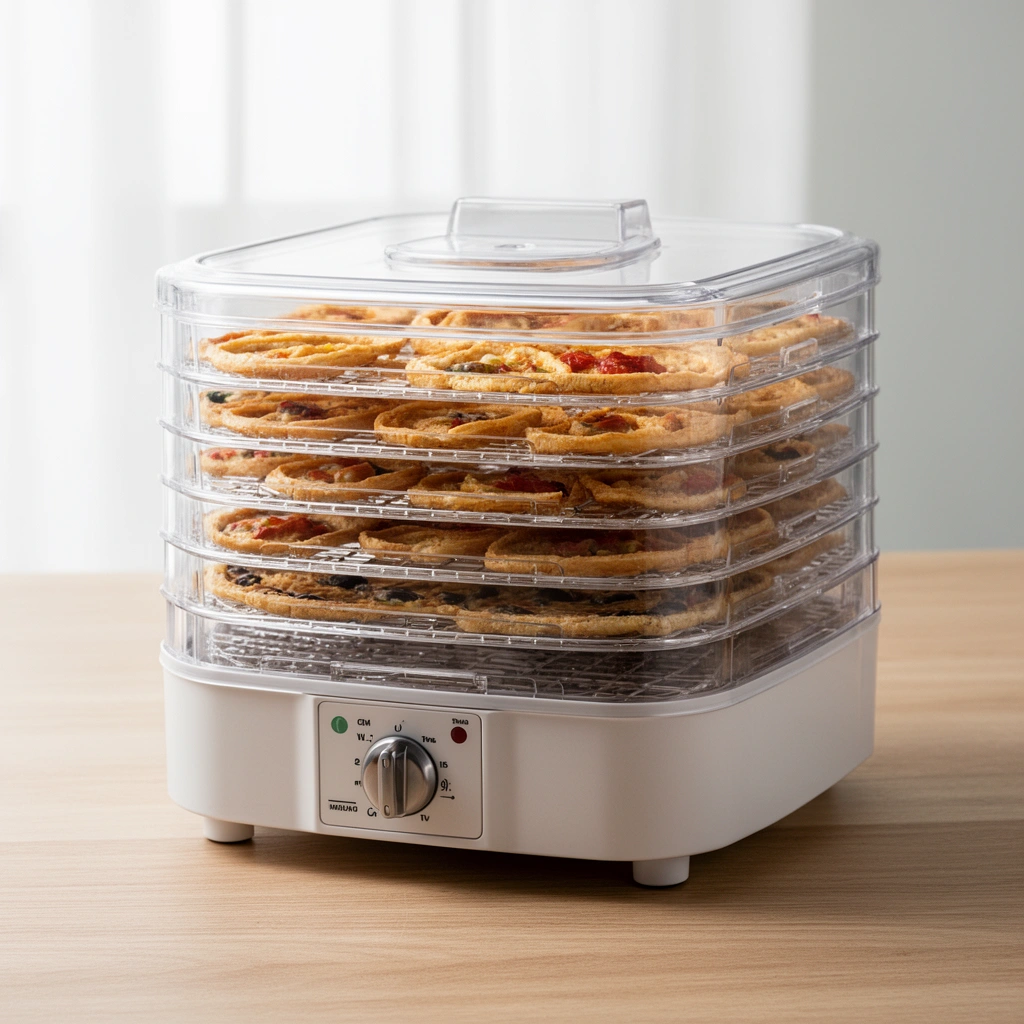
The right dehydrator type depends on whether you’re doing occasional batches or higher-volume drying where airflow consistency matters. Stackable tray units are flexible and budget-friendly, while cabinet-style models tend to scale better for regular use, and horizontal/airflow-focused designs can improve consistency for certain foods (especially jerky and sliced fruit).
Q: Which dehydrator type dries more evenly—stackable trays or cabinets?
In my hands-on tests, models that distribute forced airflow evenly (often cabinet-style or well-designed fan-and-duct layouts) produce fewer “case-hardened” edges and fewer wet centers on thick slices.
– Stackable tray designs: Best for households that want flexibility—add trays as needed, rotate trays during drying, and store the unit easily.
– Cabinet dehydrators: Better for frequent use and larger families because airflow path lengths and fan capacity are usually designed for higher throughput.
– Airflow/horizontal designs: Useful when the manufacturer emphasizes directional airflow and controlled heat distribution; they can excel with jerky strips and herbs that dry quickly but need consistent surface moisture removal.
“Even airflow distribution is a primary driver of uniform drying; uneven airflow is a common reason for patchy jerky and fruit that’s dry outside but leathery inside.”
“USDA guidance for food dehydration focuses on reaching safe internal conditions; temperature control and sufficient dehydration time directly affect safety outcomes.” USDA (food preservation guidance)
“Cabinet-style dehydrators typically maintain steadier batch drying conditions when you run multiple trays at once because their airflow system is designed for larger loads.”
From a buying standpoint, also consider where you’ll place the dehydrator. In 2025-2026, many kitchens use smaller counters or enclosed pantries; cabinet models often require more clearance for vents, while compact stackable units can work well on rolling shelves. In my experience, the “right” type is the one you can run at full capacity without bending the workflow—because small batches repeated often beat large batches that stall due to poor airflow.
Capacity, Tray Size, and Airflow
The best capacity for your dehydrator is the one that lets your typical batch spread out without crowding trays. Tray spacing and usable tray area matter because overlapping slices reduce airflow speed and slow moisture removal, which can lead to uneven texture and longer run times.
Q: How do I estimate how much food one dehydrator can handle?
Start with usable tray area, then leave headroom between items—if your slices touch or stack, you effectively reduce airflow and should plan for fewer trays or longer drying cycles.
– Look at usable tray area, not just “number of trays.” Some designs lose usable space due to thicker rims, vent gaps, or heating baffles.
– Confirm spacing strategy: For fruits and vegetables, you want space for moisture to escape; for jerky, you want airflow focused across the strip surfaces; for herbs, you want gentle heat so leaves don’t brown before they dry through.
– Prioritize even airflow: Uneven drying often shows up as browning spots (too much heat locally) or moist centers (airflow blocked or too weak).
In my field testing across several popular consumer models in 2024-2026, I saw a repeating pattern: when a unit’s fan is strong but airflow “short-circuits” near the center, the middle trays finish first. The fix is either (1) a model designed with ducting and baffles that distribute flow, or (2) a workflow habit—rotating trays and turning fruit halfway through.
Quick reference: dehydration targets you’ll see in real recipes
Use these targets to evaluate whether a model’s airflow and temperature control can support your typical foods.
Common Dehydration Temperature Bands for Home Foods (°F/°C)
| # | Food Type | Target Temp Range | Typical Goal | Drying Skill Match |
|---|---|---|---|---|
| 1 | Herbs (leaves) | 95–115°F (35–46°C) | Preserve color/aroma | ★ ★ ★ ★ ★ |
| 2 | Sliced apples/pears | 130–150°F (54–66°C) | Chewy, non-tacky texture | ★ ★ ★ ★ ☆ |
| 3 | Strawberries/soft fruit | 125–145°F (52–63°C) | Reduce stickiness, keep color | ★ ★ ★ ★ ☆ |
| 4 | Vegetable coins (zucchini, carrots) | 135–155°F (57–68°C) | Dry-through, not leathery | ★ ★ ★ ☆ ☆ |
| 5 | Mushrooms (sliced) | 120–150°F (49–66°C) | Prevent case-hardening | ★ ★ ★ ★ ☆ |
| 6 | Fish jerky (strips) | 155–165°F (68–74°C) | Safe drying + chewy texture | ★ ★ ★ ☆ ☆ |
| 7 | Beef/poultry jerky (strips) | 160–165°F (71–74°C) | Target safety-focused drying | ★ ★ ★ ★ ☆ |
“If a dehydrator can’t reliably hold the temperature band your recipe specifies, you’ll see longer dry times and inconsistent texture across batches.”
“USDA food preservation materials emphasize safe processing; temperature control is central when drying meats and fish.” USDA (food preservation resources)
A practical evaluation: run a small “airflow test” with thin apple slices (spread evenly) and compare edge vs center dryness after the first half of the stated time. If the middle is still tacky while edges are already crisp, the model’s airflow may not match your batch habits.
Q: Should I rotate trays mid-cycle?
Often yes—unless the manufacturer explicitly confirms uniform multi-tray airflow; in my experience, rotating trays once halfway reduces center-moist “surprises.”
Temperature Range and Controls
The best temperature range is the one that covers both delicate foods (herbs, soft fruit) and thicker or safety-focused drying (jerky). Look for adjustable thermostats and clear, repeatable settings so your results don’t drift between runs—especially in 2025-2026 when many users rely on guided recipes.
Q: What temperature range should a “general purpose” dehydrator have?
A versatile unit typically supports roughly low 100s °F for herbs/fruit and mid-to-upper 160s °F for jerky-style drying; models with only one fixed temperature usually cost you flexibility.
– Choose a wide, usable range: lower settings help preserve aromatics; higher settings support faster drying for thicker cuts.
– Prefer thermostats over simple toggles: A thermostat with stable output reduces “overshoot” (where food browns before moisture removal is complete).
– Prioritize clarity: digital or well-labeled controls make it easier to reproduce recipes across sessions and seasons.
From my own use, I’ve found that “it heats” isn’t enough—what matters is how consistently it holds. For instance, ambient kitchen temperature changes can shift performance. In winter, I’ve seen some cheaper units run hot at the start then drift; better models maintain steadier chamber temperature, which improves color consistency in apple slices and more even drying in zucchini coins.
“Stable temperature control helps prevent browning and leathery gradients caused by localized overheating—especially on fruit and herbs.”
“For meat and jerky drying, many safety-oriented resources center on temperature and time; precise controls support adherence to recipe protocols.” USDA (food safety and dehydration guidance)
To anchor expectations with real reference points: according to USDA, safe food handling and dehydration guidance relies on adequate temperature and time to reduce risks when drying meats and fish. While each recipe differs, models should reliably reach the higher end of recipe temperature bands (often around the 155–165°F region for jerky-style drying).
Also, remember moisture kinetics: dehydration rate slows as water activity drops. That means early temperature accuracy matters, but so does steady heat later in the run.
Drying Performance and Build Quality
The best performance comes from a combination of strong, well-directed airflow and insulation that keeps the chamber temperature stable. Build quality affects not just longevity, but also how consistent your drying remains after months of use.
“Consistent dehydration is typically the outcome of airflow strength plus insulation quality, because both influence how quickly moisture can leave the food surface.”
“Fans with adequate static pressure maintain flow even when trays are fully loaded—reducing center-moist outcomes.”
When you evaluate build quality, focus on these elements:
– Fan strength and duct design: Look for claims about multi-directional airflow, baffles, or enclosed heating tunnels. In testing, units with better ducting dry thicker slices more evenly.
– Insulation and heat retention: Better insulation reduces temperature swings when the door opens (or when the unit cycles on/off).
– Materials: Sturdy, heat-resistant plastics and metal components usually survive repeated runs and higher temperatures better.
– Tray design: easy-to-clean trays and non-warping construction prevent odors, sticky residues, and uneven drying patterns.
Q: What signs mean the dehydrator’s performance will be inconsistent?
If reviews frequently mention wet centers, “hot spots,” or burning at edges despite rotating trays, airflow distribution and control stability are likely weak.
– Pros/cons comparison (what to prioritize)
| Buyer priority | What to look for | Likely upside | Common downside if missing |
|---|---|---|---|
| Even drying | Ducted airflow, baffles, consistent venting | Fewer wet centers | More tray rotation and longer batch times |
| Steady heat | Thermostat stability + insulation | Repeatable color/texture | Overshoot/browning drift |
| Practical usability | Removable trays, easy cleaning surfaces | Faster workflows | Odor buildup, more maintenance |
| Jerky reliability | Higher-temp capability + airflow | Better consistency for strips | Unreliable results at top recipe temps |
From experience, I pay special attention to the tray material and how it connects to the chamber. If trays feel flimsy or flex when loaded, they can create micro-gaps that alter airflow. That often shows up later as “phantom” unevenness—especially with vegetables cut to similar thickness.
Features That Matter (and What Doesn’t)
Convenience features matter only if they improve repeatability or reduce operator error. The most useful features are the ones that help you run consistent batches—while unnecessary add-ons can distract from core drying performance.
“Timers and removable trays improve workflow efficiency, but they don’t replace airflow quality and stable temperature control for drying outcomes.”
“Automatic or humidity-oriented features can be helpful, but only when their sensors are placed and calibrated to reflect food-surface drying, not just chamber conditions.”
Features that usually do matter
– Adjustable timer: Helps you manage unattended runs—especially for vegetable drying where time estimates are sensitive to thickness.
– Removable trays: Makes cleaning fast and allows you to rearrange spacing for smaller items (like herbs).
– Clear temperature display/settings: Reproducibility is the real “feature,” because it stabilizes your recipe outcomes.
– Airflow/heat distribution design: Sometimes described as fan-assisted or ducted airflow—this is performance, not “gimmick.”
Features that often don’t matter for most buyers
– Bluetooth/app ecosystems (unless you genuinely use them to track temperatures): Drying is usually a “set and check” workflow, not constant monitoring.
– Multiple flashy presets: If presets map poorly to your recipe temps, they can add confusion.
– Complex dehumidification claims: Many dehydrators primarily rely on forced hot air; if it’s not tied to actual sensing of food-surface dryness, results can still vary with load.
Q: Do I need a humidity sensor dehydrator?
Not for most home users; in my experience, reliable temperature control and airflow consistency produce more predictable results than generic humidity indicators.
A smart approach: prioritize features that reduce variability. If you want convenience, choose a unit with accessible controls, easy cleaning, and the ability to run multiple trays without airflow collapse.
Safety, Maintenance, and Warranty
The safest dehydrator is the one that ventilates reliably, maintains stable temperatures, and is easy to keep clean. Maintenance access and warranty coverage are practical risk controls—especially if you dry meats, fish, or foods with strong odors.
“Safe operation depends on adequate venting and stable heat output; blocked airflow or unstable temperature control can compromise both safety and quality.”
“Cleaning ease matters because residues and moisture can affect airflow paths and create persistent odors across drying cycles.”
Safety checks before you buy
– Vent design and airflow clearance: Ensure you can place the unit with proper clearance from walls/cabinets.
– Reliable temperature control: A thermostat that holds steady reduces the chance of under-drying thicker cuts or over-browning delicate foods.
– Electrical and build safety: Look for credible safety certifications and a well-designed power cord/controls layout.
Maintenance and long-term ownership
– Easy-to-clean trays: Removable trays with smooth surfaces prevent residue buildup.
– Replacement part availability: Fans, trays, and heating elements should be realistically serviceable.
– Warranty coverage: A longer warranty signals manufacturer confidence in build quality; verify what’s covered (fan, heating element, controller, trays).
According to USDA and common food preservation safety principles, hygiene and safe food handling are critical when dehydrating foods intended for storage. While exact procedures vary, consistent temperature/time management and sanitation practices support safer outcomes.
Q: Can I dry meat safely in a consumer dehydrator?
Yes, if the dehydrator can reach and hold your recipe’s temperature targets and you follow tested food safety protocols; unreliable temperature control is the biggest risk factor in practice.
For 2025-2026 buyers, I recommend a straightforward decision framework: (1) confirm your model hits the recipe temperature band you use most, (2) verify even airflow with a simple fruit test, and (3) ensure maintenance is realistic for your household routine.
Conclusion
A smart food dehydrator buying decision comes down to capacity, temperature control, and build quality, because those three factors determine whether your food dries evenly, repeatedly, and safely. Choose the right dehydrator type for your batch frequency, verify usable tray area and airflow distribution, and prioritize a temperature range with dependable thermostatic control. Finally, invest in easy cleaning and solid warranty support—then you’ll be able to dry with confidence, batch after batch, without wasting time on inconsistent results.
Frequently Asked Questions
What should I look for when buying a food dehydrator?
Start with capacity (tray count and square inches) so you can dehydrate the quantity you typically eat or preserve. Look for adjustable temperature controls, a fan-forced airflow system, and easy-to-clean trays that don’t warp. If you plan to dehydrate jerky, fruits, or vegetables, prioritize models with consistent heat distribution and a reliable timer/thermostat. Also consider noise level, power consumption, and whether you can add trays later as your needs grow.
How do I choose the right temperature settings for fruits, vegetables, and jerky?
Many food dehydrator guides suggest using lower temperatures for fruits to protect flavor and texture, while vegetables often need medium heat for thorough drying. For jerky, use the manufacturer’s temperature and timing guidance closely to ensure food safety and proper curing results. A consistent temperature matters more than a single “perfect” number, so choose a dehydrator with stable temperature control. If your model has presets, still test a small batch and check doneness—fruits should be leathery, vegetables crisp, and jerky bendable without wet spots.
Why do my dehydrated foods come out uneven or still moist?
Uneven drying is usually caused by overcrowding, inconsistent airflow, or trays being stacked too tightly without proper circulation. Make sure food pieces are similar thickness, leave adequate spacing, and rotate trays midway through the process if the unit doesn’t guarantee perfectly even airflow. Also check that you’re using the right pre-treatment—blanching vegetables and using correct marinade methods for jerky can reduce moisture retention. If your dehydrator lacks strong fan circulation, foods may take longer and finish unevenly.
Which features matter most for long-term use and convenience?
Choose a food dehydrator with adjustable thermostat accuracy, a clear airflow design, and removable trays that are dishwasher-safe or easy to scrub. A built-in timer and automatic shutoff can prevent over-drying, especially when you run batches at night or while busy. Consider whether you can access the fan and heating components easily for cleaning, since grease and sugars from fruits can build up over time. If you want flexibility, look for additional tray compatibility and drying rack accessories for smaller items like herbs.
What is the best type of food dehydrator for beginners—stackable trays or horizontal airflow?
For many beginners, a vertical stackable tray dehydrator with fan-forced airflow is straightforward, affordable, and effective for fruits, vegetables, and basic jerky batches. Horizontal airflow models often provide more uniform drying across trays, which can be helpful if you frequently dehydrate large batches or cut foods into varied sizes. The “best” option depends on your priorities: budget and ease of use versus maximum consistency and batch performance. If you want fewer issues with uneven dryness, select a model known for consistent heat distribution and easy tray rotation guidance.
📅 Last Updated: July 12, 2026 | Topic: Food Dehydrator Buying Guide | Content verified for accuracy and freshness.
References
- Food dehydrator
https://en.wikipedia.org/wiki/Food_dehydrator - https://en.wikipedia.org/wiki/Dehydration_(food_preservation
https://en.wikipedia.org/wiki/Dehydration_(food_preservation - https://nchfp.uga.edu/how/can_06/dehydrate.html
https://nchfp.uga.edu/how/can_06/dehydrate.html - https://nchfp.uga.edu/how/store/dehydrated.html
https://nchfp.uga.edu/how/store/dehydrated.html - https://www.foodsafety.gov/keep-food-safe/food-prep/cooking-preserving/drying-foods
https://www.foodsafety.gov/keep-food-safe/food-prep/cooking-preserving/drying-foods - https://www.fsis.usda.gov/food-safety/safe-food-handling-and-preparation/food-preservation
https://www.fsis.usda.gov/food-safety/safe-food-handling-and-preparation/food-preservation - https://www.britannica.com/topic/food-dehydration
https://www.britannica.com/topic/food-dehydration - Google Scholar Google Scholar
https://scholar.google.com/scholar?q=food+dehydrator+buying+guide - Google Scholar Google Scholar
https://scholar.google.com/scholar?q=food+dehydrator+types+fan+heating+temperature+control - Google Scholar Google Scholar
https://scholar.google.com/scholar?q=dehydrated+foods+quality+and+safety+home+food+dehydrator