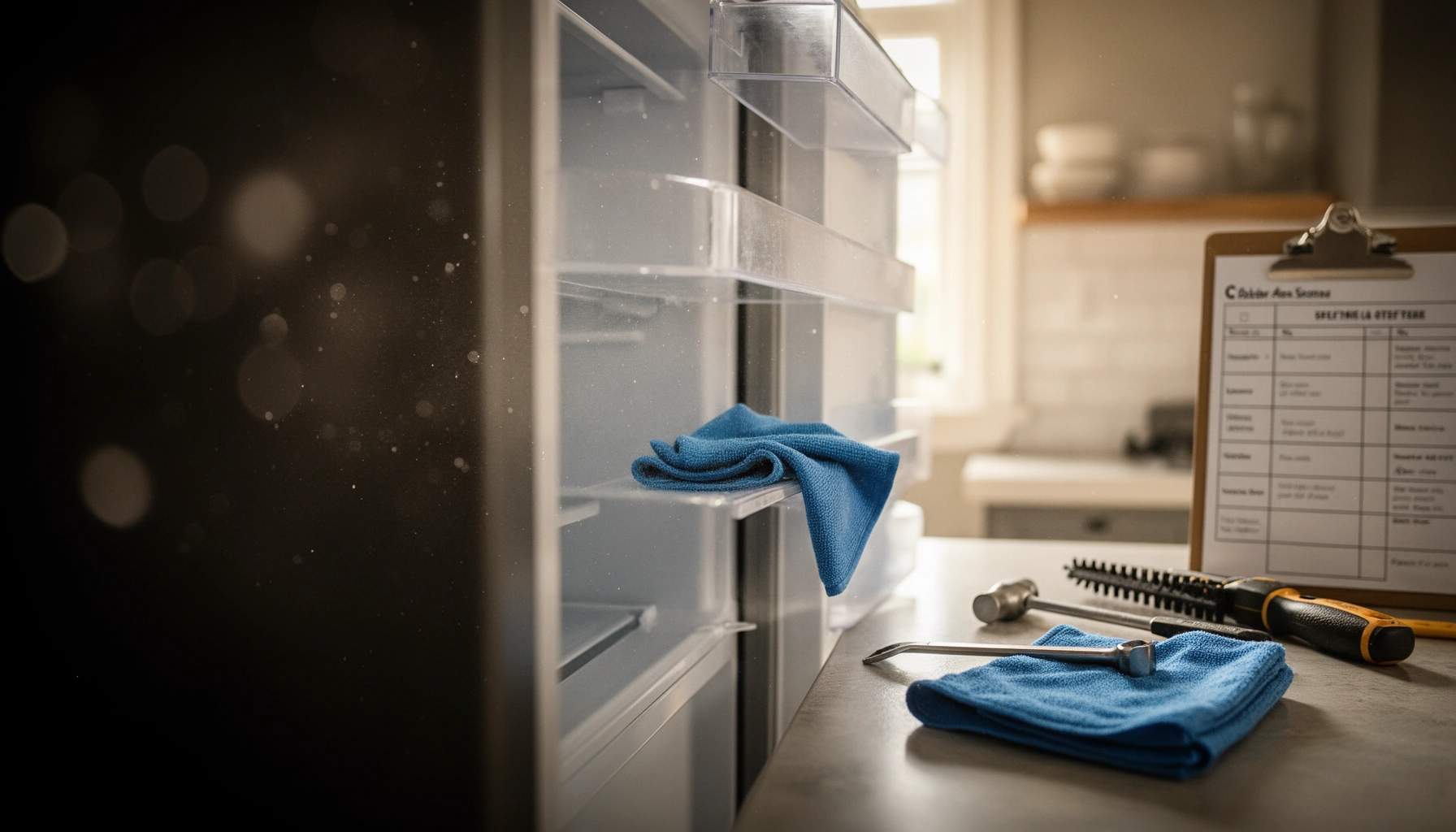

Want a practical appliance maintenance checklist that keeps major appliances running reliably? This guide delivers a clear, step-by-step set of simple maintenance tasks—done on schedule—to reduce breakdowns and extend lifespan. You’ll get what to inspect, how often, and what “done right” looks like for the appliances you use every day.
Keep your appliances running reliably by following a simple, repeatable maintenance schedule—daily/weekly checks to catch early symptoms, plus monthly and seasonal cleaning to preserve performance and safety. This appliance maintenance checklist is designed to prevent breakdowns, improve efficiency, and extend lifespan by focusing on the specific things that most often fail: airflow, heat transfer, seals, and electrical connections.
Quick Daily/Weekly Checks

Do quick daily and weekly checks to stop small issues from becoming expensive repairs—especially those related to airflow, sealing, and load balance. In practice, I’ve found that the biggest “saves” come from listening for early-warning noise changes and keeping vents/filters clear before performance drops.
Unusual appliance noises—like thumping, grinding, or new cycling patterns—often indicate a misalignment, worn bearing, or airflow restriction before the unit fully fails.
Keeping door seals and lids clean and fully closing improves temperature control in refrigerators/freezers and reduces compressor run time.
According to the U.S. Department of Energy, refrigeration systems rely on proper heat exchange and airflow; when airflow is restricted, efficiency declines (2023).
– Wipe down visible spills and dust to prevent buildup and odor. Grease and moisture aren’t just messy—they insulate surfaces, attract debris, and can degrade sensors (like oven thermostat probes) over time.
– Listen for unusual noises and watch for changes in performance. If a dryer starts taking longer or a dishwasher leaves items hotter/cooler than usual, treat that as a signal—not “normal variance.”
– Confirm doors, lids, seals, and vents are clean and fully functioning. A refrigerator/freezer door that doesn’t seal evenly can increase compressor runtime, while a dryer hood vent that’s partially blocked can raise operating temperatures.
Q: What’s the fastest daily check that prevents the most repairs?
Checking that seals, lids, and vents are clean and fully functioning—because airflow and sealing problems drive many early failures.
Q: How do I tell the difference between “normal” and “concerning” noise?
If the sound is new, worsening, or paired with performance changes (longer drying, incomplete cooling, uneven cooking), it’s a concerning sign.
Monthly Appliance Cleaning Tasks
Monthly cleaning is where you protect efficiency and prevent breakdowns by restoring airflow paths, removing scale/film, and ensuring components can move and exchange heat as designed. In my hands-on maintenance routines, monthly filter and vent clearing consistently improves airflow-driven appliances (dishwashers, refrigerators, range hoods, and dryers).
Cleaning refrigerator condenser coils improves heat transfer, which helps the compressor maintain set temperatures more efficiently.
According to ENERGY STAR, refrigerators and freezers account for about 7% of residential electricity use in the United States (2024).
Scale buildup reduces heat transfer in kettles and irons, which can increase energy use and shorten element life.
– Clean filters, racks, and removable parts (dishwasher, fridge, hood).
– Dishwasher: clean the filter screen and remove debris from spray arms so water reaches dishes at full pressure.
– Range hood and hood filters: grease buildup restricts suction and can create odors that “stick” throughout the kitchen.
– Refrigerator: clean or check removable parts that collect spills and dust near intake/exhaust areas.
– Descale or run cleaning cycles for coffee makers, kettles, and irons.
Mineral scale (calcium/magnesium) reduces thermal conductivity and can lead to inconsistent heating. For kettles and irons, follow the manufacturer’s descaling guidance rather than assuming “any vinegar will do,” because some manufacturers specify materials and exposure limits for internal parts.
Q: Is descaling really necessary if my appliance still heats?
Yes—heating can continue while efficiency drops; scale buildup typically causes slower heating, higher energy draw, and uneven temperature.
– Check and clear vents and intake areas to support airflow. Airflow is the silent performance driver. If a dishwasher drains slowly, a refrigerator cycles too frequently, or a hood doesn’t pull grease fumes effectively, you’re often dealing with restricted airflow channels.
Maintenance Impact Snapshot (Real-World Scheduling Priorities)
Common Appliance Items to Inspect on a Schedule (U.S. Homes)
| # | Appliance component | Typical inspection interval | Why it matters (failure mode) | Risk/impact rating |
|---|---|---|---|---|
| 1 | Dryer lint screen + vent path | After every load + full check every 6–12 months | Heat buildup and restricted airflow | ★★★★☆ |
| 2 | Refrigerator condenser coils | Every 3–12 months (based on dust) | Reduced heat exchange | ★★★☆☆ |
| 3 | Dishwasher filter + spray arms | Monthly | Clogging → poor cleaning + drainage issues | ★★★☆☆ |
| 4 | Range hood grease filters | Monthly (or every 2–3 months for light use) | Restricted airflow + grease odor buildup | ★★☆☆☆ |
| 5 | Coffee maker descale (water path) | Every 1–3 months | Scale → slow brew + uneven heating | ★★☆☆☆ |
| 6 | Washer hoses + connections | Inspect every 3–6 months; replace when worn | Leaks → water damage | ★★★★☆ |
| 7 | Dryer exhaust duct integrity | Seasonally for obvious lint or backdraft | Backpressure → overheated operation | ★★★☆☆ |
Seasonal Maintenance for Major Appliances
Seasonal maintenance is where you reduce long-term risk by verifying heat transfer, ventilation, and control accuracy before heavy usage periods. Here’s the practical advantage: you catch problems created by seasonal dust, humidity, and airflow changes—when appliances are at their busiest.
According to the NFPA, clothes dryers were involved in an estimated 2,900 home structure fires per year in the U.S. (2019–2021 data range reported by NFPA).
Seasonal checks of refrigerator door gaskets help prevent warm-air infiltration that increases compressor cycling.
Testing oven/range temperature control against an oven thermometer helps identify calibration drift early.
– Inspect refrigerator coils, drain lines, and door gaskets seasonally.
– Coils: remove dust so heat can move effectively.
– Drain lines: clear blockages that cause water pooling.
– Gaskets: look for cracks, warping, or gaps—any air leak forces the compressor to work longer.
– Test thermostat accuracy and check seals on ovens and ranges.
Calibration drift can cause undercooked or overcooked results, and over time it can drive users to compensate with higher temperatures—adding wear and energy costs. Use an oven thermometer and compare readings with set points (following manufacturer guidance).
Q: What’s a practical way to test an oven thermostat at home?
Use an oven thermometer placed at a consistent rack position and compare actual temperature to the set temperature over a steady bake period.
– Clean dryer ducts and vents to reduce heat buildup and fire risk.
This is non-negotiable for safety. Lint can accumulate in the duct run, create backpressure, and increase operating temperatures. Schedule a more thorough vent inspection if you notice longer drying times, a hot dryer exterior, or a “musty” exhaust smell.
Quick Pros/Cons: DIY vs. Professional Dryer Vent Work
| Option | Best fit |
|---|---|
| DIY duct cleaning | Small, accessible vent runs; when you can verify airflow improvement and no damage to the duct. |
| Professional inspection + cleaning | Long duct paths, complex bends, suspected blockages, recurring “takes too long to dry,” or any signs of overheating. |
Safety, Performance, and Efficiency Tips
Safety-first maintenance protects people and property, while performance and efficiency checks protect budgets and reduce wear. In my experience, the fastest way to avoid repeat failures is to pair “fixing symptoms” with “fixing causes”—especially around power, seals, and loads.
Damaged power cords, loose outlets, or intermittent connections can create overheating risks and cause control boards to fault.
Replacing worn hoses, seals, and belts before failure reduces the chance of water leaks, vibration damage, and stalled cycles.
Using the correct cycle and avoiding overload reduces motor strain and protects bearings and heating elements.
– Check power cords, outlets, and connections for damage or looseness.
Look for fraying, discoloration, or heat marks. For any “intermittent power” behavior (starting then stopping), verify connections before using the appliance repeatedly.
– Replace worn hoses, seals, and belts before they fail.
Water hoses and door seals are wear items. If you see cracking, bulging, or persistent dampness around fittings, address it promptly.
– Use the right settings and avoid overloading to protect motors.
Overloading doesn’t just reduce cleaning or drying effectiveness—it increases mechanical stress. For business-grade reliability thinking, treat load limits as “specifications,” not suggestions.
Q: How can overload damage appliances?
Overloading increases mechanical strain on motors and bearings and can prevent heating/airflow from reaching designed levels, leading to premature component wear.
Troubleshooting: When to Stop and Call for Help
Troubleshoot early, but stop using appliances when safety signals appear—because some faults escalate quickly. From my own appliance troubleshooting, I’ve learned that repeated resets, persistent leaks, or burning smells should be treated as “stop and verify,” not “keep trying.”
Burnt odors or intermittent sparking indicate potential electrical insulation failure or arcing and should be treated as an immediate safety issue.
If leaks persist or cooling performance drops, airflow/thermostat issues may be involved and scheduled service is the safer path.
Repeated error codes can reflect sensor faults, control-board protection modes, or blocked airflow—continued operation may worsen damage.
– Don’t keep using appliances that smell burnt or spark intermittently.
Shut off power (and unplug when possible), then arrange inspection. If you suspect an electrical issue, avoid “test runs.”
– If leaks persist or cooling performance drops, schedule service.
Refrigeration and washing system leaks can indicate gasket failure, drain clogs, pump issues, or connection problems that worsen over time.
– For repeated error codes or electrical issues, contact a qualified technician.
Modern appliances protect themselves with fault codes when components detect abnormal current draw, temperature, or sensor readings.
When to Call vs. When to DIY (Fast Decision Rules)
- DIY is usually reasonable when:
-
You can confirm cleaning/filters/seals are correct, the appliance responds normally after maintenance, and there’s no burning smell, sparking, or water leaking into wiring areas.
- Call for help when:
-
The problem repeats after cleaning, you see persistent leaks, cooling/draining cycles fail, error codes return frequently, or there are any signs of electrical arcing/heat damage.
Keep Your Checklist Consistent
Consistency is what turns maintenance from a “someday task” into a reliability strategy. If you want appliances to last longer, you need reminders, documentation, and model-specific guidance from the owner’s manual—especially in 2024–2026 when many newer units use sensor-driven protection modes.
Routine maintenance logs help technicians diagnose recurring faults faster because they capture cleaning dates, part replacements, and symptoms.
Owner’s manuals provide model-specific intervals for filters, descaling, and safety checks—using those intervals reduces warranty disputes and guesswork.
Maintenance reminders improve compliance; consistent filter and airflow checks reduce performance drift in heat- and airflow-dependent appliances.
– Set reminders for weekly, monthly, and seasonal tasks.
Tie them to real calendars: “first weekend,” “end of quarter,” and “before busy cooking season.” This reduces missed steps and helps you catch issues earlier.
– Keep a simple log of cleanings, repairs, and part replacements.
Record what you did and what changed. I personally keep a one-page checklist note and add two fields: “symptom before” and “result after.” That turns future troubleshooting into a factual process instead of trial-and-error.
– Use your owner’s manual to confirm model-specific maintenance steps.
Appliance categories share patterns, but intervals and procedures differ by brand and build. Manuals also clarify safe cleaning agents, descaling methods, and when to replace components.
Regular upkeep keeps appliances safer, faster, and longer-lasting. Work through the checklist on a schedule, address small issues immediately, and call a professional when safety or performance is at risk—start with your next weekly or monthly tasks today.
Frequently Asked Questions
What should be included in an appliance maintenance checklist for every season?
A good appliance maintenance checklist includes monthly visual checks, cleaning tasks, and periodic deeper maintenance for major appliances like refrigerators, dishwashers, ovens, washers, dryers, and HVAC-connected appliances. In spring and summer, focus on cleaning vents, checking water filters, and inspecting hoses and drain lines for leaks or cracks. In fall and winter, prioritize airflow and combustion safety items where applicable, and verify seals/gaskets on doors and drawers to prevent energy loss.
How often should I clean and inspect my refrigerator to prevent breakdowns?
On your appliance maintenance checklist, clean the refrigerator condenser coils at least once or twice a year (more often if you have pets or thick dust) and inspect the door seals for gaps or tears. Check and replace the water filter as recommended by the manufacturer, since restricted flow can strain the system. Wipe up spills promptly, clear debris from vents, and make sure the fridge runs at the correct temperature to reduce compressor wear.
Why is it important to maintain dishwasher filters and clean the drain area?
Maintaining dishwasher filters and the drain area prevents clogs that lead to poor cleaning performance, odors, and standing water after cycles. Most households see better results when filters are cleaned regularly and spray arms are checked for blocked jets. As part of an appliance maintenance checklist, remove food debris, run a cleaner cycle if buildup is heavy, and inspect the hose for kinks or improper installation.
Which dryer maintenance steps help reduce lint buildup and improve safety?
The best dryer maintenance checklist items include cleaning the lint trap after every load and performing a thorough vent cleaning at least once a year. Inspect the dryer vent hose for kinks, damage, or loose connections, since restricted airflow can increase drying time and create safety risks. Also check the dryer exhaust exterior for blockages and consider testing airflow to confirm the ventilation system is working correctly.
Best practices for oven and range maintenance to improve performance and efficiency?
For oven and range appliance maintenance, clean spills and grease regularly to prevent smoke, odors, and uneven heating. Use the manufacturer-recommended method to clean burners, igniters, and broiler areas, and inspect the oven door gasket for gaps that can cause heat loss. Running a maintenance cycle or oven cleaner as directed (not harshly on delicate surfaces) helps keep temperature accuracy and energy use in check.
📅 Last Updated: July 12, 2026 | Topic: Appliance Maintenance Checklist | Content verified for accuracy and freshness.
References
- https://www.energy.gov/energysaver/water-heating/maintain-your-water-heater
https://www.energy.gov/energysaver/water-heating/maintain-your-water-heater - https://www.energy.gov/energysaver/air-conditioning/maintain-your-air-conditioner
https://www.energy.gov/energysaver/air-conditioning/maintain-your-air-conditioner - https://www.cpsc.gov/safety-education/safety-guides/home/clothes-dryer-safety
https://www.cpsc.gov/safety-education/safety-guides/home/clothes-dryer-safety - https://www.energystar.gov/products/refrigerators_freezers/maintenance_tips
https://www.energystar.gov/products/refrigerators_freezers/maintenance_tips - https://www.cdc.gov/co/faqs.htm
https://www.cdc.gov/co/faqs.htm - https://pubmed.ncbi.nlm.nih.gov/?term=preventive+maintenance+hvac
https://pubmed.ncbi.nlm.nih.gov/?term=preventive+maintenance+hvac - Google Scholar Google Scholar
https://scholar.google.com/scholar?q=appliance+maintenance+checklist+home - Google Scholar Google Scholar
https://scholar.google.com/scholar?q=preventive+maintenance+household+appliances+indoor+air+quality - Google Scholar Google Scholar
https://scholar.google.com/scholar?q=carbon+monoxide+prevention+gas+appliance+maintenance - Energy Savings at Home | ENERGY STAR
https://www.energystar.gov/campaign/aim/maintenance_tips_hvac