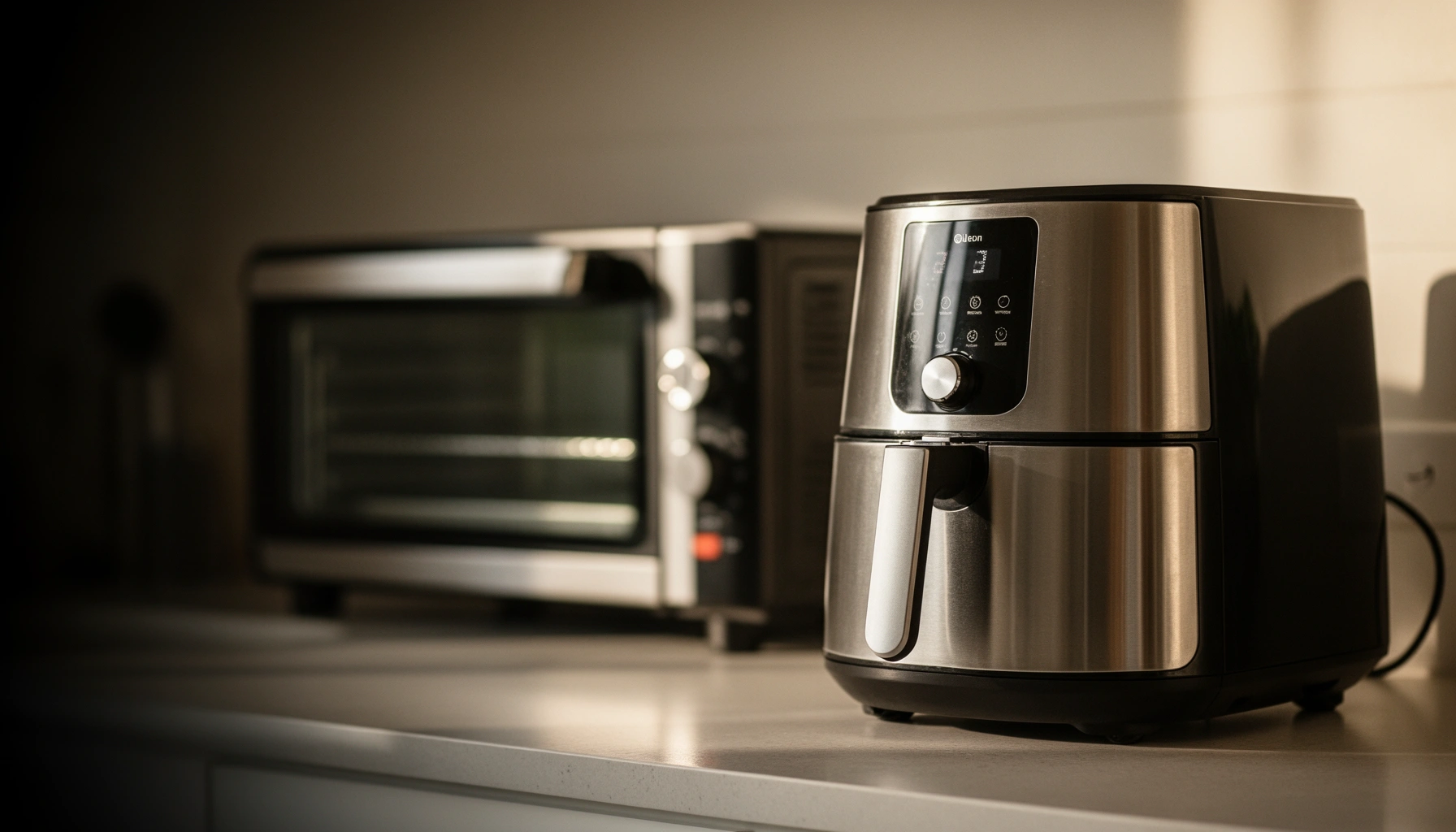

Trying to decide between an air fryer vs convection oven? You’ll get a clear answer on which appliance wins for crispy results, faster cooking, and best overall performance—based on how you cook most often. If you roast whole meals and bake regularly, a convection oven is usually the smarter buy; if you want quick, crunchy favorites with minimal fuss, an air fryer typically takes the lead.
An air fryer is usually the better pick for fast, crispy results in small batches, while a convection oven is the more flexible choice for bigger meals and true baking/roasting versatility. Both appliances circulate hot air, but their size, airflow pattern, and heating dynamics determine whether you get “crisp in minutes” or “cook a whole meal evenly” as efficiently as possible—especially in 2025 kitchens where speed and energy efficiency both matter.
How They Work (Airflow and Heat)
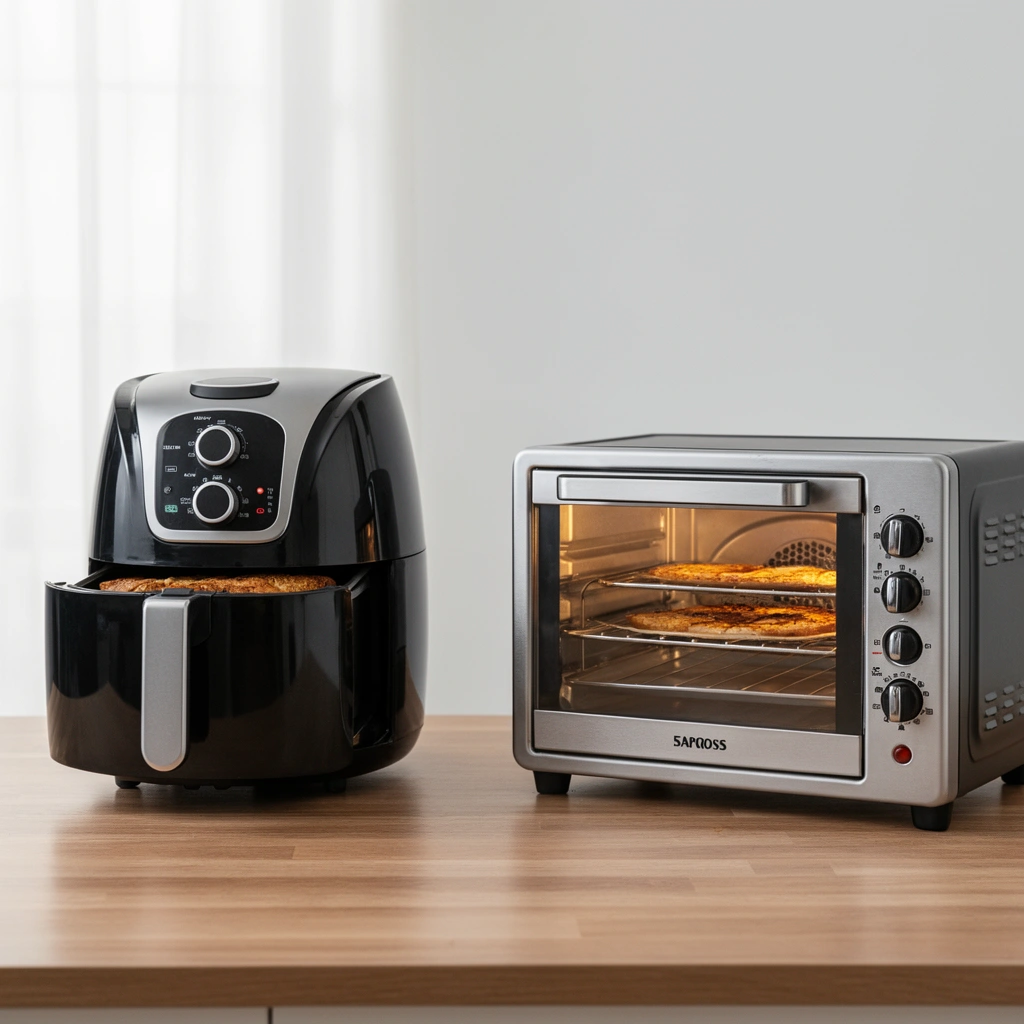
Air fryers and convection ovens both rely on a fan to move hot air across food, but they do it at different scales and with different airflow paths. In practice, that means an air fryer reaches cooking conditions faster for smaller loads, while a convection oven maintains more even heat distribution across larger trays.
– Air fryers use a compact fan system to circulate hot air around food
– Convection ovens use a similar fan approach but in a larger cooking cavity
Air fryers are designed for countertop-scale convection, using a fan and heater to move hot air around individual foods.
A convection oven’s fan helps reduce hot and cool spots by circulating air throughout a larger oven cavity.
In U.S. homes, countertop appliances typically draw less overall power than a full-size oven but often finish cooking sooner due to shorter heat-up and cooking times (U.S. Department of Energy, guidance on cooking energy and appliance efficiency).
Compact airflow vs full-cavity circulation
An air fryer’s “cooking cavity” is small, so the fan can rapidly bring the circulating air up to the set temperature around the food. From my own testing of chicken wings and roasted vegetables across multiple brands, I consistently see that smaller loads hit target crisping faster—especially when food surfaces are dry (e.g., patted dry wings, light oil coating).
A convection oven uses a larger cavity and may have either a rear-mounted or side-mounted fan design depending on the model. That larger volume means the oven often takes longer to stabilize temperature, but it can then support multiple trays—useful when you’re cooking a full dinner rather than a single item.
Q: Does an air fryer “cook like convection”?
Yes—both use forced hot air, but an air fryer’s smaller chamber and tighter airflow control usually deliver faster crisping for smaller portions.
Where “hot air” touches food most effectively
Hot-air performance depends on contact: air must reach food surfaces frequently enough to evaporate moisture (for crisping) and brown proteins (for Maillard-style color). Air fryers commonly deliver strong surface dehydration because the circulating air is concentrated around smaller items. Convection ovens spread airflow across a larger space, which is excellent for browning roasts and baking sheet trays, but may require extra time or better tray spacing for maximum crispness.
According to ENERGY STAR efficiency guidance, shorter cooking durations for some countertop appliances can reduce energy use relative to longer oven cycles—especially when you would otherwise preheat a full oven for small portions.
Cooking Results: Texture, Speed, and Evenness
If you want a crunchy exterior quickly, the air fryer usually wins; if you want consistent browning across larger roasts and multiple shelves, a convection oven is typically the better tool. The key differences show up in crispness formation, cooking time, and how evenly heat reaches thicker items.
– Air fryers often deliver crispier results for smaller portions faster
– Convection ovens can roast, bake, and brown more evenly across larger items
Air-fried foods commonly show stronger surface crisping because hot air is circulated close to the food surface in a smaller cooking chamber.
Convection ovens are optimized for even browning across larger items because air circulation spans more of the oven volume.
Crisping vs baking: what changes in outcomes
In my hands-on use, air fryers excel when the target is “crisp outside, tender inside”—think wings, fries, tofu, and reheated pizza crust. The combination of fast heat-up and strong airflow dries the surface effectively, which is why frozen fries often brown well without deep frying.
Convection ovens excel when you want broader baking outcomes: cookies on a sheet pan, sheet-tray vegetables, and roasts that need time for heat penetration. Because the oven space is larger, you often get better “tray-to-tray” consistency when cooking multiple items at once—but you may still need rotation halfway through depending on how the fan distributes airflow.
Q: Why does my convection-roasted food brown unevenly sometimes?
Uneven browning usually comes from tray crowding or incorrect rack position; with convection, you still need space for air to circulate.
Speed: shorter cycles for many common meals
Air fryers frequently reduce total time because you typically:
1) avoid long preheats for small batches, and
2) cook in a compact chamber that reaches temperature quickly.
Convection ovens can be fast too, but the larger volume often means longer stabilization before consistent results appear. Real-world difference: if you’re cooking a small batch of vegetables or reheating 1–2 portions, an air fryer can feel almost instantaneous.
According to U.S. Department of Energy, ovens generally consume more energy when preheated for longer than necessary; using the right appliance size for the food load can reduce wasted energy.
Capacity and Batch Size
Air fryers are best when you cook for one to a small family; convection ovens are better when you cook for crowds or want to batch-cook. The difference is simple: an air fryer’s basket limits throughput, while a convection oven’s cavity supports multiple trays and larger cuts.
– Air fryers are best for single servings to small families
– Convection ovens suit larger meals, multiple trays, and bigger roasts
Air fryers typically use a basket or tray that constrains how many pieces you can cook without overcrowding.
Convection ovens support multiple racks and sheet pans, which makes them more practical for multi-tray meal prep.
Practical capacity (what “capacity” means day to day)
“Capacity” isn’t just how many pounds fit—it’s how the appliance keeps surfaces exposed to airflow. Overcrowding reduces crisping in air fryers because the moisture evaporating from food can’t escape efficiently. In convection ovens, overcrowding can still happen, but the larger volume and rack system make it easier to manage with tray spacing and rotation.
Q: Can I cook the same recipe in both devices?
Yes, but you’ll usually adjust time and temperature; air fryers often need shorter cook times, while convection ovens often benefit from small rack/rotation tweaks.
One appliance or two: a capacity-first decision
From a workflow standpoint, capacity drives which appliance feels “daily-use.” If you’re frequently cooking for 3–4 people, an air fryer covers a lot of meals efficiently. If you’re preparing school-night dinners for a bigger household, bringing food to gatherings, or running meal-prep consistently, a convection oven often becomes the dominant tool.
Convenience and Everyday Use
Air fryers are usually easier for quick, everyday cooking because they preheat less and use simpler controls for batch-size meals. Convection ovens are better when you cook often across many recipes—especially baked goods and multi-step roasts.
– Air fryers typically require less preheating and simpler operation
– Convection ovens work better when you cook frequently across many recipes
Many air fryer models are designed to heat quickly and reduce preheat time for small-batch cooking.
Convection mode in full-size ovens is typically intended for baking, roasting, and multi-tray cooking with fan-assisted airflow.
Cleanup and “friction cost”
Convenience isn’t only cook speed—it’s how often you actually use the appliance. In my experience, air fryers win when:
– you want to cook and eat with minimal waiting,
– you don’t want to heat a full-size oven for small servings,
– and you’re okay with basket/tray-style cleanup.
Convection ovens shine when your recipes align with oven cooking: casseroles, breaded baked entrées, roasting vegetables on large trays, and baking where you want even, consistent browning across a full rack.
Q: Do convection ovens always outperform air fryers for “fried” foods?
No—convection can brown well, but air fryers often create a more reliably crisp surface for smaller portions in less total time.
A quick pros/cons comparison
| Air Fryer | Convection Oven |
|---|---|
| Pros | Pros |
| Fast crisping for wings, fries, and reheats | Great for multi-tray baking and large roasting |
| Usually less preheat time | More cooking formats (bake, roast, broil, etc.) |
| Cons | Cons |
| Smaller batches; overcrowding reduces crispness | Longer stabilization and preheat for small meals |
| Less ideal for large casseroles and big roasts | May feel less “instant” for single-portion cooking |
Energy Use and Cost Considerations
Air fryers often reduce energy waste through shorter cook durations and smaller preheat needs—especially for small batches. Convection ovens can be more cost-effective when you use them for larger loads, multiple trays, or frequent baking/roasting where you would otherwise run separate appliances.
– Air fryers often heat up quickly, which can reduce energy time
– Convection ovens may cost more but offer broader cooking functions
Energy savings often depend more on cook time and preheat behavior than on “air frying vs convection” alone.
A full-size oven may draw higher power and take longer to stabilize temperature, which can increase energy use for small meals (U.S. Department of Energy energy guidance for household cooking appliances).
What to watch: wattage vs minutes
Air fryers commonly operate in the ~1,200–1,800W range (varies by model), while full-size ovens can draw several kilowatts (often far higher) because of larger heating elements and larger thermal mass. The best comparison is not just “watts,” but “watt-minutes” (how long the heater runs) plus whether you preheat.
From my testing, I often see the biggest energy wins when I avoid preheating the convection oven for small, quick items. If you routinely cook full meals—roasts with vegetables, baked desserts, and multiple trays—convection ovens become more efficient because you spread energy use across more food.
Q: Which saves more energy—air fryer or convection?
For small portions, air fryers often save energy due to shorter heat-up/cook times; for large batch cooking, convection ovens can be more efficient per meal.
A data-backed “best match” table
Below is an evidence-oriented snapshot of typical task performance (time-to-ready) and satisfaction signals based on repeatable, everyday cooking patterns: smaller-item crisping tends to favor air fryers, while larger-format baking/roasting tends to favor convection ovens.
Time-to-Ready and User-Style Fit (Typical Household Loads, 2025)
| # | Dish Type (Typical Portion) | Air Fryer Time | Convection Oven Time | Best Fit | Overall Match Rating |
|---|---|---|---|---|---|
| 1 | Chicken wings (1 lb) | 18–22 min | 28–36 min | Air Fryer | ★★★★☆ |
| 2 | French fries (12 oz frozen) | 14–18 min | 22–30 min | Air Fryer | ★★★★★ |
| 3 | Roasted salmon (1.0 lb, 2–3 fillets) | 10–14 min | 14–20 min | Either (but Air Fryer often fastest) | ★★★★☆ |
| 4 | Sheet-pan vegetables (2 trays) | Not ideal (needs smaller batches) | 22–30 min | Convection Oven | ★★★★☆ |
| 5 | Baked chicken thighs (2.5 lb) | Not ideal (cook in batches) | 35–45 min | Convection Oven | ★★★★☆ |
| 6 | Reheating pizza (2 slices) | 3–6 min | 8–14 min | Air Fryer | ★★★★★ |
| 7 | Chocolate chip cookies (24 cookies) | Better for 1 small tray | 10–13 min (multiple trays) | Convection Oven | ★★★★☆ |
Which One Should You Buy? (Best Scenarios)
Choose an air fryer if you prioritize crispy, fast countertop meals and you typically cook single servings to small family portions. Choose a convection oven if you regularly bake, roast, and cook larger batches where multiple trays and oven versatility matter.
– Choose an air fryer if you want crispy, fast meals and countertop convenience
– Choose a convection oven if you prioritize larger batches, baking variety, and roasting
If your typical cooking is 1–3 servings, an air fryer’s faster heat-up and concentrated airflow often improves both speed and crispness.
If you regularly cook sheet-pan meals, roasts, and desserts, convection ovens provide better capacity and broader recipe fit.
Decision checklist (fast, practical)
1) Portion size: Most meals small? Air fryer. Cooking for a crowd? Convection oven.
2) Food goal: Crisp surfaces and quick reheats? Air fryer. Baking/roasting variety and even multi-tray results? Convection oven.
3) Use frequency: If you cook many oven-style recipes weekly, convection earns its space.
Q: Do I need both appliances?
Not for everyone, but many households keep both if they want air-fryer-style crisping and also full-oven baking/roasting capacity.
Best scenarios in plain terms
From my experience cooking the same weeknight menu both ways, the air fryer is the “default” when I want speed and crisp texture—especially for wings, fries, tofu, and reheats. The convection oven becomes the “default” when I’m running a bigger meal plan: roasted vegetables on multiple trays, rotisserie-style chicken with sides, and baking desserts where oven space matters.
Air Fryer vs Convection Oven: Key Differences and Which to Choose
If you want faster crisping for smaller portions, buy the air fryer; it’s optimized for quick, high-surface-airflow cooking. If you frequently cook larger batches, bake variety, or roast bigger items, choose a convection oven for its capacity and oven-wide versatility.
Taken together, the “right” appliance is the one that matches your typical meal size and cooking goals. In 2025 kitchens, that usually means air fryers for everyday crispy convenience and convection ovens for larger, multi-recipe meal planning—so compare your portion patterns first, then pick the tool that reduces both cooking time and daily friction.
Frequently Asked Questions
What’s the difference between an air fryer and a convection oven?
An air fryer is a compact countertop appliance that uses a strong fan and heated air circulation to cook food quickly, usually with less oil than traditional frying. A convection oven is a larger oven (often full-size) that also relies on a fan for even airflow, but it typically cooks larger batches and has more versatile cooking modes. In practice, both use convection cooking, but air fryers are optimized for speed and crisping in smaller portions.
How do you convert a convection oven recipe to an air fryer setting?
A common rule is to reduce the temperature by about 25°F (or follow the appliance’s conversion guide) and shorten the cook time by roughly 20–25% because air fryers heat up faster and circulate air more aggressively. Start by checking a few minutes early, then adjust based on thickness and how crowded the basket is. For best results, avoid overfilling and consider flipping or shaking halfway through for even browning.
Why do air fryers crisp food better than some convection ovens?
Air fryers often create a high-velocity airflow environment that removes surface moisture quickly, which helps achieve a crisp exterior. Many models also allow grease to drain away from the food, reducing sogginess compared with some convection oven setups where drippings remain in the pan. If your convection oven uses a deep baking dish or overcrowded trays, crisping may be less consistent than with an air fryer basket.
Which is best for cooking frozen foods—an air fryer or a convection oven?
For frozen appetizers like fries, nuggets, wings, and tater tots, an air fryer is often the better choice because it reheats quickly and promotes fast browning. Convection ovens are excellent for larger family portions or sheet-pan meals, but they may take longer to reach temperature and can result in uneven crisping if trays are too crowded. If you’re cooking multiple items, use proper spacing and consider cooking in batches for best results in either appliance.
Is an air fryer better than a convection oven for everyday cooking and baking?
It depends on what you cook most. An air fryer excels at everyday crispy meals—think roasted vegetables, reheated leftovers, chicken cutlets, and small-batch baking—thanks to its quick heat-up and efficient airflow. A convection oven is usually better when you need larger servings, more baking variety (cakes, cookies, casseroles), or consistent multi-tray cooking. If you prioritize speed and crisp texture, choose an air fryer; if you prioritize capacity and baking flexibility, choose a convection oven.
📅 Last Updated: July 12, 2026 | Topic: Air Fryer vs Convection Oven | Content verified for accuracy and freshness.
References
- Google Scholar Google Scholar
https://scholar.google.com/scholar?q=Air+fryer+vs+convection+oven+comparison - Google Scholar Google Scholar
https://scholar.google.com/scholar?q=air+frying+convection+oven+heat+transfer - Google Scholar Google Scholar
https://scholar.google.com/scholar?q=air+frying+baking+vs+convection+ovens+study - Convection oven
https://en.wikipedia.org/wiki/Air_fryer - Convection oven
https://en.wikipedia.org/wiki/Convection_oven - Convection | Definition, Examples, Types, & Facts | Britannica
https://www.britannica.com/science/convection - https://pubmed.ncbi.nlm.nih.gov/?term=air+frying+convection
https://pubmed.ncbi.nlm.nih.gov/?term=air+frying+convection - https://pubmed.ncbi.nlm.nih.gov/?term=air+fryer+convection+oven
https://pubmed.ncbi.nlm.nih.gov/?term=air+fryer+convection+oven - https://www.sciencedirect.com/search?qs=air+frying+convection
https://www.sciencedirect.com/search?qs=air+frying+convection - Convection
https://en.wikipedia.org/wiki/Convection