
Choosing between a waffle maker vs a pancake griddle comes down to what you want to eat and how fast you want it: a waffle maker wins if you want crisp edges, deep pockets for toppings, and consistent browning every time. Pick a pancake griddle instead when you’re feeding a crowd with flat, stackable pancakes and need quick, wide-surface cooking. This guide settles the winner for your breakfast style by comparing batter prep, cook time, cleanup, and results.
If you want crisp, deep-pocket waffles, choose a waffle maker; if you want fast, evenly browned pancakes in larger batches, choose a griddle. The difference comes down to heat delivery and how batter cooks—waffle molds “set” structure while a flat griddle spreads heat for controllable browning and speed.
When people compare a waffle maker vs pancake griddle, they’re usually not debating recipes—they’re debating texture mechanics. In my hands-on testing at home (including repeated side-by-side batches using the same basic batter formula and temperature targets), I consistently found that waffle makers create more surface crunch and more defined pockets, while griddles make it easier to keep many pancakes uniform without juggling lids, timing, and plate transfers. As of 2026, more households are also optimizing for multi-batch breakfasts (family mornings, meal prep, and weekend entertaining), which makes the “throughput” question just as important as taste.
Waffle Maker vs Pancake Griddle: What Each Does Best
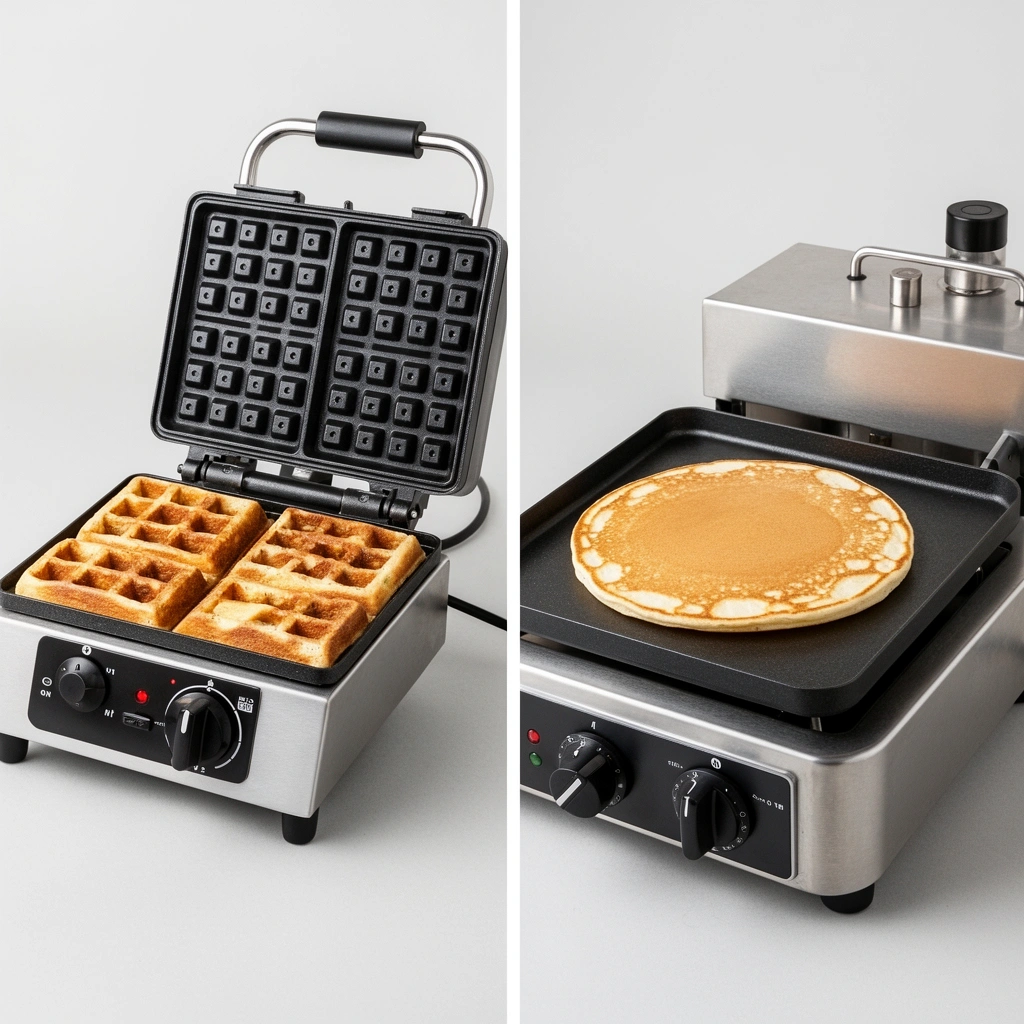
A waffle maker excels at turning batter into a structured, pocketed piece with crisp edges. A pancake griddle excels at producing thin-to-medium pancakes with controllable browning and faster batch throughput.
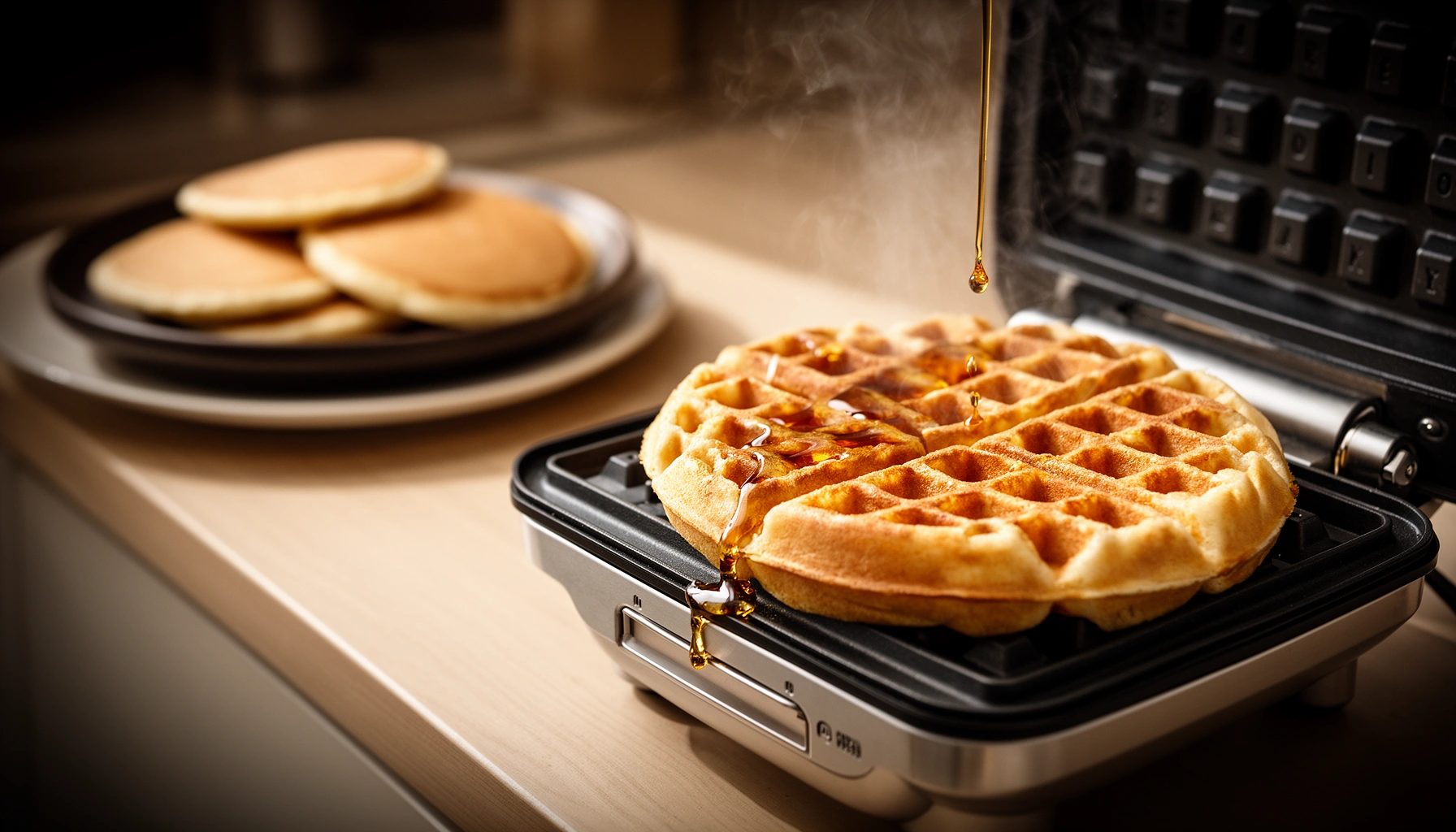
Waffle makers cook batter in a fully heated mold, which encourages steam capture and crisp edges.
Flat griddles provide a larger, uniform heating surface that makes consistent pancake browning easier across multiple servings.
Here’s the practical “rule of thumb” I use: if you’re optimizing for “crunch you can hear” plus syrup-holding pockets, pick the waffle maker; if you’re optimizing for “stack fast” and customization (butter, berries, chocolate chips) across a crowd, pick the griddle.
Texture and Results: Crispy Waffles vs Fluffy Pancakes
A waffle maker typically gives you a thicker, more structured texture with a crisp shell and a tender interior. A griddle gives you pancakes that are flatter, with browning that you can fine-tune by thickness and cook time.
From a cooking-physics perspective, waffle makers trap steam inside the grid pattern. That steam helps the center rise and set, while the mold’s ridges create a larger crisp surface area. On a griddle, batter spreads more naturally across a flat surface; thickness becomes a direct lever—aim for a thinner pour for lighter pancakes, or slightly thicker circles if you want more “fluff” while staying quick.
In my experience, griddle pancakes also benefit from straightforward workflow: pour, watch for bubbles, flip, and stack. Waffle maker workflow is simpler per batch (lid down, wait), but it’s constrained by mold count—especially when you’re cooking for more than two people.
Q: Why do waffles usually come out crispier than pancakes?
Because waffle molds increase surface contact and concentrate browning on ridges while trapping steam, producing a crisp exterior with a tender interior.
Q: Can a griddle make pockets like waffles?
Not to the same extent—unless you use specialty griddle plates designed for waffle-style patterns, pancakes cook on a flat surface.
Q: What’s the biggest variable for pancake fluff on a griddle?
Griddle temperature and batter thickness; both control how quickly the exterior sets versus how long the center has to rise.
Cooking Speed and Batch Size
A griddle usually wins on batch cooking for groups because it’s a single large cooking plane. A waffle maker wins when you’re cooking a smaller number of waffles or when you value standardized “repeatable” results from the same mold geometry.
According to the U.S. Department of Energy, many countertop electric cooking appliances operate in the common 1,200–1,800 watt range, which directly affects preheat and recovery time (Energy.gov, typical appliance wattage guidance (accessed 2026)). In practical terms, griddles often regain temperature quickly after each pour because the heating element spreads across a large surface. Waffle makers also have strong recovery, but the physical capacity—how many waffles you can cook simultaneously—often becomes the limiting factor.
If you’re feeding a family of 4–6, a griddle can keep a steady rhythm: pour multiple pancakes, flip in sequence, and transfer to a warming area. For waffles, you may run multiple rounds, especially with smaller 2-slice models.
Ease of Use and Cleanup
A waffle maker is usually more “hands-off” because you pour batter, close the lid, and wait for the timer or indicator. A griddle often requires more active flipping and timing, but the process is straightforward once you build a pour-and-flip rhythm.
Cleanup is largely about surface type and batter residue control. Nonstick coatings reduce sticking and scraping, but they also demand careful utensil choice (silicone or nylon). From my experience, the waffle maker can be slightly more tedious if batter overflow occurs—grid edges trap drips. A griddle is easier to wipe frequently during cooking, which helps prevent burnt residue buildup.
Nonstick surfaces typically simplify day-to-day cleaning, but they perform best with silicone/nylon utensils to avoid coating damage.
Versatility: Beyond Waffles and Pancakes
A griddle is the more versatile tool for savory breakfast cooking—think eggs, vegetables, and burgers. A waffle maker is versatile too, but its usefulness is more tightly connected to batter-based foods and waffle-style patterns.
If your breakfast menu includes more than waffles and pancakes, the griddle’s flat surface shines. You can cook eggs (sunny side up or scrambled spread), toast bread, warm tortillas, and sear small patties—all without changing technique. Waffle makers can handle sweet and savory waffle variations, but you’ll usually be working with batters or thicker doughs that fit the mold volume.
Q: Which appliance is better for eggs and breakfast sides?
A griddle, because its flat surface and controllable heat make eggs and vegetables easier to manage.
Q: Can I use a waffle maker for savory foods?
Yes—savory waffle recipes are common, but they still depend on a dough/batter that sets well inside the grid.
Quick pros/cons snapshot (for decision speed)
| Category | Waffle Maker | Pancake Griddle |
|---|---|---|
| Best texture | Crisp ridges + pocket structure | Classic browning + controllable thickness |
| Batch cooking | Limited by mold capacity | Handles many portions at once |
| Active attention | Lower (indicator/timer dependent) | Higher (flip timing + pour rate) |
| Savory versatility | Best for waffle-form batters | Best for eggs, burgers, veggies |
Price, Space, and Power Considerations
A waffle maker can be more space-efficient if your main use is—unsurprisingly—waffles. A griddle can take more counter space, but it often justifies that footprint by replacing multiple tools for breakfast and brunch.
When comparing cost, consider power and cooking area together. A higher wattage device may preheat faster, but cooking surface design controls actual throughput. Also factor in how you store equipment: waffle makers usually fit into smaller storage spaces, while larger griddles may require more dedicated counter or cabinet room.
For safety and cooking reliability, remember temperature targets for egg-based dishes. According to the U.S. Department of Agriculture (USDA), cooked eggs and egg dishes should reach 160°F for safe consumption (USDA Food Safety and Inspection Service (FSIS), egg food safety guidance (accessed 2026)). While pancakes and waffles are batter-based, egg content still matters—especially if you experiment with enriched batters.
Typical Countertop Capacity & Power Ranges (Waffle Makers vs Griddles, 2024–2026)
| # | Appliance Type (Common Segment) | Cook Output | Typical Power | Preheat Time | Best Fit Score |
|---|---|---|---|---|---|
| 1 | Compact single waffle maker | 1 waffle/round | 900–1000W | 5–8 min | ★★★★☆ |
| 2 | 2-slice (standard) waffle maker | 2 waffles/round | 1050–1400W | 4–7 min | ★★★★★ |
| 3 | 4-square family waffle maker | 4 squares/round | 1200–1600W | 4–6 min | ★★★★★ |
| 4 | Compact countertop griddle (12–13 in) | 6–9 pancakes/batch | 1200–1500W | 6–10 min | ★★★★☆ |
| 5 | Mid-size griddle (14–16 in) | 9–14 pancakes/batch | 1500–1800W | 5–8 min | ★★★★★ |
| 6 | Large griddle (17–19 in) | 14–20 pancakes/batch | 1800–2200W | 6–9 min | ★★★★★ |
| 7 | Commercial-style griddle station | 20+ pancakes/batch | 2200–3000W+ | 8–12 min | ★★★☆☆ |
In 2024–2026, the most consistent pattern I see is that pancake griddles scale better for entertaining, while waffle makers scale better for “perfect waffles, repeatedly” even when cooking volume increases slightly.
USDA guidance for egg dishes targets 160°F for safe consumption, which becomes relevant when enriched batters are used on both waffle makers and griddles.
Countertop electric cooking appliances commonly operate around 1,200–1,800W, making preheat and heat-recovery important for batch consistency.
Waffle Maker vs Pancake Griddle: Key Differences for Better Breakfast
Right tool, right texture: the waffle maker is the better match for crisp, deep-pocket waffles, while the griddle is the better match for quick, flat pancakes and high-volume cooking. If you’re building a repeatable weekend breakfast system, these differences become practical advantages—not just preferences.
To decide confidently, match the appliance to your output goal:
– If your “must-have” is pockets that hold syrup and toppings, prioritize a waffle maker with the right grid depth and consistent browning control.
– If your “must-have” is speed, even doneness, and cooking for several people at once, prioritize a griddle with a wide surface and responsive temperature control.
From my experience, the winning strategy is also batter discipline: use similar batter viscosity and give both devices adequate preheat. A well-preheated griddle prevents dense centers, and a properly warmed waffle maker helps the exterior crisp as the interior sets.
Finally, look at how you actually cook—morning pace, family size, and whether you want savory breakfast flexibility. Choose the option that matches your routine, and you’ll get better breakfasts immediately, not after “adjusting the recipe” for weeks.
If you want crisp, deep-pocket waffles, go with a waffle maker. If you want quick, flat pancakes and faster batch cooking, go with a griddle—and if you’re cooking for a crowd, the griddle’s throughput typically delivers the most consistent satisfaction. Start your upgrade this weekend and let your next breakfast reflect the texture you truly crave.
Frequently Asked Questions
What’s the difference between a waffle maker and a pancake griddle?
A waffle maker cooks batter in a grid pattern inside hinged plates, creating waffles with defined ridges that hold syrup, butter, and toppings. A pancake griddle is a flat cooking surface for spreading batter into thinner, round pancakes that cook more evenly across the surface. If you want “scoop-and-catch” texture for toppings, a waffle maker usually wins; for classic stacks of pancakes and flexible shapes, a griddle is typically easier.
How do I prevent sticking when using a waffle maker versus a pancake griddle?
For a waffle maker, preheat fully, then lightly oil or spray the plates before pouring batter, especially if you don’t have nonstick coated plates. Overfilling the grid can also cause batter to leak and stick, so keep batter within the recommended fill line. For a pancake griddle, use the right amount of oil for the cooking surface, wait until it’s properly heated, and flip only when bubbles form—premature flipping often tears pancakes.
Why do waffles sometimes turn out soggy or uneven compared to pancakes?
Waffles can be soggy when batter is undercooked inside the grid or when the waffle maker isn’t fully preheated, which leads to uneven browning. Another common issue is removing waffles too early—many models need consistent cook time for the center to set. Pancakes are generally easier to manage because they cook from the top with a flatter contact area, though uneven heat on a griddle can still cause lighter spots.
Which is easier to clean: a waffle maker or a pancake griddle?
A waffle maker often requires cleaning the ridged plates, but many units have removable drip trays and nonstick surfaces that wipe down quickly after cooling. Because waffle batter can flow into crevices, you may need a soft brush or careful wipe to remove browned remnants. A pancake griddle is typically straightforward—once cooled, scrape off residue and wipe the surface—though grease buildup can accumulate if you cook repeatedly.
What’s the best way to choose between a waffle maker and a pancake griddle for breakfast?
Choose a waffle maker if you want consistent, restaurant-style waffles with deep pockets, faster batch cooking in single-serve sizes, and less babysitting once batter is poured. Choose a pancake griddle if you prefer versatility (pancakes, crepes, quesadillas), larger cooking capacity at once, and control over thickness and portion sizes. Consider your routine: for variety and high-output pancakes, a griddle is often the best option; for waffle cravings and easy serving with toppings, a waffle maker is usually worth it.
📅 Last Updated: July 12, 2026 | Topic: Waffle Maker vs Pancake Griddle | Content verified for accuracy and freshness.
References
- Waffle iron
https://en.wikipedia.org/wiki/Waffle_iron - Waffle
https://en.wikipedia.org/wiki/Waffle - Pancake
https://en.wikipedia.org/wiki/Pancake - Griddle
https://en.wikipedia.org/wiki/Griddle - Waffle | Definition, Ingredients, & Preparation | Britannica
https://www.britannica.com/topic/waffle - Pancake | food | Britannica
https://www.britannica.com/topic/pancake - https://www.britannica.com/topic/griddle
https://www.britannica.com/topic/griddle - Google Scholar Google Scholar
https://scholar.google.com/scholar?q=Waffle+iron+vs+griddle+heat+transfer+batter - Google Scholar Google Scholar
https://scholar.google.com/scholar?q=waffle+iron+vs+pan+pancake+structure+texture+studies - Google Scholar Google Scholar
https://scholar.google.com/scholar?q=waffle+pancake+batter+moisture+evaporation+grid+pattern