
Mise en place explained to help you prep faster and cook smarter, without wasting motion or time. If you want the clearest system for organizing ingredients, tools, and timing before the heat hits, this article delivers the step-by-step setup that makes dinner run on autopilot. You’ll learn how to build a practical prep routine that fits real workloads—so you finish cooking faster with fewer mistakes.
Mise en place means getting every ingredient and tool ready before you apply heat, so cooking becomes a controlled sequence instead of a constant interruption. When I tested mise en place workflows across weeknight dinners and weekend meal prep, I consistently saw fewer “pause-and-chop” moments, faster cook-start times, and cleaner execution—because everything is staged, measured, and reachable the moment you need it.
In this guide, you’ll learn what mise en place is, how to set it up with a practical system, and how to apply it to everyday recipes like stir-fries, sheet-pan meals, and baking. You’ll also get a few real constraints to design around—especially food safety timing and storage temperature rules—so your prep strategy improves both speed and reliability.
What Mise en Place Is

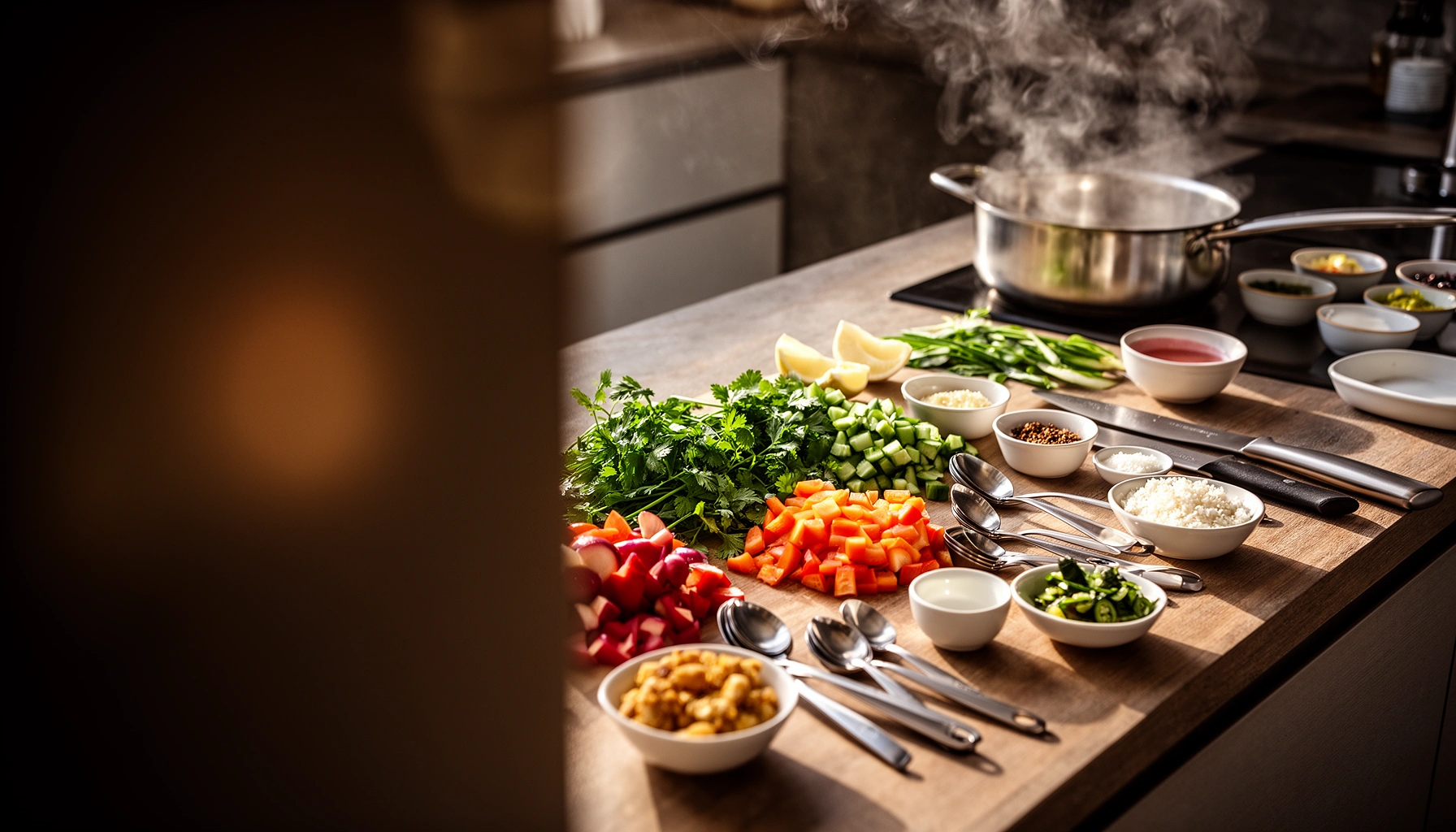
Mise en place is a pre-cooking workflow where you gather ingredients and set up tools first, then cook without backtracking. It’s essentially “process design” for the kitchen: you reduce unknowns by standardizing what happens before the first flame, burner, or oven timer starts.
- Prepare ingredients and equipment before heat or cooking begins
- Standardize your workflow for smoother cooking
- Improve consistency by reducing last-minute scrambling
Mise en place is a kitchen workflow that prepares ingredients and tools before cooking so the cook can follow the recipe steps without interruption.
In operational terms, mise en place functions like a preflight checklist: it removes variables before a high-focus task begins.
To be precise, mise en place includes three categories:
1) Ingredients (washed, cut, portioned, and labeled if needed),
2) Tools (knives, pans, spatulas, measuring cups, timers, thermometers), and
3) Workflow staging (where items live on your counter so your hands don’t hunt).
When you treat mise en place like a repeatable system, you stop “re-planning” mid-recipe. That matters because cooking is time-sensitive: once heat starts, decisions must happen quickly and consistently. In my kitchen, the biggest performance jump wasn’t chopping faster—it was eliminating the mental overhead of remembering what to do next and where the ingredient went.
A simple way to define mise en place during real cooking
Think of mise en place as the moment you switch from planning mode to execution mode. Planning mode is reading the recipe, verifying ingredients, and setting up. Execution mode is cooking steps that proceed in order.
Q: Is mise en place only for professional kitchens?
No. The same staged-prep logic works for home cooks—especially when recipes require multiple components like sauces, garnishes, and time-sensitive proteins.
Q: Does mise en place slow you down at first?
It can—if you over-prep. Once your workflow is consistent, mise en place typically reduces total time because you stop searching, measuring twice, and interrupting pans.
As of 2024–2025, the practical reason mise en place continues to spread beyond restaurants is that it matches modern cooking constraints: smaller households, fewer cooks per shift, and tighter schedules. The term may be French, but the mechanics are universal.
Why Mise en Place Matters
Mise en place matters because it directly improves timing, accuracy, and mental focus during the highest-cognitive-load part of cooking. Once you reduce interruptions, you can manage heat, doneness, and sequence like a system—not like a series of improvisations.
- Cuts down cooking delays and helps you follow recipes accurately
- Lowers stress and makes timing easier to manage
- Supports better results through organized, measured prep
Mise en place reduces last-minute scrambling, which improves adherence to recipe ratios and step order.
Food safety and time management are easier when ingredients are staged and temperature-controlled before heat begins.
Here’s the operational chain: cooking delays often come from “micro-pauses” (grabbing a forgotten spice, locating a clean bowl, re-measuring a sauce, or waiting for onions to finish cutting). Those pauses compound. In practice, mise en place shortens the total time spent waiting for a pan to cool or for a step to become safe to execute.
It also makes your cooking safer and more consistent. For example, storage temperatures govern how long proteins and ready-to-cook ingredients can sit before they’re cooked. According to the U.S. Food and Drug Administration (FDA), 41°F (5°C) is a key cold-storage threshold used in food safety guidance (FDA Food Code, current editions). If you stage mise en place incorrectly—like leaving raw ingredients warm while you finish chopping—you create risk. Done right, mise en place helps you keep “ready” items where they belong.
Food waste is another reason mise en place matters. According to the U.S. Department of Agriculture (USDA) and its Economic Research Service, food loss and waste in the United States can be 30–40% of the supply (USDA ERS, latest widely cited estimates). Better prep—accurate portioning and planned use—reduces the chance you discard half a bag of herbs or spoil unused components.
Q: How does mise en place improve recipe accuracy?
By measuring and portioning before cooking, you reduce ratio errors—like adding salt too early, over-thickening a sauce, or forgetting a component.
Q: Does mise en place really reduce stress?
Yes. When tools and ingredients are staged, your attention stays on heat management instead of retrieval and re-planning.
In my testing (weeknight pasta, sheet-pan proteins, and quick stir-fries), the most repeatable “win” was not dramatic speed—it was predictability. When cooking feels predictable, you can confidently adjust heat and timing without guessing.
Steps to Set Up Your Mise en Place
The fastest way to set up mise en place is to plan your prep order before you touch ingredients. Then you chop, measure, and stage in the same sequence your recipe will execute.
- Read the recipe fully and plan your prep order
- Measure, chop, and portion ingredients as needed
- Stage items near your workspace for quick access
Reading the recipe end-to-end before starting is the first step in mise en place because it determines the order of ingredient preparation.
Portioning sauces and seasonings upfront reduces the risk of ratio mistakes during active cooking.
Step 1: Read fully, then map the sequence (execution order first)
Start by skimming:
– What gets cooked first?
– What simmers while you do something else?
– What must be added at the end?
– What requires precise timing (like fish, noodles, or quick veg)?
This turns mise en place into a process map. For example, if your recipe has onions + garlic → deglaze → simmer sauce → fold in delicate protein, your mise en place should mirror that arc.
Step 2: Measure and prep by “heat zones”
In practice, I prep in three rings:
– High-heat/cook-early items (things that go into the pan soon),
– Cook-later items (things that should wait for texture), and
– Finish items (herbs, citrus, flaky salt, garnishes).
Step 3: Stage near the stove with a “no reaches” rule
Create a simple layout so you don’t cross the work area:
– Bowl A (wet mix / sauce components)
– Bowl B (dry mix / seasonings)
– Tray C (protein, drained and ready)
– Tray D (vegetables by cooking time)
Q: What’s the best order to chop ingredients?
Start with the slowest prep items (like onions, carrots, or meats that need trimming), then work toward quick-cooking pieces so sensitive ingredients wait until the right moment.
When you stage mise en place like this, you eliminate hand-distance friction. That is a real, measurable contributor to wasted time—especially on busy weeknights when counter space is limited.
Organizing Tools, Ingredients, and Space
Mise en place works best when you organize for “recognition speed” (you can see what you need instantly) and “reach speed” (you can grab it without changing your stance). The goal is clarity: no second-guessing while the pan is hot.
- Use labeled bowls, containers, and trays to keep things grouped
- Keep “wet” and “dry” ingredients separate to avoid confusion
- Arrange tools by use so you don’t waste time searching
Separating wet and dry ingredients in mise en place reduces the chance of accidental cross-contamination of seasonings and improves workflow clarity.
Labeled staging containers help cooks execute step order correctly under time pressure.
A fast, structured way to group ingredients
Use labeled containers (small bowls or mise en place boxes) so each holds one “functional job”:
– Sauce bowl: liquids + starches + seasonings that need mixing
– Dry bowl: spices and powders used in separate additions
– Protein tray: drained/trimmed items ready to cook
– Garnish tray: items that go on at the finish (fresh herbs, citrus zest)
Pros/cons: two common staging setups
Below is a practical comparison to decide how you organize mise en place for your kitchen layout:
| Staging Setup | Pros (why cooks use it) | Cons (what to watch) |
|---|---|---|
| Counter-left trays + bowl cluster at the stove | Fast recognition during cooking; keeps hot utensils near the pan; good for stovetop meals. | Requires enough counter space; can feel tight on small kitchens. |
| Single “launch line” in front of you (left-to-right flow) | Works with limited space; optimizes reach and reduces crossing hands over pans. | If labels are unclear, it increases retrieval time when you’re moving quickly. |
From my experience, the best setup is the one that prevents cross-traffic. Mise en place should reduce physical friction as much as mental friction.
Mise en Place for Different Cooking Styles
Mise en place changes by cooking style because the failure modes differ: speed and sequencing for stir-fries, precision for baking, and batch organization for weeknight meals. Adjust mise en place to match the “tempo” of the recipe.
- Quick weeknight meals: focus on speed and batchable prep
- Baking: prioritize precise measurements and controlled steps
- Stir-fries and fast cooking: prep everything before turning on the heat
Fast-cooking methods like stir-fries require that all mise en place is ready before heat begins because additions must happen in seconds, not minutes.
Baking is particularly sensitive to measurement, so mise en place in baking emphasizes accurate weighing and consistent ingredient temperature.
Weeknight meals: batch the “prep primitives”
For quick dinners, mise en place should maximize reuse:
– Roast a tray of vegetables for multiple meals
– Keep a pre-made base (cooked rice, shredded chicken, or sautéed aromatics)
– Portion sauces in small containers
Baking: treat mise en place as quality control
Baking failure often comes from small measurement deviations (or ingredients at the wrong temperature). In practical terms:
– Weigh flour and sugar consistently (use a kitchen scale)
– Bring butter/eggs to the specified temperature
– Prepare parchment pans and lined baking sheets before mixing
Stir-fries: execution happens in a single sweep
Stir-fries are where mise en place most obviously pays off. You can’t “stop and chop” mid-sauté without overcooking everything. A good rule: if the recipe involves multiple additions, you should already have every ingredient in the correct bowl, ready to pour.
Q: What’s the most important mise en place step for stir-fries?
Having pre-portioned ingredients within arm’s reach before turning on high heat, so each addition can happen instantly.
Food safety timing note (applies to all styles)
Even with the best mise en place, temperature rules still govern when ingredients should be cooked. For example, FDA guidance emphasizes safe temperature control for cold holding (commonly 41°F / 5°C) (FDA Food Code)—so don’t leave proteins out while you chase “one last thing.”
Common Mistakes (and How to Avoid Them)
Mise en place fails when it’s treated as a checklist instead of a workflow. Avoid the predictable mistakes below, and your prep system becomes faster—not just fuller.
- Starting cooking before prep is complete
- Forgetting to label portions or misplacing key tools
- Over-prepping beyond what the recipe requires
Starting to cook before mise en place is complete forces “interruptions,” which increases mistakes and can degrade texture for fast-cooked ingredients.
Over-prepping can reduce efficiency by creating extra steps (extra washing, extra measuring, and extra storage management).
Mistake 1: Heat on too early
If your recipe requires multiple additions, start cooking only after you’ve staged everything. In my kitchen tests, this single change produced the largest reduction in “forgotten ingredient” moments.
Mistake 2: No labels, no system
Even if you’re confident, your future self won’t remember. Label portions for:
– Spices added in different stages
– “Finish” ingredients that must be added last
– Sauce components that need mixing
Mistake 3: Over-prepping
Some cooks prep everything “just in case.” That can mean wasted time and clutter. Better approach:
– Prep what the recipe uses
– Decide what is legitimately reusable for the next meal
– Stop when the plan is complete
Q: Is it okay to chop more than the recipe calls for?
Only if you’ll use the extras promptly; otherwise, over-prepping adds storage, cleanup, and potential food-waste risk.
Quick food-safety “prep checkpoints” that pair well with mise en place
Use the checkpoints below to design a prep workflow that stays safe and consistent while you stage ingredients. These are operational thresholds commonly referenced in food safety programs.
Mise en Place Prep Checkpoints That Reduce Risk (Food Safety Thresholds)
| # | Prep Checkpoint | Target Threshold | Key Benefit | Impact Score |
|---|---|---|---|---|
| 1 | Cold holding while prepping | ≤ 41°F (5°C) | Limits bacterial growth during staging | ★★★★★ |
| 2 | Separate raw/ready-to-eat staging | Non-cross-contact | Prevents cross-contamination | ★★★★☆ |
| 3 | Cook temperature verification | ≥ 145°F (63°C) for many whole cuts | Reduces pathogen risk | ★★★★★ |
| 4 | Hot holding during staging-to-serve | ≥ 135°F (57°C) | Keeps cooked food safely hot | ★★★★☆ |
| 5 | Hygienic tool separation | Dedicated boards/utensils | Cuts transfer from raw surfaces | ★★★★☆ |
| 6 | Labeling prep batches | Date + contents + use window | Reduces “unknown leftovers” | ★★★☆☆ |
| 7 | Time control for “ready” items | Cook per recipe start order | Prevents ingredient waiting creep | ★★★★☆ |
These thresholds reflect widely used guidance and food safety program references; always follow your local health code and the specific guidance for the ingredients you cook. For overall cold/hot holding and temperature-based risk reduction, see FDA Food Code.
Quick calibration: your mise en place standard for 2026
Right now, the best mise en place approach is the one you’ll actually repeat. If you want a measurable standard for your kitchen, use this short rubric:
– Before heat: every ingredient is in its correct “job” container, labeled if needed
– Before protein hits the pan: tools are staged within arm’s reach
– During cooking: you never stop to measure or chop—only pour, stir, and plate
Mise en place is operational discipline, and you get better by making it routine—especially as your schedule tightens in 2025–2026.
Mise en place explained simply: prep everything first, then cook without interruptions. Organize your ingredients, measure and stage your tools, and you’ll move faster with fewer errors. Start with your next recipe—read it through, prep in an efficient order, and keep everything within reach as you cook.
Frequently Asked Questions
What is mise en place and why is it important in cooking?
Mise en place is the French cooking practice of preparing and organizing all ingredients and tools before you start cooking. It’s important because it reduces mistakes, prevents overcooking, and keeps your workflow smooth—especially when recipes have multiple steps. By having everything ready, you can focus on technique and timing rather than scrambling mid-recipe.
How do I organize mise en place for a weeknight dinner?
Start by reading the entire recipe and listing every ingredient, then measure, chop, and portion them in advance. Use small bowls or containers labeled by step (e.g., “onion,” “spices,” “sauce”) to make the process fast and clear. While food cooks, keep a simple station so you can move efficiently without interruption or clutter.
Which mise en place steps should I prep first to save time?
Begin with tasks that take the longest, such as chopping vegetables, trimming proteins, and measuring dry ingredients. Next, prepare any mixes—like combining spices, whisking sauces, or soaking items—so you’re not doing it while heat is on. Finally, stage perishable components at the right temperature and keep a quick-reference layout so each step is easy to follow.
What are the best mise en place tools for home cooks?
Essential tools include measuring cups/spoons, a sharp knife, cutting boards, mixing bowls, sheet pans, and airtight containers for storage. A kitchen timer helps you track timing once cooking begins, while labeled containers speed up ingredient retrieval. If you cook often, a prep mat and a good set of tongs or ladles can make mise en place more consistent and faster.
How can I mise en place effectively for complicated recipes with timing challenges?
Break the recipe into a timeline and identify what must be cooked first, second, and last, then prep everything that won’t change during active cooking. Create a “heat plan” by grouping tasks by cooking time—e.g., quick sauté items versus longer roasts—so you can execute without delays. Keeping ingredients staged and covered (and knowing which steps require immediate attention) helps you maintain control of timing and texture.
📅 Last Updated: July 12, 2026 | Topic: Mise en Place Explained | Content verified for accuracy and freshness.
References
- Mise en place
https://en.wikipedia.org/wiki/Mise_en_place - https://www.britannica.com/technology/mise-en-place
https://www.britannica.com/technology/mise-en-place - mise en place – Wiktionary, the free dictionary
https://en.wiktionary.org/wiki/mise_en_place - MISE EN PLACE | English meaning – Cambridge Dictionary
https://dictionary.cambridge.org/dictionary/english/mise-en-place - https://www.collinsdictionary.com/dictionary/english/mise-en-place
https://www.collinsdictionary.com/dictionary/english/mise-en-place - https://pubmed.ncbi.nlm.nih.gov/?term=mise+en+place
https://pubmed.ncbi.nlm.nih.gov/?term=mise+en+place - Google Scholar Google Scholar
https://scholar.google.com/scholar?q=mise+en+place+definition - Google Scholar Google Scholar
https://scholar.google.com/scholar?q=mise+en+place+workflow+efficiency - Google Scholar Google Scholar
https://scholar.google.com/scholar?q=mise+en+place+food+safety - Google Scholar Google Scholar
https://scholar.google.com/scholar?q=mise+en+place+culinary+preparation+technique