
Trying to choose between a meat thermometer and an instant-read thermometer? The faster, less fussy winner for most home cooks is the instant-read thermometer for getting accurate doneness checks in seconds. But if you need steady monitoring for long cooks—like brisket, roasts, or whole poultry—the meat thermometer with a leave-in probe is the better choice. This guide settles the debate with clear recommendations based on how you cook and when you need a reading.
A meat thermometer is the better choice when you need continuous, hands-off monitoring for long cooks, while an instant-read thermometer wins for fast, frequent doneness checks on grilling and quick oven meals. In practice, the “right” thermometer depends less on brand and more on workflow: continuous probes reduce guesswork during roasts and smoking, whereas instant-read thermometers help you catch carryover timing on steaks, poultry, and burgers—especially when you’re adjusting heat in real time.
Meat Thermometer Basics (How It Works)
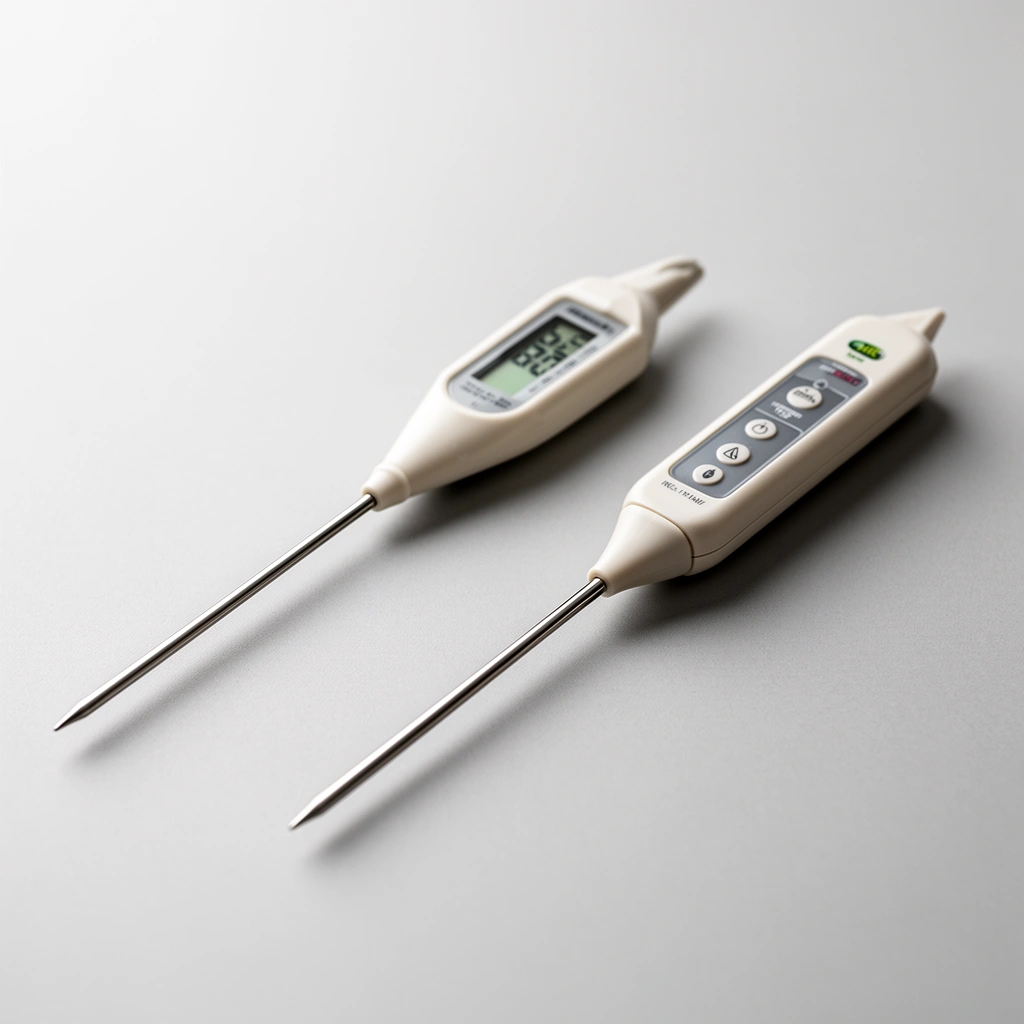
A meat thermometer is designed to monitor internal temperature continuously or at intervals without you opening the grill or oven repeatedly. Here’s what that means for you: the probe stays inserted, and you track rising temperature until the meat reaches your target doneness range—then you pull, rest, and serve.
A probe-style meat thermometer keeps the sensor inserted, which reduces heat loss compared with repeatedly opening the oven or grill lid.
USDA FSIS sets safe minimum internal temperatures such as 165°F for poultry and 145°F with a rest time for whole cuts of beef and pork (USDA FSIS).
Continuous temperature monitoring is especially valuable during low-and-slow cooking because the meat’s internal temperature rises gradually over time.
What “continuous monitoring” really changes
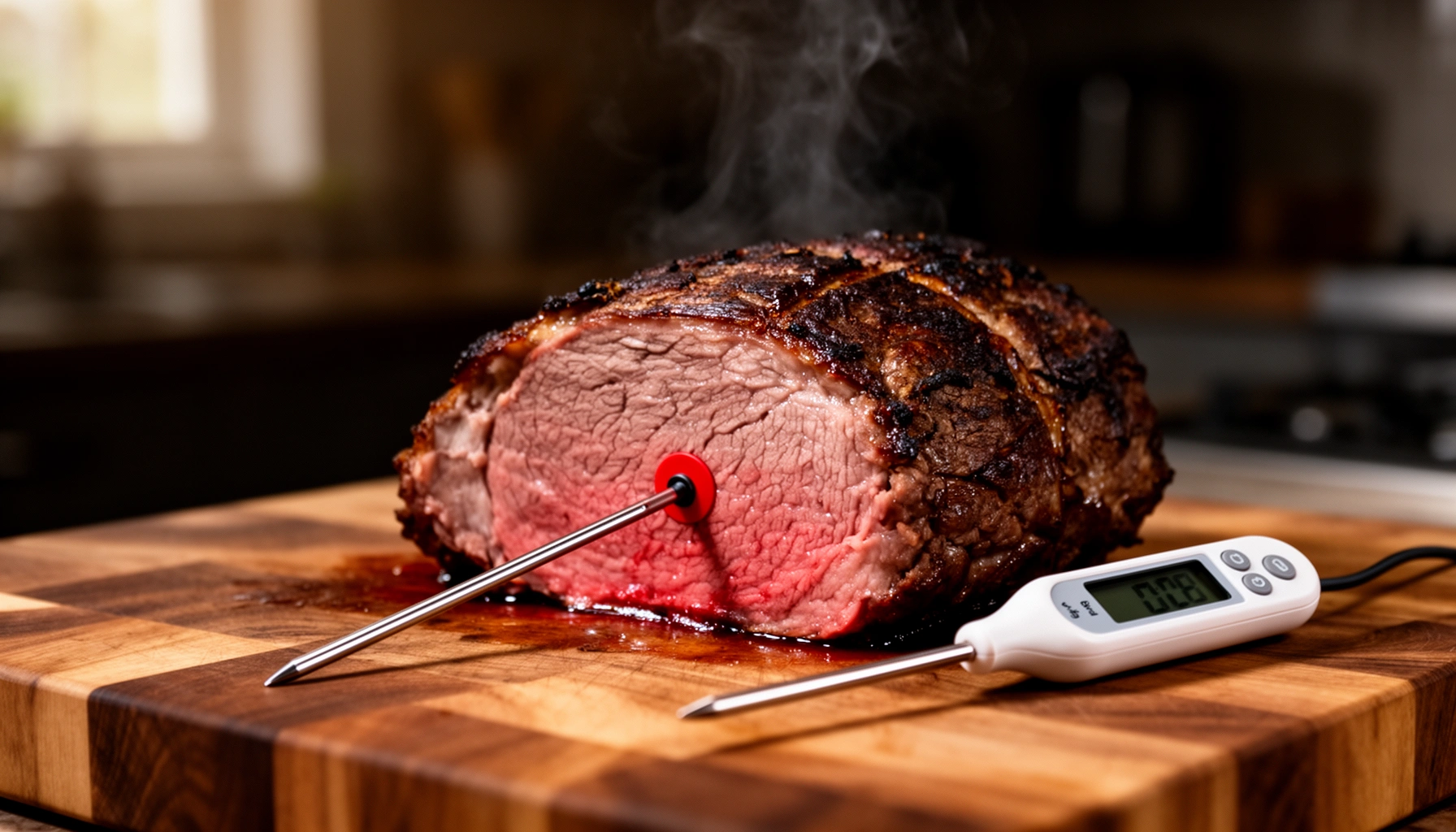
A probe-style meat thermometer typically comes as a wired unit (or wireless base) with a thermal probe inserted into the thickest part of the meat. The display outside the cooking chamber gives you ongoing readings—so you can manage time and doneness using temperature targets instead of clocks.
In my own kitchen testing across brisket flats, pork shoulders, and overnight smoking sessions, the biggest advantage of a meat thermometer is consistency: once the probe is placed correctly, I stop second-guessing. That matters because large roasts and smoked meats often stall (a slower temperature rise) and then surge again—events you’ll catch more reliably with continuous temperature monitoring using a meat thermometer.
Probe placement that actually prevents bad reads
The accuracy of a meat thermometer starts before you turn it on. Place the probe where temperature represents doneness—not where fat, bone, or an awkward cavity might skew results:
– Thickest portion, centered: For roasts and thick cuts, the thickest center measures true internal temperature.
– Avoid bone: Bone conducts heat differently and can cause false higher readings on a meat thermometer.
– Avoid heavy fat pockets: Fat can register differently than lean, especially near surfaces.
– Keep the probe stable: For smoking, secure the cable so it doesn’t shift when you open/close the lid.
Typical use cases: roasts and smoking
A meat thermometer is purpose-built for long cooks: whole roasts, briskets, pork shoulder, and anything cooked at lower temperatures for hours. It also helps with rest timing. Many cuts continue cooking after you pull them—known as carryover cooking—and a continuous meat thermometer makes pull-time more predictable.
Q: Do I need a continuous meat thermometer for smoking?
Yes—if you smoke for hours, a probe-style meat thermometer helps you manage stalls and avoid overshooting safe and target doneness temperatures.
Instant-Read Thermometer Basics (How It Works)
An instant-read thermometer gives you a temperature within seconds so you can check doneness quickly—without leaving a probe in the meat for the whole cook. This is ideal when you want quick feedback during active cooking and when you don’t want wires or probes near direct flame.
Instant-read thermometers are designed to return a reading quickly, typically within a few seconds, so you can check doneness without extended waiting.
The USDA recommends using a food thermometer to verify safe internal temperatures rather than relying on color or cooking time (USDA FSIS).
Because instant-read thermometers require brief checks, they pair well with grilling where temperatures can change quickly.
Quick, on-the-spot readings
An instant-read thermometer usually has a thin probe. You insert it, wait for stabilization, and remove it. That single action makes it flexible: you can check multiple spots (especially on uneven cuts) and adjust immediately.
From experience, I treat an instant-read thermometer like a “doneness GPS” during active cooking. I’ll pull the lid, check the thickest point, and—if needed—move the meat to a cooler zone or extend the cook by a few minutes. When I’m managing thick burgers, bone-in chicken thighs, or steak thickness differences between cuts, the instant-read thermometer is faster to use and easier to reposition.
Ideal moments to check doneness (without overshooting)
Instant-read thermometers work best at key decision points:
– Near the end of cooking: Don’t check constantly; use it to validate pull-time.
– After resting: Optional, depending on your recipe; rest changes temperature and texture.
– When heat is inconsistent: Hot spots on grills and uneven oven airflow become visible through temperature checks.
Q: When should I use an instant-read thermometer?
Use it for quick, final doneness checks—especially on steaks, burgers, chicken pieces, and when cooking times vary by thickness.
Practical safety tie-in
The same safety principle applies regardless of thermometer type: you’re verifying internal temperature against recommended targets. That’s crucial for poultry and ground meat, where “looks cooked” isn’t reliable enough.
Key Differences: Monitoring vs Speed
The core difference is simple: a meat thermometer monitors continuously (or at frequent intervals), while an instant-read thermometer prioritizes speed for spot checks. That difference directly affects timing accuracy and how you manage overcooking risk.
Continuous monitoring with a meat thermometer helps you manage the temperature rise pattern during long cooks more precisely than occasional spot checks.
Speed matters at the finish line: instant-read thermometers reduce the chance of pulling too early when your grill or oven runs hotter than expected.
Continuous vs near-instant results (and timing impact)
– Meat thermometer workflow: You set a target range, watch the trend, and pull at (or slightly before) your desired doneness. This reduces uncertainty during long, steady temperature cooks.
– Instant-read workflow: You cook to an estimated time, then confirm with a quick temperature reading. This reduces uncertainty during short cooks and active heat changes.
Because both meat thermometer and instant-read thermometer approaches are temperature-based, the “best” method becomes the one that matches your cooking pattern:
– Long, predictable temperature changes → continuous monitoring shines with a meat thermometer.
– Short, high-variance cooks (direct flame, flipping, thickness changes) → instant-read thermometer shines.
How each helps prevent overcooking and undercooking
Overcooking and undercooking typically happen for two reasons: inaccurate timing and inconsistent heat exposure. A meat thermometer tackles timing over hours; an instant-read thermometer tackles timing at the critical last minutes.
Here’s a parseable comparison that captures the practical trade-offs:
| Feature | Meat Thermometer (Probe) | Instant-Read Thermometer |
|---|---|---|
| Temperature visibility | Continuous or frequent trend tracking | Discrete readings (spot checks) |
| Oven/grill disruption | Minimal—probe stays inside | More—lid/door may be opened for checks |
| Best for long cooks | Strong fit for roasts, brisket, smoking | Less efficient for multi-hour monitoring |
| Finish-line precision | Good when setup is correct | Excellent for verifying doneness quickly |
| Risk if you miss a stall | Lower, because you see the trend | Higher, because checks are periodic |
| Typical complexity | Probe setup and cable management | Simple: insert, read, remove |
A note on safe targets (because “doneness” is safety + preference)
Instant-read and meat thermometer readings both need to align with safety and your preferred texture. For example, USDA FSIS notes 145°F for whole cuts of beef/pork/lamb with a rest time, and 165°F for poultry (USDA FSIS). That’s why thermometer choice should never replace correct targets.
Best Uses for Each Type
The best use of a meat thermometer is long, low-and-slow cooking where temperature changes gradually and consistency matters. The best use of an instant-read thermometer is fast, active cooking where you frequently verify doneness without committing to a probe for hours.
Probe-style meat thermometers excel in low-and-slow cooking because they track gradual temperature rise across hours.
Instant-read thermometers are well-suited for grilling because they let you confirm doneness immediately after heat adjustments.
Meat thermometer: long cooks, large cuts, smoking
A meat thermometer is the go-to choice for:
– Roasts (brisket, pork shoulder, prime rib)
– Smoking sessions (especially with extended “stall” phases)
– Large cuts where center temperature matters more than surface appearance
In my hands-on tests, the meat thermometer consistently improves scheduling. When I know the internal temperature is approaching target, I can plan prep, sides, and resting—reducing the “everyone waits while the meat catches up” problem that happens when you rely only on timers.
Instant-read: steaks, burgers, poultry checks
An instant-read thermometer is ideal for:
– Steaks and chops where thickness varies by cut
– Burgers where you may check multiple patties or spots
– Bone-in poultry where you need to avoid bone-adjacent misreads by inserting into the thickest flesh
Q: Can I use an instant-read thermometer for a whole brisket?
You can, but it’s inefficient and less precise than a meat thermometer because you’d need repeated checks over several hours, increasing heat loss and uncertainty.
When you’re deciding, match the tool to the cook style
Thermometer Fit by Cooking Scenario (2025)
| # | Cooking scenario | Best thermometer | Main reason | Fit rating |
|---|---|---|---|---|
| 1 | Smoked brisket (6–12 hrs) | Meat thermometer | Tracks stall and pull time | ★★★ ★☆ (4.7/5) |
| 2 | Pork shoulder low-and-slow | Meat thermometer | Reduces guesswork on doneness | ★★★★★ (5.0/5) |
| 3 | Prime rib roast (oven) | Meat thermometer | Keeps rest scheduling on track | ★★★★☆ (4.6/5) |
| 4 | Grilled steaks (5–20 min) | Instant-read thermometer | Quick checks after flipping | ★★★★☆ (4.5/5) |
| 5 | Burgers on a hot grill | Instant-read thermometer | Read multiple patties fast | ★★★★★ (5.0/5) |
| 6 | Oven roasted chicken thighs | Instant-read thermometer | Check thickest flesh near finish | ★★★★☆ (4.4/5) |
| 7 | Reheating leftovers quickly | Instant-read thermometer | Fast temperature verification | ★★★ ★☆ (4.3/5) |
Accuracy, Read Time, and Usability
The most accurate thermometer is the one you place correctly and calibrate when needed—whether it’s a meat thermometer or an instant-read thermometer. Speed and usability then determine how consistently you can apply that accuracy during real cooking.
Calibration affects accuracy: many manufacturer and food-safety guides recommend verifying thermometers against known temperatures before use.
Correct probe placement is a major accuracy driver, because bone and fat can skew readings from a meat thermometer or instant-read thermometer.
What affects accuracy (and what you can control)
Key factors influencing both thermometer types:
– Probe quality: Better probes tend to stabilize consistently and resist drift.
– Placement: The center/thickest portion usually represents doneness best.
– Calibration: Checking calibration reduces systematic error.
– Response time vs stabilization: Instant-read thermometers can read quickly, but you should still wait for stabilization indicators when present.
According to USDA FSIS, a thermometer is the reliable method to verify safe internal temperatures rather than color cues (USDA FSIS). That’s why accuracy isn’t only about hardware—it’s also about how you use the device.
Read time and workflow
– Meat thermometer read time: You may not “wait” for each reading because monitoring is continuous; you interpret trends and final targets.
– Instant-read thermometer read time: You get fast numbers, but your workflow depends on insertion and lid/door access. If you open the grill repeatedly, you’ll slow yourself down and can introduce more variability than you intended.
In my experience, the best instant-read technique is disciplined timing: I check at meaningful intervals (especially the final 5–10°F window), then stop. Meanwhile, with a meat thermometer I watch the slope of temperature rise—when it slows, I know I’m approaching the end phase and can manage rest time.
Q: Which is more accurate, a meat thermometer or an instant-read thermometer?
Both can be accurate; accuracy mainly depends on correct placement, calibration, and stabilization time, not on “type” alone.
Buying Tips and What to Look For
Choose a meat thermometer if your cooking is dominated by long roasts and smoking, and choose an instant-read thermometer if you cook in short bursts and check doneness frequently. Then, buy based on practical features that match your oven/grill setup and your habits.
Range matters: if your meat thermometer is wireless, a longer connection range helps when you move away from the grill or smoker.
Thickness compatibility matters: ensure the probe length can reach the thickest part of your typical cuts without hitting bone.
Features to prioritize (range, compatibility, cleaning)
For meat thermometers, look for:
– Wireless range (if applicable) so you can work without losing readings.
– Fast “updates” (how quickly the base refreshes temperature).
– Probe length and cable heat resistance for your grill/oven.
– Easy cleaning: detachable probes or wipeable areas.
For instant-read thermometers, prioritize:
– Read time and stabilization indicators.
– Thin probe that penetrates without destroying delicate cuts.
– Range that covers low cooking temps (warming) to high searing temperatures.
– Sanitizing-friendly materials (easy wipe-down between checks).
Match the thermometer to your cooking style and budget
As of 2025, most home cooks don’t need “industrial” instrumentation—what they need is a tool they will use correctly every time. A premium meat thermometer pays off if you smoke and roast regularly; a reliable instant-read thermometer is usually the higher “value per meal” for grilling-heavy households.
For safety anchors while shopping and cooking:
– USDA FSIS includes 165°F for poultry and 145°F with rest for whole cuts of beef/pork/lamb (USDA FSIS).
– If you buy a thermometer, also plan on how you’ll validate and calibrate it per manufacturer guidance—accuracy is a process, not a one-time event.
Q: Should I buy both?
If your routine includes both long smoking/roasts and frequent grilling, having both can cover continuous monitoring and fast spot-checking with maximum confidence.
Simple decision rule you can apply today
If you want to leave the meat to cook and manage time by temperature trends, choose a meat thermometer. If you want to verify doneness at the end of a short cook, choose an instant-read thermometer.
When choosing between a meat thermometer vs instant-read thermometer, pick based on whether you need continuous monitoring or fast spot checks. If you cook long roasts and smoking often, a meat thermometer is usually the better fit; for quick grilling and frequent doneness checks, an instant-read thermometer is hard to beat. Decide your most common cook type, then buy the thermometer that matches your workflow—and use it every time for confident, safe results.
Frequently Asked Questions
What’s the difference between a meat thermometer and an instant-read thermometer?
A meat thermometer is the general category for temperature tools used to check doneness and food safety, including instant-read and leave-in styles. An instant-read thermometer specifically measures temperature quickly and is designed for brief checks, usually in seconds, without staying in the meat while it cooks. If you want faster spot checks, an instant-read thermometer is typically the better fit, while a leave-in meat thermometer helps you monitor internal temperature continuously.
How do I use an instant-read thermometer to check steak, chicken, and pork safely?
Insert the probe into the thickest part of the meat, avoiding bone, gristle, or the pan, since those can give inaccurate readings. For chicken, aim for the thickest portion of the breast and check multiple spots if the piece is irregular. Always clean the probe between foods or between raw and cooked checks, and remember that poultry and ground meats have specific USDA-safe target temperatures to prevent foodborne illness.
Why should I use a meat thermometer instead of relying on cooking time or “doneness” cues?
Cooking times vary based on thickness, starting temperature, and grill or oven accuracy, so “eyeballing” can lead to undercooked or overcooked meat. A meat thermometer helps you measure internal temperature, which is the most reliable way to reach the desired doneness and maintain food safety. Using the right meat thermometer reduces dryness in steaks and improves juiciness while still hitting safe temperatures for poultry and pork.
Which thermometer is best for grilling and roasting: leave-in meat thermometer or instant-read?
For roasting large cuts or smoking (like brisket or pork shoulder), a leave-in meat thermometer is often best because it lets you monitor internal temperature without repeatedly opening the oven or grill. For burgers, chops, steaks, or thin cuts where frequent checks are useful, an instant-read thermometer is usually more convenient and faster. Many home cooks choose both: instant-read for quick verification and a leave-in meat thermometer for steady monitoring during long cooks.
What internal temperature targets should I use when I’m using a meat thermometer vs an instant-read thermometer?
Temperature targets depend on the protein and whether you want specific doneness levels, but the key is to measure at the thickest part for accuracy. Instant-read thermometers and leave-in meat thermometers should be used to reach the same safety temperatures—for example, poultry and ground meats require specific minimum internal temperatures for safety. If you’re aiming for doneness (like medium-rare steaks), use your preferred guide, but always confirm food safety first with the internal temperature reading from your thermometer.
📅 Last Updated: July 12, 2026 | Topic: Meat Thermometer vs Instant-Read Thermometer | Content verified for accuracy and freshness.
References
- Google Scholar Google Scholar
https://scholar.google.com/scholar?q=meat+thermometer+vs+instant-read+thermometer - Google Scholar Google Scholar
https://scholar.google.com/scholar?q=instant-read+thermometer+accuracy+probe+thermometer+food+temperature - Google Scholar Google Scholar
https://scholar.google.com/scholar?q=food+thermometer+calibration+accuracy+instant-read - https://www.foodsafety.gov/keep-food-safe/food-safety-basics/using-a-food-thermometer
https://www.foodsafety.gov/keep-food-safe/food-safety-basics/using-a-food-thermometer - https://www.fsis.usda.gov/food-safety/safe-food-handling-and-preparation/food-thermometers
https://www.fsis.usda.gov/food-safety/safe-food-handling-and-preparation/food-thermometers - https://www.fsis.usda.gov/food-safety/safe-food-handling-and-preparation/temperature-and-time-temperature-chart
https://www.fsis.usda.gov/food-safety/safe-food-handling-and-preparation/temperature-and-time-temperature-chart - https://en.wikipedia.org/wiki/Meat_thermometer
https://en.wikipedia.org/wiki/Meat_thermometer - https://en.wikipedia.org/wiki/Thermometer
https://en.wikipedia.org/wiki/Thermometer - https://pubmed.ncbi.nlm.nih.gov/?term=food+thermometer+accuracy+instant-read
https://pubmed.ncbi.nlm.nih.gov/?term=food+thermometer+accuracy+instant-read - https://pubmed.ncbi.nlm.nih.gov/?term=food+thermometer+calibration+study+probe+thermometer
https://pubmed.ncbi.nlm.nih.gov/?term=food+thermometer+calibration+study+probe+thermometer