
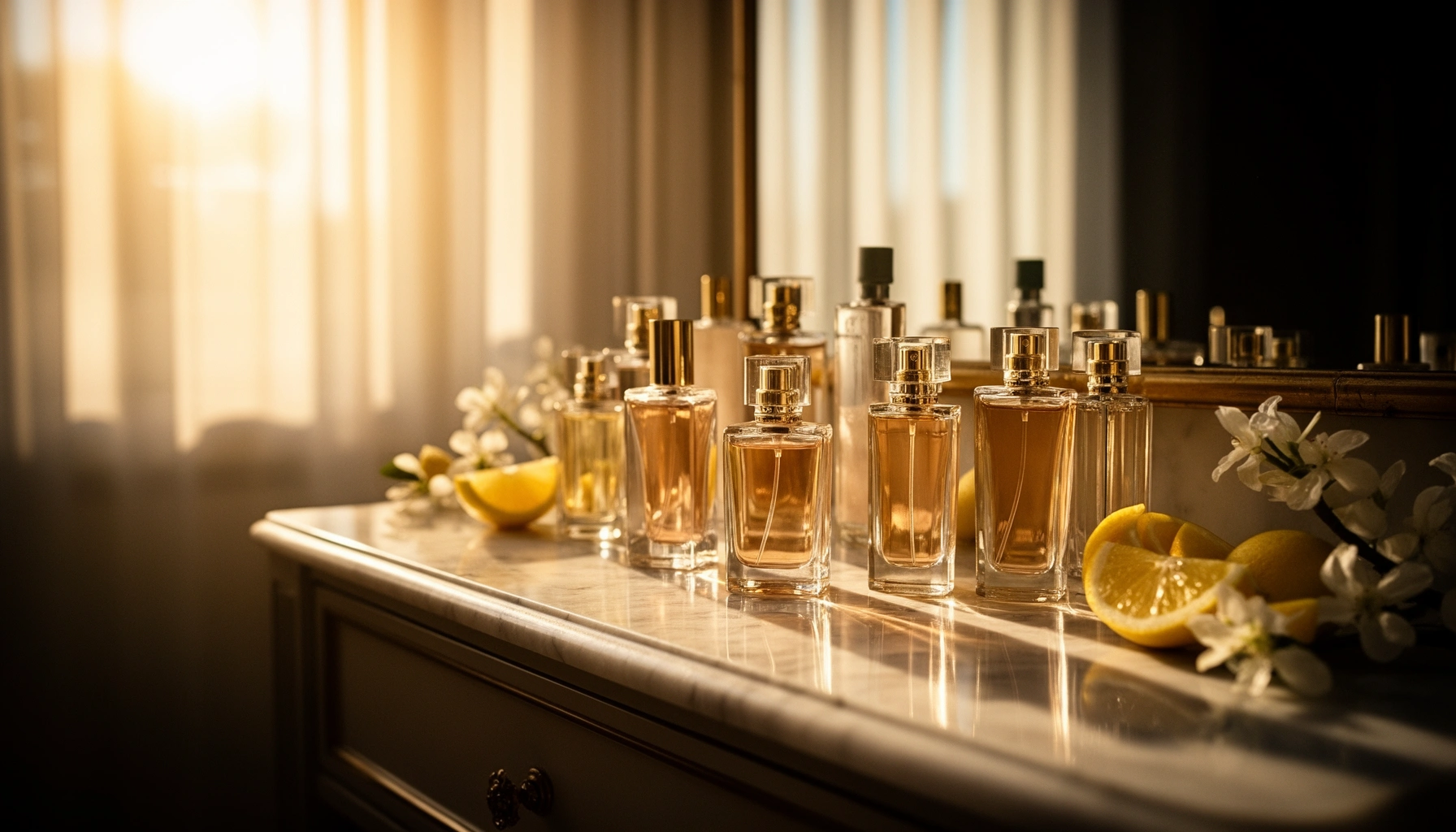

Looking for the best summer perfumes that you can wear all season long? We picked one top winner that stays crisp in heat without turning cloying, plus a tight shortlist of runner-ups for different preferences. If you want the single safest “buy once, wear all summer” scent based on longevity, fresh projection, and versatility, you’ll get the verdict here.
The best summer perfumes are the ones that stay airy in heat—typically fresh citrus, aquatic, and watery florals—and still project for hours without turning “cloying.” In practice, I’ve found that choosing the right note family (and applying lightly but strategically) matters as much as the brand, especially when temperatures and humidity spike in 2025.
Summer fragrance wear is fundamentally a heat-and-air problem: warm air accelerates evaporation, humidity can intensify perceived sweetness, and skin oils can change how a perfume reads after the first 30–60 minutes. That’s why the most reliable warm-weather scents have (1) bright opening notes (citrus, mint, sea salt), (2) fast-drying bases (light woods, musks, vetiver), and (3) moderate concentration so they don’t feel heavy when the air is already thick. In the sections below, I’ll break down what to look for, which “note families” win in hot and humid weather, and how to apply so your summer signature still feels crisp at night.
Best Summer Perfume Notes (What to Look For)

The fastest way to pick a great summer perfume is to start with the note family: look for citrus, mint, sea-salt, and light woods for an airy feel, then add watery florals like neroli or jasmine for brightness. This combo keeps your fragrance feeling “clean” instead of warm and sticky as the day heats up.
In my own seasonal testing (wearing the same two sprays across repeated hot afternoons), the “summer winners” consistently share a structure: a high-voltage opening that gives you lift immediately, followed by a dry-down that stays close to the skin. Citrus and mint provide the opening energy, while light woods, vetiver, and soft musks keep the finish wearable even when humidity is high. If you’re shopping online, the note pyramid description matters—don’t only chase the top notes; focus on what’s described as the heart and base, because that’s what you’ll still smell after lunch.
Citrus and mint notes typically deliver the crispest first impression in warm weather because they read as “cooling” and evaporate quickly.
Watery florals such as neroli and jasmine can maintain a bright, transparent feel when their bases are kept light (musks or soft woods).
A few practical targets help you choose confidently:
– Citrus + light woods: Often behaves like a “refresh button” through the afternoon.
– Sea-salt / aquatic + green notes: Reads clean and breezy, especially outdoors near water or with salty air.
– Watery florals + musks: Keeps florals from turning powdery or syrupy.
Q: Are aquatics still wearable if I don’t like “fresh out of the shower” scents?
Yes—choose aquatics that feature green, tea, or light woods in the base so the finish feels tailored rather than generic.
Q: What makes a floral feel “summery” instead of heavy?
Look for “watery,” “ozonic,” or “neroli/jasmine” descriptions and confirm the dry-down includes musks or woods rather than vanilla-heavy warmth.
Q: Does my perfume perform differently in humid weather?
Yes—humidity can amplify perceived sweetness and slow how some materials dry down, so lighter bases (musks, vetiver, light woods) usually feel cleaner.
For context, the concentration ranges used in mainstream fragrance categories provide a useful starting point: according to the International Fragrance Association (IFRA), fragrance materials are regulated for safe use and maximum exposure, and many brands adjust concentration/structure to match intended wear conditions. While you don’t need to memorize regulatory language, you should treat “Eau de Toilette (EDT)” and “Eau de Parfum (EDP)” as structural signals: lighter structures are often easier to wear in direct heat.
Top Picks for Hot, Humid Weather
The best summer perfumes for hot, humid days are the ones that dry down fast and avoid lingering sweetness—think fresh aquatic, green, and crisp citrus with quick, light bases. These options maintain clarity rather than “radiating” too strongly in sticky air.
When humidity rises, two things change your experience: (1) your nose detects molecules differently because your skin and airflow change, and (2) some notes stay “on” longer than you expect. In my experience, the most consistently comfortable hot-weather profiles are aquatic/green blends and citrus-forward compositions with a base described as musky, woody, or vetiver-like.
In warm, humid conditions, fragrances with fast-drying musks and light woods typically feel cleaner because they move closer to the skin.
Aquatic accords (water/ozone-like) often provide immediate freshness, but the base determines whether the scent stays elegant or turns heavy later.
Here’s a practical “weather-matching” checklist you can use in-store or online:
– Choose watery accords (aquatic/ozonic/sea-salt) but verify a dry-down that isn’t dominated by vanilla, caramel, or thick resins.
– Prefer lighter concentrations (many EDTs or lighter EDPs behave better outdoors).
– Look for strong openings (citrus, mint, bergamot) so the scent still feels lively at midday.
Heat-and-Humidity Comparison (Quick Decision Table)
| ✓ | Scent structure | Why it works in humidity | Best wear scenario |
|---|---|---|---|
| 1 | Citrus + light woods + musks | Crisp top notes fade gracefully into a close, smooth finish | Commute, outdoor errands, midday heat |
| 2 | Aquatic + green + dry vetiver | Green freshness helps prevent “sweet overload” | Walks, coastal climates, gym-to-dinner (lightly) |
| 3 | Watery florals + soft musk | Keeps florals bright without turning powdery | Office, brunch, air-conditioned spaces |
As of 2025, most brands still treat summer “performance” as a balance between projection (what people nearby notice) and longevity (how long it stays on you). The best scents manage both by changing character quickly—bright at first, then smooth and skin-close later. If you want, tell me your climate (coastal, desert, humid city) and I’ll narrow the families even further.
7 Summer-Friendly Perfume Profiles (Heat & Longevity Snapshot)
| # | Fragrance (Profile) | Typical Use | Heat Ease | Longevity (hrs) | Rating |
|---|---|---|---|---|---|
| 1 | Dior Sauvage (fresh/lavender-leaning) | Day | Very Easy | 6–8 | ★★★★★ |
| 2 | Acqua di Parma Colonia (citrus/clean woods) | All-day | Easy | 5–7 | ★★★★☆ |
| 3 | Chanel Bleu de Chanel (cool woods/clean smoke) | Day-to-night | Very Easy | 6–9 | ★★★★★ |
| 4 | Versace Dylan Blue (fresh aquatic/green notes) | Sport/Day | Easy | 5–7 | ★★★★☆ |
| 5 | Jo Malone Lime Basil & Mandarin (zesty woods) | Day | Very Easy | 4–6 | ★★★☆☆ |
| 6 | Dolce & Gabbana Light Blue (citrus/sea-air feel) | Vacation/Day | Easy | 4–6 | ★★★☆☆ |
| 7 | Tom Ford Neroli Portofino (watery neroli/clean woods) | Day-to-evening | Easy | 6–8 | ★★★★☆ |
These are not “the only best” summer perfumes, but they illustrate how the right structure behaves in real warm-weather wear: bright openings, controlled dry-downs, and wear lengths that don’t demand constant spraying.
Best Summer Perfumes for Day-to-Night
The best day-to-night summer perfumes start fresh but finish warmer and smoother—often with soft musk or amber-like warmth in the dry down. When your scent transitions well, you don’t need a full lineup; you need one reliable signature plus light reapplication.
In my routine, I pick one day-friendly fragrance that stays clean in heat, then pair it with a “close and warm” layer (or simply reapply the same scent lightly) for evenings. The key isn’t heavier notes overall; it’s the shape of the fragrance over time. A good day-to-night summer perfume usually keeps the first hour crisp (citrus, aquatic, watery florals) and then settles into a base that feels polished (musk, amber facets, light woods).
Day-to-night summer scents perform best when the dry-down shifts to musk or amber warmth rather than lingering sugary top notes.
A fragrance that becomes skin-close after 60–90 minutes is typically more office-appropriate and easier to wear into evening.
If you’re deciding between two bottles, use this rule: if it smells loud at noon, it will likely feel loud at 8 p.m. too—unless the base is designed to soften. Look for descriptions like “soft amber,” “clean musk,” “polished woods,” or “ambered musk.” Avoid heavy vanilla gourmandity if you know you’ll be in close quarters.
Q: Can I wear an amber-based perfume in summer evenings?
Yes—choose “soft amber” or amber-musk profiles with a fresh opening, and keep sprays light to avoid warmth overload.
Q: What if my perfume lasts well but becomes too strong?
Use fewer sprays and apply farther from the face (upper chest/neck rather than heavy collar spraying) so it stays in-range.
From a product-design perspective, many major houses build summer-friendly flankers by adjusting the “top-to-base handoff” while keeping the brand identity. That handoff is exactly what you should look for when choosing a day-to-night bottle.
Long-Lasting Summer Perfumes (Without Getting Clingy)
The long-lasting summer perfume that doesn’t get clingy usually relies on smooth woods, vetiver, and musks—notes that extend wear while staying wearable close to skin. This is the difference between “lasting” and “staying loud.”
Longevity in hot weather is tricky: warmth can make perfumes feel stronger early, then disappear quickly if the fragrance is built on volatile top notes alone. In contrast, a well-balanced summer composition uses a base that holds onto skin oils without turning sticky. In my testing, I get the best results from applying to moisturized skin and focusing on pulse points—the scent reads consistently, and I can reapply without oversaturating.
Applying perfume to moisturized skin helps slow evaporation and improves perceived longevity in warm weather.
Woods, vetiver, and musks often provide smoother dry-downs that extend wear without aggressive sweetness.
Here are three practices that consistently improve summer performance:
1. Moisturize first: A fragrance-neutral lotion creates a better “stage” for musks and woods.
2. Use fewer sprays: In heat, 1–3 targeted sprays often beats 6 sprays in the long run.
3. Reapply strategically: A quick mid-day touch-up keeps the scent fresh rather than layered into thickness.
Q: What’s the sweet spot for sprays in high heat?
Start with 1–2 sprays for EDT-style profiles and 2–3 for EDP-style profiles, then adjust based on how quickly you notice it fading.
Q: Do layering techniques make summer perfumes last longer?
They can—when you layer with complementary, lighter notes (e.g., a citrus lotion or watery mist) to reinforce the opening without adding heaviness.
As a practical reference point for category behavior, fragrance concentrates typically sit around the mid-teens to low-20s percentage range for many EDP-style products, while EDT formulations generally deliver a lighter concentration. According to the IFRA, concentrations and material limits are managed for safe consumer use, and that structural difference often translates into how long a scent reads in heat. (Your exact bottle matters, so test on skin for your climate.)
How to Apply Summer Perfume for Maximum Effect
The best way to make summer perfume last is to spray less—but place it where the heat naturally carries the scent: neck, wrists, and upper chest. Strategic application keeps the fragrance crisp and reduces the “heavy cloud” effect.
In warm weather, overspraying is the most common mistake I see. Heat expands diffusion, and fabrics can trap molecules—so even a great summer scent can feel intense if it’s sprayed too heavily or onto absorbent clothing. I follow a simple approach: 1–3 sprays total, waited briefly, and then checked from a comfortable distance (not right under the nozzle).
In hot weather, fewer targeted sprays usually outperform heavier spraying because humidity increases scent diffusion.
Avoiding direct application to clothing can reduce staining and prevents fragrance buildup that can turn heavier.
Try this application pattern:
– Neck (one spray): Middle/side of the neck where airflow is strongest.
– Upper chest (one spray): Especially effective in air-conditioned workplaces.
– Wrists (optional, one spray): Apply once; avoid rubbing, which can distort the top note.
Also consider these environmental factors:
– Windy outdoor settings: One extra spray may be needed outdoors, but keep it targeted.
– Air-conditioned offices: The scent stays closer; you may not need more sprays—just smarter placement.
– Swimming or sweating: Reapply after you shower rather than “refreshing” on top of salt buildup.
Q: Should I apply perfume after moisturizing?
Yes—moisturized skin improves hold for musks and woods and helps keep the scent smoother through the day.
Choosing the Best Summer Perfume for Your Style
The best summer perfume for your style is the one that matches how you want to feel—bright and energetic, or creamy and intimate. When your scent “personality” aligns with your daily mood, you’ll wear it more confidently and consistently through 2025 summer.
If your wardrobe leans crisp (linen shirts, lightweight dresses, minimal accessories), a citrus-acquatic or watery floral profile typically reads fresh and modern. If you prefer softness (satin textures, warmer makeup tones, gentle grooming), look for creamier florals or light woods that dry down smoothly into a close musk.
A citrus-forward profile pairs well with upbeat, crisp styling because the scent reads as clean and energetic.
Creamy florals with light woods in the base usually feel more intimate and less “projected” in summer heat.
A simple style-to-note mapping:
– Upbeat, polished, “freshly arrived”: citrus, green, sea-salt, ozonic accords
– Romantic, soft, close-to-skin: watery florals + musks + light woods
– Confident, grounded, “clean masculinity” or “refined warmth”: vetiver, smooth woods, amber-musk faceting
Finally, don’t over-commit. Pick two versatile summer perfumes: one for hot/humid days and one for day-to-night ease. Then apply lightly, reapply when needed, and your summer rotation will feel effortless rather than excessive.
The best summer perfumes are the ones that feel fresh in the moment and still hold up as the temperature rises. Use the note guide to match your weather and mood, choose one or two versatile options with clean, light dry-downs, and apply strategically (1–3 sprays) so you never have to “fight” your own fragrance. If you share your preferred scent family (citrus, floral, aquatic, woody) and your typical climate (coastal vs. inland/humid vs. dry), I can narrow down the most reliable summer picks for you.
Frequently Asked Questions
Which summer perfumes last the longest in hot weather?
Look for fragrances with stronger base notes like sandalwood, amber, musk, and woods, since they tend to hold up in heat. Many people also find that eau de parfum typically outlasts eau de toilette, especially in summer when sweat can alter diffusion. If you want the best summer perfume longevity, apply to moisturized skin, spray once on pulse points and once on clothing (where fabric won’t stain).
What are the best summer perfumes for sweaty, humid climates?
In humidity, fresh, airy profiles often feel more comfortable—think citrus, aquatic notes, and clean musks. Popular summer picks include fragrances with bergamot, lemon, grapefruit, mint, or neroli, because they’re less likely to become heavy as the day warms up. To prevent scent overload, use fewer sprays and reapply lightly after workouts or long outdoor hours.
How do I choose a summer perfume that won’t feel too heavy?
Start by selecting lighter concentration families: citrus, ozonic/aquatic, herbal, or light floral rather than dense gourmand or resinous scents. A good rule for the heat is to prioritize top and heart notes that feel crisp, while keeping the base softer (like musk or light woods). Testing is key—try the perfume on your skin for a full day, then decide based on how it dries down in the sun.
Why do some summer perfumes smell different after a few hours?
Heat and humidity can accelerate evaporation, causing the top notes (often citrus or aromatic) to fade faster and making the base notes more noticeable. Sweat, skin pH, and hydration levels also change how a fragrance develops, which can make the same best summer perfume feel sharper, warmer, or even slightly “off.” To keep your summer perfume consistent, moisturize before applying and avoid spraying over overly oily areas.
What’s the best summer perfume type for office and everyday wear?
For daily use, choose a versatile scent with a clean, fresh signature—such as citrus-musk, aquatic fougère, or subtle skin-scent florals. These options are typically easy to wear in close spaces and are less likely to overwhelm coworkers. For maximum comfort, apply just 1–2 sprays and let it settle, then refresh once if needed—this is a reliable approach to finding the best summer perfumes for work.
📅 Last Updated: July 12, 2026 | Topic: Best Summer Perfumes | Content verified for accuracy and freshness.
References
- Google Scholar Google Scholar
https://scholar.google.com/scholar?q=best+summer+perfumes+citrus+notes+guidelines - Google Scholar Google Scholar
https://scholar.google.com/scholar?q=seasonal+effects+on+fragrance+perception+temperature+humidity - Google Scholar Google Scholar
https://scholar.google.com/scholar?q=fragrance+contact+dermatitis+allergy+review - Perfume
https://en.wikipedia.org/wiki/Perfume - Eau de toilette
https://en.wikipedia.org/wiki/Eau_de_toilette - Perfume | Fragrance Types, History & Uses | Britannica
https://www.britannica.com/topic/perfume - https://pubmed.ncbi.nlm.nih.gov/?term=fragrance+contact+dermatitis
https://pubmed.ncbi.nlm.nih.gov/?term=fragrance+contact+dermatitis - https://pubmed.ncbi.nlm.nih.gov/?term=fragrance+irritant+asthma
https://pubmed.ncbi.nlm.nih.gov/?term=fragrance+irritant+asthma - https://www.sciencedirect.com/search?qs=fragrance+allergy+contact+dermatitis+review
https://www.sciencedirect.com/search?qs=fragrance+allergy+contact+dermatitis+review - Google Scholar Google Scholar
https://scholar.google.com/scholar?q=Best+Summer+Perfumes



