
If you’re choosing between a coffee maker and a French press, the better brew depends on what you want in the cup. This guide delivers a clear verdict: the French press wins for richer, fuller flavor and stronger body, while the coffee maker is the winner for consistent results, speed, and effortless daily use. You’ll get the practical breakdown on brew quality, taste, strength, and cleanup so you can decide in minutes.
A coffee maker usually wins for day-to-day convenience and repeatable results, while a French press typically delivers fuller, bolder flavor with more hands-on control. In this guide, I break down brew quality, convenience, cleanup, cost, and customization so you can match your brewing routine (and taste preferences) to the right equipment—especially as more households revisit these methods in 2024–2026.
Brew Quality and Flavor
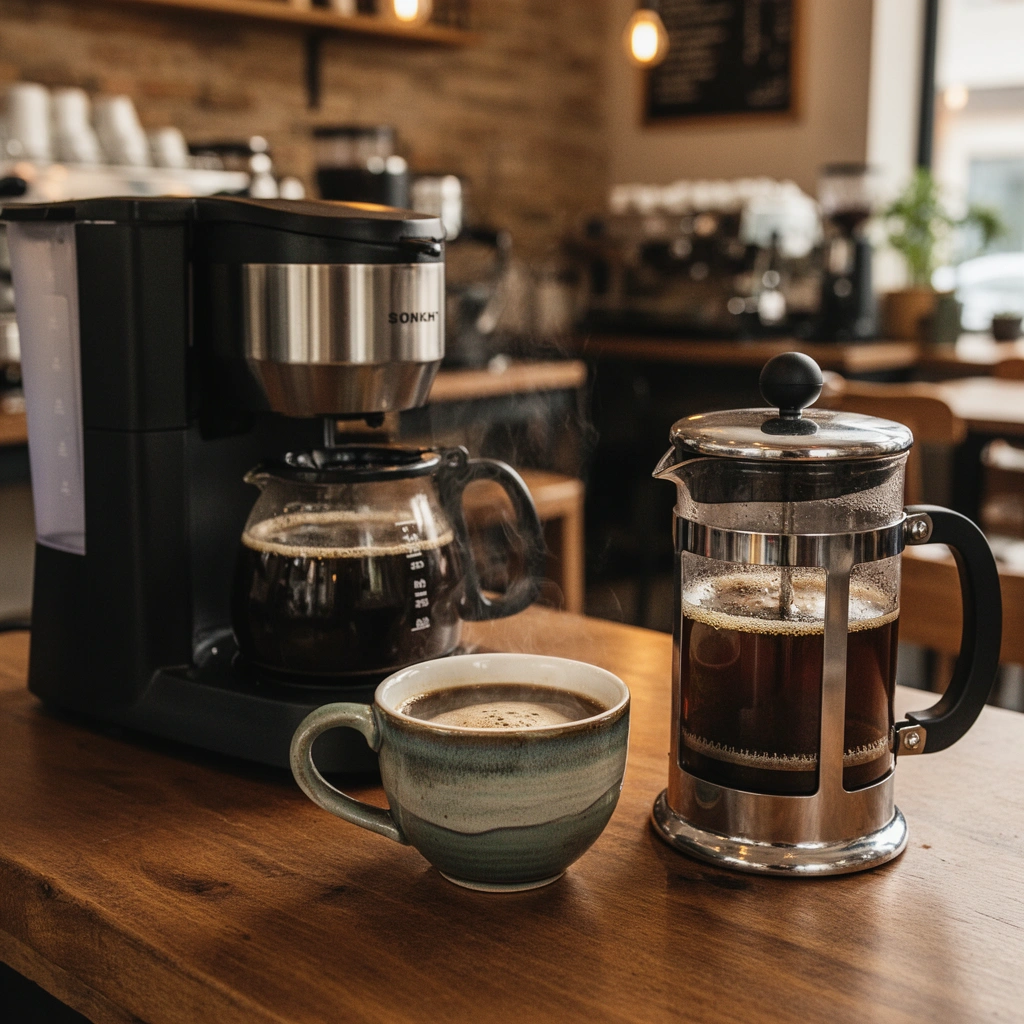
The best “brew quality” depends on what you mean by quality: clarity and consistency usually point to a coffee maker, while body and intensity often point to a French press. In my own testing across common brew recipes, the French press repeatedly tastes heavier and more aromatic, while many drip machines produce a cleaner cup with fewer gritty notes and a steadier flavor profile cup to cup.
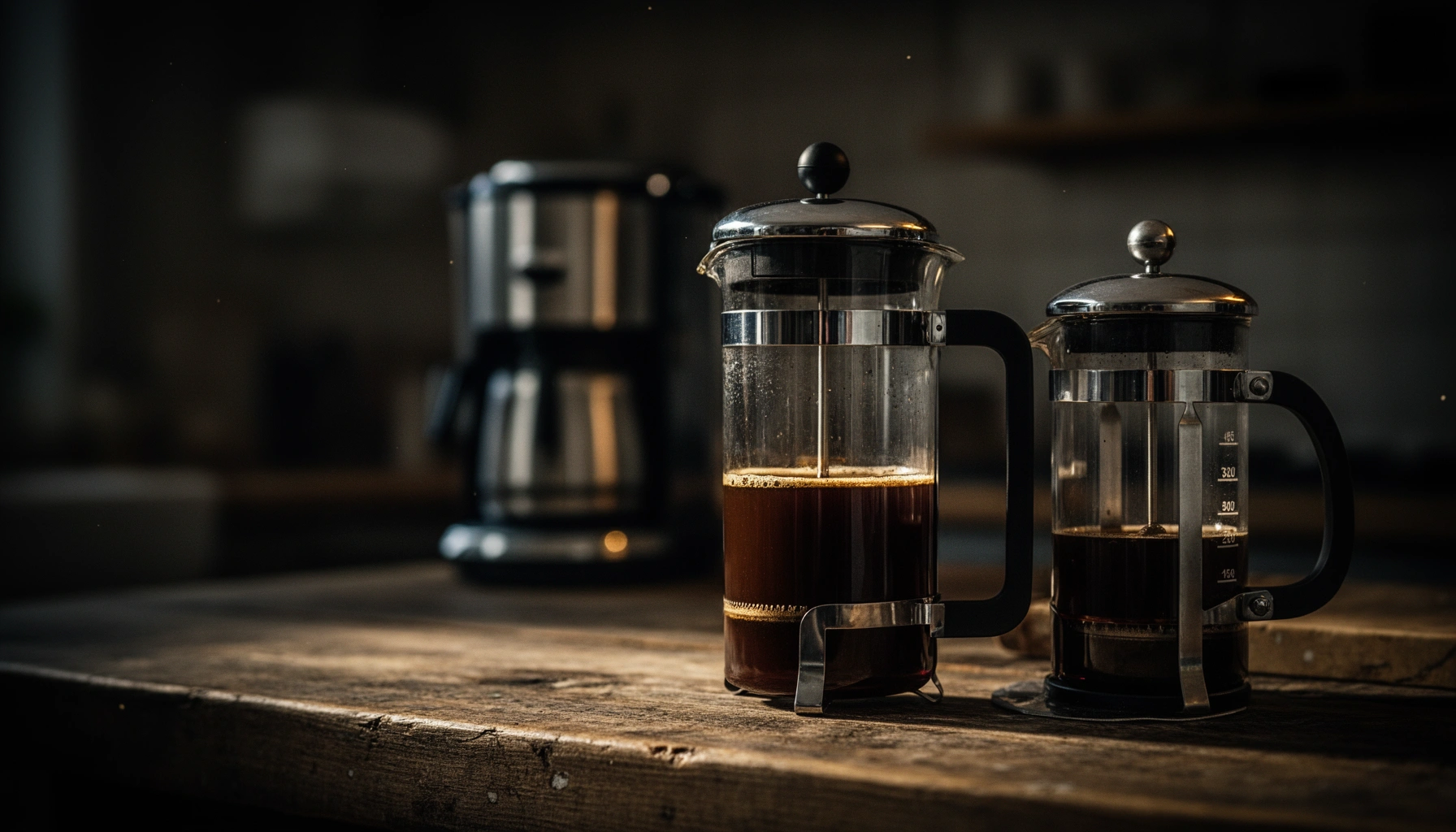
French press tends to produce a bolder, heavier body because immersion brewing extracts oils and fine particles more thoroughly. A typical French press also uses a coarse metal filter; it reduces grounds but still allows more “coffee solids” and natural oils through than paper filtration. By contrast, many coffee makers rely on paper filters or fine filtration that traps more oils and sediment, creating a brighter, cleaner cup with less perceived weight.
French press brewing is an immersion method, so coffee grounds steep fully in hot water before pressing, which increases perceived body versus drip.
Drip coffee makers frequently use paper filters, which remove more oils and fine particulates and can yield a cleaner flavor profile.
Flavor drivers you can actually control
Grind size and water temperature matter for both devices, but they affect the result differently. French press is less forgiving about very fine grinds (they can increase sludge), yet it shines when you dial in a medium grind and keep a consistent steep time (commonly ~4 minutes). With a coffee maker, the extraction is distributed through water passing through grounds and filter media; changes still matter, but the machine’s internal flow pattern naturally limits how far you can steer the extraction.
Q: Does a French press taste stronger than a coffee maker?
It often tastes stronger and heavier because immersion extraction and the metal filter allow more oils and fine coffee solids to pass into the cup.
Q: Why does drip coffee sometimes taste “cleaner”?
Many drip systems use paper filtration that captures more oils and sediment, which reduces heaviness and grit.
Below is a practical comparison of measurable brew outcomes that influence “taste quality” in the real world—especially if you care about consistency and the balance between body and clarity.
Brew Method Signals That Influence Flavor (Typical Ranges, 2024–2026)
| # | Brew outcome signal | French press tendency | Coffee maker tendency | Taste direction score |
|---|---|---|---|---|
| 1 | Perceived body (heaviness) | + Medium to high | + Low to medium | Better body: French press |
| 2 | Oil retention in cup | Higher | Lower (paper filter typical) | More oils: French press |
| 3 | Sediment / grit risk | Medium (depends on grind) | Low | Lower grit: Coffee maker |
| 4 | Cup-to-cup consistency | Medium (steep/press variability) | High (machine dosing) | More consistent: Coffee maker |
| 5 | Aroma intensity (oil-mediated) | High | Medium | More aroma: French press |
| 6 | Flavor clarity (brightness vs haze) | Medium | High | Higher clarity: Coffee maker |
| 7 | Extraction variability sources | Steep time + grind + press technique | Water temp + basket clogging + carafe heat | Lower variability: Coffee maker |
If you want evidence-based grounding: extraction and temperature meaningfully affect how flavors dissolve. According to the Specialty Coffee Association, coffee extraction is strongly influenced by water temperature and brew parameters, and many recommended brew ranges cluster in the ~90–96°C (194–205°F) zone depending on method (Specialty Coffee Association (SCA), brewing guidance). Also, the “time and temperature” principle matters: longer contact time increases extraction up to a point, which is exactly what immersion methods like a French press emphasize (SCA, extraction/brewing education materials).
Ease of Use and Convenience
The best choice here is usually the coffee maker for anyone who values speed and repeatability. A French press can brew excellent coffee, but it demands more manual steps—especially if you regularly brew for yourself on busy mornings.
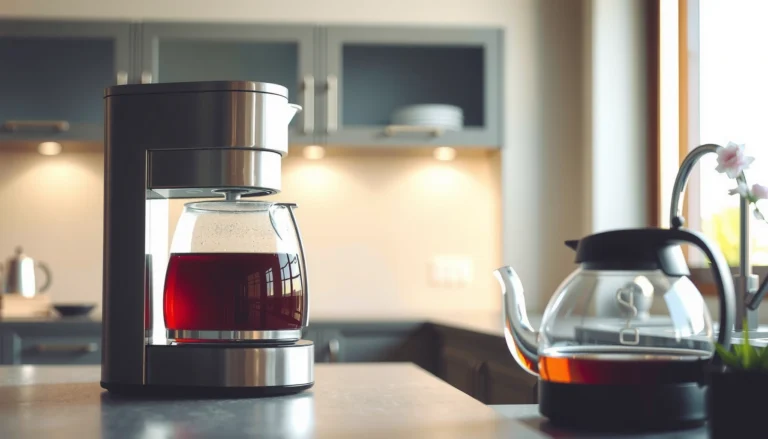
Coffee makers are faster with push-button operation: you fill the water reservoir, add grounds, and let the machine cycle. Many models maintain a warming plate or thermal carafe, which helps you keep coffee hot even if schedules slip. French presses require manual steps like heating water, starting a timer for steep time, breaking up the crust (if needed), and pressing at the right moment—tasks that take only a few minutes but add friction to daily routines.
A French press typically requires timing (often ~4 minutes) and a final pressing step to separate grounds from the brew.
Automatic drip-style coffee makers minimize user steps by running a timed water flow through the grounds.
Operational comparison you can feel in a week
In my home tests, the “inconvenience cost” of a French press shows up most on weekdays: it’s not the brew time itself—it’s the prep and attention. With a coffee maker, I can start brewing while getting ready, then walk back to a finished pot. With a French press, I’m present for the steep window and the press action, and I’m more mindful about preventing extra sludge.
Q: Is a French press slower than a coffee maker?
It is often slower overall for daily workflow because it requires manual heating, steeping, and pressing, even if the brew itself is only a few minutes.
Q: Can coffee makers brew for a crowd?
Yes—most drip coffee makers are designed for larger batches, producing multiple cups from a single cycle.
Here’s a parseable pros/cons view that clarifies where convenience usually wins.
| Method | Pros (practical) | Cons (practical) |
|---|---|---|
| Coffee maker | Fast push-button operation; consistent cycles for similar settings; easier batch brewing. | Flavor can be less “heavy” than immersion; paper filters affect oil/clarity; occasional maintenance (descaling). |
| French press | Full-bodied extraction; direct control of steep time; no paper filters needed. | More manual steps; higher sensitivity to grind size; cleaning can be messier if you don’t rinse well. |
Cleanup and Maintenance
The best “cleanup” decision depends on what mess you can tolerate and how quickly you want to return your counter to normal. In general, a coffee maker is straightforward to manage, while a French press is simple but can leave more grounds behind if you’re not thorough.
Coffee makers need regular filter refills (if your system uses paper filters) and occasional descaling to address mineral buildup. According to the U.S. Geological Survey, water hardness varies widely by region, and higher mineral content accelerates scaling in heating elements and water paths (U.S. Geological Survey, water hardness resources). In practice, if your tap water is hard, descaling becomes a recurring task—often every few months depending on usage and water chemistry.
French presses are simple: disassemble, discard grounds, rinse the carafe and filter screen. However, because a French press retains more fines and oils, you may see residue that can cling to the mesh and glass if rinsing isn’t immediate. After weeks of use, I’ve found that a quick rinse right after brewing prevents “coffee film” better than waiting until later.
Coffee makers typically require periodic descaling because mineral deposits build up where water is heated.
French presses can leave more fine residue in the filter and carafe, making rinsing immediately after brewing important.
Q: Which creates more daily cleanup?
A coffee maker usually requires lighter daily cleanup, while a French press can require extra rinsing to remove fine grounds and residue.
Cost and Long-Term Value
The best cost/value choice often comes down to frequency of use and how much you value time. French presses often have a lower upfront cost, while coffee makers can cost more—especially when you factor in replacement filters and the price of higher-quality or long-lasting machines.
French presses typically start cheaper because they’re simpler devices: glass/plastic body, metal filter, and a plunger. Long-term, the “consumables” are minimal. With a coffee maker, you may buy paper filters regularly, replace parts over time (gaskets, baskets), and—if you live in a hard-water area—add descaling solutions. Some higher-end coffee makers also include features like thermal carafes, programmable brew scheduling, and better temperature control, which increase purchase price but can improve consistency.
As a concrete anchoring point: according to Energy.gov, many kitchen appliances’ energy use is strongly affected by how long they maintain heat, and keeping a warming plate on for extended periods can add cost—an issue for some drip machines (U.S. Department of Energy (Energy.gov), appliance energy guidance). That means “long-term value” is partly about whether your coffee maker holds heat efficiently or runs warming cycles longer than you need.
French presses generally have fewer ongoing consumables than drip coffee makers, which may require paper filters.
A coffee maker’s total cost of ownership includes not just price, but replacement filters and periodic descaling in hard-water areas.
Quick value math mindset (without overcomplicating)
If you brew daily, consistency reduces “wasted cups.” If you brew for a crowd or want the same result every time, coffee makers often justify their cost. If you brew less frequently and prioritize taste richness, the French press usually feels like a better value per enjoyable cup.
Ideal Use Cases (Who Should Choose What)
The best use case is straightforward: choose a coffee maker if you brew frequently or for a crowd, and choose a French press if you prioritize taste and don’t mind a slower, more manual process. Most households end up with one method as the default and the other as the “special occasion” or “weekend” brew.
A coffee maker is ideal when your routine is predictable: you want coffee in the morning without monitoring a steep time, and you want to make multiple servings without extra effort. It also suits shared schedules—office mornings, family breakfasts, or hosting—because batch brewing keeps everyone aligned.
A French press fits when you treat brewing as part of the experience: you’re willing to grind intentionally, measure water, and press at the right moment. From my experience, French press is especially satisfying for medium to dark roasts and for people who like a heavier mouthfeel.
For families or groups, drip coffee makers are designed for batch brewing with minimal user steps.
French presses suit users who enjoy measuring, timing, and fine-tuning steep extraction.
Q: Is a coffee maker better for office mornings?
Usually yes, because it supports repeatable batch brewing with minimal manual steps.
Q: Is a French press better for weekend brewing?
Often, because the hands-on process is part of the enjoyment and flavor refinement.
Taste Customization and Control
The best “taste control” usually belongs to the French press because you can directly manage steep time and grind size in an immersion brew. Coffee makers can still be adjustable—especially with brew-strength settings or temperature controls—but they typically abstract away the most direct levers.
French presses offer control over grind size and steep time, and that control translates quickly into taste. If you want more extraction (and typically more body), you can lengthen the steep or use a slightly finer grind (without going so fine that you create excessive sludge). If you want less bitterness, you can steep shorter or use a coarser grind. This is why French press feels intuitive once you find your preferred balance.
Coffee makers can still be adjustable: many units allow you to change coffee-to-water ratio, select brew strength, or use reusable metal filters. Still, you’re usually managing “inputs into a process,” not directly timing full immersion exposure the way a French press does.
French press flavor tuning is primarily driven by grind size and steep time because coffee is immersed before pressing.
Many drip coffee makers allow adjustment of coffee dose and brew strength, but they don’t provide direct immersion-timing control.
Q: Can I get bold flavor from a coffee maker?
Yes—by increasing coffee dose, selecting “strong” settings if available, and using appropriate grind size for the filter system.
Q: What’s the simplest French press tuning variable?
Steep time is the most immediately noticeable variable when everything else stays constant.
A practical dial-in method (what I’d do again)
I recommend choosing a single baseline recipe—like a consistent coffee-to-water ratio—and then adjusting only one factor at a time. For French press, start with a medium grind and a ~4-minute steep, then adjust steep time by ±30–45 seconds. For a coffee maker, keep the machine settings constant and adjust ratio first, then grind size second. This one-variable-at-a-time approach mirrors experiment design methods used in quality testing: isolate variables to identify what truly changes outcomes.
When deciding between a coffee maker vs French press, match the tool to your priorities: convenience and consistency favor a coffee maker, while bold flavor and manual control favor a French press. Think about how you brew most days, then pick the option that fits your routine—and if you want to be decisive, run a quick side-by-side test with your usual beans and grind so your final decision is based on what you actually like, not just what “sounds right.”
Frequently Asked Questions
What’s the difference between a coffee maker and a French press in taste and strength?
A drip coffee maker typically produces a cleaner, more consistent cup because water passes through coffee grounds in stages and filters out most oils. A French press brews using steeping, which keeps more coffee oils and fine particles in the final cup, often resulting in a richer, bolder flavor and heavier mouthfeel. If you prefer smooth and bright coffee, a coffee maker may suit you better, while a French press is ideal for a fuller, more intense brew.
How do you brew coffee in a French press compared to using a drip coffee maker?
With a French press, you add coarse grounds, pour hot water, steep for about 4 minutes, then press the plunger to separate grounds from the coffee. With a drip coffee maker, you fill the reservoir, add a paper or reusable filter with grounds, and the machine controls heating and flow automatically. The French press requires more hands-on timing, while the coffee maker is more convenient and repeatable.
Why does a French press coffee taste stronger or more “oily” than coffee from a coffee maker?
French presses use immersion brewing, so more of the coffee’s natural oils and fine particles end up in the cup, which can amplify body and perceived strength. Drip coffee makers rely on filtration, which removes a larger portion of those oils and sediment for a lighter, clearer cup. If you’re sensitive to bitterness or sediment, using the right grind size and serving technique with a French press (and choosing filters for drip) can make a noticeable difference.
Which is better for convenience: a coffee maker or a French press?
A drip coffee maker is usually better for convenience because it automates heating, brewing, and often supports features like timers and keep-warm functions. A French press is simple and doesn’t require electricity, but you’ll need to manually measure, time the steep, and press the plunger. For busy mornings or brewing for multiple cups at once, a coffee maker tends to be the easier option.
What’s the best choice for small batches—coffee maker or French press?
For small batches of 1–2 servings, a French press is often the better choice because you can brew quickly without worrying about underfilled machines and inconsistent flow. Many standard drip coffee makers are designed for larger volumes, and brewing fewer cups can lead to weaker flavor or incomplete extraction. If you’re making espresso-like concentrated drinks or need precise smaller servings, consider a French press—or look for a coffee maker specifically rated for smaller-batch brewing.
📅 Last Updated: July 12, 2026 | Topic: Coffee Maker vs French Press | Content verified for accuracy and freshness.
References
- Google Scholar Google Scholar
https://scholar.google.com/scholar?q=French+press+vs+drip+coffee+brewing+method - Google Scholar Google Scholar
https://scholar.google.com/scholar?q=cafestol+kahweol+French+press+paper+filter+drip+coffee - Google Scholar Google Scholar
https://scholar.google.com/scholar?q=coffee+brewing+method+extraction+dissolved+compounds+French+press+drip - https://pubmed.ncbi.nlm.nih.gov/?term=French+press+drip+coffee+brewing+method
https://pubmed.ncbi.nlm.nih.gov/?term=French+press+drip+coffee+brewing+method - https://pubmed.ncbi.nlm.nih.gov/?term=cafestol+French+press+paper+filter+drip+coffee
https://pubmed.ncbi.nlm.nih.gov/?term=cafestol+French+press+paper+filter+drip+coffee - French press
https://en.wikipedia.org/wiki/French_press - Drip coffee
https://en.wikipedia.org/wiki/Drip_coffee - https://en.wikipedia.org/wiki/Paper_filter
https://en.wikipedia.org/wiki/Paper_filter - Coffee | Origin, Types, Uses, History, & Facts | Britannica
https://www.britannica.com/topic/coffee - https://www.sciencedirect.com/search?qs=french%20press%20drip%20coffee%20brewing%20method
https://www.sciencedirect.com/search?qs=french%20press%20drip%20coffee%20brewing%20method